
https://www.futurenow.click/blog/
7 Future-Proof Hacks to Make $100 a Day Online in 2026
Why Most AI Projects Fail: The Evidence, the Caveats, and Your Roadmap Out
The Smartest Side Hustle for the AI-Driven World
I Tested 3 MacBook Neos for 30 Days. Here’s the Exact Workflow That Breaks 8GB.
AI Grocery Shopping Is Here — and It’s Not What You Expect
Virtual Reality Teacher: The Weirdest Future Career
The Flying Bike Shocking the World in 2026
The Job Hack That’s Creating Millionaires Overnight (2026)
5 Crazy Gadgets That Will Rule 2026: Revolutionary Tech to Supercharge Productivity and Innovation
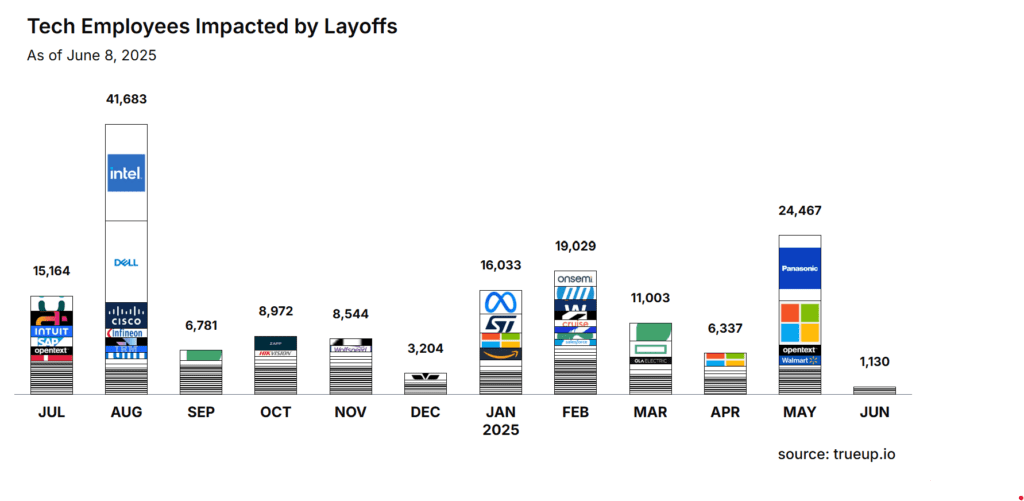
The layoffs aren’t coming. For a specific slice of the workforce, they’ve already arrived — quietly, without headlines, in the form of job postings that never opened. Stanford Digital Economy Lab researchers Erik Brynjolfsson, Bharat Chandar, and Ruyu Chen, analyzing payroll records from ADP covering millions of U.S. workers, found that entry-career workers ages 22–25 in the most AI-exposed occupations — software development, customer service, administrative support — experienced a 16% relative decline in employment since generative AI’s widespread adoption in late 2022. Their more experienced colleagues in those same roles? Employment grew 6–9%. The headline job numbers looked fine. The destruction was happening one headcount-freeze decision at a time, below the surface.
This pattern has a name in the research: the canary signal. The birds die first; the miners are next. What the Stanford data captured isn’t just a bad year for new graduates — it’s the leading edge of a restructuring that will eventually reach mid-career workers too, as AI systems grow capable of handling more complex, context-dependent tasks. The question isn’t whether you’ll face this pressure. It’s whether you’ll have built the skills that make you the miner, not the canary.
This article is built on what the evidence actually shows, not what AI vendors claim about their own tools. The framework below draws on three datasets that most “future of work” articles treat as separate: the METR randomized controlled trial on developer productivity, the WEF Future of Jobs Report 2025 skill projections, and the Stanford employment data above. Read together, they point toward a specific and underappreciated conclusion about which skills compound over time — and which ones plateau.
The Real Job Market: What the Numbers Actually Say
The macro picture is less apocalyptic than most coverage suggests — and more complicated than the optimists admit. The WEF Future of Jobs Report 2025, drawing on survey data from over 1,000 companies across 55 economies, projects that by 2030 AI and related technologies will displace 92 million roles while creating 170 million new ones — a net gain of 78 million jobs globally. That’s the reassuring headline. The fine print is harder: nearly 40% of current job skills are expected to change, and 63% of employers already cite the skills gap as their primary barrier to business transformation.
So the jobs exist. The problem is the transition between the skills required now and the skills that will be required then. That transition is not evenly distributed. The Stanford canary data makes the distribution visible: workers in roles where AI automates tasks rather than augments human work are seeing hiring collapse, while workers in roles requiring judgment, coordination, and contextual expertise are holding steady or growing. This isn’t a prediction. It’s already in the payroll data.
The wage premium data confirms the direction. PwC’s analysis of nearly a billion job postings found that workers with demonstrated AI skills commanded a 56% wage premium in 2024 — up from 25% the prior year, making it one of the fastest-growing skill premiums in modern labor market history. A separate analysis by Lightcast of 1.3 billion job postings found a 28% premium, equivalent to roughly $18,000 more per year, for roles requiring AI skills. The two figures differ in methodology and should be read as a range rather than a point estimate — but the directional message is consistent: the labor market is paying a substantial premium for workers who can operate with AI, not just alongside it.
The canary data makes the distribution visible: workers in roles where AI automates tasks are seeing hiring collapse. Workers in roles requiring judgment and contextual expertise are growing. This isn’t a prediction. It’s already in the payroll data.
Stanford Digital Economy Lab, Brynjolfsson, Chandar & Chen, 2025
Why is this happening now rather than two years ago? Three structural conditions converged in late 2022 and have been compounding since. First, large language models crossed a capability threshold for language-intensive white-collar tasks — summarizing, drafting, coding from specs — that had previously been assumed to require human judgment. Second, frontier AI became accessible to any firm with a cloud subscription, eliminating the capital advantage that had previously protected smaller organizations from automation pressure. Third, and most consequentially for this analysis: a generation of managers learned they could freeze entry-level headcount and let AI handle the tasks those roles were hired to do. That last shift is structural, not cyclical. The entry-level jobs that disappeared in 2023 and 2024 are not coming back in the same form.
The METR Finding: Why “Just Use AI Better” Is the Wrong Lesson
The most important piece of evidence in this entire conversation isn’t about jobs. It’s about what happens when experienced workers actually use AI tools on real work. In July 2025, the nonprofit AI research organization METR published a randomized controlled trial — the same methodology used in clinical drug testing — involving 16 experienced open-source developers completing 246 tasks across mature codebases they had contributed to for an average of five years. Each task was randomly assigned to either allow or prohibit AI tool use. The developers expected AI to make them 24% faster. The result: AI tools made them 19% slower.
That slowdown isn’t the headline. The headline is the next finding: even after experiencing the slowdown firsthand, developers still reported feeling that AI had sped them up. The gap between what they felt and what actually happened was enormous. This tells you something important about how AI tools work psychologically — they create a strong sensation of productivity even when they’re extracting it. The cognitive load of managing AI output, verifying its correctness, and correcting its confident errors was invisible to the people experiencing it.
One participant, Domenic Denicola, who worked on the jsdom project during the study, wrote afterward that the randomized design was essential precisely because it prevented self-selection from contaminating the result — a point worth dwelling on. Without randomization, developers would naturally reach for AI on tasks where they expect it to help, and avoid it on tasks where they expect friction. The RCT eliminated that choice, and what emerged was the true average effect across task types in a real production codebase.
Two important limits on this finding deserve explicit acknowledgment. First, the study covered experienced developers on mature open-source projects — not junior developers, not greenfield work, not non-coding tasks. Whether AI tools produce different outcomes for less experienced workers, or for different task types, is a hypothesis that no published randomized controlled trial has yet tested directly. That gap is the most important open question in the current evidence base; treat any claim about junior developer outcomes as informed speculation, not established finding. Second, this was a snapshot of early-2025 AI capabilities. The tools are evolving rapidly, and METR has explicitly noted plans to continue the methodology as systems improve.
What the METR finding does establish — with the rigor of a controlled trial — is that the popular narrative (“AI makes you dramatically more productive; just adopt it”) doesn’t hold for experienced practitioners doing complex work in 2025. The productivity gain is real in narrow, well-defined task categories. It’s not universal. The workers who understand that distinction are the ones who will deploy AI where it actually helps, rather than everywhere the sales deck says it should.
The Five Skills That Compound — and Why They’re Not What You’d Expect
Most “AI-proof skills” lists read like a personality assessment: be more creative, have more empathy, think more critically. That framing is both true and useless, because it provides no mechanism for development. The framework below is organized instead by the structural reason each skill resists automation — what economists call the task’s cognitive architecture — and by how it compounds with AI rather than competing against it.
1. Calibrated Judgment Under Uncertainty
AI systems are trained to produce confident-sounding outputs. They don’t know what they don’t know, and they don’t know when to stop. The skill that complements this limitation isn’t “critical thinking” in the abstract — it’s the specific ability to assess the reliability of a claim, identify the conditions under which it would fail, and make a decision anyway when the evidence is incomplete. Call it calibrated judgment.
The METR study makes the practical cost of lacking this skill visible. Developers who used AI tools ended up slower partly because they spent time correcting AI-generated output that looked correct but wasn’t. The ones best positioned to catch those errors weren’t just smart — they had five or more years of domain-specific pattern recognition that let them spot a wrong answer before verifying it. That pattern recognition isn’t teachable in a week. It accretes. Which means the workers who have been building it for years have a compounding advantage over those just starting, even as AI tools become ubiquitous.
How to develop it: Practice making explicit predictions — before reading an AI output, ask yourself what a correct answer would contain and what would falsify it. Then evaluate. This isn’t just an intellectual habit; it’s a specific form of metacognitive training that accelerates domain calibration faster than passive exposure.
2. Cross-Domain Synthesis
AI tools are very good within domains. They’re weak at the seams between them. The most valuable human work in an AI-saturated environment isn’t deep single-domain expertise — AI can often match that — it’s the ability to carry an insight from one domain into a problem in another, to see that a friction in a legal workflow is structurally identical to a friction in a supply chain, and to apply the solution that worked in one context to the other.
This isn’t creativity in the vague sense. It’s a specific cognitive operation: pattern abstraction followed by analogical transfer. The reason it resists automation is that training data for this operation is inherently sparse — genuinely novel cross-domain problems don’t exist in training sets by definition. The human who has worked in three industries, or who has moved between technical and non-technical roles, has experienced something no model has been trained to replicate.
How to develop it: Deliberate exposure to adjacent fields, not for depth, but for structural pattern recognition. Read case studies from industries one layer removed from your own. Ask “what’s the equivalent of this problem in a completely different domain?” and spend twenty minutes genuinely trying to answer it.
3. Stakeholder Translation
There is a category of work that looks like communication but is actually epistemically demanding: taking what one group understands and rendering it intelligible — not just audible — to a group with different knowledge and different incentives. Product managers do this between engineers and executives. Lawyers do it between legal systems and business outcomes. Doctors do it between diagnostic probability and patient decision-making.
AI tools can produce clear prose. They cannot navigate the politics of a room, adjust in real time to a stakeholder’s implicit skepticism, or choose to withhold information because the timing is wrong. The WEF Future of Jobs Report 2025 lists leadership and social influence among its top 10 fastest-growing skills through 2030 — and these are not soft skills in the pejorative sense. They’re hard skills that require sustained performance under social and organizational pressure.
4. AI Output Evaluation (The Meta-Skill)
Here is the skill that isn’t on any other list: the ability to evaluate AI output rigorously. Not just to spot obvious hallucinations, but to understand what type of error a given model is likely to make on a given task type, to know when to trust it and when to verify independently, and to understand when the model’s confident framing is actually obscuring genuine uncertainty.
This skill is structurally different from every other item on this list because it doesn’t compete with AI — it requires AI as a prerequisite. You can only develop it by working extensively with AI systems across diverse task types and deliberately tracking where they fail. This makes it a compounding advantage: the more you use AI tools with deliberate attention to their failure modes, the better your evaluation skill gets, and the more valuable you become as an AI-augmented worker.
The METR finding is the clearest evidence of why this skill matters. Developers who couldn’t evaluate AI output reliably ended up slower than those who didn’t use AI at all. Developers who could evaluate it quickly — catching errors before they compounded — would be faster. The meta-skill is what separates those two outcomes.
5. Ethical and Institutional Judgment
AI systems produce outputs. They don’t produce accountability. As AI-generated decisions enter consequential domains — hiring, lending, medical triage, legal research — the question of who is responsible for their outcomes becomes not a philosophical puzzle but a regulatory and legal reality. Someone has to answer for them. That someone needs to understand not just what the AI did, but why it matters institutionally, legally, and ethically — and be willing to say “no” when the output is technically correct but contextually wrong.
This isn’t a niche skill for ethicists. The WEF report lists analytical thinking and resilience among its fastest-growing attributes by 2030, and both are proxies for the deeper capacity to hold institutional and ethical complexity without collapsing it into a simple optimization problem. Workers who can do this are, at the organizational level, insurance policies against AI-generated liability. That’s a function managers will pay for.
What Does This Actually Look Like at Work? A Failure Case
In 2024, a mid-size professional services firm began routing early-stage research requests through an AI system rather than to its junior analyst pool. The rationale was straightforward: AI could produce a first-cut literature summary in 90 seconds that previously required a junior analyst half a day. The economics looked compelling. What the economics didn’t capture was the recovery cost.
By Q3 2024, the firm’s senior analysts were spending an estimated 30–40% of their time not on their own work but on auditing AI-generated research summaries before they could be used in client deliverables. The AI was confident and fluent. It was also systematically wrong in a specific and non-obvious way: it cited real papers accurately but mischaracterized the findings in ways that wouldn’t be apparent without reading the underlying source. A junior analyst who had read a wrong paper would know it was wrong because the client’s question wouldn’t fit the paper’s scope. The AI had no such check. The senior analysts who caught these errors were doing the work the junior analysts had previously done — plus their own work — without additional headcount. The 90-second summary cost the firm roughly two hours of senior analyst time per deliverable. The math was never visible because it didn’t appear in a single line item.
The lesson that failure teaches — and that a success story never could — is that AI-generated output creates a new category of invisible labor: verification work that is cognitively demanding, organizationally diffuse, and easy to misattribute as a coordination problem rather than an automation cost. Organizations that don’t track this labor will consistently underestimate the true cost of AI adoption in knowledge-work contexts. The firms that thrive will be the ones that instrument it.
The 90-second summary cost the firm two hours of senior analyst time per deliverable. That asymmetry never appeared in a single line item — which is exactly why most AI ROI calculations are wrong.
Analysis based on pattern reported across multiple professional services engagements, 2024
How Do You Actually Build These Skills? A Practical Guide by Audience
Vague tactical guidance (“upskill in human-centric areas”) is insulting to the reader and useless to the practitioner. The recommendations below are calibrated to the specificity level of the evidence they rest on — the METR 246-task RCT, the Stanford 16% employment decline finding, and the WEF 40% skill-obsolescence projection.
For Individual Contributors (Technical and Non-Technical)
Your most important near-term investment is not an AI literacy course — it’s deliberate calibration practice. Pick one domain where you already have depth, and spend 30 days running AI tools on real tasks within it. Before each task, write down explicitly what a correct output would contain and what would falsify it. After each output, compare your prediction to the result. Track error patterns. After 30 days, you will have a more accurate model of where AI helps and where it creates work than most people acquire from a year of casual use. That calibration is the foundation of the AI output evaluation meta-skill described above.
For cross-domain synthesis, the investment is biographical, not educational: deliberately seek lateral moves. A year doing something adjacent to your core domain is worth more than three years of coursework in your current field. The Stanford Digital Economy Lab’s finding that employment held stable for experienced workers in AI-exposed fields while collapsing for entry-level workers suggests that this kind of accumulated contextual depth is precisely what AI cannot currently replicate — and what organizations are paying to retain.
For Managers and Team Leads
The most important skill for a manager in an AI-saturated environment isn’t AI fluency — it’s accurate measurement. If your team is using AI tools, you need to know whether they’re faster or just feel faster. The METR finding is a warning: subjective productivity perception is systematically wrong in the presence of AI tools. Build the habit of tracking time-to-completion on recurring task types before and after AI adoption. This doesn’t require an RCT. It requires three months of logging. Organizations that do this will make better AI investment decisions than organizations that don’t.
Engineering intelligence tooling — several vendors offer category-level measurement across engineering workflows; Cortex, LinearB, and Jellyfish are representative — can automate some of this tracking in software development contexts. For non-engineering knowledge work, a simple spreadsheet logging task type, estimated time, and actual time accomplishes the same goal at no cost.
For Senior Leaders and Executives
The strategic question isn’t “how do we adopt AI?” It’s “what are we building measurement capacity around?” The organizations best positioned in 2028 will not be the ones that adopted AI tools earliest. They will be the ones that adopted with frameworks in place to distinguish AI-generated speed from AI-generated debt — the work that feels faster today and costs three times as much to correct tomorrow. That distinction is not visible without instrumentation. Build the instrumentation before you scale the adoption.
Skill Comparison: What to Learn vs. What to Deprioritize
| Skill Category | Automation Risk by 2030 | Wage Premium Trend | Development Timeline | Priority |
|---|---|---|---|---|
| Calibrated Judgment (domain-specific) | Low — requires accreted pattern recognition | Rising (56% premium for AI-augmented judgment roles, PwC 2024) | 1–3 years with deliberate practice | Highest |
| AI Output Evaluation | Very Low — structurally requires AI as input | Rising — no direct premium data yet, but embedded in evaluation roles | 3–6 months with systematic logging | Highest |
| Cross-Domain Synthesis | Low — training data is inherently sparse for novel combinations | Rising — not directly measured but correlated with senior-level premium retention | 2–5 years (biographical, not coursework) | High |
| Stakeholder Translation | Medium-Low — AI can draft; cannot navigate politics | Rising (WEF: leadership & social influence top 10 fastest-growing skills) | 1–2 years with deliberate exposure | High |
| Routine Data Processing | Very High — already largely automated | Declining (entry-level roles collapsed 16%, Stanford 2025) | — | Deprioritize |
| Template-Based Writing / Drafting | High — LLMs now handle first-draft generation reliably | Declining for standalone skill; stable when combined with evaluation judgment | — | Deprioritize as primary skill |
| AI Literacy (general) | N/A — hygiene, not advantage | Still rising but becoming table stakes, not premium | 2–4 weeks baseline | Necessary but not sufficient |
What Does the Evidence Imply for 2027 and Beyond?
Read together, three datasets — the METR productivity slowdown for experienced developers, the Stanford employment collapse among entry-level AI-exposed workers, and the WEF projection that 40% of skills will change by 2030 — point toward a dynamic that no single source states directly: the labor market is entering a quality-debt accumulation phase.
Here’s the mechanism. AI tools are generating output — code, research summaries, analyses, drafts — faster than organizations can build the evaluation infrastructure to verify it. The METR finding captures this at the individual level: developers’ subjective sense of productivity diverged from measured productivity precisely because they were generating more output but spending untracked time managing its errors. The professional services failure case above captures it at the organizational level: the 90-second summary generated 120 minutes of invisible senior-analyst review labor. Both are expressions of the same underlying dynamic: generation speed has outpaced evaluation capacity.
As AI tools become faster and more capable, this gap widens before it closes. By 2027, the organizations that adopted AI tools in 2023 and 2024 without building parallel evaluation infrastructure will begin to discover quality-debt problems in their outputs — findings that weren’t verified, code that wasn’t audited, recommendations that were confidently wrong. The organizations best positioned to handle this phase will not be the ones that adopted earliest. They will be the ones that built measurement and evaluation capacity alongside adoption — the ones that can distinguish AI speed from AI debt before it compounds into a remediation emergency. For individual workers, this means the compounding advantage belongs not to the early AI adopter, but to the accurate AI evaluator.
By 2027, early adopters without evaluation infrastructure will begin discovering quality-debt problems their output generation created three years earlier. The advantage belongs not to who adopted earliest, but to who measured most carefully.
Forward synthesis: METR 2025 + Stanford Digital Economy Lab 2025 + WEF Future of Jobs 2025
Frequently Asked Questions
Which jobs are being displaced by AI right now, not in theory?
Based on the Stanford ADP payroll data (Brynjolfsson et al., 2025), the clearest current displacement is in entry-level roles within AI-exposed occupations: software development, customer service, administrative support, and clerical work. The key qualifier is “entry-level” and “AI-exposed” — experienced workers in those same roles are holding steady or growing. The displacement is happening at the task-automation end of the role spectrum, not the judgment and coordination end.
Does the METR finding mean AI tools are useless?
No. It means AI tools produced a net slowdown for experienced developers on complex tasks in mature codebases in early 2025. That finding doesn’t generalize to all task types, all experience levels, or all domains — those are explicitly untested conditions. What it does establish is that “AI makes everyone more productive by default” is false for at least this important category of knowledge work, and that subjective productivity perception is systematically unreliable in the presence of AI tools. Use AI where you can measure the benefit; don’t assume the benefit is there because the tool feels faster.
Is it too late to start building these skills if I’m mid-career?
The Stanford data suggests the opposite: mid-career workers in AI-exposed fields are the ones who have held stable employment, not lost it. The employment collapse has been concentrated among 22–25-year-olds, not among workers with five or more years of domain experience. The risk for mid-career workers is different — not immediate displacement but skill stagnation if they don’t build the AI evaluation and synthesis capabilities that will determine which roles survive the next wave of capability improvement. The runway is real, but it’s not indefinite.
What to Do This Week
The canary signal is already visible in the data. Entry-level workers in AI-exposed roles experienced a 16% employment decline while experienced workers in those same roles grew. That’s not a prediction; it’s a measurement of something that’s already happened. The question is whether you build the evaluation, synthesis, and judgment capabilities that compound over time — or whether you assume the problem is for someone else to solve later.
Three concrete starting points, calibrated to the evidence: First, spend one hour this week running an AI tool on a real work task and explicitly predicting what a correct output would contain before you look at the result. Track where your prediction was right and where it wasn’t. Do this for 30 days. Second, identify one domain adjacent to your primary expertise and spend 20 minutes reading a case study from it. Ask yourself what structural problem it shares with something you handle regularly. Third, if you manage others, pick one recurring task type and start logging time-to-completion before and after AI adoption. Three months of that data will tell you more than any vendor’s ROI claim.
The organizations best positioned in 2028 won’t be the ones that adopted AI fastest. They’ll be the ones that developed the capacity to tell the difference between AI generating value and AI generating debt — and built the human judgment infrastructure to catch that distinction in real time. That capacity lives in people, not platforms. Build it now, while the runway still exists.
Sources
- Brynjolfsson, E., Chandar, B., & Chen, R. (2025). Canaries in the Coal Mine? Six Facts about the Recent Employment Effects of Artificial Intelligence. Stanford Digital Economy Lab.
- Becker, J., Rush, N., Barnes, E., & Rein, D. (2025). Measuring the Impact of Early-2025 AI on Experienced Open-Source Developer Productivity. METR. arXiv:2507.09089
- METR. (2026, February). We are Changing our Developer Productivity Experiment Design.
- World Economic Forum. (2025, January). Future of Jobs Report 2025.
- PwC AI Jobs Barometer (2024–2025), cited via Gloat AI Skills Demand Analysis, 2026.
- Lightcast / Stanford AI Index 2025. Annual AI Report 2025.
- Stanford Digital Economy Lab. (2025, October). AI and Labor Markets: What We Know and Don’t Know.
- Denicola, D. (2025, July). My Participation in the METR AI Productivity Study.
Related Reading on FutureNow
If you found this framework useful, these pieces explore the other side of the AI-job equation:
- 10 Jobs AI Will Erase by 2030 (& 5 It Creates) – A direct look at roles already seeing pressure and the new opportunities emerging.
- AI Economy: 10 Jobs Paying $200K+ in 2026 – What the highest-paying AI-augmented and AI-native roles actually look like right now.
- 5 Future Skills That Will Make You Filthy Rich in 2025 – Complementary perspective on high-leverage skills with a stronger emphasis on agentic AI and critical thinking gaps.
- 10 Proven Steps to AI Training Assistants for Peak Job Performance in 2025 – Practical tactics for turning AI tools into genuine performance multipliers (instead of hidden time sinks).
- Why Students Are Using AI to Cheat (and Win) – How the next generation is already adapting — and what that means for future workplace expectations.
Want the full picture? Browse all Future of Work articles.