
AI Grocery Shopping in 2026: What’s Actually Working vs. the $2.6B Warning Nobody Heeded
Only 15% of Americans use AI for groceries. 69% say they want to. The gap isn’t a technology problem — it’s a trust design problem, and every retailer is racing to solve it before a third-party agent makes the question irrelevant.
Forty-six minutes. That’s the average American grocery trip — drive, park, navigate, wait, load. Every week. For decades. And now Albertsons says its AI shopping assistant does the same job in four.
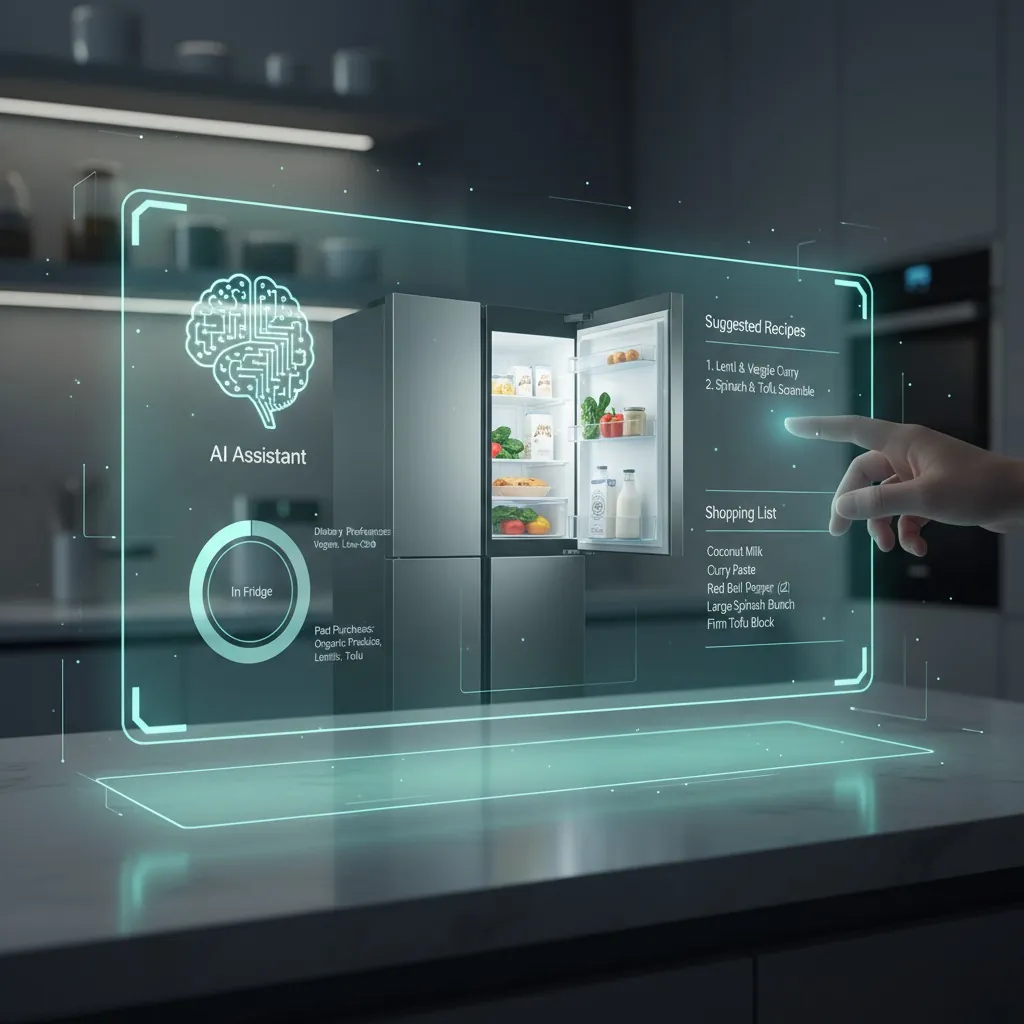
I want to be specific about what “the same job” means, because the hype has been — unsurprisingly — a mess. The AI builds you a cart. It suggests meals. It cross-checks your pantry. Then you confirm before anything happens. That distinction matters, adn we’ll get to why in a minute.
So here’s where we actually are: Kroger has Google Gemini integrated into its shopping flow. Walmart is running an OpenAI partnership. Uber rolled out an AI personal shopper in February 2026. Albertsons went live across all its banners — Safeway, Vons, Jewel-Osco — with agentic cart-building in late 2025. The technology is functional. In production. Not vaporware.
And yet: 15% of US consumers have actually used AI for grocery shopping in the past year. That’s from Dunnhumby’s Consumer Trends Tracker, February 2026. Representative survey of US adults; exact n not publicly disclosed. Meanwhile, 69% say they’re interested, per PYMNTS Intelligence, January 2026. n = 2,299 US adults, Nov–Dec 2025.
That gap — 15% actual, 69% interested — is the whole story. Everything else is footnotes.
What “Agentic AI Grocery Shopping” Actually Means — Five Levels, One That Matters Right Now
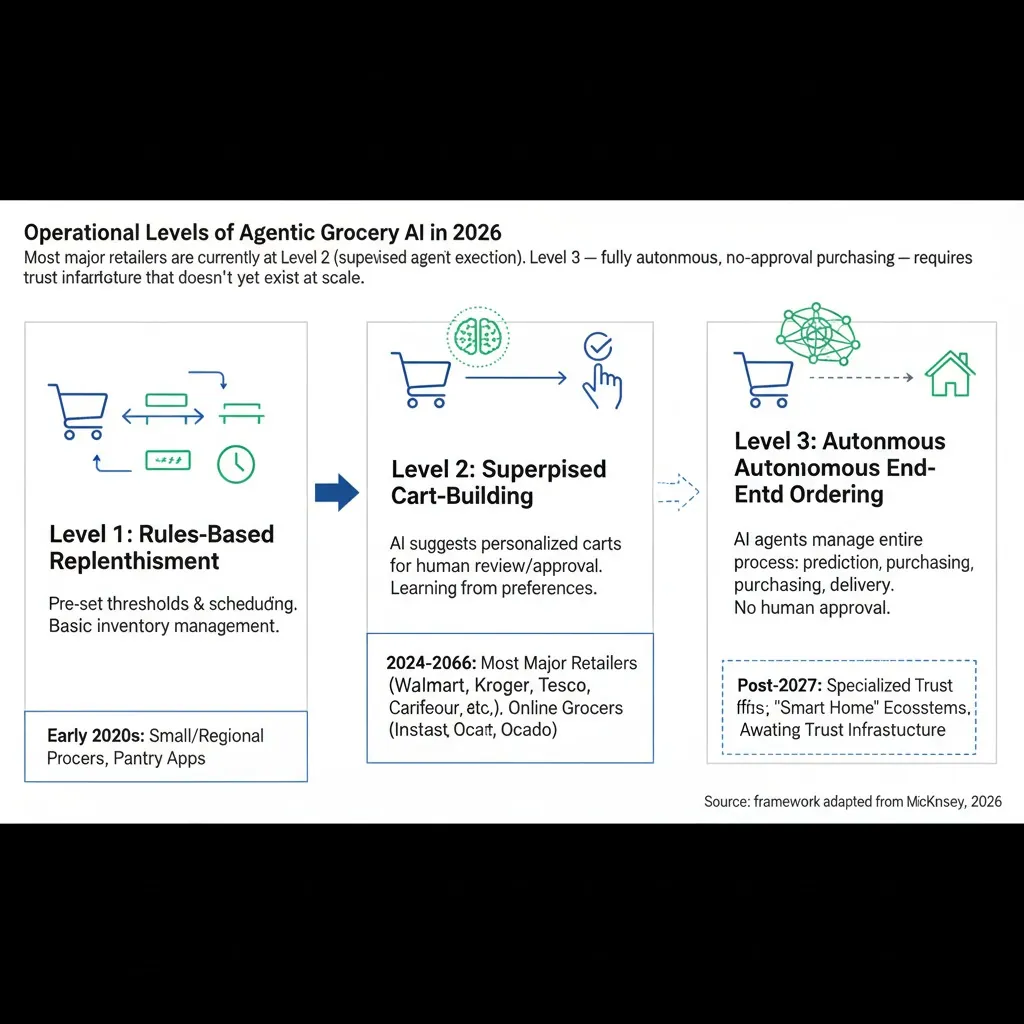
The public debate is a disaster because it keeps conflating five different things. McKinsey published a framework in early 2026 that finally draws the map clearly. Here it is with current retail positions added.
| Level | What It Does | Current Example | Human Approval? | ⚠ Limitations / Not Yet Solved |
|---|---|---|---|---|
| 0 Rules-based replenishment | Reorders preset items on fixed schedule | Amazon Subscribe & Save ~23% of US Amazon shoppers; CIRP via McKinsey | Set-and-forget | Rigid — price spikes and substitutions go undetected. No dietary adaptation. |
| 1 Assisted planning | Suggests cart from past behavior; human builds it | Early Instacart recommendations, legacy grocery apps | Human selects each item | Echo-chamber problem: reflects past habits, doesn’t surface new options or budget shifts. |
| 2 Supervised agentic execution | Agent builds full cart + meal plan; human confirms | Albertsons, Kroger/Gemini, Walmart/OpenAI — live in 2025–2026 | Confirm before checkout | Known failure: specialty/cultural ingredient substitutions misfire frequently. Safeway BETA tool returned zero results for “vegan Christmas dinner” vs. six for “vegan holiday dinner” — same intent, different phrasing. |
| 3 Fully autonomous end-to-end | Agent plans, buys, schedules delivery — no human input | No major US retailer at scale | None — agent acts independently | Unresolved: liability standards, payment rail requirements (Mastercard still building), consumer comfort. ~50% of US consumers not yet comfortable. Bain & Company, Nov 2025. |
Level 2 is where the industry is racing. Level 3 is where the hype lives. Confusing them is why the same tech gets called “here today” and “years away” in the same news cycle — and both camps are right, they’re just talking about different rows in that table.
One production number has arrived. Albertsons CTO Anuj Dhanda disclosed in a February 2026 CIO Dive report that the Ask AI tool drove a 10% basket size increase for users. Self-reported; covers predecessor tool, not the December 2025 agentic launch. No independent audit. Treat as directional. Albertsons has commercial incentive to frame adoption positively. It’s the first internal production number any major grocer has released publicly. Directional — not verified — but notable.
“Chatbots respond to commands. Agents act on goals. That one sentence describes everything that changed in mid-2025.”
Doug Baker, VP Industry Relations, FMI, October 2025Baker’s framing is useful. But what it understates is how sharp the transition feels from inside a grocery app. The Kroger/Gemini integration — announced at NRF Big Show in January 2026 — doesn’t just suggest items. One instruction triggers delivery-time selection, loyalty-point optimization, and checkout sequencing simultaneously. That’s not a better search bar. That’s a different kind of tool.
You follow? The tech works. So why is usage stuck at 15%?
The $2.6B Warning Shot Everyone Ignored
Before the success stories, the failure. Because it contains the most important lesson in grocery automation that almost nobody is saying plainly.
In November 2025, Kroger announced it was closing three robotic Customer Fulfillment Centers — Wisconsin, Maryland, Florida — and writing off $2.6 billion in impairment charges. Plus a $350 million exit fee to UK partner Ocado. The partnership had launched in 2018 with plans for dozens of robotic US warehouses. Seven years later: digital business unprofitable, centers running below viable order volumes.
Here’s what’s underreported: Kroger built the facilities outside cities, on cheaper land, which worsened the economics automation was supposed to solve. A robotic warehouse picks faster than any human, sure. But it still has to deliver. With low population density and long delivery distances, per-order costs spiraled. Meanwhile, Instacart and DoorDash were expanding 30-minute delivery in the cities Kroger had stepped back from. Analyst Neil Saunders of GlobalData put it directly: the location decision was a key structural flaw — “hard places to make this model work.”
Kroger automated the wrong bottleneck. Warehouse picking was already fast enough. Last-mile delivery to dispersed suburban addresses was the actual constraint — and robots don’t fix that. The insidious part: during ramp-up, the facilities looked like they were progressing. Order volumes climbed. The problem — that they could never reach the density needed to make the cost structure work — only became visible at scale. Standard operational metrics showed improvement while the underlying unit economics were already broken. Grocery Dive documented this in November 2025.
Agentic AI, operating as software on existing delivery infrastructure, has no equivalent capital risk. $2.6 billion can’t evaporate from a software rollout the same way it evaporates from fulfillment centers built in the wrong zip codes. But the strategic risk is analogous: deploy AI against the wrong problem, and you get abandonment, not adoption. And abandonment, unlike a write-down, is invisible until it’s a competitive rout.
“The lesson isn’t that automation fails in grocery. It’s that automating the wrong bottleneck at capital-intensive scale produces write-downs rather than margins.”
Editorial synthesis — sources: Grocery Dive (Nov 2025), GlobalData/Saunders commentary (Nov 2025)The Trust Gap: 15% vs. 69%, and Why It’s Design-Solvable (But Not Equitably Solvable)
The 15% actual-usage figure vs. 69% stated interest — that gap has a specific anatomy. Dunnhumby isolates it: 38% of non-users “don’t see the need,” and 37% “prefer to make their own decisions.” US consumers are, Dunnhumby notes, “significantly less trusting of AI recommendations than the Americas average.”
And then there’s this: Bain’s research finds consumers trust retailers’ own on-site AI agents three times more than third-party agents like ChatGPT or Perplexity. That’s the window every major grocer is racing to jump through right now. It’s also why Amazon sued Perplexity in late 2025 — framing it as a “degraded shopping experience,” which is technically true and also not the real reason. The real reason is that an agent buying you the objectively best product at the lowest price bypasses sponsored listings, upsells, and discovery friction — the architecture that makes Amazon’s margins work. The conflict of interest is structural, and it means the consumer most likely to benefit from a genuinely objective AI shopping agent is, right now, the consumer least likely to get one.
| Consumer Signal | Data Point | Source | ⚠ Methodological Caveat |
|---|---|---|---|
| Currently using AI for grocery shopping | 15% of US consumers | Dunnhumby, Feb 2026 | Representative survey; exact sample size not publicly disclosed. Strong methodologically; treat as directional benchmark rather than precise figure. |
| Interested in agentic AI for grocery & meal planning | 69% of US consumers | PYMNTS Intelligence, Jan 2026 | n = 2,299 US adults. Stated interest ≠ behavioral intent. Interest questions are prone to social desirability bias — real adoption is always lower. |
| Using GenAI for product research & comparison | 30–45% of US consumers | Bain Consumer Lab, Nov 2025 | Range reflects different consumer segments. “Used for research” is a lower bar than “trusted for purchasing decisions.” Not equivalent measures. |
| Cautious about AI handling end-to-end transactions | ~50% of US consumers | Bain & Company, Nov 2025 | Approximate figure; reflects discomfort with Level 3 autonomy specifically. Same consumers may be comfortable with Level 2 supervised execution. |
| Will likely use AI for grocery within one year | 28% of current non-users | Dunnhumby, Feb 2026 | Forward-looking self-report. Historical accuracy of “within one year” adoption intentions runs 30–50% lower than stated. Directional only. |
PYMNTS’ analysis concludes something important: the barriers are largely design-solvable. Trust rises when autonomy is interruptible — approve before it acts, reverse after, invoke human review at any point. Consumers aren’t rejecting AI grocery shopping. They’re insisting it be accountable. Different thing.
Read Bain’s three-times trust advantage for retailer agents, the Dunnhumby 15% actual-usage floor, and the PYMNTS interruptibility finding together, and something specific emerges: the trust gap is not uniform. It’s a UI design problem masquerading as a cultural one. Consumers who trust Albertsons’ app already trust its AI agent substantially — the conversion barrier is interruptibility UX, not AI skepticism. The retailers that will convert the 69% are not the ones with the most capable AI; they’re the ones that build the clearest “here’s what I’m about to do, do you want to stop me” interface. That’s a design sprint, not a model-training problem.
But. And this is where the piece gets uncomfortable: “design-solvable” is not the same as “equitably solvable.”
Recommendation engines trained on majority purchasing patterns reflect the preferences of higher-income, urban, digitally-literate shoppers. They can systematically misweight cultural food staples with lower online review counts. Substitution logic can misfire on ingredients that don’t have robust US e-commerce histories. The 15% adoption floor isn’t evenly distributed — consumers with older devices, limited broadband, or less consistent digital infrastructure are disproportionately in the 85% not yet using these tools. And disproportionately in the populations that would benefit most from price-comparison automation.
Any grocery AI system not explicitly tested for substitution equity across income brackets and cultural food categories is, by default, optimized for the customers who least need the help. That’s not a reason to slow deployment. It’s the most important design constraint that no major retailer has publicly committed to solving. Sound familiar?
“Consumers are not rejecting AI grocery shopping. They’re insisting that it be interruptible. Confusing those two things is why adoption is stuck at 15%.”
Editorial synthesis — sources: PYMNTS Intelligence (Jan 2026), Bain & Company (Nov 2025)The 2028 Inflection Point — and Who’s Actually Positioned for It
Put the McKinsey automation framework, the Dunnhumby trust gap, and Kroger’s write-down together. What’s visible isn’t a technology inflection point. It’s a quality-of-trust inflection point.
The capability is ready. Albertsons, Kroger, and Walmart have Level 2 in production. Kroger’s Sage platform — actively used by 150,000 associates, now extending to customers via Gemini — is live. What’s missing isn’t capability. It’s the interruptibility infrastructure: consumers feeling that the agent works for them, not for the retailer’s margin architecture or a third-party platform’s data harvest.
Bain’s warning is direct: retailers have a short window to build on-site AI capability before the trust advantage over third-party agents closes. Once a consumer trusts Perplexity to do their grocery shopping as much as they trust the Albertsons app, the retailer loses the price premium, the loyalty data, the substitution margin, and the discovery surface — everything that makes grocery retail profitable at thin margins.
BCG’s December 2025 scenario describes retailers reduced to “mere background utilities in increasingly agent-controlled digital marketplaces.” Plausible risk scenario, not a confident prediction. BCG framing is explicitly scenario-based. Based on the current third-party agent adoption trajectory, it’s realistic for retailers that treat agentic AI as a feature launch rather than a trust-building program.
What to Do Right Now
Start with co-pilot, not autopilot
Look, here’s what this actually is: a review tool, not a replacement for your judgment. The reframe that matters — this isn’t “handing over grocery shopping to a robot.” It’s “let the robot draft the cart, then spend 90 seconds editing it.” That’s a different proposition entirely.
What you do: Log into your Albertsons, Kroger, or Walmart account. Find the AI assistant. Use it to build one week’s cart for staple, repeatable items — pantry replenishment, household essentials. Review everything. Confirm. The goal isn’t to delegate — it’s to calibrate. Learn where the agent’s judgment aligns with yours and where it misfires. A Grocery Dive hands-on test in December 2025 found a telling failure: “vegan Christmas dinner recipes” returned zero results, “vegan holiday dinner recipes” returned six. Same intent, different phrasing, completely different output. The Safeway tool warns “AI BETA can make mistakes” — honest, and exactly right about the interaction model.
Trust infrastructure before capability expansion
The strategic priority isn’t deploying more autonomous AI. It’s building the interruptibility stack that converts the 69% who say they’re interested. The specific investment that separates the retailers who own the agentic moment from those who get disintermediated by a third-party agent: clear approval flows, easy reversals, transparent substitution logic, and human-review escalation that doesn’t feel like a punishment.
What you do: Before the next capability launch, audit your current agent UX for three things: Can a user see exactly what the agent intends to do before it does it? Can they reverse a decision in under three clicks? Can they flag an item for human review without abandoning the cart entirely? Engineering intelligence tools that track substitution acceptance rates and agent-driven basket abandonment — vendors in this space include LinearB, Jellyfish, and Cortex — are worth evaluating, but they don’t solve the trust problem if the underlying agent experience feels coercive.
Also: The equity problem is real and currently unaddressed. An AI system not tested against low-income household substitution patterns and cultural food category performance is a liability in FTC terms as much as a business risk. Budget for that testing. Directional; no specific regulatory enforcement in grocery AI as of April 2026, but pattern of FTC scrutiny of algorithmic systems is documented.
The discovery surface is shrinking. Optimize for how agents decide, not how humans browse.
Adobe research cited by Visa shows AI-driven traffic to retail sites surged 4,700% year-on-year in the US. Self-reported Adobe/Visa figure; no independent audit found. Treat as directional on trajectory, not on precise magnitude. An agent choosing the “best” olive oil for a household budget doesn’t browse a branded end-cap. It reads structured product data, ratings, price, and whatever signals the retailer has exposed to the agent layer.
What you do: Audit your structured product data first — ingredient lists, allergen information, nutritional data, verified review counts. An agent can’t surface what it can’t read cleanly. Then look at your substitution category signals: what triggers an agent to swap your product for a competitor’s. The disintermediation risk BCG flags applies to brands even more acutely than to retailers.
The annual planning implication that’s specific to your budget cycle: the data quality gap in AI recommendation systems runs 12–18 months behind clean structured input. Brand investment in product data infrastructure now shows up in agent recommendation rates in 2027–2028 — past most brands’ current planning horizons, which is exactly why most brands aren’t doing it yet.
The Honest Forecast
Grocery shopping isn’t going anywhere. The ritual, the pleasure of a good farmers’ market, the discovery of something new — none of that’s being automated. What’s ending is the 46-minute obligation for the same 30 items you buy every week. That’s a cognitive tax agentic AI can eliminate now, for anyone willing to try the supervised version that already exists.
The harder question — who benefits, and who gets optimized around — is the one nobody’s committed to answering publicly.
Kroger spent seven years and $2.6 billion learning that automating the wrong bottleneck produces write-downs. The industry is now discovering whether the right bottleneck — consumer trust — is actually automatable before someone else does it for them.
Whether that someone is Perplexity, ChatGPT, or a browser agent that doesn’t exist yet: the window is measured in months, not years. Bain said so. The usage numbers confirm it. And the retailers still running trust-infrastructure as a Q4 budget item are going to feel that mismatch.
So yeah.
Sources
- Albertsons Companies / CIO Dive. “Albertsons outlines the top 4 AI priorities.” February 2026.
- Grocery Dive (Catherine Douglas Moran). “More than a Store: Can Albertsons’ agentic AI tool fix the drudgery of grocery e-commerce?” December 2025.
- Bain & Company. “Agentic AI in Retail: How Autonomous Shopping Is Redefining the Customer Journey.” November 2025.
- BCG. “Agentic Commerce Is Redefining Retail.” December 2025.
- Dunnhumby Consumer Trends Tracker. Via Grocery Dive. February 2026.
- FMI. “The Rise of AI Agents: Grocery Shopping Gets More Automated, More Personal.” October 2025.
- Grocery Dive. “Kroger taps Google Gemini.” January 2026.
- Grocery Dive. “Kroger is closing automated fulfillment facilities.” November 2025.
- Grocery Dive. “Kroger acknowledges that its bet on robotics went too far.” November 2025.
- Mastercard. “Trusting AI to buy: Agentic commerce that’s secure, transparent.” January 2026.
- McKinsey & Company. “The Automation Curve in Agentic Commerce.” 2026.
- PYMNTS Intelligence. “From Assistive to Agentic AI: Consumers Wade Into Autonomous Commerce.” January 2026. n = 2,299 US adults.
- PwC. 2025 CPG Survey. Via Food Dive. October 2025. (Self-reported forward expectations; treat as directional.)
- World Economic Forum. “This month in AI: The rise and risks of AI shopping agents.” November 2025.
Internal links: AI & Retail hub · Agentic commerce primer · Grocery tech timeline 2023–2026 · Full Kroger/Ocado breakdown
Why AI Will Reshape Banking by 2030—Precision Agentic Transformation
AI Jobs 2026: Why Regional Data Tells a Different Story Than Global Headlines
AI Is Running Your Life: 12 Shocking Ways It Controls You Now
7 Skills You Need Before AI Replaces You
Future Side Hustles That Pay More Than a Job