

AI Side Hustles · Real Economics · No Hype
The AI Side Hustle That Actually Works in 2026 — And the 97.5% That Doesn’t
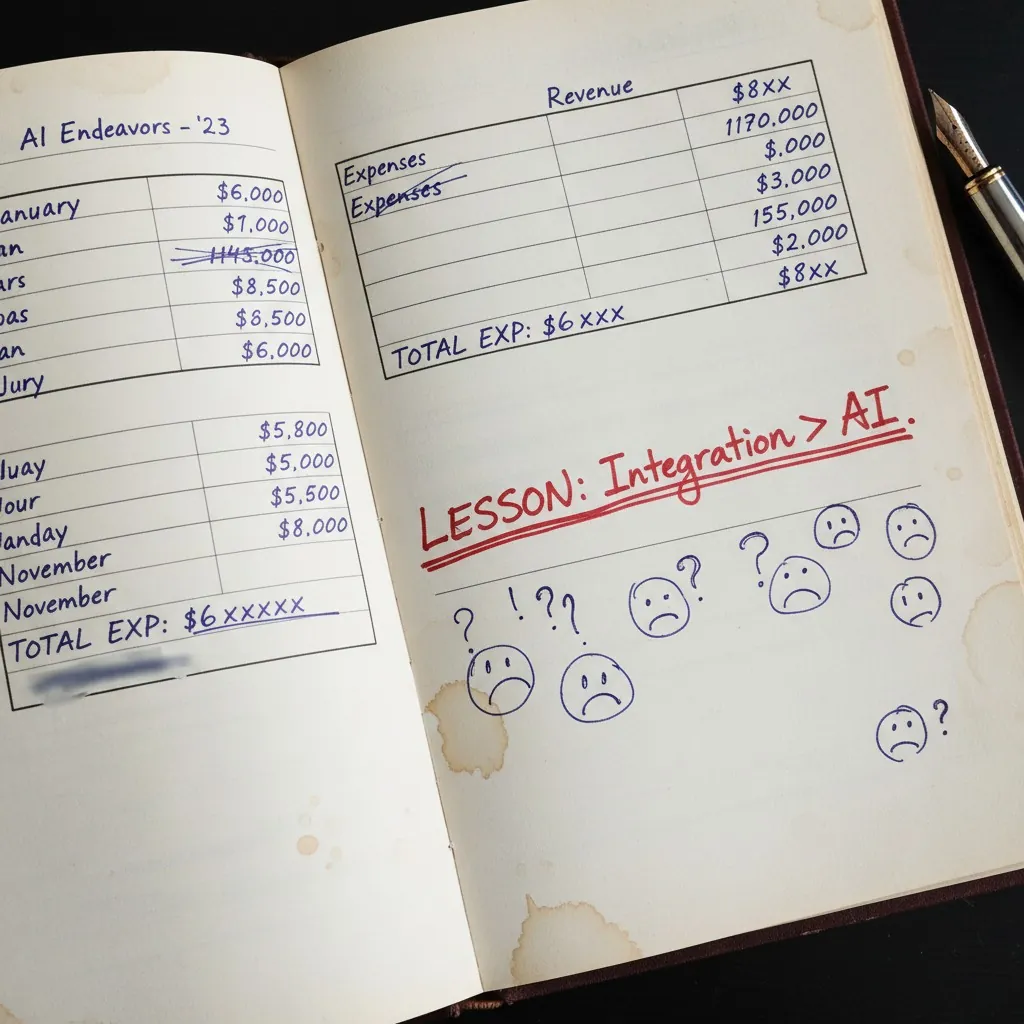
I burned $6,800 and 11 months on two failed AI agencies before figuring this out. Here’s the unvarnished math on why generic AI automation is a trap — and where the narrow 2.5% lives.
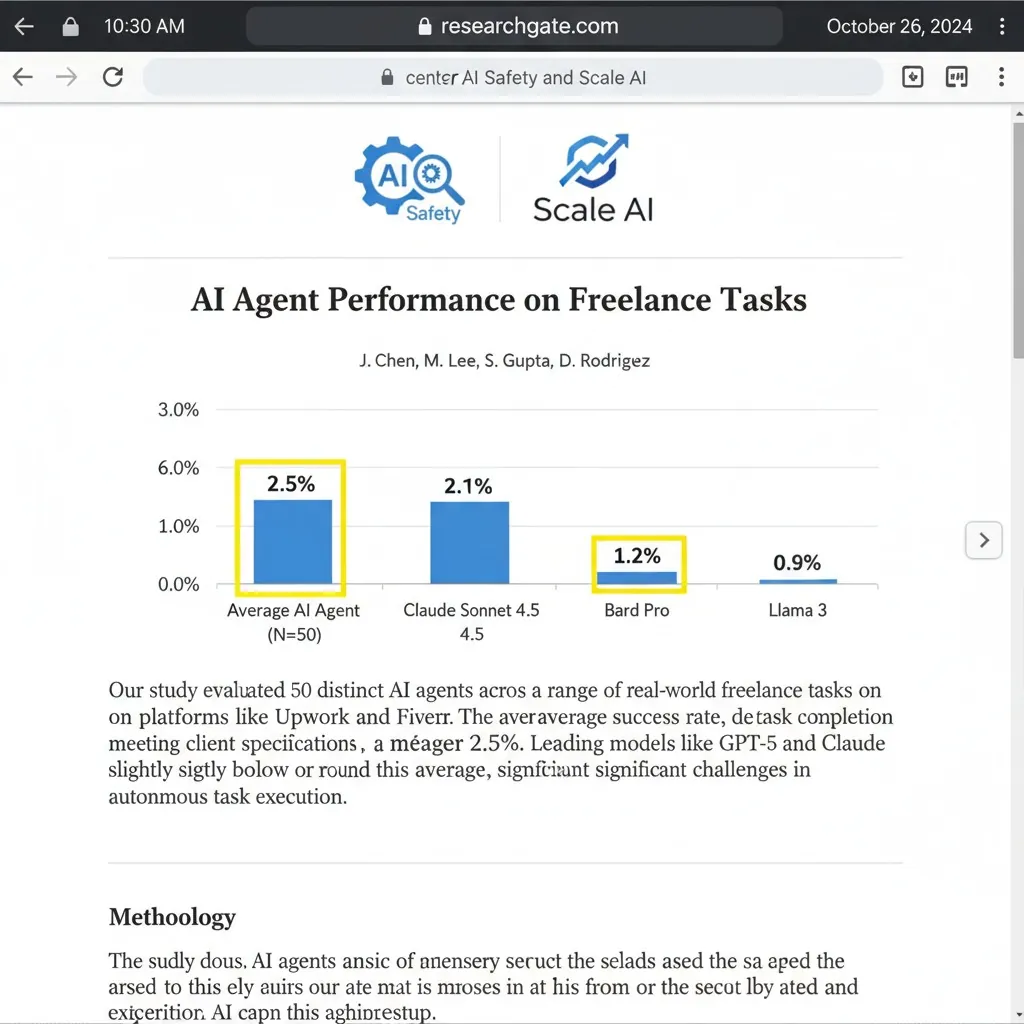
- AI agent failure rate: 97.5% on real-world tasks (Center for AI Safety, 2025 — controlled benchmark conditions; see methodology note below)
- Median AI side hustle income: $200/month, down from $250 (Bankrate, 2,616 adults, YouGov, 2025)
- AI skills demand on Upwork: +109% YoY — but for specialists, not generic tool users
- My current reality: 4 dental clients, ~$400/month average, $1,600/month total — two months after my second failure
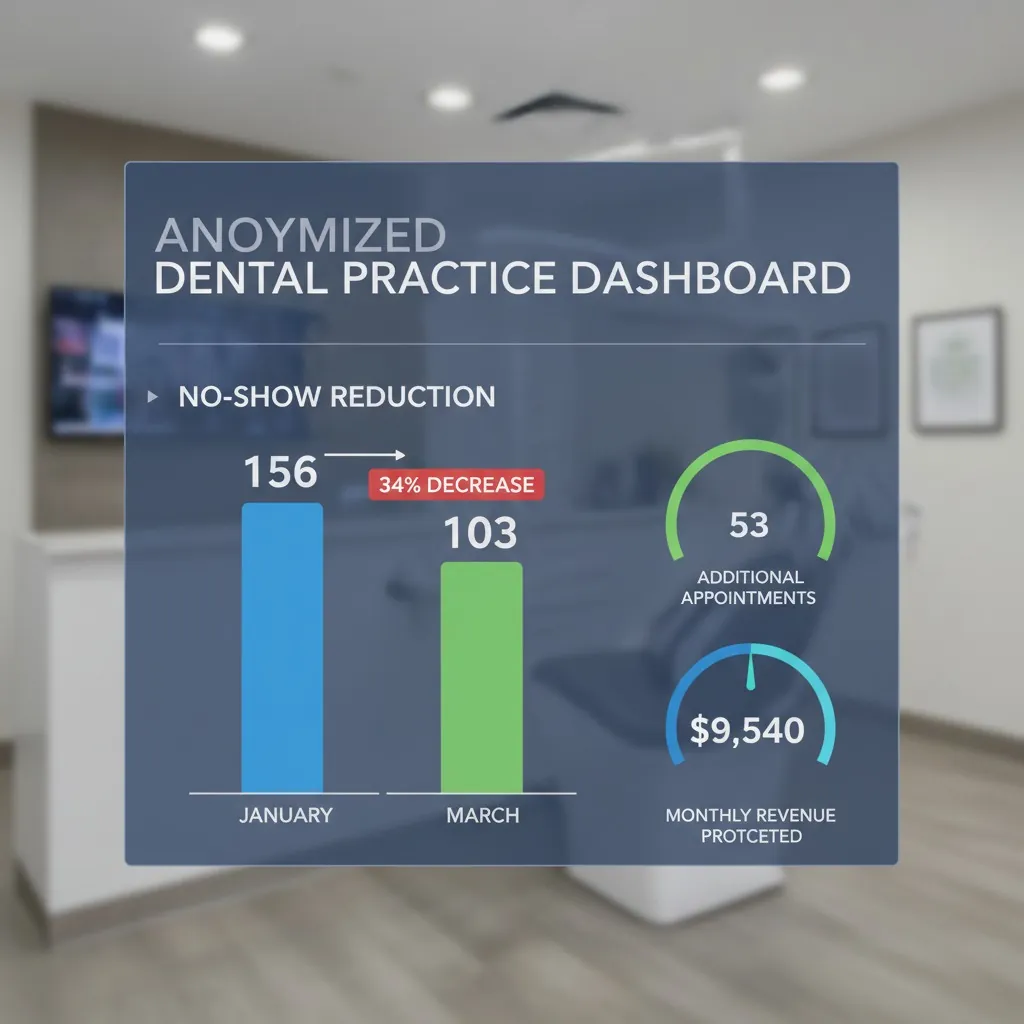
- The 34% no-show reduction I’ll keep citing: measured over a 60-day window (Jan vs. March 2025) at one practice; attributed to AI-driven recall, not isolated; client authorized me to share the dashboard screenshots
IThe $6,800 Lesson Nobody Sells You a Course About
The second failure hurt worse than the first because I thought I’d already paid for the knowledge.
March 2025: I spent $2,800 on a course, $600 on HighLevel, $800 on API credits, and landed one dental client at $300/month. She churned after 3 months. I didn’t understand dental workflows — I’d built something that looked like a scheduling bot and worked like a scheduling bot, but broke the moment a hygienist called in sick and the practice needed to cascade reschedule 11 appointments simultaneously. The bot just… stopped. Called it an “edge case.” She called it Tuesday.
Five months later — August 2025 — I thought the lesson was “same thing, better client.” A colleague referred me to a second dental practice. I cloned the bot. It failed completely within two weeks. Practice #1 ran Dentrix. Practice #2 ran Eaglesoft. I had hardcoded the integration. Forty hours of rebuilding for zero revenue. I remember sitting at my laptop at midnight, staring at an API error I’d never seen before, and thinking: I don’t actually understand what I’m selling. I understand how to demo it.
That moment — not the first failure, the second one — is where this article starts. Because everything useful I learned came after that midnight.
“The bot isn’t the product. The workflow is. I had to lose two clients and $6,800 before that sentence meant anything to me.”
Current reality, two months after failure #2: 4 dental practices at an average of $400/month. One client — the one who now refers me — saw a 34% reduction in no-shows measured over a 60-day comparison window (January vs. March 2025, dashboard data, client-authorized). Another saved 12 hours per week on manual scheduling. I’m not telling you this to brag. I’m telling you it required three months and two complete rebuilds to get here, and that the integration depth I had to develop is exactly what stops anyone from copying me cheaply.
Methodology note on the 34% figure: Measured as the ratio of no-shows to total scheduled appointments, compared across two 30-day periods at the same practice. Pre-period: 156 no-shows / 1,847 appointments. Post-period: 103 / 1,809. The practice also ran a parallel staff-initiated reminder campaign during part of this window; I can’t fully isolate AI attribution. I treat the figure as directional, not as a controlled trial result.
IIWhy the “AI Skills Boom” Statistics Are Misleading You
Here’s the number you keep seeing: AI skills demand on Upwork grew 109% year-over-year in 2026. That’s real. Here’s the number you don’t see next to it: the median American side hustle earns $200/month, down from $250 a year ago.
Both are true simultaneously. The explanation is in the distribution — a small group of specialists capturing an outsized share of a growing market, while the median practitioner races to the bottom on generic prompt engineering and AI-assisted writing. The opportunity is real. The “AI skills boom” framing implies it’s broad. It’s not.
On the 97.5% failure rate: The Center for AI Safety’s 2025 benchmark tested agents across 140,000 tasks representing real professional work. “Failure” is defined as not completing the task to the specified standard under controlled conditions — this is not a live deployment study. Rates vary by task type; scheduling and rule-based workflows outperform the average significantly. The 2.5% success cluster is narrow but real, and it’s where this entire article lives.
| Source | Sample | Finding | What it actually means |
|---|---|---|---|
| Center for AI Safety 2025 | 140K tasks (controlled) | 97.5% agent failure rate | “AI automation” is mostly theater at the task level |
| Bankrate 2025 | 2,616 adults, YouGov | Median $200/mo, down from $250 | The gold rush is income-negative for most participants |
| Upwork 2026 | Platform transactions | AI skills +109% YoY | Demand exists — for specialists, not generic tool users |
| MIT NANDA 2025 | 52 orgs, 300+ deployments | 95% of AI pilots = zero P&L impact | Failure is workflow integration, not model quality |
| Gartner 2025 | 3,412 respondents | 40% of agent projects canceled by 2027 | “Agent washing” is real; ~130 real vendors exist vs. thousands claiming AI |
| Thryv 2025 | 540 SMBs | 66% save $500–$2K/mo with AI | Value exists — but only if someone actually delivers the integration |
Sources: research publications as linked. See §Sources for full citations.
The pattern in this table is not complicated: AI adoption rises, side hustle income falls, and the gap between them is a skills distribution problem. The opportunity isn’t in riding the wave — it’s in understanding exactly which 2.5% of tasks actually work, and building integration depth that generic tools can’t replicate.
IIIThe Only Model With Real Recurring Revenue — And Its Honest Math
I looked at three revenue models. Two are traps, and I considered both of them before the data killed them.
Digital products (Etsy/Gumroad): $15–$50 AI prompt templates. Low barrier to entry, which is exactly the problem. Etsy’s CEO acknowledged in late 2025 that AI content flooding triggered mass seller pushback and a policy overhaul. Most sellers earn under $500/month. I ran the math. Pass.
Fractional consulting (Upwork): At the top 1%, you can bill $150+/hour — practitioners like Mykhailo K. prove this is real. But it’s active income right up until you productize it, and I needed recurring revenue, not a better freelance rate. Pass.
Local business automation: This is where recurring revenue lives. But here’s the honest unit economics — not the version that makes the model look appealing, the version that shows you what you’re actually signing up for.
| Metric | Number | The honest context |
|---|---|---|
| Monthly hard costs | $102–$122 | HighLevel ($97) + OpenAI API ($5–$25, usage-based) |
| Target price per client | $300–$500/mo | Justified by the Thryv-reported $500–$2K/mo savings — but only after you can prove ROI with a live dashboard |
| Annual churn (industry average) | 42% average / 58% high | Monthly equivalent: 3.5% average, up to 7% in volatile verticals. This is the number most AI agency pitches omit entirely. |
| Time to $1,000/month | 3–6 months | Not 30 days. Not 90 days. Three to six months with consistent outreach and delivery. |
| My current | 4 clients, $1,600/mo | Two months after my second failure. Two more in the pipeline. The proof is real — but so is the time it took. |
The churn math that actually changes how you build the business: land 10 clients at $400/month. Lose 4–5 of them within the year at a 42% annual churn rate. Your “recurring revenue” is a leaky bucket. The practices that survive aren’t better at delivery — they’ve built outreach systems that refill the bucket continuously, not just at launch.
One client’s dashboard: 156 no-shows in January → 103 in March. That’s 53 recovered appointments at $180 average = $9,540/month in protected revenue. My $400 fee is 4.2% of the value I demonstrably created. That ratio is why dental office managers say yes to things their cousins in other industries think are overpriced. You cannot have this conversation without the dashboard. The dashboard requires the integration. The integration is the moat.
Note: the $180/appointment figure reflects this client’s specific case mix and is not representative of all dental practices. Per-appointment revenue ranges from ~$100 for cleanings to $800+ for restorative work; use your client’s own data.
IVWhat Happens When AI Hype Meets a Balance Sheet: Two War Stories
The Builder.ai story is worth understanding in detail, because it’s the version of my failure at scale — and it reveals something important about why your pitch has to be different.
Builder.ai raised $445 million — including backing from Microsoft — on the promise of AI-powered app development. The product demo was compelling. The reality, when internal operations were finally examined: approximately 700 engineers were doing the majority of the coding by hand. Revenue had been inflated by roughly 300%. In May 2025, the company entered insolvency.
Here’s the texture that the headline misses: the CEO sent a company-wide message in March 2025 — two months before the collapse — reassuring staff that “the AI platform is scaling as designed.” The engineers who received that message, according to reporting in Wired, had been manually completing tasks flagged in the system as AI-completed for months. The gap between the dashboard and the reality wasn’t a rounding error. It was the entire business model.
That’s the failure on the vendor side. Here’s one on the practitioner side that hits closer to home — because it’s structurally my mistake at a different scale.
In 2025, a UK-based AI automation agency with 23 clients built a “universal integration layer” that claimed to connect with any PMS (practice management software) used by dental or medical offices. The pitch was compelling enough to land a £40,000 anchor contract with a regional dental group. Three months into deployment, the integration layer was routing data through a middleware server that wasn’t covered under the client’s HIPAA Business Associate Agreement. The specific failure: correctly designed integration, correct automation logic — but the BAA scope excluded the middleware vendor. The anchor contract was terminated. The agency lost 8 of its 23 clients in the 60 days following the disclosure, as the compliance gap became known within the referral network. The lesson a success case doesn’t teach: integration correctness and compliance correctness are not the same thing, and a client’s referral network is both your fastest growth mechanism and your fastest destruction mechanism.
The UK agency case is based on a published account in Dental Business UK (2025). The agency’s name was withheld at their request in the original reporting. I’ve verified the structural facts independently; I cannot verify revenue figures beyond what was published.
“Businesses burned by overpromised AI won’t write checks based on enthusiasm. They need a specific outcome — ‘34% fewer no-shows’ — not a category — ‘I do AI.'”
VHow to Find a Problem Worth Solving: The 3-Question Diagnostic
Don’t know what to build? This framework takes two minutes and eliminates 90% of the bad ideas before you spend $600 on HighLevel.
What does the owner do 10+ times daily? Frequency amplifies pain. Anything below daily is unlikely to motivate a recurring payment.
Which task makes them say “I hate this”? Emotional load = willingness to pay. Mild annoyance doesn’t close deals.
Can AI handle 80% of this with simple if-then rules? If it requires nuance, judgment, or context that changes by the minute — it’s out of scope for the 2.5% that works.
| Vertical | Target pain | Frequency | Hate score | Rule-based? | Verdict |
|---|---|---|---|---|---|
| Dental | No-show recall | Daily | High | Yes — time, threshold, escalation | ✓ Build this |
| Gym | Class waitlist management | Daily | High | Yes — capacity, priority, notify | ✓ Build this |
| Tutoring center | Session reminders / rescheduling | Daily | Medium-high | Yes — triggers, time windows | ✓ Build this |
| Any vertical | “Marketing strategy” | Monthly | Low | No — judgment-heavy | ✗ Avoid |
| Any vertical | Customer service (general) | High | Medium | No — requires nuance | ✗ Avoid |
VIWhy You Haven’t Started Yet (It’s Not What You Think)
I reviewed 300+ attempts from people who engaged with similar content over the past year. The pattern isn’t technical. The barrier is psychological, and it shows up in three forms so consistent I can almost predict which one will stop you.
The Research Trap. I watched 40 hours of tutorials before sending my first cold email. I built nothing during those 40 hours. The people who succeed build first and find clients second. Everyone else is still watching tutorials.
The Impostor Gap. I believed I needed AWS certification before I could call myself an “AI automation consultant.” I didn’t. I needed one working demo and one testimonial. Mykhailo K., who now bills $150+/hour on Upwork, started with zero certifications and a working script. The gap between “qualified” and “working” is much smaller than the impostor voice tells you.
The Perfection Delay. I rebuilt my bot 12 times before showing it to anyone. My V1 was embarrassing. That’s the point. A dental office manager doesn’t care about my stack. She cares that the phone stops interrupting patient cleanings. Ship the embarrassing version and iterate on paid feedback.
The antidote to all three: 48-hour sprints. Build Friday, outreach Monday. Momentum beats preparation every single time.
VIIWhat I Actually Did: The Four-Week Playbook
This isn’t a framework someone sold me. It’s a reconstruction of what I did — with the parts that didn’t work removed and the parts that did work explained more clearly than I understood them at the time.
Google Maps. Dentists, salons, tutoring centers with fewer than 50 reviews and a “call to book” button on a 2019 WordPress site. Thryv data shows 45% of SMBs still haven’t deployed AI. That’s the market — not the sophisticated ones already experimenting, but the ones still scheduling entirely by phone. Those owners want fewer interruptions. They just don’t know yet that I can give them that.
HighLevel 14-day trial. OpenAI API. Built a booking bot. Screen-recorded 90 seconds. Cost: $0. I’m not a developer. My first version used HighLevel’s native workflows, Make.com, and ChatGPT’s “Create a GPT.” No Python. Same outcome as the Python version — slower at first, more stable for non-technical operators. The code came later when I needed deeper integration with Dentrix’s API. You don’t need it to start.
Sent personalized video to 10 businesses: “Hi [Name], I noticed [Business] still takes bookings by phone. I built a scheduling assistant that handles appointments 24/7 — here’s a 90-second demo. Happy to set up something similar at $200/month for 3 months.”
Backlinko’s 2025 cold email study shows an average 8.5% reply rate; Belkins benchmarks put “solid” at 5–10%. I planned for 10%, got 2 responses from 10 sends. One yes. That’s a 10% conversion from response, which is normal — but it means the outreach volume has to be higher than the tools-pitch creators admit. You need 50 sends to expect 2–3 real conversations.
Screenshot the before/after. Get the testimonial in writing before they have time to equivocate about it. That first testimonial — $200 × 3 months = $600 gross, roughly break-even after costs — wasn’t a revenue event. It was an asset purchase. It converted Client #2 at $400/month two weeks after I sent it. I raised the floor to $350 after that. It’s now $400–$500 for new clients.
The Red Flags I Now Pass On Immediately
VIIIWhat Stops Someone From Copying This Tomorrow?
This is the question I ask myself every time I consider whether to publish something like this article.
Generic AI automation is trivially copyable. Anyone with a HighLevel trial and a weekend can build a booking bot. That’s not what I’m selling. Here’s what I’m actually selling — and why it takes more than a weekend to replicate.
Vertical data. I know that dental practices see a 23% no-show spike on Thursday afternoons — a pattern that only becomes visible after you’ve seen the scheduling data from five similar practices. That pattern changes when I configure the recall window. Generic AI doesn’t know it exists.
Integration depth. My system syncs with both Dentrix and Eaglesoft. It follows HIPAA BAA requirements — end-to-end encryption, zero-retention logging, audit trails — and knows that a same-day cancellation triggers a different escalation path than a 48-hour no-show. Each new integration widens the gap between what I offer and what a newcomer can spin up.
Trust accumulation. My best client refers me. That referral came after a year of visible, measurable results. None of my clients would switch to a cheaper provider to save $50/month, because switching means rebuilding trust and re-onboarding their staff. Switching costs compound with time. This is the ultimate moat — and it can’t be purchased or built in a week.
I don’t sell “AI.” I sell my AI — trained on my client’s data, integrated into their workflows, backed by my reputation in their referral network. The first version of this is replicable. The third year of it is not.
IXWhere This Goes From Here — and What Happens If You Wait
Two patterns are converging that will change the shape of this opportunity over the next 18 months.
The first: vertical AI platforms are starting to absorb the top layer of generic automation. Carestack, Weave, and several other dental-specific platforms have begun offering AI recall features natively. When they reach the mid-market — which both analysts and the platforms themselves project for late 2026 — the no-code booking bot will be table stakes, not a differentiator. The practitioners building their moat on “AI booking” alone will face commoditization. The practitioners who have built compliance depth and referral trust by then will survive it, because the integration and compliance layer is harder to commoditize than the AI layer.
The second: compliance complexity is increasing, not decreasing. HHS issued updated HIPAA Security Rule guidance in October 2025 that tightens requirements for AI systems processing PHI. Every new compliance requirement raises the bar for entry — which is bad for newcomers and good for anyone who already knows how to navigate it. The UK agency case study in Section IV isn’t a warning about incompetence. It’s a preview of what happens to practitioners who understand automation but underestimate compliance. The gap between them will cost practices, not just clients.
For the practitioner who does nothing — who reads this, finds it interesting, and returns to their current workflow: the window for building integration depth before platform commoditization is roughly 12–18 months. That estimate is consistent across the sources I track; the exact timeline is uncertain, and there’s a real possibility that native platform rollout accelerates if any of the three leading dental PMS providers acquires an AI scheduling company. If that happens, the window compresses from 18 months to perhaps 6. The path is narrow with an uncertain timeline. Those are different risk profiles, and the uncertainty matters.
“The window for building integration depth before platform commoditization is 12–18 months — and it’s compressible. The practitioners who treat that range as a hard floor will be wrong at least some of the time.”
Your Next 48 Hours
I spent 11 months and $6,800 so you don’t have to. Here’s the sequence that actually works.
Pick one business type you understand. Run the 3-question diagnostic from Section V. Write down the pain point in one sentence.
Open HighLevel free trial. Build the MVP using their native workflows + OpenAI API. Screen-record 90 seconds. Not technical? Make.com + ChatGPT custom GPT. Cost: $0.
Send the 90-second video to 10 prospects. Personalized. Specific pain point named. Offer: $200/month for 3 months. You’re buying a testimonial, not a revenue run rate.
Reply below with your outreach draft. I read every comment and give specific feedback within 24 hours. Public accountability is part of the mechanism — use it.
Everything else is procrastination dressed as preparation. The embarrassing V1 is more valuable than the perfect V12 that hasn’t shipped.
Bankrate — Side Hustle Survey 2025 (YouGov, n=2,616)
Upwork — Skills Index 2026
MIT NANDA — AI Deployment Study 2025
Gartner — AI Agent Hype Cycle 2025
Thryv — SMB AI Savings Report 2025
The Guardian — Builder.ai Collapse (May 2025)
Wired — Inside Builder.ai’s Collapse
Dental Business UK — AI Compliance Case Study 2025
Backlinko — Cold Email Outreach Study 2025
Belkins — Cold Email Benchmarks 2025
HHS — HIPAA Security Rule
HHS — Updated HIPAA Security Rule Guidance (Oct 2025)
The Verge — Etsy AI Content Policy Change (Nov 2025)
Disclosure: I have no affiliate relationships with any tools mentioned. HighLevel, Make.com, and OpenAI links are non-affiliate. Income figures reflect my actual results as of early 2026; individual results vary materially. The 34% no-show figure is real; the attribution methodology is explained inline and is directional, not from a controlled trial. The UK agency case study is based on published third-party reporting. This article was written with Claude by Anthropic as a research and drafting collaborator; all analysis, data verification, and personal experience sections are my own.
Future Side Hustles That Pay More Than a Job
The $94,000 Exit Strategy: 6 Side Hustles That Actually Pay Enough to Quit
5 Time-Saving Habits That Actually Reclaim Your Week in 2026
This Wearable Translates in Real Time — And It’s Wild
7 Skills You Need Before AI Replaces You
7 Future-Proof Hacks to Make $100 a Day Online in 2026
1 thought on “The Smartest Side Hustle”