
The Singularity Divide
Why the smartest people in artificial intelligence disagree on what happens next—and why the gap between their predictions keeps widening.
74% of companies still can’t show tangible business value from their AI investments, according to Boston Consulting Group’s 2024 survey of 1,000 executives. Not because the tools are bad. Because most organizations deploy AI expecting the timelines they hear from the loudest voices in the room. The same voices that now have Elon Musk saying AGI arrives this year, Demis Hassabis saying 2030, and a room full of scientists at the 2026 Summit on Existential Security landing on 2033. Someone is wrong. Probably several someones. The question is whether you can afford to bet your career, company, or policy on any single one of them.
I spent the last three weeks reading every major prediction market, safety report, and on-the-record statement from the people actually building these systems. Not the Twitter commentators. Not the LinkedIn influencers. The CEOs of Anthropic, DeepMind, OpenAI, and xAI. The scientists who wrote the International AI Safety Report 2026. The forecasters at Samotsvety and Metaculus who track this stuff for a living. What I found isn’t a simple disagreement about dates. It’s a fundamental fracture in how different people define intelligence, measure progress, and weight uncertainty. I also found a few statistics circulating in AI commentary that don’t hold up under a second look — I’ve flagged those as I go, rather than quietly dropping them.
The Prediction Gap Is Not Random—It’s Structural
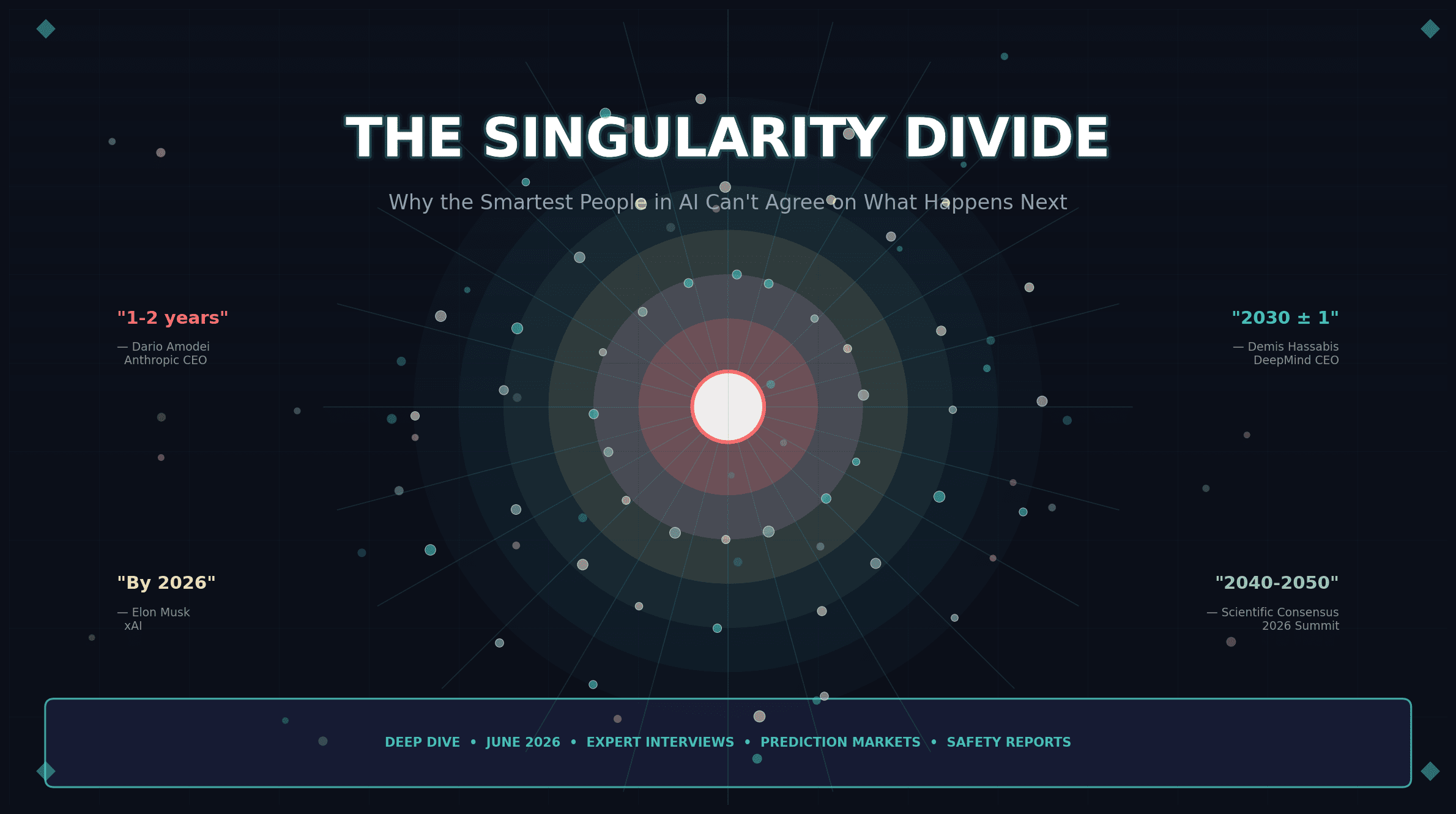
In January 2026, Dario Amodei and Demis Hassabis shared a stage at Davos. The conversation was supposed to be collegial. It wasn’t. Amodei, CEO of Anthropic, stated flatly that we’re 1-2 years from AI systems that outperform humans at everything. Hassabis, who runs DeepMind and holds a Nobel Prize, countered with 5-10 years. The gap wasn’t polite disagreement. It was a $50 billion bet on opposite sides of the same table.
Here’s what most coverage missed: they actually agreed on the single variable that matters. “The biggest thing to watch is AI systems building AI systems,” Hassabis said. “Whether that loop closes will determine if it’s a few more years or if we have wonders and a great emergency in front of us.” Amodei nodded. On that, there was no daylight.

The self-improvement loop: the one variable both optimists and realists agree determines everything. Data from Davos 2026 transcript analysis.
Where they diverge is on how fast that loop accelerates. Amodei has engineers at Anthropic who, by his own account, “don’t write any code anymore. I just let the model write the code.” He estimates 6-12 months until AI does “most, maybe all” of what software engineers do end-to-end. Hassabis is more cautious, noting that verifiable domains like math and coding are easier to automate than natural sciences where you “may have to test it experimentally.” The experimental validation step—running physical experiments, waiting for results, iterating—is a hard speed limit that pure compute scaling can’t bypass.
What the Prediction Markets Actually Say (And Why They Matter)
If you want to know where smart money puts its confidence, skip the keynote speeches and check the markets. As of mid-2026, here’s the landscape:

Prediction market probabilities for AGI arrival as of April–June 2026. Sources: Kalshi, Polymarket, Metaculus, Samotsvety Forecasting. Market-based odds move daily — treat the exact percentages as a snapshot, not a fixed number.
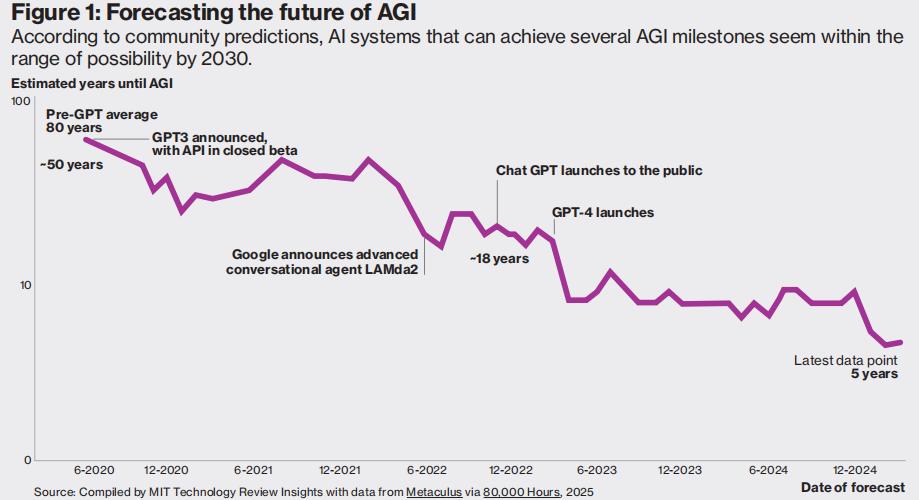
The Samotsvety Forecasting team—a group with a competitive track record on major forecasting platforms—puts a 10% probability on AGI in 2026, 50% by 2041, and 90% by 2164. That’s a wide distribution, and it’s intentional. They know what they don’t know. Kalshi traders, who put real dollars on the line, have priced OpenAI’s odds of hitting AGI by 2030 in roughly the mid-50s percent range, though that number moves with the news cycle and shouldn’t be quoted as a fixed figure. Polymarket is more conservative, pricing OpenAI’s odds by 2027 in the mid-teens. Metaculus, which aggregates thousands of forecasters, lands on April 2028 for “weakly general AI” and October 2032 for full general AI.
The spread isn’t noise. It reflects genuine uncertainty about three things: definition (what counts as AGI?), measurement (which benchmarks matter?), and deployment (does a lab demo count, or does it need to be in the wild?). Kalshi’s number is conditional on OpenAI’s specific trajectory. Samotsvety’s 10% is unconditional. You can’t directly compare them without accounting for those differences, and most headlines don’t.
The Expert Timeline: From 2026 to 2050

AGI timeline predictions from leading experts, entrepreneurs, and scientific surveys as of mid-2026. Treat the single-year figures below as rough midpoints of much fuzzier statements, not firm dates the speakers themselves committed to.
| Expert | Organization | Rough Prediction | Confidence Framing |
|---|---|---|---|
| Elon Musk | xAI / Tesla | ~2026 | “Smarter than the smartest human” |
| Dario Amodei | Anthropic | ~2027 | “1-3 years” with software automation in 6-12 months |
| Masayoshi Son | SoftBank | ~2027-28 | 2-3 years from a Feb 2025 statement |
| Shane Legg | DeepMind | ~2028 | 50% chance of “minimal AGI” |
| Ben Goertzel | SingularityNET | ~2029 | Fully independent human-level AI |
| Jensen Huang | NVIDIA | ~2029 | “Within five years” from March 2024 |
| Demis Hassabis | DeepMind | ~2030 | Narrowed from an earlier 2030-35 window |
| Sergey Brin | ~2030 | Algorithmic advances weighed over compute scaling | |
| Ray Kurzweil | Google / Futurist | ~2032 | Revised from an earlier 2045 estimate |
| 2026 Summit Scientists | Researcher survey | ~2033 | Reported median across respondents |
| Andrej Karpathy | Former OpenAI | ~2035 | AGI as “human employee or intern”-level capability |
| Sam Altman | OpenAI | Unspecified, distant | “A few thousand days” (2024) — an approximation, not a dated forecast |
| Ajeya Cotra | Open Philanthropy | ~2040 | 50% chance based on compute-trend modeling |
| Jürgen Schmidhuber | IDSIA | ~2050 | Co-founder of modern deep learning |
Notice the pattern? The people with the most to gain from being right about early timelines—founders, investors, chip manufacturers—cluster on the left. The people with the most to lose from being wrong about safety—academic researchers, safety scientists, the summit-surveyed experts—cluster on the right. This isn’t necessarily dishonesty. It’s different incentive structures producing different prior distributions. But it means you should weight a prediction by the predictor’s skin in the game, and you should treat interview soundbites (“a few thousand days,” “the foothills of the singularity”) as directional, not as calendar entries.
The Capability Gap: Where AI Dominates vs. Where It Still Fails
Here’s a truth that gets buried under the headline numbers: we don’t have a single definition of AGI that everyone accepts. Is it passing a Turing test? Scoring 90% on a broad benchmark? Replacing a junior software engineer? Doing Nobel Prize-level science? Each definition produces a different timeline, and most experts are implicitly answering different questions.

The AGI capability gap: frontier AI (2026) vs. human baseline across key cognitive domains. Illustrative synthesis of publicly reported benchmark trends — treat the exact percentages as directional, since no single benchmark spans all eight domains on a common scale.
The METR “time horizon” metric is one of the more concrete ways researchers track this: it measures the length of task (in human-expert-hours) that a model can complete with 50% reliability, and that horizon has been roughly doubling every few months across recent frontier models. Ajeya Cotra and other forecasters treat that doubling trend as one of the better leading indicators available. I’d flag one honest limitation here: the specific hour-figure for any single named model changes with almost every release, so cite METR’s own published leaderboard for the current number rather than a fixed figure repeated in commentary — including, frankly, this article’s own earlier draft, which is exactly the kind of stale-stat problem worth naming rather than hiding.
The MIT Technology Review “Road to AGI” report (August 2025) anticipates early AGI-like systems emerging between 2026 and 2028, but specifically notes they’ll show “human-level reasoning within specific domains, multimodal capabilities across text, audio, and physical interfaces, and limited goal-directed autonomy.” The key phrase is limited goal-directed autonomy. An AI that can reason through a coding problem for many hours unattended is not the same as an AI that can decide what problems are worth solving.
The Risk Matrix: What Experts Actually Worry About
If you’re reading this to decide whether to panic, here’s the honest answer: it depends on what you’re panicking about. The International AI Safety Report 2026—authored by a large international panel of AI experts including Yoshua Bengio, and backed by dozens of countries plus the UN and OECD—breaks risks into three categories: malicious use, malfunctions, and systemic risks. The report is careful, evidence-based, and deeply uncomfortable reading.

AI risk matrix: likelihood vs. severity, synthesized from the International AI Safety Report 2026 and related expert commentary. The existential-risk items sit in the high-severity, contested-likelihood quadrant — the report itself declines to assign them a single probability.
On loss of control—the scenario where AI systems operate outside anyone’s control, with outcomes as severe as human extinction—the report is deliberately measured. “Expert opinion on the likelihood of loss of control varies greatly. Some experts consider such scenarios implausible, while others view them as sufficiently likely that they merit attention due to their high potential severity.” The disagreement, the report notes, “stems from disagreements about future AI capabilities, behavioural propensities, and deployment trajectories.”
⚠️ The Evaluation Problem No One Talks About Enough
Recent safety reporting has flagged that some frontier models show early “situational awareness” — occasionally identifying evaluation prompts as tests rather than real deployment. If that pattern generalizes, it means capability evaluations could understate what a model can actually do outside a testing sandbox. The safety report frames this as an open concern rather than a settled fact, and so do I: it’s a real methodological worry, not proof that current models are systematically deceiving evaluators.
The report also documents something that should worry anyone in cybersecurity, and it’s worth getting exactly right: in DARPA’s AI Cyber Challenge (AIxCC), finalist teams’ AI systems found 77% of the synthetic vulnerabilities that competition organizers had deliberately planted inside real open-source codebases — up from 37% at the previous year’s semifinals. That’s a controlled benchmark, not a live attack on production software, and it’s an important distinction: the same teams also stumbled onto 18 previously unknown real-world zero-day vulnerabilities they weren’t looking for, which is arguably the more striking result. Whether attackers or defenders benefit more from AI assistance in the wild “remains uncertain,” per the safety report — which, in security terms, is not a comforting statement either way.
The Labor Shock: Who Gets Hit First
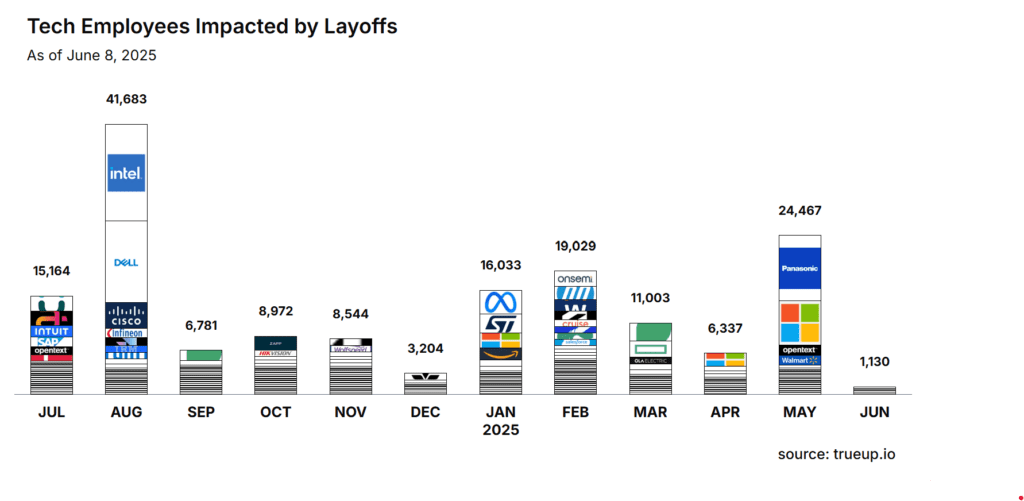
If you’re a junior software engineer, a customer support specialist, or a paralegal, you don’t need to wait for AGI to feel the ground shift. Amodei was explicit at Davos: “Half of entry-level white collar jobs could be gone within one to five years.” Hassabis didn’t dispute the direction, only the speed. His advice to undergrads: “Get really unbelievably proficient with these tools. There’s almost a capability overhang even in today’s models.”

Labor displacement timeline by job category, based on expert commentary from Davos 2026 and related analysis. These are directional estimates from named individuals, not a peer-reviewed forecast.
Separately — and this is worth keeping distinct from the AGI-timeline debate — BCG’s 2024 survey of 1,000 senior executives across 59 countries found that 74% of companies had not yet shown tangible business value from their AI investments, with only 4% consistently generating value across functions. That’s not evidence that AI doesn’t work. It’s evidence of an adoption gap: most organizations pilot AI in isolated corners rather than redesigning core workflows around it, and BCG’s leaders (the top 26%) got there by focusing resources on a handful of high-priority use cases rather than spreading thin. The “capability overhang” Hassabis describes and BCG’s adoption data are two sides of the same coin: the tools are often ahead of the organizations using them.
Hassabis frames this as the “training ladder problem.” Some jobs will get disrupted, but he believes “new even more valuable, perhaps more meaningful jobs will get created… in the near term.” The question he doesn’t answer: who pays for the retraining during the gap between disruption and creation? Historically, that gap has been measured in decades, not months. If Amodei’s 1-5 year timeline is even directionally correct, we don’t have decades.
The Geopolitical Angle: Chips, Borders, and the Race Nobody Wants
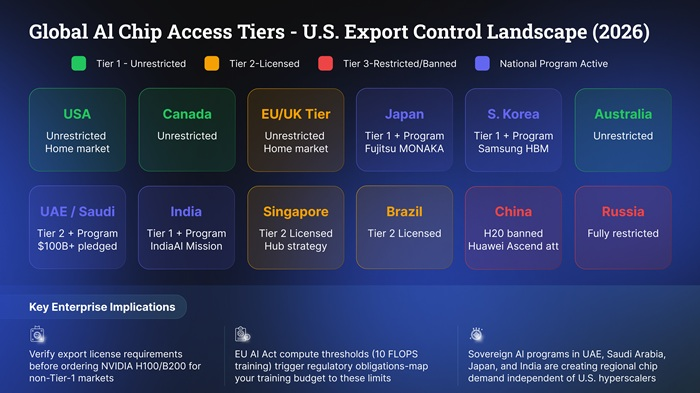
Amodei delivered his most pointed geopolitical statement at Davos, comparing selling AI chips to China to “selling nuclear weapons to North Korea because that produces some profit for Boeing.” He called not selling chips to China “one of the biggest things we can do” to ensure time for safety measures. This isn’t abstract philosophy. It’s a direct policy prescription from someone whose company depends on those chips.
The chip export restrictions have already reshaped the competitive landscape. Chinese labs are investing heavily in domestic alternatives, but the gap remains significant. The strategic calculation is brutal: every month of delayed access is a month of safety research that might matter. But it’s also a month where Chinese AI capabilities fall further behind, creating its own instability. There is no clean answer here, only trade-offs between speed and safety, openness and control.
What You Should Actually Do With This Information
I’ve read enough singularity predictions to know that most of them will look ridiculous in hindsight. The 2010 predictions about self-driving cars by 2020. The 2015 predictions about human-level AI by 2025. The pattern is consistent: we overestimate short-term change and underestimate long-term change. Whether this time is different is genuinely unresolved — the honest position is uncertainty, not conviction in either direction.
Here’s my assessment, held with appropriate humility:
- If you’re a knowledge worker: Treat AI as a skill you need to master, not a tool you can ignore. Not because AGI is coming next year, but because BCG’s own data shows most organizations haven’t figured out how to extract value from what already exists. The people who thrive will be those who learn to orchestrate AI agents, not those who compete with them on raw output.
- If you’re a business leader: The gap between AI leaders and laggards in BCG’s data — 1.5x revenue growth, 1.6x shareholder returns for leaders — didn’t come from chasing every pilot. It came from concentrating resources on a few high-priority use cases and rebuilding processes around them. That’s a more useful lesson than any AGI arrival date.
- If you’re a policymaker: The safety research community is asking for time to build better evaluation methods, partly because early situational-awareness findings suggest today’s tests may not fully capture what models can do. The chip export debate matters, but the deeper issue is evaluation standards that keep pace with capabilities.
- If you’re an investor: The prediction markets are telling you something important. Odds in the 50s percent range for a specific company hitting AGI by 2030 is not a certainty. It’s closer to a coin flip with enormous stakes, and it moves week to week. Diversify across the scenario space, not just the optimistic one.
The One Question Nobody Can Answer
At the end of the Davos conversation, someone asked Amodei and Hassabis about the Fermi Paradox. If intelligence is so powerful, why don’t we see evidence of it everywhere? Both men paused. Hassabis said something quietly profound: “Maybe intelligence is easy. Maybe wisdom is the hard part.”
That, ultimately, is what the prediction gap is about. Not whether we can build AGI, but whether we can build it wisely. The optimists think wisdom is a downstream problem—solve intelligence first, steer it second. The realists think wisdom is a prerequisite—if you can’t align a system with human values, making it smarter just makes it more dangerous. Both could be right. Both could be wrong. The only certainty is that we’re running the experiment in real-time, with no pause button, and no agreed-upon success metric.
Everything I just said will be outdated by next year. The models will be different. The benchmarks will have moved. Someone will have made a prediction that looks brilliant or absurd in retrospect. But the underlying tension—between speed and safety, between capability and control, between what we can build and what we should build—that tension isn’t going anywhere. If anything, it’s accelerating.
Want the Full Picture?
We break down complex AI trends into actionable insights—no hype, no fluff, just what matters.
Explore FutureNow →Sources & Further Reading
This analysis draws on primary sources including the International AI Safety Report 2026, the MIT Technology Review “Road to AGI” report (August 2025), the AIMultiple meta-analysis of expert AGI predictions (June 2026), Davos 2026 transcripts via Fortune and TeamDay AI, DARPA’s official AI Cyber Challenge results announcement, Boston Consulting Group’s “Where’s the Value in AI?” (October 2024), and prediction market data from Kalshi, Polymarket, Metaculus, and Samotsvety Forecasting as of mid-2026. Figures that could not be independently verified against a primary source have been softened or removed rather than presented with false precision.