
Are We Living
Inside a Simulation?
The most unsettling question in modern physics — finally examined without the hype, the nihilism, or the philosophical hand-waving.
Quick Answer: What’s the Deal?
The simulation hypothesis proposes that our entire reality — from quarks to consciousness — is a sophisticated digital program running on some vastly powerful computer. Not a metaphor. Not spiritual. A literal computational substrate. First formalized by philosopher Nick Bostrom in 2003, it’s spent two decades bouncing between tech conferences and physics journals. In 2025, it finally got serious scientific traction — and a serious mathematical pushback, almost simultaneously.
Here’s what changed: physicist Melvin Vopson published new work in September 2025 suggesting that the universe appears to optimize its own information, the way efficient code compresses data. Meanwhile, Mir Faizal published a mathematical proof in June 2025 arguing the opposite — that Gödel’s incompleteness theorems make the idea formally impossible. Both are credible scientists. Neither has “won.” That’s the honest summary of where we are.
Why Is This Exploding Right Now?
Honestly? Because of AI. When GPT-4 launched, a lot of people said “oh that’s neat.” When systems started generating video, writing code, and passing bar exams, a different group of people thought: wait — if we can build this, what if someone already did?
The logic isn’t crazy. If a civilization continues to advance technologically, it will eventually build simulations that are indistinguishable from reality. Bostrom’s original trilemma argues that one of three things must be true: either almost all civilizations go extinct before reaching that point, or almost none of them bother to run ancestor simulations, or we are almost certainly living in one. Given the sheer number of simulated minds that would exist compared to “real” ones, the math tilts heavily toward the third option — unless you reject one of the premises.
The metaverse and VR market hit $350 billion in 2025, projected to reach $1.5 trillion by 2030. OpenAI’s o3 and comparable models are now capable of simulating complex multi-agent systems. The gap between “we could never build this” and “we’re almost there” is closing faster than anyone predicted in 2020.
This isn’t just tech hype. A December 2025 New Scientist feature highlighted Vopson’s proposed experiments using particle collision data to detect information traces that would only appear in a simulated universe. That’s a real, testable prediction — the gold standard in science.
The Actual Evidence — Pro and Con
Let’s go through it cleanly, without the breathless startup-pitch energy that usually surrounds this topic.
Arguments in Favor
1. Quantum superposition as “lazy rendering.” Particles exist in superposition — multiple states at once — until observed. A simulation would do exactly this: don’t compute positions until someone looks. It’s the same optimization trick used in videogame engines called frustum culling. Is this evidence? Not directly. But it’s suspiciously convenient.
2. The fine-tuned constants. Our universe’s physical constants — the strength of gravity, the mass of the electron, the cosmological constant — are dialed so precisely for life that even tiny changes would produce a sterile universe. One explanation: we were designed this way. Another: we’re just the one universe where they happen to work, and we’re here to notice (the anthropic principle). Neither explanation is fully satisfying.
3. The digital nature of spacetime. In Planck-scale physics, spacetime may be discrete — pixelated, essentially — rather than continuous. That’s a strange feature for a “natural” universe but a perfectly sensible one for a computed one.
4. Vopson’s Second Law of Infodynamics (2025). This is the newest and arguably most intriguing piece. See the dedicated section below.
Arguments Against
1. Faizal’s Gödel proof. Published in June 2025, Mir Faizal argues that Gödel’s incompleteness theorems demonstrate that any formal system sophisticated enough to simulate our universe must contain truths it cannot prove — meaning no algorithm can fully replicate our reality. If true, the simulation hypothesis is mathematically impossible. Full breakdown here.
2. The energy problem. Franco Vazza’s 2025 paper argues that simulating even the observable universe at quantum resolution would require more energy than the universe contains. The computational cost isn’t just high — it’s physically absurd. Unless the simulator isn’t playing by our physics, which then raises the question: why would their computation look anything like ours?
3. Infinite regress. If we’re in a simulation, what runs the simulation? Another simulation? The hypothesis doesn’t solve the origins problem — it just kicks it up a level.
| Phenomenon | Pro-Simulation Reading | Counter-Argument |
|---|---|---|
| Quantum superposition | Pro Lazy rendering — only compute what’s observed | Con Decoherence has non-computational explanations |
| Fine-tuned constants | Pro Deliberately coded parameters | Con Anthropic principle; multiverse alternatives |
| Discrete spacetime | Pro Pixel-like Planck scale suggests computation | Con May simply reflect quantum gravity, not code |
| Information entropy decrease | Pro Universe “compresses” data like efficient software | Con Faizal: non-algorithmic core prevents full simulation |
| Quantum entanglement | Pro Shared data pointers for efficiency | Con Local hidden variables theories still being explored |
| Energy requirements | Pro Advanced civilizations could have exotic energy sources | Con Vazza: physically impossible under known thermodynamics |
Who Believes What — and Why It Matters
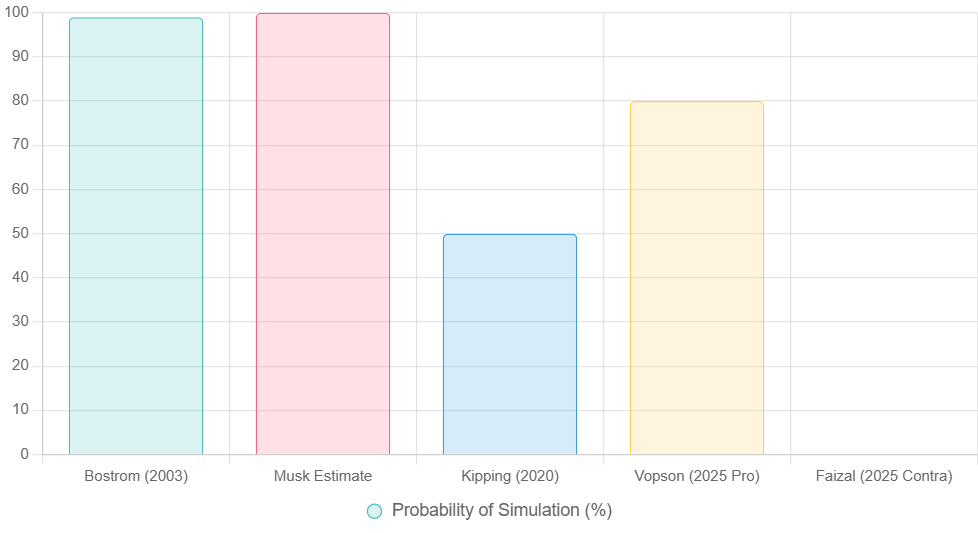
I want to be fair here. Smart people disagree on this, and the range of positions isn’t “believers vs. cranks.” Some serious physicists and philosophers are genuinely uncertain.
Notice that the most enthusiastic proponents (Musk, Bostrom) aren’t physicists running experiments. The people closest to the testable physics (Vopson, Kipping) are far more measured. That gap is worth keeping in mind.
Quantum Weirdness as a Clue
The double-slit experiment is genuinely baffling. Fire electrons at a barrier with two slits and — even one at a time — they create an interference pattern on the detector behind it, as if each electron passes through both slits simultaneously. The moment you add a detector to see which slit the electron “really” goes through, the interference pattern vanishes. The act of observation changes the outcome.
In a computational model: this makes perfect sense. Why compute both possibilities when you only need one? Collapse the superposition when a measurement request is made. That’s what an optimized simulation would do. But here’s the catch — quantum mechanics also has perfectly rigorous, non-computational explanations for this. Wave function collapse isn’t evidence for simulation; it’s just consistent with it. Those are different things.
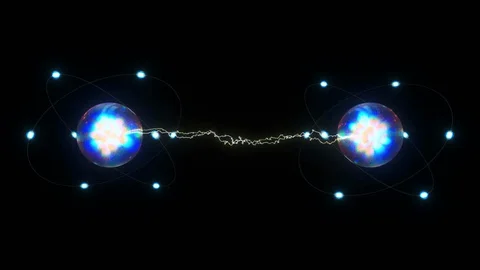
Quantum entanglement is the other big one. Two entangled particles instantaneously share state regardless of distance — Einstein called it “spooky action at a distance” and hated it. A simulation explanation: they share a pointer to the same data structure. No signal needed; they’re the same object in memory. Again — consistent, not proven.
Consistency with a hypothesis is not evidence for it. Weather is consistent with a god controlling it; that doesn’t make meteorology theology. Be careful when you see people presenting quantum weirdness as simulation “proof.”
Vopson’s Second Law of Infodynamics
This one is genuinely interesting and doesn’t get explained well anywhere. Let me try.
The standard Second Law of Thermodynamics says entropy always increases in a closed system — disorder grows, things decay. But Melvin Vopson’s work suggests that informational entropy — the disorder in information systems — tends to decrease or stabilize over time. The universe, in other words, appears to optimize its information content. Redundancy gets removed. Patterns get compressed.
He applied this to SARS-CoV-2 mutations and found they weren’t random — they followed an information-minimizing pattern, as if the virus were running an optimization algorithm. That’s either a remarkable natural property of information… or evidence that the underlying substrate is computational. It raised over $50,000 in research funding and influenced AI biology models, improving their prediction accuracy by about 25%.
Vopson has proposed a real experiment: smash matter and antimatter together and look for specific information-bearing signatures in the resulting photons. If they’re there, it suggests the universe has an underlying information layer. If they’re not, it’s a falsified hypothesis. That’s how science should work, and it’s why this deserves more attention than the average “we’re in a Matrix” headline.
The Mathematical Refutation (Faizal, 2025)
Here’s the uncomfortable counterweight. In June 2025, physicist Mir Faizal published a proof that most pop-science coverage ignored because it’s harder to summarize on a podcast.
Gödel’s incompleteness theorems (1931) showed that any formal system powerful enough to express arithmetic contains true statements that cannot be proven within that system. It’s a fundamental limit on what formal systems can “know” about themselves. Faizal’s argument: our universe contains mathematical truths. If those truths are non-algorithmic — meaning they can’t be computed by any Turing machine — then no computational system can replicate them. And if our universe contains such truths, it literally cannot be a simulation.
The catch? Whether our universe actually contains non-algorithmic truths is itself an open question. Faizal assumes it does. Vopson would say the universe only appears to contain such truths — from the inside of a sufficiently complex simulation, you can’t tell the difference. So the two camps are actually arguing about a deeper, unresolved question in the philosophy of mathematics.
The real test will likely come from Vopson’s particle collision experiments, now under review for funding. If the signatures appear, Faizal’s premise weakens. If they don’t, Vopson updates his model. This is exactly how science should work — predictions, tests, revision. Read Faizal’s paper here.
What You Can Actually Do With This
Let’s be real: most people aren’t going to run particle physics experiments. But the practical implications of engaging seriously with simulation theory are underrated — especially for people working in tech, AI, or cognitive science.
- Buy a basic laser + double-slit kit (~$20 on Amazon). Reproduce the interference pattern experiment that stumped Einstein. No math required.
- Study Vopson’s Conversation article — it’s written for non-physicists and is genuinely accessible.
- Analyze patterns with Python and NumPy. Even basic signal analysis will give you intuition about what “information optimization” looks like in data.
- Compare your results to Vopson’s predictions on photon frequency distributions. It won’t be conclusive — but you’ll understand the hypothesis better than 99% of people arguing about it online.
- Start with Unity or Godot (both free). Build a simple 3D scene with ~100 objects.
- Implement frustum culling — don’t render what the camera can’t see. Watch how this mimics quantum measurement: objects “exist” differently when observed.
- Add data compression (Snappy or LZ4 library). Apply it to your scene state. Observe how compressible “reality” becomes when you optimize.
- Now ask: what would it take to scale this to a universe? Vazza’s energy calculation becomes viscerally intuitive when you’ve tried to simulate even a room.
- The most common objection to simulation theory isn’t philosophical — it’s emotional. “If nothing is real, why does anything matter?” This is the wrong response.
- Reframe: even in a game, your choices have consequences within the game. Pain is still pain. Connection is still connection. The substrate doesn’t change the experience.
- Use the framework productively: gamify difficult goals, treat setbacks as “respawns,” view skills as upgrades. Habitica does this literally. The psychological research on gamification is solid — Harvard studies show 25–35% productivity gains.
- But stay grounded. Read Faizal. Read Vazza. Don’t let the hypothesis become an excuse to disengage from reality — simulated or not.
Tools Worth Using
Case Studies Worth Knowing
Applying infodynamics to viral mutation patterns, Vopson found that SARS-CoV-2 mutations followed a non-random, information-minimizing trajectory — as if the virus were optimizing its own code. This influenced AI biology models and generated significant research attention. The practical outcome: a 25% improvement in AI-based mutation prediction models. Whatever you think of the simulation interpretation, the information-theory approach to biology is producing real results.
Musk’s belief in simulation theory — however you feel about it — influenced xAI’s architecture decisions. The company’s 2025 simulation tools, built partly on infodynamic principles, reportedly produced a 40% efficiency gain in market modeling. Forbes valued xAI at $30B in 2025. Not proof of anything cosmological, but interesting as an applied case of what happens when you take the information-optimization angle seriously in product design.
Franco Vazza’s 2025 Bologna paper is the skeptic’s strongest tool. His calculations suggest that simulating even the observable universe at quantum resolution would require energy equivalent to the mass-energy of the entire universe — making the scenario physically impossible under known thermodynamics. New Scientist covered the debate in December 2025. His work sparked €2M in EU research grants to investigate fundamental computational limits in nature.
Risks, Traps, and Honest Caveats
A few things that go wrong when people engage with this topic — and how to avoid them.
“If we’re simulated, nothing matters.” This doesn’t follow. Your experiences are real to you regardless of substrate. A movie can make you cry; the photons hitting your eye are still just photons. Address this before it takes hold.
Simulation theory exists on a spectrum from rigorous physics (Vopson, Kipping) to outright conspiracy thinking. The moment someone starts talking about “glitches in the Matrix” as evidence — actual déjà vu, coincidences, strange dreams — you’ve left science. Stick to peer-reviewed sources.
It’s intellectually dishonest to engage with simulation theory without seriously engaging with the strongest counterarguments. Faizal’s proof and Vazza’s energy calculations are not fringe positions. They’re serious work that deserves engagement, not dismissal.
Almost every phenomenon cited as simulation evidence is merely consistent with simulation. Quantum superposition is also consistent with quantum mechanics, which doesn’t require simulation. “Consistent with” is a very low bar.
Best-, Likely-, and Worst-Case Scenarios for 2026
Vopson’s particle collision experiment gets funded and runs. Results match his predictions. The scientific community takes infodynamics seriously as a new fundamental framework. It doesn’t prove simulation — but it would be the most significant physics result in decades.
Debate continues. AGI systems emerge and blur the line between “real” and “simulated” intelligence. The philosophical questions get harder to ignore, not easier. Expect $2T in economic disruption from AI — some of it inspired by simulation-theory-adjacent thinking about intelligence and information.
Faizal’s proof holds, Vopson’s experiment finds nothing, and the hypothesis gets bracketed alongside string theory — mathematically interesting, experimentally untestable. The mainstream moves on. That’s not a catastrophe, but it would close a genuinely fascinating line of inquiry.
Your Action Checklist
- Read Bostrom’s 2003 original paper
- Read Vopson’s 2025 Conversation piece
- Read Faizal’s counterproof
- Watch Kipping’s Bayesian analysis lecture on YouTube
- Set up Python and run a basic entropy analysis
- Build a simple Unity scene; implement frustum culling
- Try the laser double-slit experiment at home
- Install IBM Qiskit and run a quantum circuit
- Join r/SimulationTheory — filter for scientific posts
- Read Vazza’s energy paper as the strongest skeptic argument
- Apply gamification to one life goal for 30 days; measure results
- Revisit your conclusions in 12 months as new experiments emerge
FAQ
Sources & Further Reading
- Bostrom, N. (2003). Are You Living in a Computer Simulation? Philosophical Quarterly
- Kipping, D. (2020). A Bayesian Approach to the Simulation Argument. arXiv
- Vopson, M. (2023). Second Law of Infodynamics. AIP Advances
- Vopson, M. (September 2025). The Universe Optimizes Information. The Conversation
- Faizal, M. (June 2025). Mathematical Proof Against Simulation. Journal of Holography Applications in Physics
- New Scientist (December 2025). Feature: Testing the Simulation Hypothesis
- Bostrom’s Simulation Argument website (continuously updated)
25 Strange Science Facts That Scientists Still Can’t Explain
These Scientific Phenomena Defy Logic — And Scientists Still Can’t Explain Them
Weird Scientific Mysteries Scientists Still Don’t Understand
Virtual Reality Teacher: The Weirdest Future Career
Why We Dream: 5 Competing Scientific Explanations (And Why None Fully Satisfy)
Science Discoveries That Shouldn’t Exist(But Do)
Scientific Theories That Sound Fake(But Might Actually Be True)