

Why We Dream: Five Competing Theories,
Ranked by What the Evidence Actually Shows
A science writer’s honest synthesis — including what’s genuinely settled, what’s still contested, and what the research implies you should do tonight.
How to Read the Evidence Ratings
Every claim in this article carries one of five evidence markers. Here’s what they mean — read this once and the rest of the article makes more sense.
Every morning, billions of people wake up from experiences they didn’t choose, can’t fully remember, and still feel the emotional residue of hours later. Dreams are arguably the most universal human phenomenon. They’re also one of science’s most genuinely stubborn open questions.
Here’s the thing that most popular articles about dreams get wrong: they present the science as though we’re mostly figured it out, with one or two interesting debates left at the edges. The actual situation is almost the reverse. We know a lot about what happens in the brain during dreaming. We know much less about why. The five theories below aren’t five ways of saying the same thing — they make different predictions, emphasize different mechanisms, and in some cases flatly contradict each other.
That’s what makes this genuinely interesting. Let’s go through them properly.
→ The Complete Sleep Science GuideWhat Actually Happens in Your Brain During a Dream
Before the theories, the neuroscience everyone agrees on 🔴. Dreaming occurs primarily during REM (rapid eye movement) sleep, though non-REM dreaming — more thought-like, less emotional, more tied to current concerns — is well-established and complicates the tidier REM-centric story 🔴.
During REM, the thalamus relays sensory information to the cortex while the dorsolateral prefrontal cortex — the part of you that checks whether things make sense — goes largely quiet 🔴. This is why dream logic feels so convincing in the moment: the part of your brain that would flag “wait, I can’t fly” isn’t really running. The amygdala and anterior cingulate cortex stay highly active, which is why dreams can carry emotional weight out of proportion to their content 🔴.
Chemically, REM is a strange state. High acetylcholine, minimal norepinephrine — a profile unique among activated brain states 🔴. PGO waves (pons-geniculate-occipital) pulse through visual cortex and limbic structures, probably triggering dream imagery, though their exact causal role is still debated 🟡. Skeletal muscles are paralyzed via a pontine-mediated spinal pathway — REM atonia — which is why you don’t act out most dreams 🔴. When that system fails, you get REM behavior disorder, and people do act out their dreams, which has actually given researchers a rare window into dream content they can observe from the outside 🔴.
“Your brain during REM is running on high acetylcholine and near-zero norepinephrine — a chemical state that exists nowhere else in waking or sleeping life. Whatever dreams are for, they’re doing it in conditions the brain creates specifically for this purpose.”
Whether this whole neurochemical profile enables specific dream functions — or merely permits dream phenomenology as a byproduct of sleep maintenance — is exactly where the five theories diverge. That question is experimentally unresolved 🟡 and varies by theoretical framework. Here’s where each theory lands.
→ REM Sleep: A Visual ExplainerThe 5 Theories — What They Claim, What the Evidence Shows
Memory Consolidation — Stickgold, Walker, and colleagues
🔴 Strongest evidence baseThis is the best-supported theory, and it’s worth leading with that. The core claim: sleep — and REM sleep specifically — consolidates declarative and procedural memories, integrating new information with existing neural networks. Dream content incorporates “day residues” woven into broader memory structures.
At the 2024 Nobel Conference, Harvard’s Robert Stickgold described sleep and dreams as carrying out “what may well be the most sophisticated functions that the human brain performs” — building models of ourselves and the world, shaping autobiographical memory. That’s a strong claim from someone who has spent decades running the controlled studies to back it up.
Post-training sleep enhances retention 🔴. Dream content incorporates recent learning experiences 🔴. Targeted memory reactivation during sleep improves consolidation 🔴. Hippocampal-cortical dialogue correlates with overnight memory gains 🔴. The 2024–2025 DREAM database EEG/mentation correlations confirm NREM dreaming patterns that complicate simple REM-only models 🟡.
Emotional Regulation — Active Processing During REM
🟡 Strengthening, but mechanism unresolvedThe basic claim: REM dreaming decouples emotional arousal from memory traces, reducing next-day amygdala reactivity and maintaining emotional homeostasis. The elegantly named “sleep to forget, sleep to remember” framework — you retain the informational content of emotional experiences while the raw emotional charge is dampened.
Post-2020 research has moved this from interesting hypothesis to something more solid. REM sleep consistently reduces next-day amygdala reactivity to prior emotional stimuli in controlled designs 🔴. Targeted memory reactivation during REM specifically dampens emotional memory intensity while preserving informational content 🟡. A 2025–2026 Northwestern University study showed that playing subtle sound cues during REM prompted people to dream about specific unsolved puzzles — and those puzzles were solved far more often the next day. 75% of participants dreamed about cued problems. That’s remarkable, and it implicates REM dreaming in active processing rather than passive replay.
Threat Simulation — Revonsuo’s Evolutionary Framework
🟡 Elegantly testable; contested prevalence estimatesAntti Revonsuo proposed this in 2000, and it remains one of the few dream theories that generates specific, falsifiable predictions. The claim: dreaming evolved to simulate threatening scenarios in safe contexts, providing rehearsal for survival-critical responses. Threat dreams should exceed waking threat frequency, and they should activate realistic motor programs.
Direct tests show consistent threat-bias in dream content across cultures 🟡. Trauma-exposed populations display amplified threat content correlating with waking vigilance 🟡. The theory correctly predicts realistic motor actions in threat dreams versus impossible physics in other dream types 🔴.
Creativity and Problem-Solving — Barrett, Dement
🟠 Real but modest; replication issuesThe famous version: Kekulé dreamed the benzene ring structure, Watson dreamed about DNA, Einstein dreamed about relativity. The scientific version is considerably more cautious. Dreams provide hyperassociative cognitive states where loose connections between concepts can produce novel insights — “sleep on it” as a genuine cognitive strategy, not folk wisdom.
Barrett found 50% of college students dreamed about problems they’d been incubated with, 25% dreamed solutions 🟡. A 2024 meta-analysis (Sanders et al.) found small but significant effects of dream incubation on creative problem-solving (d = 0.31) when restricting to studies with independent solution evaluation 🟡. The Northwestern REM cuing study mentioned above adds to this picture: 75% of cued participants dreamed about target problems, and solution rates were significantly higher the next day 🟡.
The Overfitted Brain Hypothesis — Hoel (2021)
⚪ Elegant; unvalidated in humansErik Hoel’s proposal is the most computationally elegant of the five, and the least empirically tested. The claim: dreams introduce statistical noise — “warped” reality — that prevents neural networks from overfitting to daily experience, enhancing generalization. The bizarreness of dreams is functional: it’s the brain doing something analogous to what machine learning researchers call regularization.
If you’ve worked with neural networks, this resonates immediately. If you haven’t, here’s the intuition: a model trained only on its existing data gets too good at reproducing what it’s seen and loses the ability to generalize to new situations. Introducing noise prevents that. Hoel argues dreams are that noise.
Where the Theories Agree — and Where They Clash
Most popular articles present these five theories as independent alternatives. They’re not. Read together, they reveal a pattern of partial agreement that no single theory captures on its own.
Where ≥3 theories agree
- REM sleep serves active functions, not passive byproduct
- Emotional salience shapes what gets processed
- Dream content relates to waking concerns (continuity hypothesis 🔴)
- The physiology is purposeful; whether conscious dreaming is, is disputed
Where they directly contradict
- Bizarreness: functional noise (Hoel) vs. failed reality monitoring (others)
- Emotional intensity: adaptive (emotional regulation) vs. incidental (memory)
- Threat bias: evolved feature (Revonsuo) vs. byproduct of salience weighting
- Conscious dream experience: causal vs. epiphenomenal
The unresolved question all theories share
None of the five has cleanly answered whether conscious dream experience itself does anything — or whether the work is done by the underlying REM neurophysiology and the dreaming is just along for the ride. This is, right now, the most important open question in dream science.
What 2025–2026 research adds
The Northwestern REM cuing results (75% dream incorporation, improved next-day solutions) and the DREAM database EEG work both suggest active, directed processing during dreaming — nudging the field slightly toward “dreaming matters” rather than “REM physiology matters, dreaming is incidental.”
Quick Comparison: All Five at a Glance
| Theory | Core claim | Strength | Key limitation |
|---|---|---|---|
| Memory Consolidation Stickgold, Walker | Dreams reflect synaptic plasticity and network stabilization from the day’s learning | 🔴 Strong | Dreaming may reflect consolidation rather than cause it; NREM contributions complicate the model |
| Emotional Regulation Contemporary researchers | REM actively decouples emotional arousal from memory traces; “sleep to forget” | 🟡 Moderate | Mechanism boundary unresolved; nightmares are counterevidence; context-dependent effects |
| Threat Simulation Revonsuo (2000) | Dreams evolved to rehearse threatening scenarios in safe contexts | 🟡 Moderate | Prevalence varies widely by method; rehearsal vs. expression unresolved; PTSD undermines adaptive claim |
| Creativity / Problem-Solving Barrett, Dement | Hyperassociative dreaming enables novel concept connections and creative insight | 🟠 Mixed | Small effect sizes; replication issues; trivial lab tasks; mechanisms unisolated |
| Overfitted Brain Hoel (2021) | Dream bizarreness is statistical noise preventing neural overfitting | ⚪ Weak | No direct human validation; lesions don’t impair generalization as predicted |
What Dreams Actually Reveal — and What They Don’t
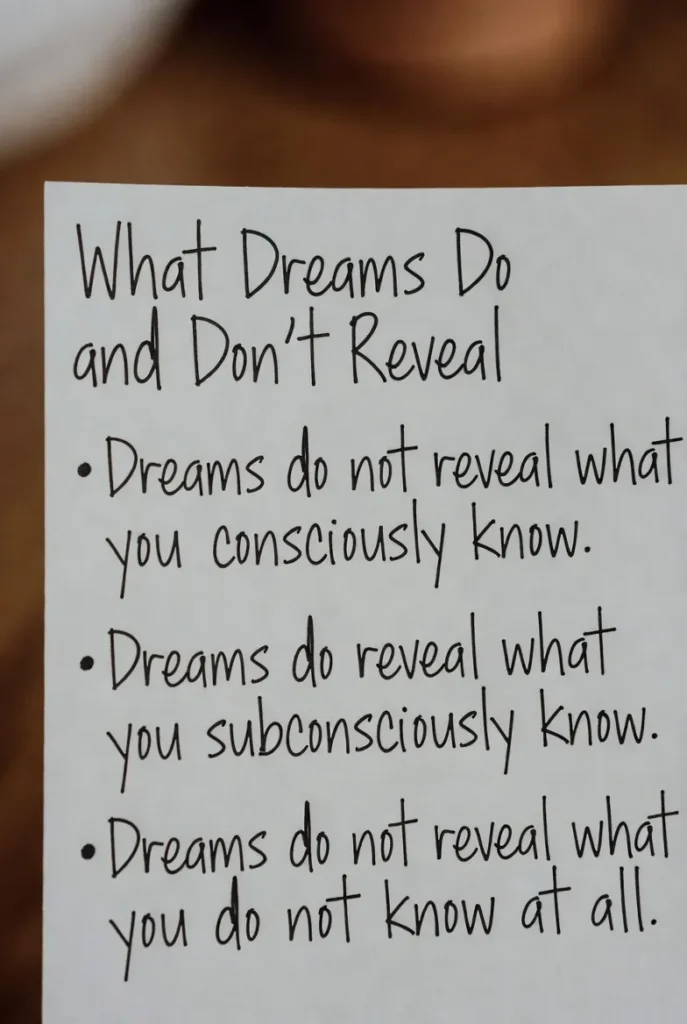
The continuity hypothesis is one of the most robustly supported findings in dream research: dream content reflects waking concerns, relationships, and emotional preoccupations 🔴. Transformation occurs through associative and emotional logic rather than literal reproduction. You dream about the people and situations that are live in your life — not randomly.
What dreams don’t reveal: universal symbolic meanings. No scientifically validated dream symbol dictionary exists 🔴. Cultural symbol systems — Jungian archetypes, traditional interpretations, every dream dictionary ever published — lack empirical support for universal applicability. A snake in a dream may represent fear, transformation, sexuality, or a recent zoo visit. Interpretation requires personal context, not a lookup table.
What This Research Actually Implies for Tonight
This is the section most dream science articles skip. They describe the theories without asking: given what we know, what should you actually do differently? Here’s a theory-by-theory translation into practice, with honest evidence ratings attached.
Prioritize sleep after learning new skills or studying — don’t pull all-nighters before exams or big presentations. Sleep consolidates; post-learning sleep is when the work happens.
If you’re processing a difficult experience, protecting REM sleep (no alcohol, consistent sleep schedule) may support the emotional dampening process more than you’d expect.
Dream incubation has modest but real support. Review a problem intentionally before sleep. Keep a notebook bedside. Effect sizes are small — don’t bet a deadline on it, but it’s worth trying.
Image Rehearsal Therapy (IRT) and CBT-N (cognitive behavioral therapy for nightmares) have strong empirical support 🔴. If nightmares are impairing your sleep, these are the evidence-based first-line treatments — not interpretation work.
For lucid dreaming specifically: MILD (Mnemonic Induction of Lucid Dreams) combined with WBTB (Wake Back to Bed) are the most reliably replicated induction techniques 🔴. Expect high individual variability and a learning curve of weeks to months.
15 Questions People Actually Ask — Evidence-Based Answers
The Honest Synthesis
After reviewing five theories across a literature that spans evolutionary biology, pharmacology, cognitive neuroscience, and computational modeling, the most intellectually honest answer to “why do we dream?” is: probably for several overlapping reasons, and the one we’re most confident about — memory consolidation — may not require conscious dream experience to work.
That last part is the underappreciated sting in the tail of this research. The possibility that dreaming is epiphenomenal — that the experience of dreaming is a byproduct of REM processes that would do their work anyway — isn’t the same as saying dreams don’t matter. It means we haven’t proven they do, in the specific sense of “the conscious experience does something the underlying physiology couldn’t do alone.” That’s the question the next decade of dream research needs to answer.
What is settled: the brain is doing something sophisticated and purposeful during REM sleep. Sleep after learning matters enormously. Emotional experiences are processed differently after sleep than before. Nightmares represent a failure mode of systems that normally serve us well. And the most productive use of this research, for most readers, isn’t better dream interpretation — it’s protecting sleep quality with the understanding that something genuinely complex is happening there, every night, whether or not you remember it in the morning.
“The people who will benefit most from dream science aren’t the ones who decode their dream symbols. They’re the ones who stop treating sleep as the negotiable variable in a busy schedule — and start treating it as the environment where the brain’s most sophisticated work actually happens.”
Primary Sources & Further Reading
- Stickgold, R. (2024). Keynote address at the Nobel Conference, Gustavus Adolphus College. Covered in: Psychiatric News, 2025.
- Northwestern University / ScienceDaily. (2026). “Scientists found a way to plant ideas in dreams to boost creativity.” sciencedaily.com
- Demirel, Ç. et al. (2025). “Electrophysiological Correlates of Lucid Dreaming.” Journal of Neuroscience. Covered at BrainFacts.org
- Mutti, M. et al. (2024). “Dreaming conundrum.” Journal of Sleep Research. Wiley Online Library
- Cognitive Neuroscience Society. (2024). “Untangling Dreams and Our Waking Lives.” CNS Annual Meeting, Toronto. cogneurosociety.org
- McGovern Institute for Brain Research, MIT. “Why do we dream?” mcgovern.mit.edu
- Sleep Foundation. “Dreams: Why They Happen & What They Mean.” sleepfoundation.org
- Revonsuo, A. (2000). “The reinterpretation of dreams: An evolutionary hypothesis of the function of dreaming.” Behavioral and Brain Sciences, 23(6).
- Hoel, E. (2021). “The overfitted brain: Dreams evolved to assist generalization.” Patterns, 2(5).
- Sanders et al. (2024). Meta-analysis on dream incubation and creative problem-solving. Dreaming. (Direct open-access link varies by institution; search via PubMed.)
- Tandfonline. “The neuropsychoanalysis of dreams: a meta-review focusing on neuroanatomy.” Published Oct 2025. tandfonline.com
What Happens When AI Learns to Dream? Science of Machine Dreaming [2026]
What Happens When Cash Completely Disappears?
We Live in a Simulation: Weird Physics Theory Suggests
Weird Scientific Mysteries Scientists Still Don’t Understand
Scientists Revived Viruses Frozen for 48,500 Years. Here’s the actual science.
25 Strange Science Facts That Scientists Still Can’t Explain
We Might Not Need Sleep by 2050 — Here’s Why
Scientific Theories That Sound Fake(But Might Actually Be True)