
SpaceX Ate xAI for $1.25 Trillion. Here’s What That Actually Means.
The largest private merger in history closed February 2, 2026. The vertical integration is real. So is the billion-dollar monthly burn, the governance structure with no independent oversight, and a valuation gap the IPO will have to answer for.
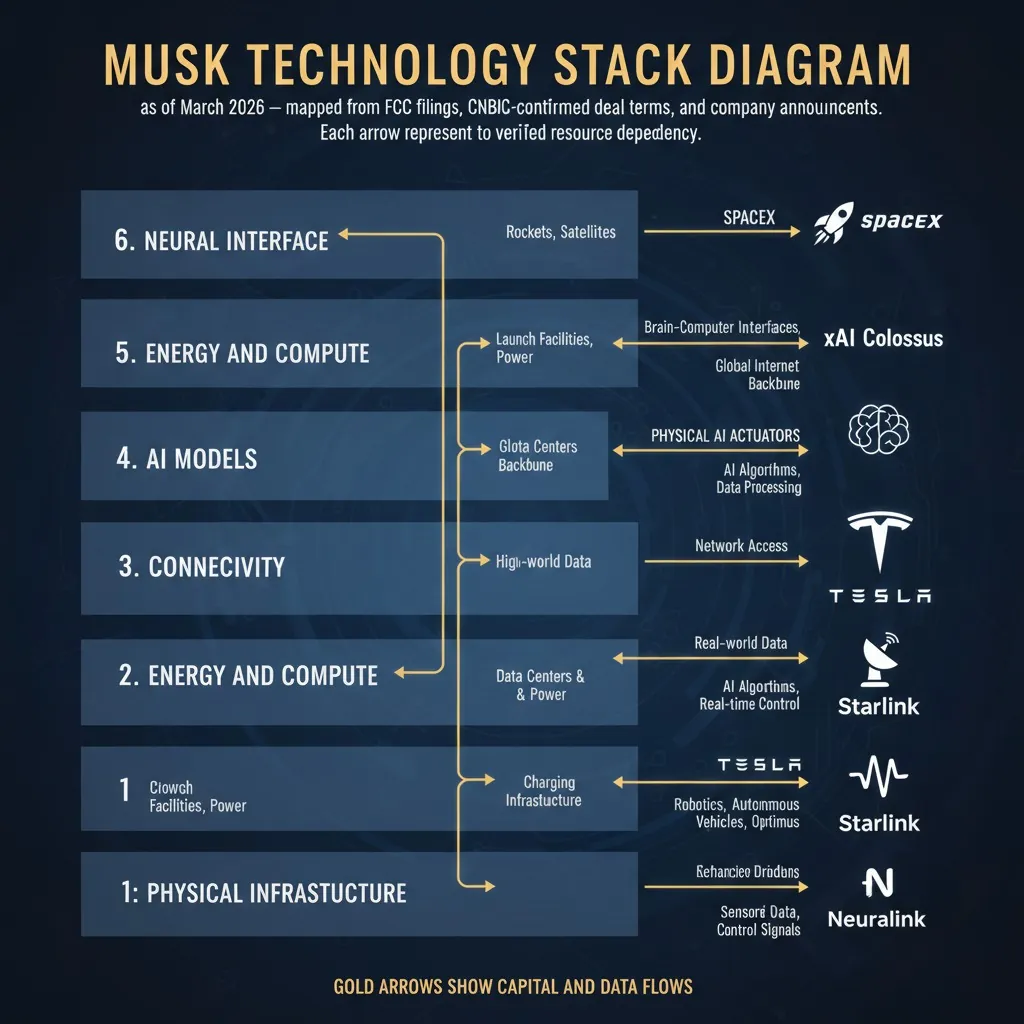
The SpaceX–xAI merger closed February 2, 2026, at $1.25 trillion — the largest private merger in history. The vertical integration is real: Starlink funds xAI compute, Tesla data trains Grok, SpaceX enables orbital ambitions.
Colossus is a genuine engineering achievement, but Tom’s Hardware satellite imagery (December 2025) found ~350MW cooling installed versus 1GW+ announced. That gap may have narrowed — but investors should expect announced figures to lead operational reality.
The merger’s governance structure — no independent committee, no fairness opinion, no shareholder vote — parallels the Tesla-SolarCity deal that led to Musk’s $51.4 billion pay package being rescinded in Delaware. Whether that precedent applies post-IPO is an open legal question investors should evaluate explicitly.
Three things happened inside 72 hours in late January and early February 2026. SpaceX filed with the FCC for up to one million orbital data center satellites. Then the merger closed. Then the IPO targeting $50 billion at a $1.5 trillion valuation entered planning. Read those events in sequence and you get the narrative. Read them simultaneously — same entity, same week, same capital logic — and you get the actual story.
This is not a technology story dressed in finance clothes. It’s a capital structure problem that happens to involve rockets, GPUs, and autonomous vehicles. xAI burned $9.5 billion in the first nine months of 2025 — per CNBC. It needed a path to public markets. SpaceX, at roughly $15 billion in 2025 revenue with ~$8 billion in profit and 50% growth (Motley Fool, citing Payload Space and Reuters), had the financial gravity to carry it. The merger created that path. The IPO is the exit.
“The vertical integration is real. The question is whether the IPO prices the integration at its current operational value or at its aspirational endpoint — and whether investors understand which one they are buying.”
Editorial synthesis — sources: CNBC (Feb 3, 2026), Motley Fool/Payload Space (Feb 22, 2026), Sacra (Feb 2026)
Three conditions converged in 2025–2026 to make this happen. The AI infrastructure arms race — Meta, Microsoft, and Google each committing $50–80 billion in annual capex — created a capital environment where an $18 billion GPU purchase and a $20 billion funding round could close in the same quarter. Private-market liquidity hit a window: SpaceX crossed $1 trillion while still private, making the IPO a capitalization event for the entire stack. And regulatory fragmentation — FCC, FDA, NHTSA, and EPA each addressing one Musk portfolio piece in isolation — left no cross-agency framework evaluating the integrated entity. That gap allowed two Musk-controlled companies to merge without independent oversight. Which matters, and we’ll get to it.
What the Merger Built — and What It Needs the IPO to Fund
The deal mechanics: SpaceX valued at $1 trillion, xAI at $250 billion (bank document range: $219–294 billion, confirmed by CNBC), with a share conversion ratio of 1 xAI share to 0.1433 SpaceX shares. The strategic case should be stated at full strength. Starlink revenue funds xAI compute. Tesla driving data trains Grok models. Tesla Megapacks buffer Colossus power demand. SpaceX’s launch capability is the only plausible path to orbital compute. These resource flows are verified. Combining the entities that produce them creates vertical integration that no competitor can replicate.
The timing and capital structure tell a more immediate story. Independent analysts surveyed by NBC News were unanimous: MoffettNathanson’s Nick Del Deo said it would take “many years before anything substantive happens in orbit.” Deutsche Bank placed terrestrial cost parity “well into the 2030s.” Forrester described the timing of the merger, FCC filing, and IPO as “classic ingredients for pre-IPO narrative lift.”
Revenue multiples are analyst estimates (Sacra, Motley Fool/Payload Space), not audited disclosures. Directional — treat accordingly.
xAI’s standalone revenue multiple of ~500× is not just an investor risk. It’s the reason the Grok rebuild matters so much. A company carrying that valuation can’t miss two consecutive benchmark cycles. And the rebuild — nine of eleven co-founders gone, product described internally as “not built right” (Fortune, March 16, 2026) — is underway right now, during IPO preparation. The monitoring dashboard shows a company rebuilding while pricing at peak.
Announced vs. Operational: The Pattern Across Every Layer
The gap between announced capacity and independently verified capacity is not unique to the orbital narrative. It’s a structural feature of the entire stack. Three examples, each independently verifiable.
Colossus Compute
xAI’s Memphis supercomputer is the most ambitious AI infrastructure project currently under construction. Originally built in 122 days with 100,000 H100 GPUs, it now contains approximately 230,000–250,000 GPUs operationally, targeting 555,000+ GPUs at an estimated $18 billion across three buildings and 2 gigawatts of total power. NVIDIA CEO Jensen Huang called the original buildout “superhuman,” operational in 19 days versus the typical four-year timeline.
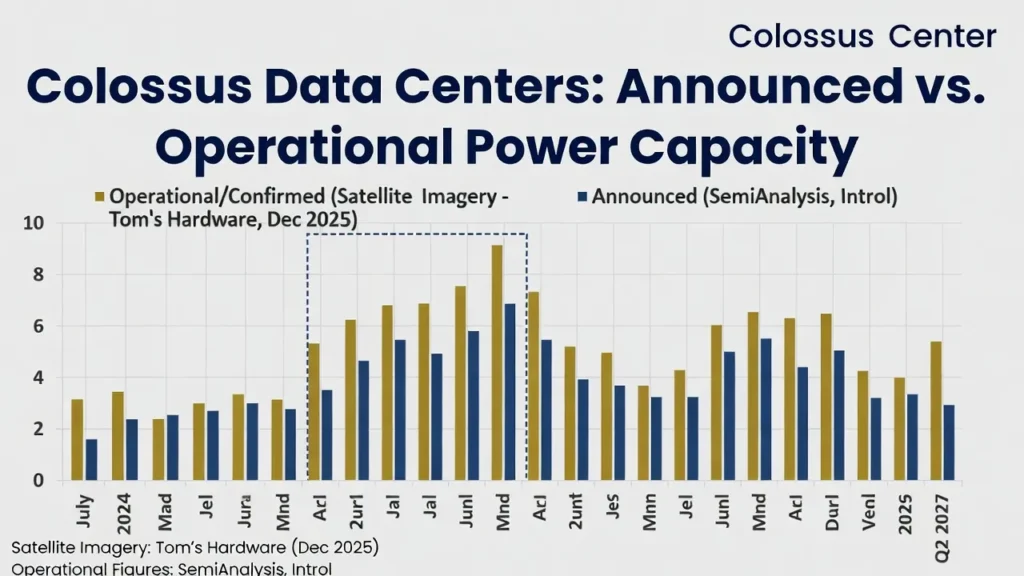
Colossus Power Capacity — Announced vs. Independently Verified (MW)
The Tom’s Hardware satellite imagery (December 2025) found only ~350MW of cooling capacity installed — well below the announced 1GW+ target. Given the pace of prior phases, that gap may have narrowed significantly. The distinction matters regardless: for investors pricing the IPO, independently verified capacity is what counts. Not press releases.
Tesla Cybercab
Mass production begins April 2026 at Gigafactory Texas. No steering wheel, no pedals, target price under $30,000. Musk warned at the January 2026 annual meeting that initial production will be “agonizingly slow” because “almost everything is new” (Fortune, January 22, 2026). The robotaxi network economics — Musk’s projected sub-$0.20/mile — depend on volume that doesn’t exist yet. FSD Unsupervised regulatory approval is currently limited to Texas-only operation, and Tesla chair Robyn Denholm acknowledged the vehicle can be retrofitted with a steering wheel if regulators require it. Commercial robotaxi deployment at scale is a 2027–2028 reality, not a 2026 one.
Neuralink Blindsight
Blindsight bypasses eyes, retina, and optic nerve — 1,024 electrodes across 64 neural threads stimulate the visual cortex directly, potentially enabling basic vision in the ~39 million people globally who are blind. It received FDA Breakthrough Device designation in June 2025. Accelerated review, not approval. IEEE Spectrum noted that designation “does not mean that Blindsight is yet considered safe or effective.” Neuralink announced technical readiness for first implantation in February 2026, pending clearance. Musk’s own description of initial resolution: “like Atari graphics.” If it works even at that level, it’s transformative. Investors should understand the condition.
The pattern across Colossus, Cybercab, and Blindsight isn’t selective optimism — it’s endemic to frontier infrastructure projects where the engineering timeline and the capital-raising timeline are operating simultaneously. Genuine achievements accompanied by public figures that run ahead of independently verified reality. The same pattern appears in the Grok model rankings: xAI ranks #2 on owned compute and #5 on foundation model adoption behind OpenAI, Google, Anthropic, and Meta (Sacra, February 2026). Compute advantage does not automatically translate to model quality — a gap compounded by the rebuild timing.
Sources: Tom’s Hardware satellite imagery (Dec 2025), Fortune (Jan 2026, Mar 2026), Sacra (Feb 2026), SemiAnalysis, Introl (Jan 2026)
What Colossus Cost Beyond GPUs
Colossus sits in Boxtown — a predominantly Black, low-income Memphis neighborhood with historically elevated pollution rates. xAI operated 33 methane gas turbines when permitted for only 15, exploiting a portable-equipment loophole that the EPA closed in January 2026.
KeShaun Pearson, director of Memphis Community Against Pollution, put it precisely: “That’s not what makes you a technological city. That spin is dangerous because it opens our city up for exploitation even further” (HPCwire, May 2025).
“Build first, permit later, absorb the regulatory cost as a rounding error on the infrastructure value. That arithmetic — one documented incident — becomes a pattern if the same calculus holds at the next facility.”
Editorial synthesis — sources: HPCwire (May 2025), Wikipedia/Colossus EPA ruling (Jan 2026)
The cost asymmetry matters for investors: running 18 unpermitted turbines for months kept the Colossus cluster operational during its critical 100,000-to-200,000 GPU scaling window — compute capacity worth billions in training throughput. xAI’s response — an $80 million wastewater treatment pledge and a permitting compliance process — represents a fraction of the value extracted during the unpermitted period. And it carries compounding regulatory risk for a company headed to public markets.
| Component | Announced / Claimed | Independently Verified | Evidence Level | ⚠ Adversarial — What This Can’t Establish |
|---|---|---|---|---|
| Colossus cooling capacity | 1GW+ (announced target) | ~350MW installed (Dec 2025 satellite imagery, Tom’s Hardware) | Strong | Imagery is Dec 2025; buildout pace may have closed gap significantly since then |
| xAI burn rate | ~$1B+/month | $9.5B in 9 months Jan–Sep 2025 (CNBC, Feb 2026) | Strong | Post-merger capital structure may have changed burn profile; no post-merger disclosure available |
| Grok 3 AIME benchmark (93.3%) | 93.3% accuracy | Used consensus@64 vs. competitors’ pass@1 — Artificial Analysis scored 25/Intelligence Index (median 20) | Moderate | Methodology controversy flagged by OpenAI employees and independent researchers; no adjudicated standard for benchmark comparisons in the field |
| SpaceX 2025 revenue | ~$15B revenue, ~$8B profit | Directional — sourced from Payload Space/Reuters via Motley Fool; not audited public disclosure | Directional | SpaceX is private; no audited financials. Figures are analyst estimates, not verified accounts |
| xAI standalone revenue | ~$500M annualized | Sacra estimate, February 2026 — analyst estimate, not disclosed by company | Directional | Sacra estimates are not audited. xAI has not disclosed revenue publicly |
The Governance Question the S-1 Must Answer
The SpaceX–xAI merger was negotiated between two Musk-controlled private entities with no independent special committee, no outside fairness opinion, and no shareholder vote. D&O Diary (March 2026) compared this structure directly to the Tesla-SolarCity acquisition — the deal that resulted in the Delaware Court of Chancery rescinding Tesla’s $51.4 billion CEO pay package and criticizing the approval process as lacking sufficient independence.
D&O Diary noted that a public-company version of the SpaceX-xAI deal “would ordinarily trigger independent special-committee oversight” and that “someone would probably own the shares, dislike the merger, and sue.”
The scrutiny that a public company would have faced before the merger was deferred, not eliminated. Once the entity goes public, that scrutiny becomes available to shareholders and their attorneys. They would inherit a combined entity whose foundational transaction was conducted without the independence safeguards the Delaware court found necessary in the directly comparable precedent.
A reasonable objection: The SolarCity precedent was public-to-public. SpaceX–xAI was private-to-private — no public shareholders existed to be harmed at the merger date. Whether Delaware courts apply the same standard post-IPO is an open legal question, not settled law. D&O Diary’s analysis suggests the scrutiny is plausible at IPO. Investors should price it as an identified risk with uncertain probability.
The people inside the deal ecosystem see the tension. ION Analytics reported that a banker working with a cornerstone SpaceX investor described “a mix of enthusiasm and ambiguity” around the strategy. An IPO advisor at a major consultancy said the merger heightens scrutiny around governance, integration, and disclosure: “The key is a simplified, investable equity story. Public investors value transparency.” Joseph Alagna, founding partner at Buttonwood Funds — which invested in SpaceX roughly eighteen months ago — framed the scale differently: this could raise more in one deal than most IPO markets do in an entire year.
“The architecture is extraordinary. The governance structure that produced it has already been tested in court and found insufficient in the closest precedent.”
Editorial synthesis — sources: D&O Diary (Mar 2026), Delaware Court of Chancery Tesla-SolarCity ruling, ION Analytics (Feb 4, 2026)
Three Signals Before the IPO
The SpaceX S-1 filing will be the most information-dense event in the Musk ecosystem this year. Three signals will determine which scenario plays out.
xAI Liability Treatment
How the S-1 classifies xAI’s $9.5 billion nine-month burn and ongoing compute capex will reveal whether the combined entity treats xAI as a growth asset or a risk factor. If the liabilities are consolidated without ring-fencing, every SpaceX public shareholder is underwriting xAI’s rebuild.
Post-Rebuild Grok Benchmarks
xAI ranks #2 on owned compute and #5 on model adoption. That gap is the most important variable for xAI’s revenue trajectory. When xAI launched Grok 3, it claimed 93.3% accuracy on AIME using consensus@64 while comparing against competitors’ pass@1 scores — a methodology mismatch flagged by OpenAI employees and independent researchers. If post-rebuild benchmarks repeat the pattern, enterprise buyers will notice. (Source: AI Certs, Artificial Analysis, Feb 2026)
Governance Disclosure
Whether the S-1 includes a fairness opinion, an independent committee review, or any mechanism for public shareholders to challenge the merger terms. The absence of any of these is a direct parallel to the structure the Delaware court found insufficient in SolarCity. If present — the risk profile changes materially.
What You’re Actually Pricing
Look, here’s what this actually is: you’re not buying a technology company at a technology multiple. You’re buying a capital structure problem that has been solved in the short term (SpaceX’s cash generation covers xAI’s burn) and deferred in the medium term (governance, rebuild risk, benchmark credibility). The $1.5 trillion IPO target embeds the orbital compute narrative at operational value — not the 2030s trajectory Deutsche Bank and MoffettNathanson are pricing.
What you do: Model the combined entity at two scenarios — xAI at $500M annualized revenue (current Sacra estimate) and at $3B (if the rebuild succeeds and model adoption closes the compute gap). The valuation spread between those two outcomes is larger than the governance risk. Price the scenario you believe, not the narrative in the roadshow.
Here’s what’s going to stop you: No audited financials. SpaceX is still private at S-1 filing, and xAI has never disclosed revenue publicly. You will be making allocation decisions on analyst estimates and satellite imagery. That’s the information environment.
The Procurement Decision You’re Probably Deferring
The rebuild is real. Nine of eleven co-founders out. Product described as “not built right” by the company itself. That’s not a reason to never buy Grok — it’s a reason to know exactly what you’re buying and when. Enterprise procurement cycles run 12–18 months from evaluation to deployment. A Grok evaluation that starts now will complete during the rebuild window. The product you evaluate is not the product you’ll deploy.
What you do: Run your Grok evaluation against post-rebuild benchmark releases, not current ones. The benchmark methodology controversy on Grok 3 (consensus@64 vs. pass@1) means current competitive scores are not apples-to-apples. Independent assessments — Artificial Analysis scored Grok 3 at 25 on their Intelligence Index against a median of 20 — give you a more honest baseline than xAI’s own releases.
Here’s what’s going to stop you: Compute scale as a proxy for reliability. The $18 billion Colossus infrastructure is real, but enterprise SLAs aren’t guaranteed by GPU count. The rebuild timing creates a window where inference capacity and model quality may not be in sync.
Frequently Asked Questions
-
What is Elon Musk’s most important project in 2026?
By financial scale, the SpaceX–xAI merger dominates. By human impact — if it works — Neuralink Blindsight, a visual cortex implant bypassing damaged eyes, is the most consequential. By near-term execution risk, the Tesla Cybercab production start in April 2026 tests whether autonomous manufacturing at volume actually functions. Each of these is genuinely in a different risk category.
-
Will SpaceX IPO in 2026?
SpaceX CFO Bret Johnsen confirmed a 2026 target. The Financial Times reported mid-June 2026 as the likely window, raising up to $50 billion at up to $1.5 trillion. Multiple share classes maintaining founder control are expected. No formal S-1 filing had been made as of March 18, 2026.
-
What are the main risks of the SpaceX-xAI merger for investors?
Three. Governance risk: no independent committee, SolarCity-parallel structure, open legal question post-IPO. Capital risk: xAI’s billion-dollar monthly burn rate during a post-co-founder-exodus rebuild, consolidated into the combined entity without ring-fencing. And valuation risk: xAI’s standalone ~500× revenue multiple — higher than any AI peer — embedded in the IPO price without audited financials. All three become public investor concerns at S-1 filing.
-
What is the Colossus supercomputer and why does it matter?
Colossus is xAI’s GPU cluster in Memphis, Tennessee — currently approximately 230,000–250,000 H100-equivalent GPUs, targeting 555,000+ GPUs at an estimated $18 billion. It is the compute foundation for training Grok models. It matters for the IPO because the gap between announced capacity (1GW+ cooling) and independently verified capacity (~350MW as of December 2025 satellite imagery) is one of three documented cases where xAI’s operational reality trails its announced figures. That pattern is what investors should track in the S-1 disclosures.
-
What happened with Grok 3’s benchmark controversy?
When xAI launched Grok 3 in February 2025, it claimed 93.3% accuracy on the AIME math benchmark. OpenAI employees and independent researchers flagged that xAI used consensus@64 — 64 attempts with the best answer selected — while comparing against competitors’ pass@1 scores (single attempt). Artificial Analysis, using standardized methodology, scored Grok 3 at 25 on their Intelligence Index, above the median of 20 but not dominant. The benchmark controversy matters specifically because it’s the pattern to watch in post-rebuild benchmark releases.
The Untold Story Behind Tesla’s Next Big Launch
How Your Smart TV Could Be Selling Your Data: An Investigative Analysis
7 Unethical AI Experiments That Shouldn’t Be Legal in 2025
10 Lifestyle Trends That Will Dominate in 2030: Actionable Strategies for Developers, Marketers, Executives, and Small Businesses to Boost Efficiency and Revenue
Why Speed Outperformed Polish in B2B LinkedIn (Jan-Feb 2026 Data)
Will Humans Really Live on Mars by 2035?