
https://www.futurenow.click/blog/
Weird Scientific Mysteries Scientists Still Don’t Understand
From a universe expanding faster than physics allows, to the unsettling question of why you exist at all — these are the open wounds in our map of reality.
The universe has some genuinely embarrassing gaps in its user manual
Science has sent rovers to Mars, edited human genes, and mapped the neural activity of a sleeping brain in real time. And yet some of the most basic questions about reality — what is it, why does it exist, how is it organised — remain completely open. Here’s the quick version:
- The Hubble tension: Two independent methods of measuring how fast the universe expands give stubbornly different answers. An April 2026 study confirmed the gap to 1% precision — it’s real, and nobody knows why.
- Dark matter and dark energy together account for roughly 95% of everything that exists. We’ve never directly detected either.
- Consciousness — why does physical brain activity produce subjective experience? Neuroscience can map it; it still can’t explain it. A major 2025 adversarial test between rival theories ended without a winner.
- The origin of life: We have excellent chemistry for the pieces. We have no clear story for how the pieces assembled themselves the first time.
- Dark energy may be changing — new DESI data suggests it’s not a fixed constant, which would upend the standard model of cosmology.
- These are not peripheral puzzles. They sit at the centre of physics, biology, and philosophy. Solving any one of them would be among the largest intellectual events in human history.
The post below covers ten mysteries in depth, with the latest research citations, what’s actually being done, and honest assessments of how close — or how far — we really are to answers.
Table of Contents
- Why These Mysteries Matter
- The Hubble Tension Crisis
- The Dark Matter Problem
- Dark Energy — And Why It May Be Changing
- The Hard Problem of Consciousness
- The Origin of Life
- The Placebo Effect’s Hidden Machinery
- Why Time Only Runs One Way
- Why Anything Exists At All
- Why We Dream — And What For
- Mystery Comparison Table
- FAQ
Why These Mysteries Matter More Than You’d Think
There’s a comforting story science tells about itself — that it’s filling in the blanks, one discovery at a time, gradually completing the picture. For large stretches of the last century, that story held up. We found the structure of DNA. We mapped the human genome. We detected gravitational waves. We built machines that can outperform human experts at protein structure prediction.
But underneath all that progress, several truly fundamental questions sit untouched. Not because researchers haven’t tried — some of these mysteries have absorbed decades of brilliant effort and billions in funding. They remain open because they’re genuinely hard, in ways that our current conceptual tools may not be equipped to handle.
What follows isn’t a list of scientific curiosities. These are the pressure points where our understanding of nature either breaks down completely or simply doesn’t exist yet. They involve the structure of the cosmos, the nature of mind, and the origin of life itself. Getting any one of them right would be one of the defining intellectual achievements of this century.
A note on methodology: Every claim in this article is drawn from peer-reviewed research or statements from named institutions. Where findings are contested or preliminary, that’s made explicit. Science writing that presents open questions as solved, or solved questions as mysterious, does nobody any favours.
The Hubble Tension: The Universe Is Expanding at Two Different Speeds
This one feels technical until you grasp its implications. The universe is expanding — Edwin Hubble established that in 1929. The speed of that expansion is described by a number called the Hubble constant (H₀). Measure it from the nearby universe using stars and supernovae as cosmic distance markers, and you get roughly 73 km/s per megaparsec. Measure it by modelling the early universe from the faint afterglow of the Big Bang — the cosmic microwave background — and you get around 67 km/s per megaparsec.
That’s not a rounding error. It’s a real, persistent discrepancy between two independent methods, and it has refused to go away despite decades of refinement.
“This isn’t just a new value of the Hubble constant — it’s a community-built framework that brings decades of independent distance measurements together, transparently and accessibly.”
— H0 Distance Network (H0DN) Collaboration, Astronomy & Astrophysics, April 10, 2026In April 2026, the H0DN Collaboration published what is now the most precise measurement of the local expansion rate, achieving just over 1% precision: 73.50 ± 0.81 km/s/Mpc. The work drew on data from NSF’s Cerro Tololo Inter-American Observatory in Chile and Kitt Peak National Observatory in Arizona, and arose from a collaborative framework launched at an ISSI workshop in Bern in March 2025. The result didn’t resolve the tension. It deepened it.
As EarthSky put it in its coverage of the study: the measurements are now so precise that the gap between local and early-universe values exceeds any plausible statistical fluctuation. “This disagreement has persisted for a decade, and it exceeds the threshold for a statistical fluctuation and has withstood extensive scrutiny,” the researchers noted.
Meanwhile, separate work from the University of Illinois and University of Chicago has explored gravitational waves from colliding black holes as an entirely new measuring stick for cosmic expansion — an approach that could, in principle, sidestep the problem entirely. And a July 2025 analysis proposed that our galaxy sits inside a roughly billion-light-year-wide underdensity — a cosmic bubble — which may locally accelerate expansion and partially explain the tension.
What does this mean? If the discrepancy is real — and it increasingly appears to be — it points to new physics. Possible explanations include an “early dark energy” phase that briefly pushed expansion right after the Big Bang, modifications to general relativity, or the existence of new particles we haven’t detected. None of these has been confirmed. “This is the dream of every physicist,” UCLA’s Tommaso Treu told Keck Observatory. “Find something wrong in our understanding so we can discover something new and profound.”
Source: H0DN Collaboration — NSF NOIRLab, April 10, 2026
Dark Matter: The Invisible Stuff Holding the Universe Together
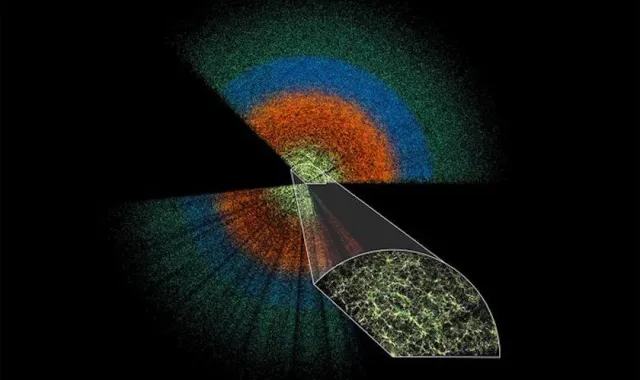
Roughly 27% of the universe is made of something that doesn’t emit, absorb, or reflect light. We know it exists — without it, galaxies would fly apart; the math simply doesn’t work otherwise. We’ve mapped its distribution through gravitational lensing. We’ve observed its effects on the cosmic web. But we’ve never directly detected a single dark matter particle.
The leading candidate for decades was the WIMP — weakly interacting massive particle — a theoretically elegant object that multiple major experiments have searched for without success. The LHC found no WIMPs. Multiple underground detectors have found nothing. This has pushed researchers toward alternative candidates: axions (extremely light particles), sterile neutrinos, and primordial black holes, among others.
In October 2025, researchers at Tohoku University published a paper in Physical Review D proposing networked quantum sensors — superconducting qubits connected in carefully designed graph structures — as a new tool for detecting ultralight dark matter. The idea is that dark matter leaves faint signals too subtle for conventional instruments. Quantum sensing networks might catch them. (Phys.org, October 2025)
Separately, a University of Tokyo researcher announced in November 2025 that they may be “catching a glimpse” of dark matter using novel detection techniques — though this remains preliminary and awaits independent confirmation.
Scale check: The standard cosmological model (ΛCDM) puts dark matter at ~27% of the universe’s energy content, dark energy at ~68%, and all visible matter — everything you’ve ever seen — at roughly 5%. We have a reasonably good theory for 5% of reality.
Dark Energy: Not Just Unknown, But Possibly Changing
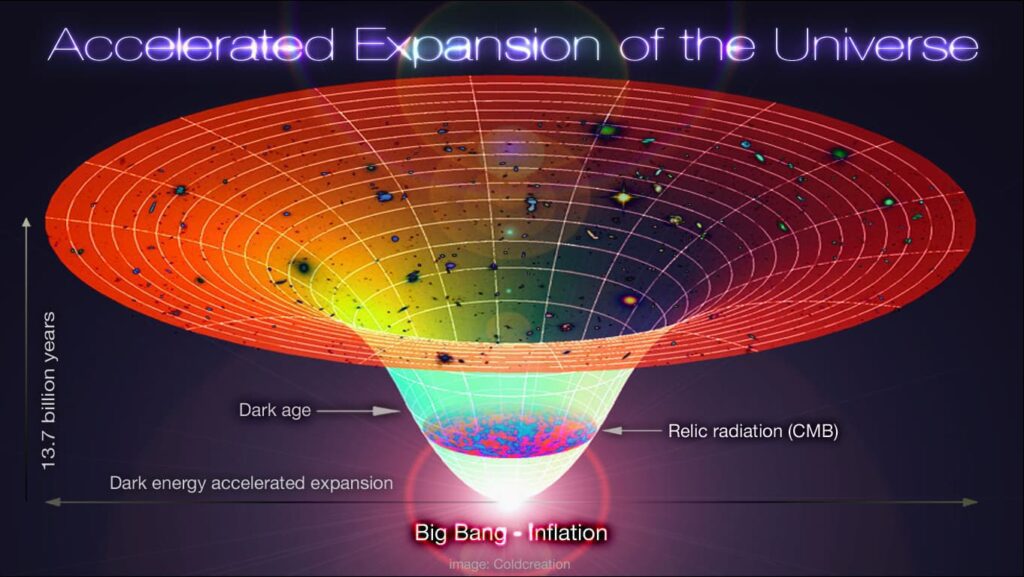
If dark matter is strange, dark energy is stranger still. It accounts for approximately 68% of the universe’s total energy content, and its only known property is that it causes space itself to expand at an accelerating rate. When cosmologists discovered this acceleration in the late 1990s — work that won the 2011 Nobel Prize in Physics — they incorporated it into the standard model via a parameter called the cosmological constant (Λ), which Einstein had originally introduced and later called his “greatest blunder.”
For about twenty years, the cosmological constant fit the data adequately. Then things started getting complicated. The Dark Energy Spectroscopic Instrument (DESI) has been accumulating evidence that dark energy may not be constant at all — it appears to have been stronger in the earlier universe than it is today. This “dynamical dark energy” scenario would require significant revisions to the standard model.
In February 2026, Cornell physicist Henry Tye published a provocative analysis in the Journal of Cosmology and Astroparticle Physics arguing that new data suggests the cosmological constant may actually be negative — which would mean the universe’s expansion will eventually reverse, ending in a “big crunch” rather than an infinite cold expanse. This contradicts what most cosmologists assumed for the past two decades, though it remains controversial.
Meanwhile, Chinese Academy of Sciences researchers published a framework in The Astrophysical Journal in March 2026, proposing that evolving dark energy models could simultaneously address the Hubble tension — connecting two of the biggest open problems in cosmology in a single framework.
The core problem, though, goes deeper than any of these developments. Quantum field theory predicts a vacuum energy density roughly 10120 times larger than what we actually observe. This enormous mismatch — sometimes called the “cosmological constant problem” — is arguably the largest quantitative discrepancy between a prediction and a measurement in the history of science. We have no idea why the value is so staggeringly small.
The Hard Problem of Consciousness: Why Does Experience Feel Like Anything?
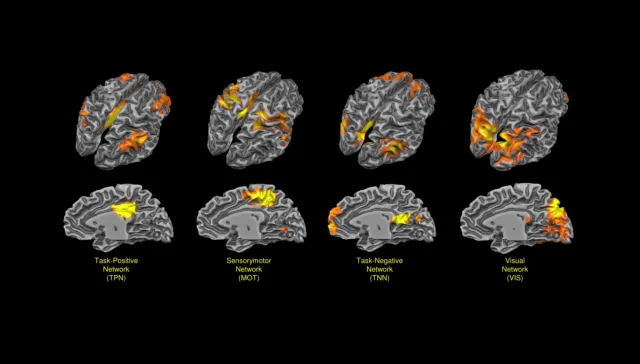
Neuroscience has made extraordinary progress in mapping brain activity. We can track which neural circuits fire during memory formation, watch emotional processing in real time, and predict certain decisions from brain scans before the person is consciously aware of making them. What neuroscience has not done — and what philosopher David Chalmers famously called the “hard problem” — is explain why any of this physical activity produces subjective experience at all.
The question isn’t “which parts of the brain are involved in vision?” We largely know that. The question is: why does light hitting your retina result in the qualitative experience of seeing red, rather than just information processing in the dark? Why is there something it is like to be you?
In April 2025, the Cogitate Consortium published results of an adversarial collaboration in Nature — a deliberate head-to-head test between the two dominant theories of consciousness. Integrated Information Theory (IIT) and Global Workspace Theory (GWT) made conflicting predictions about measurable neural signatures. The experiment ran. Neither theory came out clearly on top. The result, according to a January 2026 analysis in Medium, “destabilized the two dominant neuroscientific theories of consciousness” and triggered a wave of theoretical rethinking.
In April 2026, neuroscientist Christof Koch — one of the field’s most prominent figures — presented at Porto’s “Behind and Beyond the Brain” Symposium, arguing that materialism still dominates scientific thinking but faces “important gaps.” Koch highlighted that despite major advances, scientists have yet to explain how subjective experience arises from physical brain processes. ScienceDaily summarised his argument bluntly: “The brain might not create consciousness after all.”
A December 2025 paper in Frontiers in Human Neuroscience, from physicist Joachim Keppler at the DIWISS Research Institute, proposed that conscious states may arise from the brain resonating with the quantum vacuum — the zero-point field that permeates all space. This is a minority view and hasn’t been experimentally confirmed, but it illustrates how far outside conventional neuroscience researchers are willing to look.
“Materialism still dominates scientific thinking, but even with major advances in neuroscience, scientists have yet to explain how subjective experience arises from physical brain processes.”
— ScienceDaily, summarising Christof Koch’s April 2026 presentation in PortoSource: ScienceDaily — Koch, April 2026 | Keppler, Frontiers in Human Neuroscience, 2025
The Origin of Life: Chemistry Can Explain the Parts, Not the Whole
We know life exists. We know roughly when it appeared on Earth — the first evidence of microbial life dates to around 3.7 to 4.2 billion years ago. We know the chemistry of life: amino acids, RNA, lipid membranes, metabolic cycles. We can even synthesise many of these components in the lab from prebiotic conditions. What we cannot do is string those steps into a coherent, evidence-backed narrative of how non-living chemistry became a self-replicating, evolving organism.
The most widely accepted framework — the RNA world hypothesis — proposes that RNA preceded both DNA and proteins, serving as both genetic material and catalyst. The problem is that forming an RNA polymer long enough to replicate itself by random chemical reactions is, mathematically, absurdly unlikely. A July 2025 paper from Imperial College London’s Robert G. Endres, published in a peer-reviewed journal and covered by Universe Today, used cutting-edge mathematical approaches to show that the spontaneous origin of life “faces far greater challenges than previously understood,” particularly around assembling structured biological information under plausible prebiotic conditions.
One notable 2026 development moved an adjacent puzzle forward: in February, researchers at the University of Texas at Austin, publishing in Nature, appear to have cracked the longstanding mystery of how two incompatible microbes — one requiring oxygen, one thriving without it — could have merged to give rise to all complex (eukaryotic) life. That’s not the same as explaining how life started, but it resolves a major gap in the story of how it evolved.
Worth noting: A privately funded prize of $10 million has been offered for a scientifically rigorous, naturalistic explanation of life’s origin. As of 2026, it remains unclaimed. This doesn’t mean an explanation doesn’t exist — prizes like this are hard to formally win — but it reflects how open the field genuinely is.
Source: Universe Today — Endres, July 2025 | UT Austin — Nature, February 2026
The Placebo Effect: Real Medicine That Shouldn’t Work
Give someone a sugar pill, tell them it’s a powerful painkiller, and their brain will release endogenous opioids. Their pain will genuinely diminish — measurably, physiologically, not just reported. This is well-documented and reproducible. It is also, when you sit with it for a moment, quite strange.
The placebo effect isn’t just about expectation softening the experience of pain — although that’s part of it. In some studies, patients who are told they’re receiving a placebo and believe the experimenter still show physiological improvement. People have experienced measurable changes in everything from blood pressure to immune function based on inert treatments. There are even documented cases of surgery placebos — sham arthroscopic knee surgery that produced outcomes equivalent to the real procedure in some patients.
A 2025 review published in the New England Journal of Medicine reiterated that the placebo effect “represents a powerful, untapped window into the mind-body connection that defies simple chemical explanation.” Researchers are struggling to harness this ability deliberately without fully understanding the precise neurological trigger that sets it off.
One working theory involves expectation activating dopaminergic reward circuitry, which then modulates pain signals. Another points to conditioning — the body learns that the ritual of taking a pill precedes relief, and begins to respond to the ritual alone. Both have some supporting evidence. Neither is complete. The mechanism for why belief affects physiology at a biochemical level, and why it works even when the belief is partial or absent, remains genuinely mysterious.
The Arrow of Time: Why Does Time Only Flow Forward?
The laws of physics, at the fundamental level, are time-symmetric. If you filmed a pair of billiard balls colliding and played the film backwards, physicists couldn’t tell you which direction was forward. The equations don’t prefer one direction over the other. And yet every experience you’ve ever had flows in one direction only. Eggs break and don’t unbreak. Memories point backward, never forward. Heat flows from hot to cold, never the reverse.
The standard explanation for this involves entropy — the second law of thermodynamics states that the entropy of a closed system increases over time. But this just pushes the mystery back a step. Why did the universe start in an extraordinarily low-entropy state, from which it could increase? That initial condition isn’t explained by thermodynamics; it’s simply assumed.
Some researchers have proposed that the arrow of time is fundamentally linked to quantum mechanics — that the irreversible collapse of quantum possibilities into definite outcomes is what gives time its direction. Others suggest it’s an emergent property of consciousness itself. Interestingly, researchers at Interesting Engineering noted in 2025 that physicists ran one million trials to demonstrate a bizarre “negative time” quantum effect, which showed that quantum measurements can, in a narrow technical sense, appear to precede the events they measure — adding further strangeness to the question of what time actually is.
Matter-Antimatter Asymmetry: Why Does Anything Exist?
When the universe was created in the Big Bang, physics as we understand it should have produced equal quantities of matter and antimatter. When matter and antimatter meet, they annihilate each other in a burst of energy. If the initial conditions were perfectly symmetric, everything would have cancelled out, leaving a universe full of light and absolutely nothing else.
Obviously, that didn’t happen. You exist. Galaxies exist. There is a universe full of matter. This means that somewhere in the first fractions of a second after the Big Bang, slightly more matter was produced than antimatter — roughly one extra particle of matter per billion matter-antimatter pairs. Everything you see in the universe is made from that tiny excess.
Why? The standard model of particle physics allows for a small difference in behaviour between matter and antimatter (known as CP violation), but the amount permitted by the standard model is nowhere near large enough to account for the observed imbalance. This is one of the strongest indications that there is physics beyond the standard model that we haven’t discovered. The Large Hadron Collider has been searching for it. So far, nothing that explains the matter surplus has been found.
Dreams: The Brain’s Elaborate Stories No One Ordered
Every night, your brain produces vivid, emotionally charged, narratively complex experiences — and then erases most of them by morning. You spend roughly two hours a night in REM sleep, dreaming. Across a lifetime, that adds up to six years of immersive hallucination. This is clearly not an accident; sleep is conserved across virtually all mammals and most vertebrates. The evolutionary pressure to maintain it must be substantial. But what exactly is it for?
We know sleep is essential for memory consolidation, metabolic waste clearance (the glymphatic system), and immune function. These are better understood. Dreams specifically — the bizarre narrative content — remain puzzling. A 2025 fMRI study by the Max Planck Institute for Human Cognitive and Brain Sciences suggested that dreams are essential for “future-proofing” memory and practicing social scenarios. But the exact mechanism of content generation — why you dream about your childhood home, or a stranger with your colleague’s voice, or flying — remains opaque.
Freudian interpretations are largely not taken seriously in modern neuroscience. The “threat simulation theory” — that dreams allow practice for dangerous scenarios — has some support but can’t explain most dream content. The “memory consolidation” model explains certain dream themes but doesn’t account for the surreal, non-literal quality. We genuinely don’t know why the dreaming brain constructs narratives rather than just replaying memories.
Data Overview
Mystery Comparison Table
| Mystery | Domain | Years Open | Status | Latest Development |
|---|---|---|---|---|
| Hubble Tension | Cosmology | ~10 | Unresolved | 1% precision measurement deepens gap (Apr 2026) |
| Dark Matter | Particle Physics | ~90 | No detection | Quantum sensor networks proposed (Oct 2025) |
| Dark Energy | Cosmology | ~27 | Redefining | DESI data suggests it may be dynamic (2025–26) |
| Consciousness | Neuroscience | Centuries | Unresolved | IIT vs GWT adversarial test: no winner (Apr 2025) |
| Origin of Life | Biochemistry | ~170 | Unresolved | Abiogenesis probability analysis (Jul 2025) |
| Placebo Effect | Medicine | ~80 | Mechanism unknown | NEJM review confirms deep mystery (2025) |
| Arrow of Time | Physics | ~140 | Unresolved | “Negative time” quantum effect demonstrated (2025) |
| Matter-Antimatter | Particle Physics | ~60 | Unresolved | LHC continues search for new CP violation |
| Dreams / REM | Neuroscience | ~70 | Partial progress | Max Planck “future-proofing” hypothesis (2025) |
Frequently Asked Questions
Real questions, honest answers — no hype, no hedging.
Honestly, nobody knows — and that’s a philosophically unusual position for science to be in. The hard problem is hard partly because it’s not clear what a “solution” would even look like. A complete neural map of brain activity during conscious experience wouldn’t, by itself, explain why that activity feels like anything. Some philosophers (including Chalmers himself) think it may require genuinely new concepts. Others think it’ll dissolve once neuroscience becomes precise enough. The 2025 adversarial test between IIT and GWT was supposed to make progress; instead it showed neither theory is quite right. We’re further from an answer than we’d hoped to be at this point.
It’s now much less likely to be measurement error. The April 2026 H0DN study achieved 1% precision using a framework built from decades of independent measurements, and the tension persisted. Independently, JWST and Hubble telescope data, gravitational lensing time delays from the University of Tokyo, and multiple other methods all point the same direction. The statistical significance now exceeds what researchers would typically require to reject the null hypothesis that the gap is a fluke. The strongest remaining argument for “measurement error” involves potential systematic biases in Cepheid variable star calibration, which some researchers still flag as a concern.
The honest answer is we don’t know. WIMPs (weakly interacting massive particles) were the leading candidate for decades and have been almost completely ruled out by underground detectors and the LHC. Current live candidates include axions (extremely light, theorised to solve a separate problem in QCD), sterile neutrinos, primordial black holes formed before stars existed, and various “fuzzy dark matter” wave-like scenarios. The quantum sensor network approach proposed by Tohoku University in 2025 specifically targets ultralight dark matter in the axion mass range. No candidate has been confirmed.
The RNA world hypothesis is the most widely accepted framework — it proposes that RNA came before DNA and proteins, as it can act as both genetic material and catalyst. Deep-sea hydrothermal vents are a leading candidate for the location, given their chemical gradients and energy sources. But neither is settled. The core problem — how you get from simple organic chemistry to a self-replicating polymer long enough to actually replicate — remains unsolved. The July 2025 Imperial College London analysis quantified how extreme the probability barrier is under realistic prebiotic conditions.
It’s been considered seriously. Some researchers have proposed that the apparent acceleration could result from our galaxy sitting inside a large underdensity — a “void” — that would locally mimic accelerating expansion without requiring dark energy. A July 2025 study revived this idea, suggesting our galaxy may sit inside a roughly billion-light-year-wide cosmic bubble. But the evidence for accelerating expansion comes from multiple independent methods — Type Ia supernovae, the CMB power spectrum, baryon acoustic oscillations — and they’re consistent with each other. Removing dark energy requires explaining all of those simultaneously, which is hard to do.
Not quite. The phrase “thinking yourself better” can suggest the improvement is imagined or psychosomatic in a dismissive sense. But placebo-induced pain relief involves measurable release of endogenous opioids — real neurochemical changes in the brain. Some placebo responses involve measurable immune markers. The mystery isn’t whether it works; it does. The mystery is the precise mechanism — especially why it can persist even when patients know they’re receiving a placebo, and why belief or expectation can trigger specific neurochemical changes with the specificity of a real drug.
Because without it, there would be no universe of matter. Equal matter and antimatter would annihilate to produce pure radiation. The fact that you exist at all is the result of a tiny asymmetry — roughly one extra matter particle per billion pairs — in the first instants after the Big Bang. The standard model of particle physics allows for a matter-antimatter asymmetry (via CP violation), but the amount it allows is far too small to explain the imbalance we observe. This is one of the strongest theoretical motivations for physics beyond the standard model.
Several of them seem to be. The Hubble tension, dark matter, and dark energy may all point toward the same gap: the ΛCDM cosmological model being incomplete. A revision to one would likely force revisions to the others. Consciousness and the origin of life are somewhat separate, though both involve the question of how complex organisation gives rise to something qualitatively new (subjective experience; self-replication). The arrow of time arguably underlies all of them — if we don’t fully understand why time flows as it does, we may be missing something fundamental about how physical processes work at all levels.
The Fermi paradox is a genuine puzzle: given the age and size of the universe, and the apparent prevalence of potentially habitable planets, where is everyone? It connects directly to the origin-of-life mystery — if life forming from chemistry is extraordinarily unlikely (as the 2025 Imperial College analysis suggests), that would partly explain the cosmic silence. Alternatively, the “great filter” could be ahead of us rather than behind. SETI research continues; no confirmed technosignature has been detected as of 2026.
Probably the Hubble tension, in the sense that the problem is well-quantified and the experimental tools to test competing explanations — DESI, JWST, next-generation CMB experiments — are either running or coming online shortly. We may not “solve” it in the sense of understanding why the universe expands as it does, but we may identify which known mechanism explains the discrepancy within the next decade. Dark energy dynamics (DESI’s ongoing programme) may also yield a clearer picture relatively soon. Consciousness and the origin of life seem furthest from resolution.
Increasingly. Machine learning is being used to search for subtle dark matter signals in detector data, to model protein structures relevant to abiogenesis research, and to analyse large cosmological datasets from DESI and other surveys. In consciousness research, large language models have become a somewhat unexpected test case — the debate about whether AI systems could be conscious has sharpened the conceptual tools researchers use for the question in general. The 2025 adversarial test between IIT and GWT used AI-assisted neural data analysis. None of this has produced a solution, but AI is genuinely accelerating the rate of analysis.
Final Thoughts
The Honest Upshot
If there’s a common thread running through all of these mysteries, it’s this: reality appears to be both more knowable and more strange than we bargained for. We can measure the Hubble constant to 1% precision and still not understand why it disagrees with itself. We can map every active neuron in a dreaming mouse brain and still not know what the dream is for.
None of this is cause for despair about science. It is, if anything, cause for a certain intellectual delight. The universe is not a completed puzzle. It’s an ongoing argument between what we think should be true and what turns out to actually be the case. Every one of these mysteries represents a door that’s stuck — and doors that are stuck usually get opened eventually, by someone who comes at them from an unexpected angle.
What seems most likely, given the current trajectory of research, is that some of these mysteries will yield to better instruments and more data (the Hubble tension, dark matter searches), while others may require genuinely new theoretical frameworks (consciousness, dark energy). The origin of life might be illuminated by laboratory chemistry or by astrobiological discoveries off-Earth. The arrow of time could turn out to be deeply connected to quantum mechanics in ways not yet understood.
The uncomfortable truth is that we don’t know which will crack first, or what the answers will look like. That uncertainty isn’t a failure. It’s what makes this the most interesting time in history to be paying attention.
More Deep Dives on FutureNow
Explore the frontiers of science, technology, and what comes next — futurenow.click
Why Most AI Projects Fail: The Evidence, the Caveats, and Your Roadmap Out
I Tested 3 MacBook Neos for 30 Days. Here’s the Exact Workflow That Breaks 8GB.
We Live in a Simulation: Weird Physics Theory Suggests
25 Strange Science Facts That Scientists Still Can’t Explain
Why We Dream: 5 Competing Scientific Explanations (And Why None Fully Satisfy)
Virtual Reality Teacher: The Weirdest Future Career
These Scientific Phenomena Defy Logic — And Scientists Still Can’t Explain Them
Could time travel exist as a secret? 7 Clues for 2025
10 Proven Steps to AI Training Assistants for Peak Job Performance in 2025
Science Discoveries That Shouldn’t Exist(But Do)
Scientific Theories That Sound Fake(But Might Actually Be True)