
The Tech Industry’s Best-Kept Secrets — And How They Actually Work
Deep Analysis · April 2026
The Untold Story Behind Tesla’s Next Big Launch
Tesla is not launching a car. It’s launching a new civilization of motion — the Cybercab, Optimus, and the Roadster are just the opening act of the most audacious corporate reinvention in modern history.
- 01 The End of an Era
- 02 The Cybercab: The Bet That Changes Everything
- 03 Optimus: The Robot Behind the Curtain
- 04 The Full Product Storm: What’s Coming, and When
- 05 The Untold Risk: What the Headlines Are Missing
- 06 Who’s Actually Competing With Tesla?
- 07 The Deeper Pattern: Tesla Has Always Been a Bet on the Future
The End of an Era Hiding in Plain Sight
There’s a moment in every company’s history when the clues were always there — hiding in quarterly calls, buried in product decisions, quietly embedded in how executives stopped using certain words. For Tesla, that moment is now. And honestly? Most people completely missed it.
The Model S and Model X are dead. In late March 2026, Tesla confirmed that custom orders were over. “All that’s left are some in inventory,” Musk posted on X. The vehicles that made Tesla a household name — the cars that turned Silicon Valley ambition into a genuine automotive movement — are being retired. Not to make room for another car. To make room for a robot.
That factory floor at Fremont, California — the one where workers assembled Falcon Wing doors and hand-stitched luxury interiors — is being converted to produce the Optimus humanoid robot. It’s the most symbolic industrial reboot in modern history. And it barely made front pages.
We’re making very, very big investments. Tesla is building a world of abundance.
— Elon Musk, Q4 2025 Tesla Earnings Call, January 2026On that same call, Musk revised Tesla’s mission statement — from “accelerating sustainable transport” to “building a world of abundance.” A decade of EV evangelism, replaced in one sentence. If you were still treating Tesla as a car company after that, the sentence was your final warning.
(first decline in company history)
(double Wall St. forecast)
(missed estimates by ~3%)
(war chest for the pivot)
That $20B+ capital expenditure number is the one that stops people cold when they see it. More than double what analysts projected. More than Tesla has ever spent in a single year. It’s not the budget of a company slowly pivoting — it’s the spending plan of a company that has already decided what it is, and is racing to build it before anyone else can.
The Cybercab: The Bet That Changes Everything
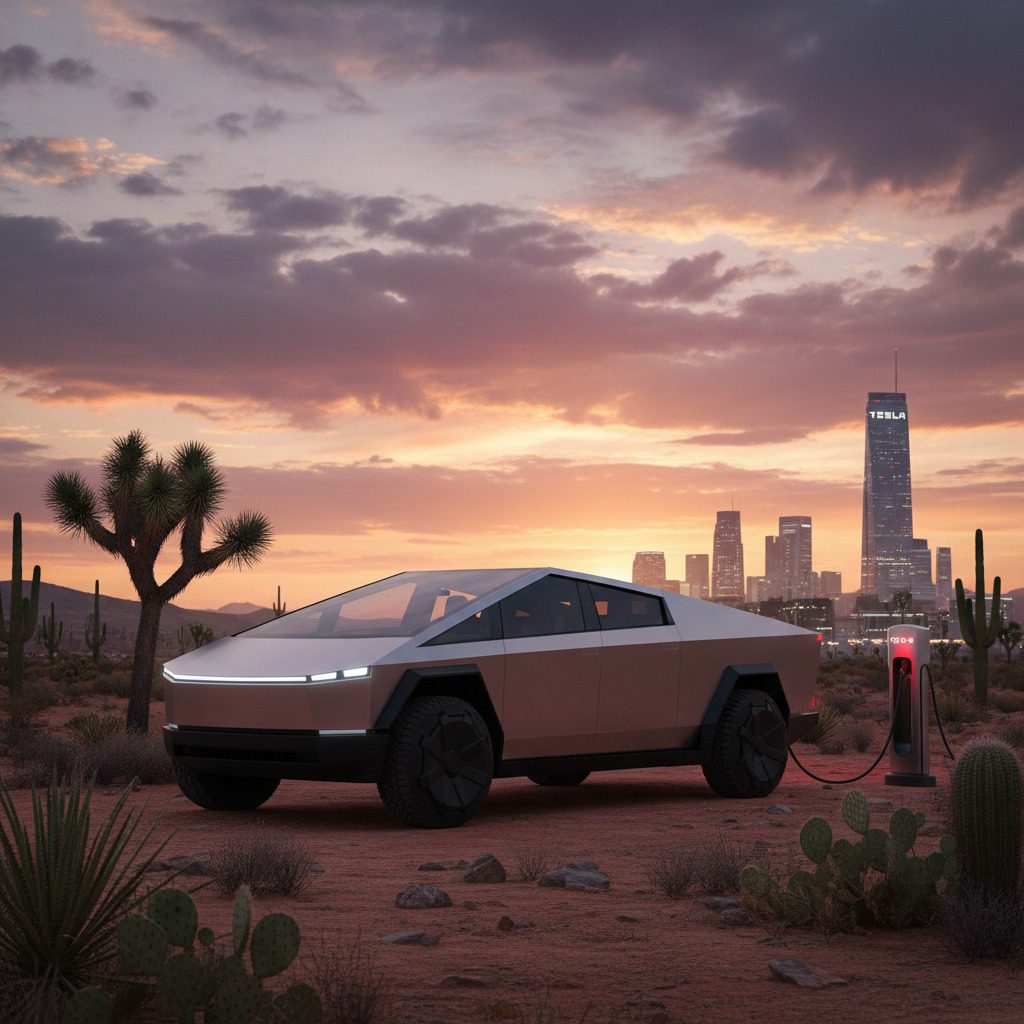
The first Cybercab rolled off the Gigafactory Texas assembly line in February 2026. Mass production started in April. It has no steering wheel. No brake pedals. No NACS charging port — only wireless inductive charging, a deliberate architectural choice signaling this vehicle was never designed for ordinary ownership.
This is Tesla’s most consequential product since the original Roadster — arguably more important than any car the company has ever built. The Cybercab isn’t a transportation device. It’s Tesla’s declaration that the personal vehicle — that century-old relationship between a human, a machine, and the open road — is finished.
The whole thing rests on a single economic argument. Musk expects the Cybercab to run 50–60 hours per week, compared to the 10–11 hours a typical personal vehicle is actually used. At an anticipated operating cost of 25–30 cents per mile and a target price under $30,000, the unit economics — if they materialize — would be disruptive on a civilizational scale. That’s the pitch. The math is real. Whether the conditions will cooperate is a different question entirely.
The regulatory landscape is the wild card. Federal Motor Vehicle Safety Standards require steering wheels and pedals. Tesla has not publicly confirmed filing for the necessary NHTSA exemptions. The company is essentially building mass supply ahead of confirmed legal demand — betting that regulation catches up, or that Texas (with its more permissive AV rules) serves as a sufficient first market to build the safety record needed for broader approval.
Optimus: The Robot Behind the Curtain
The Cybercab gets the headlines. Optimus may be the larger story.
The factory floor being cleared in Fremont will become the first scaled production line for the Optimus Gen 3 humanoid robot — described by Tesla engineers as approaching “human functionality and form factor,” designed to look like “a human in a superhero suit.” It’s an odd phrase, until you see the thing move. Then it makes sense.
Tesla is targeting 50,000 to 100,000 Optimus units in 2026 alone, ramping toward a dedicated Gigafactory Texas line with a stated capacity of 10 million robots per year by 2027. External deliveries to industrial partners are expected by late 2026, priced at an estimated $20,000–$30,000 per unit.
The Optimus business has the potential to be worth more than Tesla’s car business, Tesla’s energy business, and everything else combined.
— Elon Musk, multiple Tesla shareholder addressesThe strategy is deliberate and internally consistent: deploy Optimus onto Tesla’s own factory floors first, use production as a proving ground, then expand to external customers. It’s the same playbook used with Full Self-Driving — accumulate real-world miles, iterate relentlessly, unlock value at scale. The difference is that robots can do things cars simply cannot. They work inside warehouses, carry objects, perform surgery-adjacent tasks, operate in environments with no road markings. The addressable market is almost impossible to calculate. That’s either exciting or alarming, depending on your perspective.
Wedbush analyst Dan Ives has estimated that Tesla’s self-driving capabilities alone, if they scale, could add a trillion dollars to overall company valuation. Optimus is a separate and potentially larger number. Together, they are the thesis behind that $20 billion 2026 capex plan — a record investment for any single year in the company’s history.
The Full Product Storm: What’s Coming, and When
The Cybercab and Optimus dominate the narrative, but they’re not the only launches converging in 2026. A remarkable pipeline of vehicles, software platforms, and infrastructure is arriving simultaneously — making this the most complex product year in Tesla’s history, and honestly one of the most ambitious single-company product calendars any investor or observer will have seen in years.
The Untold Risk: What the Headlines Are Missing
Every great launch story has a shadow narrative. Tesla’s is no exception — and understanding it is essential for anyone who wants to see the full picture rather than just the promotional one.
Risk #1: The regulatory gap is real and unresolved. The Cybercab cannot legally operate as a commercial driverless vehicle in most U.S. jurisdictions without specific federal exemptions. There’s no public evidence Tesla has filed for them. The company is building mass supply ahead of confirmed legal demand — a calculated bet that regulation will catch up. Maybe it will. But “maybe” is doing a lot of work in that sentence.
Risk #2: The AI4 launch-on-legacy-hardware problem. The Cybercab enters production on the same computer currently in consumer Tesla vehicles — hardware that hasn’t achieved unsupervised autonomy at scale. AI5, with its 10× compute uplift, is delayed to mid-2027. This means the most consequential autonomous vehicle in history will spend its first year running on yesterday’s brain. Tesla’s own chairwoman has left the door open to adding a steering wheel and pedals if FSD isn’t ready. That’s not a minor caveat. That’s the entire thesis at risk.
Risk #3: Sales are declining, not growing. Tesla reported 1.69 million vehicles sold in 2025 — a decline for the second consecutive year. Q1 2026 deliveries came in at 358,023 units, roughly 6% better year-over-year but below analyst expectations. The stock is down over 21% year-to-date as of April 7, 2026. Musk frames this as a deliberate trade-off — sacrificing near-term vehicle revenue to fund the AI and robotics transition. That’s a coherent argument. It also requires the new platforms to succeed. Both things are true simultaneously.
Risk #4: The Musk distraction problem. Musk simultaneously leads Tesla, SpaceX, xAI, and the DOGE advisory role in the U.S. government. That’s a span of control that would challenge any executive, and it has visibly impacted Tesla’s management attention. Some institutional investors have already flagged this explicitly in their communication. It’s uncomfortable to say out loud, but leaving it out of this analysis would be dishonest.
- If Cybercab scales: Tesla becomes the world’s first trillion-dollar AI-mobility platform, with a moat no legacy automaker can replicate in a decade.
- If FSD fails to achieve unsupervised reliability by mid-2027: The Cybercab adds a steering wheel, destroying its core thesis and repricing the entire company narrative.
- If Optimus hits 10M units/year by 2030: Tesla’s robot business alone dwarfs every other segment it operates in today. This is Musk’s actual endgame.
- If regulatory approval stalls: Tesla will have invested billions in infrastructure for a product it cannot legally sell at scale — a capital efficiency disaster.
- If BYD and Chinese EV-tech hybrids keep gaining ground: Tesla’s traditional revenue buffer erodes faster than the new platforms can ramp, creating a dangerous gap year.
Who’s Actually Competing With Tesla?
Most coverage of Tesla’s pivot ignores the competitive landscape almost entirely. That’s a significant gap. The race for autonomous mobility and humanoid robotics is genuinely contested — and the competitors are better-funded and further along than most people realize.
| Competitor | Product | Real Advantage vs Tesla | Real Weakness vs Tesla | Threat Level |
|---|---|---|---|---|
| Waymo (Alphabet) | Robotaxi (Jaguar, Zeekr) | Already operating fully driverless in multiple cities, no regulatory question marks | Lidar-heavy cost structure; no path to $30K vehicle economics; no hardware vertical integration | High — Right Now |
| BYD | EVs + autonomous features | Dominant in China; aggressive global expansion; vertical integration nearly matching Tesla’s | Still camera-only FSD equivalent is years behind Tesla’s; limited U.S. market access due to tariffs | High — Global EV Revenue |
| Figure AI / Boston Dynamics | Humanoid robots | Figure 02 already in BMW factories; Boston Dynamics’ Atlas has superior hardware agility | No vertical integration with vehicles; no proprietary AI training data at Tesla’s scale | Medium — Watching |
| Baidu Apollo | Robotaxi (China) | Dominant in Chinese tier-1 cities; government regulatory alignment; massive ride data | Essentially zero U.S. market access; hardware costs remain high | Medium — China Only |
| GM Cruise | Robotaxi | N/A — Cruise has effectively paused operations after 2023 safety incident | Regulatory setback; massive internal restructuring; trust deficit with regulators | Low — Sidelined |
The honest takeaway: Waymo is the most credible near-term robotaxi competitor, and it’s operating in the real world right now. Tesla’s FSD advantage — if it materializes — is scale. Waymo’s operations produce roughly 200,000 paid rides per week across San Francisco, Los Angeles, and Phoenix. Tesla has tens of millions of vehicles collecting FSD training data daily. It’s not the same kind of data, but the volume differential is staggering.
The Deeper Pattern: Tesla Has Always Been a Bet on the Future
Critics have been writing Tesla’s obituary since 2008. They wrote it when the original Roadster nearly bankrupted the company. They wrote it during Model 3 “production hell” in 2017 and 2018. They wrote it every time Musk missed a deadline by months or years — and there were a lot of those.
Every single time, Tesla survived — not because the critics were wrong about the difficulties, but because they consistently underestimated how far Musk was willing to go on the long arc of the technology. The Cybercab isn’t a derivative of the Model 3. The Optimus isn’t a factory automation upgrade. Together, they represent a genuine attempt to build the first company whose primary product is intelligence — deployed in vehicles and bodies that operate without human oversight.
The late April Roadster reveal is the perfect metaphor for this moment. A supercar nobody strictly needs, unveiled as punctuation on a decade of EV growth, while the real transformation unfolds on the Gigafactory floor. The Roadster is the showroom. The Cybercab is the business. The Optimus is the endgame.
The next 12 months — the Cybercab production ramp, the Austin robotaxi pilot, the first Optimus external deliveries, the AI5 timeline — will determine whether Tesla’s reinvention is the most audacious pivot in corporate history, or its most spectacular overreach. Either way, the story is unlike anything that has come before it.
And frankly, whether you’re bullish or bearish, this is the most interesting company on earth to watch right now. That much is not in dispute.
The coming 12 months will likely determine whether Tesla returns to its $2 trillion glory or faces a “lost decade” as a niche hardware player.
— Finterra Research, April 2026- → Electrek — Tesla news and analysis
- → TechCrunch — Tesla coverage
- → Not A Tesla App — community tracker
- → Zacks Investment Research — Q4 2025 Tesla earnings review
- → SEC EDGAR — Tesla official filings
- → NHTSA — autonomous vehicle regulatory framework
- → Tesla Investor Relations — official earnings transcripts
- → AI Invasion — AI and robotics competitive landscape analysis
Elon Musk: What $1.25 Trillion Actually Buys You at IPO
How Your Smart TV Could Be Selling Your Data: An Investigative Analysis
10 Personal Finance Moves That Could Free Up $10,000 This Year
Why Future Cars Won’t Have Steering Wheels: Best Guide 2026
AI Jobs 2026: Why Regional Data Tells a Different Story Than Global Headlines