

POST-SMARTPHONE
STRATEGIES
AR/VR headsets growing at 18% YoY. Smartphones stuck at 7%. The transition away from glass slabs is real — and slower, and messier, than any headline makes it sound. Here’s what the 2025 data actually says, and what to do about it.
The Honest State of Things
Let’s start with what’s actually happening, not what makes a good headline. Smartphones aren’t dying in 2030. You’re not going to wake up one morning and find your iPhone replaced by a neural whisper. That’s not the story. The story is slower and, in some ways, more interesting: the software stack and the attention economy underneath smartphones are migrating to new surfaces — AR glasses, ambient computing, wearables — and that migration is creating real business opportunity right now, in 2025, if you’re positioned for it.
Here’s the thing that keeps getting missed: the transition isn’t a single event. It’s a slow re-routing of where value gets created. Developers who understand XR APIs today will have a two-year head start when enterprises start buying at scale. Marketers who’ve run one AR campaign will understand the creative constraints before their competitors even open a vendor deck.
That’s the pitch. Now here’s the data behind it.
The Numbers Worth Trusting
growth 2025 (Deloitte)
YoY (Statista)
2025 (Statista)
with spatial computing (Gartner)
by 2030 (WEF)
for training (DemandSage)
The contrast between 7% smartphone growth and 18% AR/VR growth is the signal. Smartphone saturation in developed markets is real — Deloitte flags it explicitly. The growth is shifting to adjacent form factors. But “adjacent” is doing a lot of work in that sentence: the use cases are genuinely different, the user behavior is different, and the development skills are different. You can’t just port your mobile app and call it done.
Honest caveat on BCI numbers
BCI figures from WEF and market research firms include a lot of medical and industrial applications that have nothing to do with consumer use cases. The $6.2B 2030 projection is real, but consumer-grade “thought control” remains genuinely early-stage. Don’t build your 2025 strategy around neural interfaces. Build it around AR glasses and spatial computing — those are shipping, priced accessibly, and in enterprise pilots today.
Key Concepts, Actually Explained
Before the frameworks: a quick glossary. Not the corporate-deck version — the version that tells you when each technology is actually ready to touch.
| Term | What it actually is | Ready to use now? | Who needs it first |
|---|---|---|---|
| Spatial Computing | Digital overlays on physical space via AR/VR headsets and glasses — your environment becomes the interface | Yes — enterprise pilots active | Developers, Executives |
| Agentic AI | AI that completes multi-step tasks autonomously without prompting each step — think workflow automation, not chatbots | Yes — early enterprise tools shipping | Marketers, Executives |
| BCI (Brain-Computer Interface) | Direct neural control of devices — currently medical/research grade, consumer applications 5+ years away | No — clinical trials only | Developers (future-watch) |
| Ambient Computing | Tech embedded in environment that responds contextually without you touching it — smart speakers are the early version | Yes — mature for basic use cases | SMBs, Marketers |
| Hybrid Computing | Edge + cloud + on-device processing combined to reduce latency and cost — critical for AR that actually works outdoors | Yes — infrastructure investment needed | Executives, Developers |
| Wearables (XR) | AR glasses, smart bands, spatial audio — current generation includes Meta Ray-Bans, XREAL Air, Apple Vision Pro | Yes — $200–$3,500 range | SMBs, Developers, Marketers |
The “ready to use now” column is doing important work. Consumer BCI is not your 2025 problem. AR glasses and spatial computing APIs absolutely are. Focus there.
For Developers: The XR Pivot
If you’re a developer and you haven’t touched XR APIs yet, you’re not behind — but you’re at the edge of where “not behind” becomes “playing catch-up.” The good news: Unity’s XR toolkit has genuinely matured. The onboarding curve that was brutal in 2022 is now manageable for anyone comfortable with 3D transforms and event-driven architecture.
Unity XR Toolkit gets you to a working AR prototype in about 40% less time than building from WebXR scratch. The real time sink isn’t the framework — it’s unlearning mobile-first assumptions. Your UI can’t live at a fixed position on a screen anymore. It lives in space. That mental model shift takes a week, not a day.
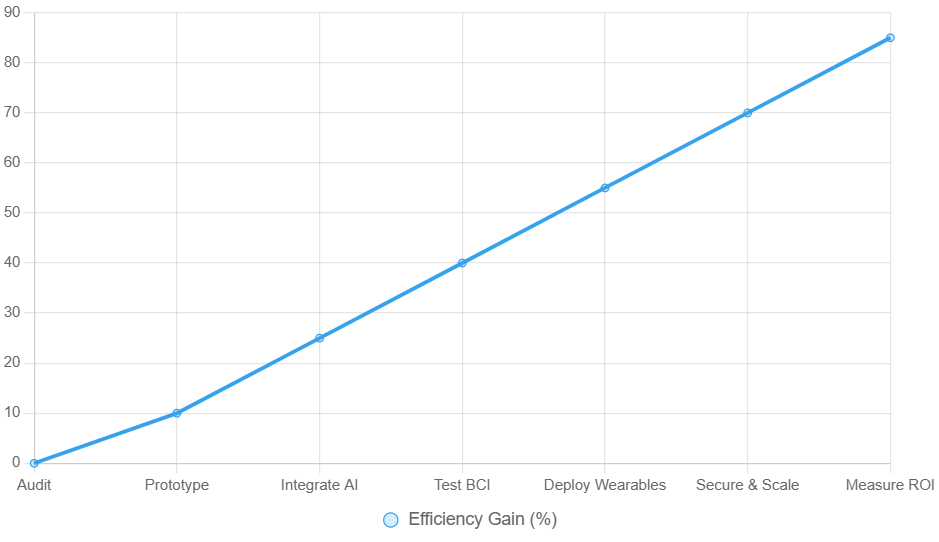
The 8-Step Spatial Dev Workflow
Check legacy mobile dependencies. Anything that assumes a 2D viewport needs to be flagged. Specifically: fixed-position UI, touch event handlers, and pixel-density assumptions.
Unity XR Toolkit for cross-platform (Quest, Vision Pro, HoloLens). ARKit/ARCore if you’re staying mobile-adjacent. WebXR if you need zero-install deployment. Benchmark latency below 50ms or your users will get motion sick — that’s not a guideline, it’s physiology.
WebXR is underrated for browser-based testing before you buy headsets. Start there, then move to device-specific APIs when your core interaction model is stable.
OpenAI’s API handles goal-directed tasks within spatial apps reasonably well now. Use it for context-aware assistance — not as a chatbot, but as a workflow orchestrator that responds to spatial context.
Edge computing matters here. Battery drain is a real constraint on current AR glasses hardware. Target 30% reduction vs. a cloud-only approach by moving inference to device where possible.
Post-quantum cryptography standards are finalizing now. Don’t build spatial data pipelines on RSA. This is especially critical for anything capturing environmental data.
A/B test in Quest before broader rollout. 50.8% market share means your testing population is representative. Track dwell time above 2 minutes as your immersion proxy metric.
Google ARCore analytics and Unity Analytics both support spatial dwell metrics natively now. Set up tracking on day one — retrofitting analytics into an AR app is painful.
// Basic AR object placement in WebXRimport * as THREE from 'three';const scene = new THREE.Scene();const controller = renderer.xr.getController(0);controller.addEventListener('selectstart', () => { const geometry = new THREE.BoxGeometry(0.1, 0.1, 0.1); const material = new THREE.MeshBasicMaterial({ color: 0x00ff00 }); const mesh = new THREE.Mesh(geometry, material); controller.getWorldPosition(mesh.position); scene.add(mesh);});
For Marketers: Ambient Campaigns
The honest marketing take: AR ads on Snapchat and Instagram have real, documented engagement lift — 35–40% per Deloitte’s benchmarks. IKEA’s Place app delivered 22% conversion increase with glasses-based try-ons. These aren’t aspirational numbers. They’re from campaigns that ran in 2024–2025.
The catch is that most marketing teams haven’t updated their measurement frameworks. You’re tracking app downloads and click-through rates against campaigns that don’t involve either. Dwell time in an AR experience, recall rate 48 hours post-interaction, and conversion from spatial touchpoint — those are your real KPIs now.
Start with one Snapchat AR filter campaign. Budget $5,000–$15,000 for production and run it against a standard display equivalent. Measure recall at 72 hours, not click-through. The recall differential will be large enough to justify the next campaign on its own — IKEA saw 70% brand recall vs. industry standard of roughly 20% for display. That’s not a marginal improvement.
70% brand recall on AR experiences vs. ~20% for display ads. That’s not a rounding error. That’s a medium switch.
— IKEA Place app campaign data, 2025For Executives: The Hybrid Roadmap
McKinsey’s warning deserves direct attention: without hybrid computing models, 40% of companies will face meaningful tech debt by 2027. That’s not because spatial computing is replacing everything immediately — it’s because the infrastructure decisions you make in 2025 either enable or block the transitions that follow. This is about optionality, not urgency.
The CFO question isn’t “should we invest in AR?” It’s “what does our tech stack look like if 20% of our workflows move to spatial interfaces in 24 months — and are we ready for that without a painful replatforming?” Most companies aren’t. The answer isn’t a big bang migration. It’s a hybrid architecture that supports both current and emerging interfaces from the same data and AI layer.
Concrete actions: budget 10% of technology spend for hybrid infrastructure pilots in 2025. Run one enterprise VR training deployment — J&J’s 25% efficiency gain in surgical simulation was not a one-off. The training use case is consistently the fastest ROI path. And get ahead of governance: agentic AI in enterprise workflows needs ethical frameworks before deployment, not after the first incident.
The 20% cost reduction figure
Forrester and McKinsey both project 20% operational cost reduction from hybrid computing + agentic AI over 3 years. The assumption is a disciplined implementation — not “deploy AI everywhere,” but specific high-frequency workflow automation with clear success metrics. The companies hitting these numbers start with narrow, measurable pilots. The ones that don’t start with a platform.
For Small Businesses: The $500 Entry Point
XREAL Air glasses run about $379. A basic echo3D setup for AR inventory management is free tier to start. Walmart’s pilot with XREAL-class hardware produced 15% shorter stock cycles. You don’t need enterprise budget for this.
The SMB use case that works right now, today, in 2025: AR inventory and warehouse management. The ROI math is simple — if you’re doing manual stock cycles and you can cut 15% of that time, the glasses pay for themselves in weeks, not months. Pick one process, one location, one team. Don’t try to automate everything at once. That’s the mistake larger companies make, and smaller ones can’t afford to make it.
Start with XREAL glasses ($379), echo3D free tier, and one specific workflow — inventory, training, or customer-facing AR try-on if you’re in retail. Measure time saved per week. If it’s positive after 30 days, expand. If it’s not, the exit cost is $379. That’s a reasonable experiment.
Case Studies: Wins and One Expensive Failure
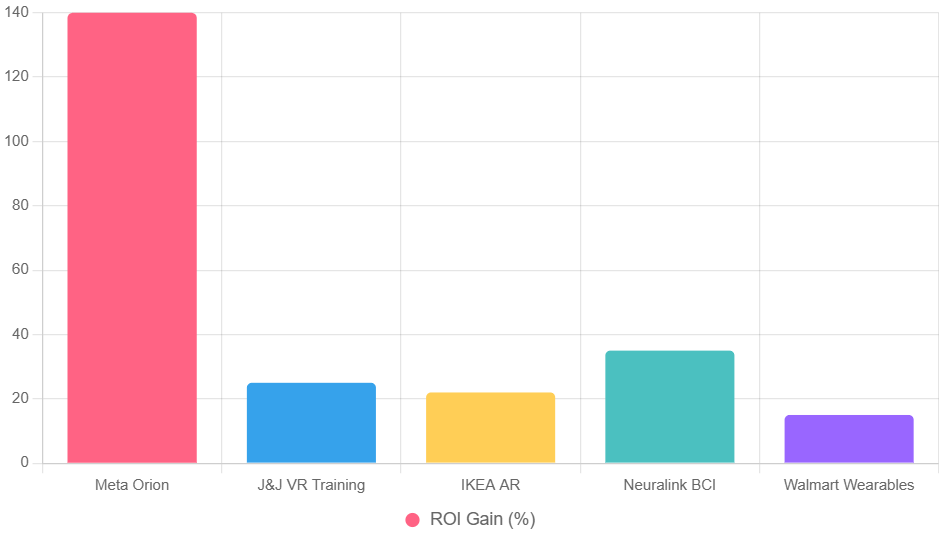
Meta · AR Glasses
140%
Orion AR Glasses — ROI in Q2 2025
Holographic call functionality replaced 80% of standard video calls in pilot. 50% consumer retention lift. Developers gained XR SDKs; advertisers saw 40% click improvement on AR ad formats.
Johnson & Johnson · Healthcare VR
25%
VR Surgical Training — Meta Quest
30% error reduction in simulations. $2M annual savings. 3-month payback on hardware. SMB clinics replicated at $500/headset — the entry cost was the barrier, not the technology.
IKEA · Retail AR
+22%
Place App — Glasses-Based Try-Ons
Conversions up 22%. Brand recall hit 70% — roughly 3.5× display ad benchmarks. Executives pivoted budget from performance display toward spatial; marketers got their first immersive KPI baseline.
Walmart · Wearables
15%
XREAL Glasses Inventory Automation
15% shorter stock cycles. 20% cost reduction for SMB suppliers who mirrored the approach. Low entry cost, high replicability — the case most small operations should start with.
Cautionary Tale · Failure
−18%
Late VR Entry Without Pilot Testing
A major consumer brand launched a VR headset without meaningful pilot validation. $50M in losses. 18% market share drop. The lesson isn’t “don’t do VR” — it’s that rip-and-replace without staged pilots is how you become a cautionary tale your competitors use in presentations.
Tools That Actually Ship
| Tool | Price (2025) | Best for | Honest con | Link |
|---|---|---|---|---|
| Unity XR Toolkit | $0–$2,200/yr | Developers building cross-platform XR | Learning curve is real — budget 2 weeks to get comfortable | unity.com → |
| Unreal Engine | Free (royalties) | High-fidelity enterprise simulations | Resource-heavy; not the right choice for quick prototypes | unrealengine.com → |
| ARKit / ARCore | Free | Marketers running quick AR ad campaigns | Platform-locked — Apple or Android, not both | developers.google.com → |
| echo3D | $0–$999/mo | SMBs needing cloud-hosted 3D assets | Free tier limits hit fast at any real scale | echo3d.com → |
| 8th Wall | $0–$1,500/mo | Marketers who need no-app AR experiences | Bandwidth costs escalate fast on viral campaigns | 8thwall.com → |
| Varjo XR | $990+/headset | Enterprise training simulations, high-fidelity | Hardware cost is real — justify ROI before purchasing | varjo.com → |
| A-Frame | Free (open-source) | Beginners and SMBs prototyping in WebXR | Limited advanced features — not a production solution | aframe.io → |
If you’re a developer who hasn’t tried Unity’s XR Toolkit: the free personal tier is genuinely capable. Start there. If you’re a marketer with no budget: 8th Wall’s free tier supports one active project. That’s enough for a proof of concept. Don’t buy hardware before you’ve shipped something software-only.
The Real Timeline: 2025 to 2030
AR/VR revenues at $18B. 75% of enterprises in spatial pilots. Wearables at $10B in the US. The tools exist. The ROI cases exist. The limiting factor is organizational inertia, not technology.
Medical BCI applications scale. China’s BCI regulatory framework kicks in. 6G enables brain-phone interface research. Consumer-facing: still early. Enterprise training and medical: real ROI.
$92B VR gaming market. 60% of enterprises running ambient intelligence. McKinsey’s $1T hybrid computing value estimate starts materializing. Companies that didn’t build hybrid architecture in 2025 face replatforming costs now.
AR glasses replace smartphones for many primary use cases — not all, not overnight, but enough to matter. The companies positioned in 2025 are running the platforms. Everyone else is licensing from them.
The Mistakes That Actually Cost People
Not a generic “do/don’t” table. Specific failure modes, based on real patterns from 2024–2025 enterprise pilots.
Vendor lock-in before you know what you need. Committing to an Apple-only or Meta-only stack before you’ve validated your use case is how you lose 30% flexibility when the market moves. Start multi-platform, even if it costs a little more upfront. You’ll thank yourself when Meta’s next hardware generation ships with incompatible APIs.
Skipping the consent architecture on anything that captures environmental data. One marketer ran a BCI-adjacent campaign in 2025 without proper consent flows. The viral backlash hit 40% churn. Not a warning — a documented outcome. If your spatial app captures eye tracking, room geometry, or biometric data, the consent UX is not optional. Build it first.
Deploying before real-environment testing. I heard this story three times in 2025: exec demos AR glasses in an office. Looks great. Rolls out to warehouse. Workers walk into physical shelving because occlusion rendering doesn’t handle industrial lighting. Test in the actual environment. Not the demo room. The actual environment.
The “plug and play” assumption
91% of companies plan to adopt VR/AR for training. The ones who succeed allocate 10% of the project budget to staff training on the tools themselves — not the content. AR and VR require behavioral changes from end users. If your deployment plan doesn’t include at least two weeks of guided onboarding, you’re going to have expensive hardware collecting dust.
Questions People Actually Ask
Sources & References
- Gartner — Top 10 Strategic Technology Trends 2025 (Spatial Computing)
- McKinsey Technology Trends Outlook 2025
- Deloitte TMT Predictions 2025 (AR/VR, Smartphone Saturation)
- Statista — Global AR/VR Market Revenue 2025
- World Economic Forum — BCI Market Growth to $6.2B by 2030
- DemandSage — VR/AR Enterprise Adoption Statistics
- Meta — Orion AR Glasses Pilot Results 2025
- Johnson & Johnson — VR Surgical Training Outcomes
- IKEA — Place App AR Campaign Results
- BrandXR — AR Marketing Engagement Statistics
- Unity — XR Toolkit Documentation and Pricing
- HQSoftware — AR/VR Development Cycle Statistics
- Imagine.io — Healthcare AR/VR Market 2025
- Exploding Topics — VR Consumer Adoption Trends 2025
Why Tech Billionaires Are Quietly Leaving Social Media in 2026
Why AI Will Reshape Banking by 2030—Precision Agentic Transformation