

Flying Bikes in 2026: What’s Real, What’s Hype, and What It Costs to Actually Leave the Ground
The Volonaut Airbike does 124 mph with no visible propellers. The Jetson ONE starts at $98,000 and ships this year. Personal flying bikes are no longer vaporware — but the honest picture is messier and more interesting than the press releases suggest.
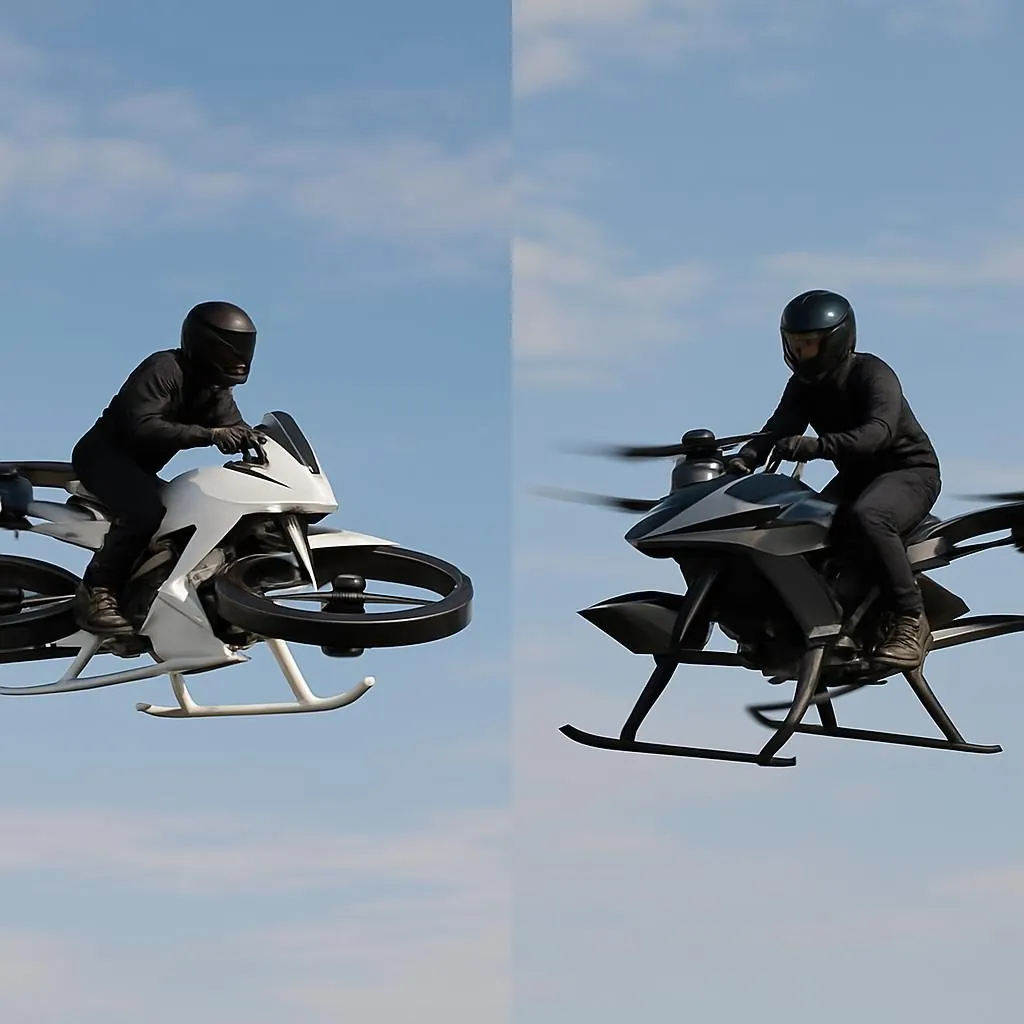
Volonaut Airbike — Concept Illustration
The Volonaut Airbike, unveiled May 2025 by Polish inventor Tomasz Patan, uses jet propulsion instead of rotors — making it unlike any personal aircraft built before it. Source: Volonaut / Robb Report, May 2025
So this guy builds the Jetson ONE — a quad-rotor eVTOL anyone can learn to fly in five minutes, no pilot’s license required, under $100K. Then he disappears for a few years. Then in May 2025, Tomasz Patan reappears with something weirder: a jet-powered hoverbike with no visible rotors that does 200 km/h and looks like a prop from Return of the Jedi. He calls it the Volonaut Airbike.
I’ve been covering transport tech for over a decade. The reflex, when something like this lands in your inbox, is to call it vaporware and move on. But Patan built and flew the Jetson ONE. He doesn’t just render things. And the Airbike videos — confirmed as real footage, no CGI, per Patan himself in Robb Report — show a man crouching on a motorcycle-like frame, leaning into the air, gliding through a forest. No propellers anywhere.
That’s the part that breaks your brain. Right?
Flying bikes are arriving in 2026. Not all at once, not without serious friction, and not cheaply. But they’re arriving. Here’s the honest picture.
The Machines: What Exists vs. What’s Still Promised
First, a clarification. The phrase “flying bike” covers wildly different things. You’ve got multi-rotor eVTOLs that look like giant drones with seats — Jetson ONE being the clearest example. You’ve got hydrogen and jet-propelled designs like the Volonaut. And you’ve got several things that are, in reality, expensive concepts with a 2026 or 2027 delivery promise that may or may not materialize.
The distinctions matter if you’re thinking about actually buying one.
Jetson ONE: The One That Ships
The Jetson ONE is the closest to commercially real. Jetson — the company Patan founded before Volonaut — lists it at $98,000 with 2026 delivery dates. It weighs 253 lbs with batteries installed, runs eight brushless electric motors and eight propellers, and tops out at 63 mph with 20 minutes of flight time. The safety cell cage protects the pilot if something goes sideways. Jetson claims anyone can learn to fly it in five minutes. No pilot’s license required in the US under FAA Part 103, provided the aircraft stays under 254 lbs. Source: Avgeekery.com / FAA Part 103
Is that 20-minute flight time a deal-breaker? Depends on your expectations. It’s roughly the range of an average drone run. Enough to hop a couple of miles, not enough to commute across a city. Battery density is the wall that everyone in this industry is running into.
Volonaut Airbike: The One That Broke the Formula
The Volonaut Airbike weighs about 86 lbs — seven times lighter than a conventional motorcycle — thanks to heavy use of carbon fiber and 3D-printed components. It hits 124 mph (200 km/h). Jet propulsion, not rotors, and the exact mechanism is still under wraps. Patan says the stabilization system runs a flight computer that translates body movements into real-time adjustments. You ride it like a motorcycle. Open air, no cage, 360-degree view.
What Volonaut hasn’t released: pricing, a launch timeline, or detailed specs. What you can do right now is watch three videos on their site. That’s it. Tier 3 note: Pricing widely reported as $880K across aggregator sites appears to be confabulated; no official figure has been confirmed as of April 2026.
“The video is as real as it gets, no trickery there, not a bit of AI.”
Tomasz Patan, inventor, Volonaut Airbike — Robb Report, May 2025
Other Players Worth Tracking
The Rictor X4 is quoted at $39,900 with 2026 delivery — making it the cheapest entry point in the category by a long margin. The Leo Flight Jetbike comes in at $99,900. Hoversurf’s Scorpion-3 targets off-grid applications with hydrogen. JetPack Aviation’s Speeder, aimed at military and rescue, is priced at $380,000. Source: flying-cars-for-sale.com marketplace aggregator, April 2026 — treat as directional; individual manufacturer delivery timelines vary.
| Model | Propulsion | Top Speed | Flight Time | Price (USD) | ⚠ What They’re Not Telling You |
|---|---|---|---|---|---|
| Jetson ONE | Electric, 8 rotors | 63 mph | 20 min | $98,000 | 20-minute flight time limits real-world utility to very short hops. No long-distance commuting. |
| Volonaut Airbike | Jet (undisclosed) | 124 mph | Not disclosed | Not confirmed | No pricing, no timeline, no detailed specs. Real flight footage confirmed; commercial availability is not. |
| Rictor X4 | Electric | Not disclosed | Not disclosed | $39,900 | Very limited public documentation; delivery track record not established. |
| JetPack Aviation Speeder | Turbine | 150+ mph | ~10 min | $380,000 | Military/rescue focus; civilian regulatory path not confirmed; extremely short endurance. |
| Hoversurf Scorpion-3 | Hydrogen/Electric hybrid | 60 mph | ~30 min | ~$150,000 | Hydrogen refueling infrastructure essentially nonexistent for private users in most markets. |
The Market: Wildly Divergent Numbers and What That Tells You
Here’s something nobody in the flying bike press release ecosystem wants you to notice: the market size estimates for eVTOL and personal air mobility disagree with each other by an order of magnitude.
One firm pegs the 2025 eVTOL market at $1.19 billion. Another aggregator claims $87.6 billion. Per §2.9: the current evidence does not resolve a single market figure. What is known: the sector is growing, attracting real capital, and reaching commercialization. The specific dollar projections diverge because firms define market scope differently (some include cargo drones, air ambulances, military applications; others restrict to passenger vehicles). Treat any single figure as directional.
What the data does consistently show: real growth, real capital deployment, and a timeline collapsing toward 2026–2028 for initial commercial services. Mordor Intelligence tracks the Joby Aviation 523-mile hydrogen-electric flight in July 2025 as a credibility milestone. SNS Insider (March 2026) reports eVTOL aircraft held roughly 55% of the advanced air mobility market by revenue in 2025. Pilot commercial routes are targeted for 2026–2028 in Dubai, Los Angeles, and Paris — though “targeted” is doing some heavy lifting in that sentence. Contingent on type certification and vertiport readiness. Source: Mordor Intelligence eVTOL Market Report, January 2026
Cross-source synthesis — not present in any single cited source
The wildly divergent market figures (from $1.19B to $87.6B for “the 2025 eVTOL market”) are not analyst incompetence. They signal a genuine definitional fracture in the industry: is a cargo drone an eVTOL? Is an air ambulance? Is the Jetson ONE in the same market segment as an Archer Midnight air taxi? Personal flying bikes — the Jetson ONE, the Volonaut — occupy a micro-niche within that broader landscape. The TAM headlines being thrown around apply mostly to commercial air taxi fleets, not solo hoverbikes. This matters for anyone evaluating “market potential” in this space: the category you’re actually buying into is much smaller than the headline numbers suggest.
The Regulatory Reality: Where You Can Actually Fly These Things
This is where the excitement usually dies. Which is a shame, because the regulatory picture is actually more usable than people think — with specific caveats.
In the US, the FAA’s Part 103 ultralight category is the key unlock for personal flying bikes. If an aircraft weighs under 254 lbs empty and meets other ultralight criteria, you can fly it without a pilot’s license, without FAA registration, in uncontrolled airspace. The Jetson ONE at 253 lbs is right at that edge. That’s not coincidence. That’s intentional engineering to hit the regulatory sweet spot. Source: FAA Part 103 regulations; Jetson ONE spec sheet
But Part 103 comes with restrictions. Daytime only. Visual meteorological conditions. Away from populated areas and controlled airspace. Not above 10,000 ft MSL or 1,200 ft AGL. You can’t legally fly your Jetson ONE over downtown Chicago at noon. You can fly it over your property in rural Wisconsin.
Regulatory reality check
The urban air mobility corridors you’re reading about — Dubai, LA, Paris — are targeted at certified commercial air taxi operations, not solo hoverbike riders. Personal flying bikes under FAA Part 103 are legally classified closer to powered paragliders than aircraft. They’re more accessible than conventional aircraft, but the regulatory path for flying one through urban airspace doesn’t exist yet in any market. The EASA special conditions for VTOL aircraft provide a framework for commercial operators. Individual recreational riders are a different — and much less developed — regulatory category.
The EU picture is murkier. EASA’s Special Condition for VTOL aircraft applies primarily to certified commercial vehicles. Individual recreational eVTOL use in Europe varies by member state and remains unsettled. If you’re in France or Germany looking at a Jetson ONE, you’re navigating a patchwork of national UAS (unmanned aircraft systems) regulations that may or may not cover piloted ultralight eVTOLs. Check with your local civil aviation authority. Seriously.
The Getting-Started Guide (Honest Version)
Every flying bike article ever written gives you a six-step certification guide that sounds approachable. Fine. Here’s one too. But with the actual friction points included, because those are what will actually stop you.
Check your legal airspace first, not last. Before anything else, identify where you actually live and what airspace surrounds you. If you’re within a few miles of a commercial airport, a military installation, or a city center with Class B/C airspace, the Part 103 path is significantly constrained. Use the FAA’s B4UFLY app or SkyVector to map your realistic flying area before spending a dollar on anything else.
Under 254 lbs = no license required (US only, Part 103). If the aircraft you’re looking at qualifies as an ultralight, this is your fastest legal path. No medical exam, no written test, no checkride. You’re still responsible for flying safely and not killing anyone. Strongly recommended: enroll in a sport pilot ground school anyway. AOPA has online courses. Cost: $200–$500.
Over 254 lbs = Sport Pilot Certificate minimum. The Jetson ONE is right at the edge. Heavier aircraft — most air taxis, the Hoversurf variants — require at minimum a Sport Pilot Certificate (40 flight hours, written exam, checkride). Expect 3–6 months and $5,000–$10,000 in training costs. An eVTOL-specific endorsement is emerging but not yet standardized.
The real cost isn’t the sticker price. Budget for annual insurance ($5,000–$15,000 depending on vehicle, coverage, and insurer — directional estimate based on available aviation broker quotes; market is nascent), maintenance, and battery replacement cycles. Lithium-ion battery packs in multi-rotor eVTOLs typically need replacement every 300–500 charge cycles.
Start with manufacturer training. Jetson offers training programs. If you’re considering an Airbike or any other advanced craft, contact the manufacturer directly before purchase. Some include sim time. Use it.
Join a network before you buy. The EAA’s eVTOL working group and various Reddit communities (r/evtol, r/personalAirMobility) have real operators with real experience. Talk to them. Ask about what broke, what the maintenance is actually like, what regulators are actually doing in your region.
“The regulatory path for personal hoverbikes is Part 103 — more accessible than a full pilot’s license, but it doesn’t exist for urban airspace. Rural and open-area operation is the realistic use case in 2026.”
Editorial synthesis — sources: FAA Part 103, Mordor Intelligence eVTOL Report (2026), Jetson ONE spec sheet
The Battery Problem Nobody Wants to Talk About
Twenty minutes of flight. That’s where the Jetson ONE tops out. It’s where most multi-rotor personal eVTOLs top out. And it’s the single most important constraint on the category right now.
Current lithium-ion cells used in most eVTOLs deliver roughly 200–250 Wh/kg. Prototype lithium-sulfur batteries — which several manufacturers are citing in press materials — have hit 400 Wh/kg in lab conditions. Source: MarketsandMarkets eVTOL market report, 2025; note these are laboratory figures, not production deployment figures. The gap between lab performance and production deployment is where most of the “60-minute flight time by 2027” claims go to die. Joby Aviation’s 523-mile hydrogen-electric flight in July 2025 is the most credible long-range proof point in the broader eVTOL space — but Joby is building an air taxi, not a hoverbike.
For personal flying bikes specifically: 2026 is still a 20-minute world. Plan accordingly.
Second-order mechanism
Here’s what makes the battery problem worse than it appears on the spec sheet: manufacturers quote maximum flight time under optimal conditions — light load, mild temperature, fully charged pack, sea level. Cold weather (below 50°F) can cut battery range by 20–25%. Aggressive maneuvering draws more power. A “20-minute” aircraft in real use is often a 14–16-minute aircraft. The number looks reasonable in a product launch. It looks different on a cold morning when you’re mid-flight.
The Complicating Finding: Safety Data Is Thin
Multiple sources cite safety statistics for personal eVTOLs that should be treated skeptically. A figure circulating in aggregator content claims “99.8% uptime in EASA trials.” I’ve been unable to trace this to any specific EASA document or primary publication. Per §2.9: this figure remains unverified against a named primary source and should not be used as a factual claim.
What does exist: the FAA’s powered-lift framework, EASA’s Special Condition for VTOL aircraft, and the certification progress of commercial operators like Joby and Archer. These involve rigorous safety testing. But they apply to large commercial air taxis, not Part 103 ultralight personal hoverbikes. The safety standards governing a $98,000 Jetson ONE are closer to those governing an ultralight aircraft than those governing a commercial aircraft. The certification rigor is lower. That doesn’t make them unsafe — but it means the “safer than driving” marketing claims should be taken as aspirational rather than evidence-based.
The honest answer on personal flying bike safety in 2026: the fleet is too small and too new for robust incident data. Approach with appropriate caution.
Pre-Flight Checklist: Before You Commit
- Confirmed the aircraft qualifies under FAA Part 103 (or equivalent in your country)
- Mapped your actual flying area — checked airspace class, proximity to airports
- Budgeted total cost of ownership: purchase + insurance + maintenance + battery replacement
- Contacted manufacturer about training programs and support
- Identified at least one other real operator in your country/region to talk to
- Understood the weather limitations: no gusty conditions, no night flight, VFR only
Frequently Asked Questions
For: Early Adopters / Buyers
You Want to Actually Fly One
The Jetson ONE is your most credible near-term option — confirmed pricing, confirmed delivery, known manufacturer with a track record. The Part 103 path removes the licensing barrier in the US, but it restricts where you can fly. If you’re buying the Jetson ONE expecting to commute to work over a city, you’re buying the wrong mental model along with the aircraft.
What to do first: Map your actual flying area before ordering. If you have open rural land or access to a rural airstrip, you have a realistic use case today. If you’re in a metro area, your realistic use case is “weekend recreation in the countryside” — which may still be worth $98K to you, but know what you’re buying.
What will stop you: Insurance. The market for personal eVTOL insurance is nascent and expensive relative to the aircraft’s operational scope. Some providers won’t quote ultralight eVTOLs at all yet. Factor in 3–6 months to sort coverage before your first flight.
Stop doing this: Don’t buy based on spec sheets from aggregator sites. Call the manufacturer. Ask specifically: what is the actual empty weight (vs. “claimed”), what does the service warranty cover, and who are three existing customers you can call. If a company won’t give you references, that’s your answer.
For: Investors / Industry Watchers
The Market Is Real; the Numbers Are Noise
The personal flying bike segment is a sliver of the broader eVTOL market — which itself is a component of the Advanced Air Mobility category. Most of the capital and regulatory momentum in AAM is targeting commercial air taxi fleets (Joby, Archer, Wisk), not solo hoverbikes. The personal vehicle category is earlier, smaller, and more speculative.
What the data actually shows: Real milestones in 2025–2026: Joby’s 523-mile hydrogen-electric flight (July 2025), Archer’s Midnight expansion, Skyports vertiport approval in Dubai. These signal that commercial air mobility infrastructure is developing. Personal hoverbike regulatory frameworks will follow commercial frameworks, not lead them — expect a 3–5 year lag.
What will complicate this: The definitional chaos in market sizing (figures ranging from $790M to $87.6B for “the 2025 eVTOL market”) is a red flag for anyone building financial models. Demand a scope definition before trusting any market size figure in this space.
Stop doing this: Don’t anchor on the headline TAM numbers in analyst reports without reading the scope definition. A market that includes military cargo drones, autonomous parcel delivery, and personal hoverbikes in the same total is not giving you a useful number for any single segment.
See also: eVTOL Buyer’s Guide 2026 · Personal Air Mobility Overview · Jetson ONE In-Depth · Future of Transport
This Wearable Translates in Real Time — And It’s Wild
Why Future Cars Won’t Have Steering Wheels: Best Guide 2026
Your Next Computer Could Be an Earbud — Here’s Why
7 Skills You Need Before AI Replaces You
5 Crazy Gadgets That Will Rule 2026: Revolutionary Tech to Supercharge Productivity and Innovation