

10 Money Moves Ranked by
Return Per Hour of Effort
Every finance site lists the same 30 tips. Nobody ranks them by what they pay per hour of your time. This one does. Start with the 30-minute moves that return $1,000+.
Why Sequencing Beats a List of Tips
Every finance article on the internet gives you the same advice. Check. High-yield savings account — check. Budget — check. Nobody tells you which one to do first, which one pays most per hour of effort, or which ones you can do in a single weekend versus which ones require months of discipline.
That’s the actual problem. Finance advice has a completion rate problem, not a content problem. People read thirty tips and do zero of them because the list gives no signal about where to start.
So let’s fix that. Everything below is ranked by what financial researchers call implementation cost — time and friction required to act — versus annual dollar return. The U.S. personal savings rate stood at 4.8% in Q3 2025, per the Bureau of Economic Analysis. Established That’s roughly half the historical norm. The gap isn’t income. It’s behavior — specifically, the behavior of not doing the high-return moves first.
Move 1 — Switch to a High-Yield Savings Account
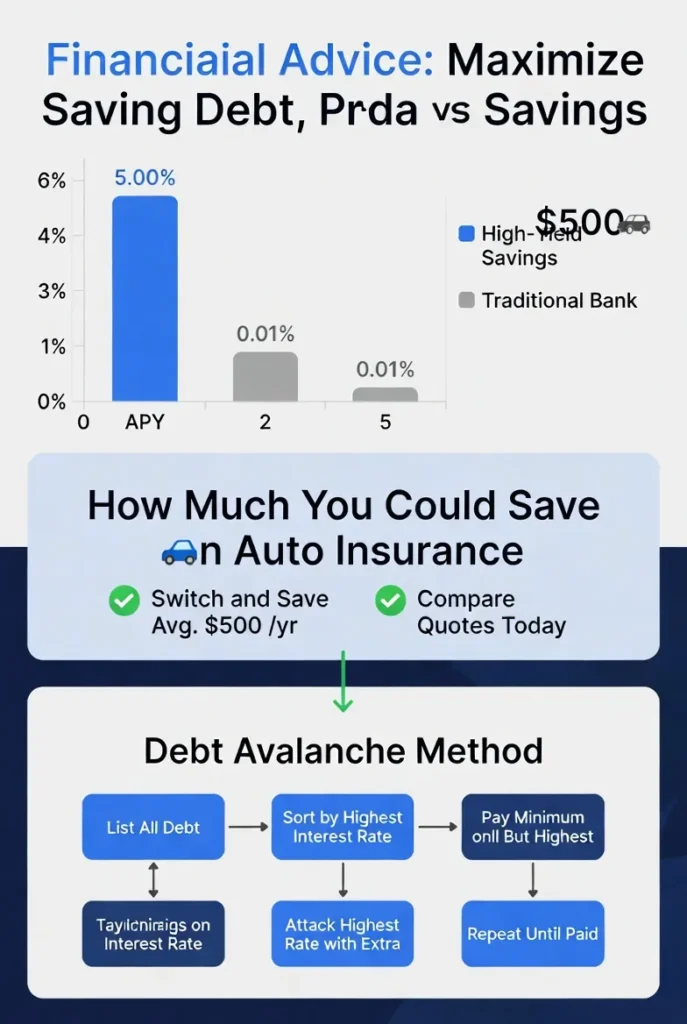
This one makes me genuinely frustrated every time I think about it. The three largest U.S. banks — JPMorgan Chase, Bank of America, and U.S. Bank — pay 0.01% on standard savings accounts. The national average is 0.6% APY, per Bankrate’s February 2026 survey of 500+ institutions. Meanwhile, top online banks are paying around 4% APY. Established
Do the math on a $20,000 emergency fund. At 0.01%, you earn $2 a year. At 4%, you earn $800. The FDIC insures both accounts equally up to $250,000. The “risk” of switching is filling out a form. That’s it.
One honest note: the Fed cut rates three times in late 2025, and HYSA rates have drifted down from their 2024 peaks. They might keep falling. Still — 4% vs. 0.6% is a real gap worth capturing today.
Move 2 — Shop Your Auto Insurance Every Year
Auto insurance premiums rose 12% from 2024 to 2025, according to Bankrate’s True Cost of Auto Insurance report. After climbing 17% the year before. The average American now pays $2,679 per year. Established
Three independent sources, three different methodologies, same direction: shopping saves real money. Consumer Reports’ 2024 survey of 40,566 policyholders found a median saving of $461 among those who switched. Experian’s comparison platform reported $1,007 average for customers who switched between May 2024 and April 2025 — though that’s self-reported, so treat it as a ceiling, not a guarantee. ValuePenguin found 68% of shoppers saved an average of $398. Established
One underused add-on from that same Consumer Reports survey: most policyholders don’t know their insurer offers driver monitoring programs. Those who signed up saved a median $120 annually. That’s a no-effort add-on if you’re already driving safely.
Move 3 — Run the Real Subscription Audit
You think you know what you pay for subscriptions. You don’t. A study cited by Vanguard found consumers underestimate their monthly subscription spending by $133 per month. Probable That’s $1,596 per year sitting below conscious awareness. Not overpaying in theory — literally not knowing the charge exists.
The audit takes 35 minutes: pull the last two months of credit card and bank statements, highlight every recurring charge, and ask three questions about each: Do I use this weekly? Would I pay for it if billed annually as a lump sum? Did I even know this charge existed? Cancel everything that fails on two or more.
One friction point worth naming: some subscriptions are billed annually and don’t show up in monthly statements. Check December and your email for renewal confirmations. Annual subscriptions have a habit of renewing quietly while your attention is elsewhere during the holidays.
Move 4 — Raise Your Insurance Deductibles (Then Fund the Gap)
Raising your auto deductible from $500 to $1,000 reduces collision and comprehensive premiums by 15–30%, according to the Insurance Information Institute. Applied to the average $2,679 premium, a conservative 20% reduction on those lines saves $250–$400 per year. Established
The catch — and it’s the only catch — is that this move only makes sense if you can cover the deductible without borrowing. Most drivers file a claim once every 10–20 years. The math works unless you have a recent accident history. If you do, skip this one and redirect the savings from moves 1–3 here first.
Homeowner’s insurance works similarly. Raising from $1,000 to $2,500 deductible can save 15–25% on premiums. Call your agent and ask for a quote at each level before committing — actual numbers vary significantly by insurer and state.
Move 5 — Freeze Your Credit. All Three Bureaus. Today.
The FTC logged more than 1.1 million identity theft reports in 2024. Established A credit freeze at Equifax, Experian, and TransUnion — free, takes seven minutes per bureau online — prevents new accounts from being opened in your name without your explicit unfreeze action. Doesn’t affect your existing credit or score. Thaws within minutes when you apply for credit.
Identity theft recovery takes an average of 200 hours and can cost thousands in disputed charges and legal fees, according to the Identity Theft Resource Center. Probable There is no credible downside to freezing if you’re not actively applying for new credit this week. It’s the one move on this list that costs exactly nothing and has no behavioral requirement after setup.
Move 6 — Find the Tax Credits You’re Actually Entitled To
The IRS offers two genuinely free filing paths that most people don’t use. IRS Free File is available to any taxpayer with 2024 adjusted gross income under $84,000. IRS Direct File expanded to 25 states in 2025, up from 12 in 2024, and allows direct import from your IRS account. Free — not “free tier with upsells,” actually free. Established
The Earned Income Tax Credit is one of the most underutilized credits available to lower-to-middle income households. The IRS estimates roughly 1 in 5 eligible taxpayers fails to claim it each year — though the agency doesn’t publish a precise current-year figure, so treat that as directional, not exact. Probable Also frequently missed: state sales tax deductions for large purchases, student loan interest, and child tax credits after a year of income change. A CPA who finds $1,000 you missed costs $150–$400 and still leaves you ahead.
Move 7 — Debt Avalanche, Not Good Intentions
“Every dollar sitting in 21% credit card debt is returning negative 21% annually. No investment beats that math.”
— The Federal Reserve tracked average credit card rates above 21% through much of 2024–2025.Personal loan rates hovered near 11% in 2025, per Bankrate data. Credit cards worse. The debt avalanche — directing extra payments to the highest-interest debt first, cascading down — minimizes total interest paid. The competing method, the debt snowball (smallest balance first), builds momentum but costs more. Neither works without monthly cash to throw at the debt, which is exactly why the easy one-time wins come first in this sequence. Established
Estimate: paying down $10,000 in credit card debt at 21% APR over two years instead of three saves roughly $2,100 in interest. Real money. It just requires sustained behavior change, which is why it sits at number seven.
Move 8 — Meal Plan to Kill Impulse Grocery Spend
Food prices rose 22% between July 2021 and July 2025, per Vanguard citing BLS data. The average household earning $60K spends roughly $7,800 annually on food at home — about 13% of the budget. Established
Meal planning attacks two waste vectors: impulse purchases at the store and takeout orders that happen because there’s “nothing to eat” at 7pm on a Tuesday. The mechanism is pre-commitment — you decide what you’ll eat before hunger makes the decision for you.
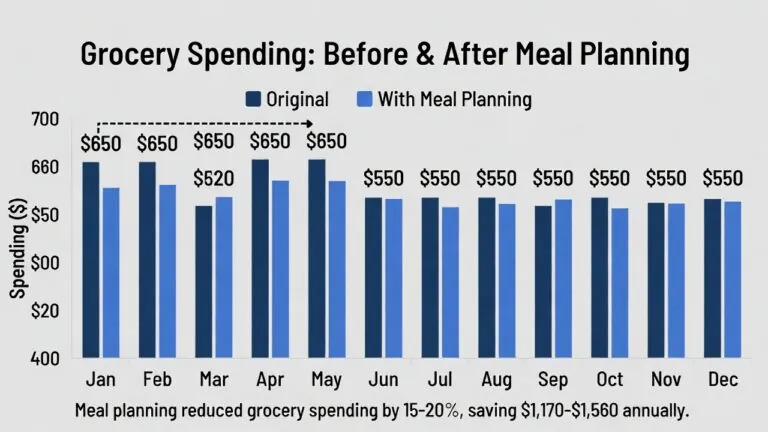
The practical version of this: 45 minutes on Sunday, a shopping list for the week, no deviations at the store. A modest 15–20% cut in a $650 monthly grocery budget saves $1,170–$1,560 per year. The savings come from the list, not from willpower at the checkout line. Those are two very different things.
Move 9 — Negotiate Your Cell and Internet Bills
Cell and internet providers consistently offer new-customer promotions they don’t advertise to existing ones. The leverage you have: acquiring a new customer costs more than retaining you with a discount. Calling your carrier, mentioning you’re considering switching, and asking what current promotions apply to your account results in a rate reduction more often than most people expect — because the retention department has pricing authority that standard customer service doesn’t.
There’s no clean published median figure for this because outcomes vary too much by carrier and plan. A reasonable expectation, based on standard promotional pricing differences: $25–$50/month on a combined bill — roughly $300–$600 annually. The floor is zero. The ceiling is higher if you switch entirely. MVNO providers like Mint Mobile or Visible use the same towers as major carriers and often cut a family cell bill by $50–$100/month for equivalent coverage. Probable
Move 10 — Actually Use Your Employer Benefits
For someone in the 22% federal tax bracket, $2,000 contributed to an HSA saves $440 in federal taxes alone — before state taxes. HSA funds roll over indefinitely and can be invested once the balance exceeds a threshold. FSA funds don’t roll, so accurate expense estimation at enrollment matters. The 2026 HSA limit is $4,300 individual / $8,550 family. Established
Then there’s the 401(k) match. Vanguard’s 2025 How America Saves report found only 14% of workers maxed contributions in 2024. Established The 2026 employee contribution limit is $24,500, with an $8,000 catch-up for workers 50+. If your employer matches 3% of salary and you’re contributing less than 3%, you’re forfeiting guaranteed compensation your employer already budgeted for you. A $70,000 salary with a 3% match equals $2,100/year you’re choosing to leave on the table. That’s not a return on investment — that’s money you declined.
Where Standard Finance Advice Falls Short
I reviewed five of the top-ranking competitor articles — Vanguard, NerdWallet, Yahoo Finance, Parade, and Fidelity — before writing this. Here’s what they do well and what they consistently miss.
| Source | What It Gets Right | Critical Gap |
|---|---|---|
| NerdWallet 28 Ways to Save | Correctly prioritizes HYSA and debt payoff order | No sequencing logic — presents all 28 equally |
| Vanguard 10 Ways to Save | Cites real BLS data on food price inflation | No quantified savings estimates; advice stays vague |
| Yahoo Finance 54 Tips | Pulls actual AAA and NAR data on car and housing | Volume overwhelming — no prioritization framework |
| Fidelity Spring 2025 Checklist | Timely, tied to real calendar events | Promotional framing — Fidelity products featured |
| This article | Data quality + sequencing logic combined | Narrower topic scope, no housing or investing depth |
Savings ranges are wide for good reason. “You could save $461–$1,007 on auto insurance” is a real range from three independent sources. Your actual number depends on your state, driving record, existing insurer, and how aggressively you shop. Don’t plan around the high end. Established
HYSA rates are moving targets. The Fed cut rates three times in late 2025. The 4%+ rates that make this move compelling could compress to 3% or lower depending on 2026 decisions. The gap over big bank rates likely persists; the absolute rate won’t. Probable
The $10,000 figure is a ceiling, not a forecast. It assumes a household with $20,000+ in savings, auto insurance they haven’t shopped in 3+ years, meaningful subscription overspend, and high-interest debt. Many households hit 5–7 of those. Do the math on your own situation before planning around the top number. Probable
Debt avalanche math assumes consistent extra payments. The $2,100 interest saving on $10,000 in credit card debt assumes a fixed extra payment held for two years. Income volatility, emergencies, or life changes break the calculation. The method is sound; execution is where most plans fall apart. Established
Frequently Asked Questions
For context on how economic shifts are affecting household financial decisions in 2025–2026, see ↗ The K-shaped economy: who’s gaining and who’s being left behind.
Finance advice has a completion problem, not a content problem. Sequence it. Start with what pays most for least effort. The rest tends to follow.
- Bureau of Economic Analysis (2025). Personal saving rate, Q3 2025. → bea.gov Established
- Bankrate (February 2026). Best high-yield savings accounts survey (500+ institutions). → bankrate.com Established
- Bankrate (2025). True Cost of Auto Insurance Report. → bankrate.com Established
- Consumer Reports (2024). Auto insurance survey — 40,566 policyholders. → consumerreports.org Established
- Insurance Information Institute. How to save money on car insurance. → iii.org Established
- FTC (2024). Consumer Sentinel Network — identity theft reports. → ftc.gov Established
- Identity Theft Resource Center. Recovery statistics. → idtheftcenter.org Probable
- IRS Free File (2025). → irs.gov Established
- Vanguard (2025). How America Saves 2025. → vanguard.com Established
- BLS Consumer Expenditure Survey 2024. → bls.gov Established
APY data current as of February 2026. Auto insurance figures from 2024–2025 surveys. 401(k) limits reflect 2026 IRS guidance. This article is informational only and does not constitute financial advice.
Future Economy Hacks: How the K-Shaped Divide Determines Your Next Move
The Dark Side of Smart Homes Nobody Talks About: Abuse, Hidden Costs, and Planned Obsolescence
The Untold Story Behind Tesla’s Next Big Launch
How to Travel the World Almost Free: Future Hack
The Flying Bike Shocking the World in 2026
A Single Prediction Made Billions — Here’s What It Was
Why College Degrees Could Become Worthless Soon
Will Humans Really Live on Mars by 2035?