


AI Regulation Predictions 2026:
How Governments May Control Artificial Intelligence
The EU wrote a 400-page law. The US wrote executive orders. China wrote six. Here’s what actually happens when enforcement begins.
In March 2025, a client asked me whether they should delay their AI product launch until “regulations settle.” I told them the same thing I’ll tell you now: the settling will take a decade, and the first wave of enforcement is already here. By June 2026, three distinct governance models have emerged — the EU’s comprehensive risk-based law, the US fragmented patchwork of state and federal action, and China’s layered regulatory architecture — and none of them are waiting for consensus.
This is not a summary of press releases. I spent the last three months reading the actual regulatory texts, tracking enforcement announcements, and speaking with compliance officers who are building these systems under pressure. What follows is what I wish someone had handed me in January: a clear-eyed map of who is regulating what, by when, and what it actually costs to comply.

The EU AI Act: From Paper to Prison Time
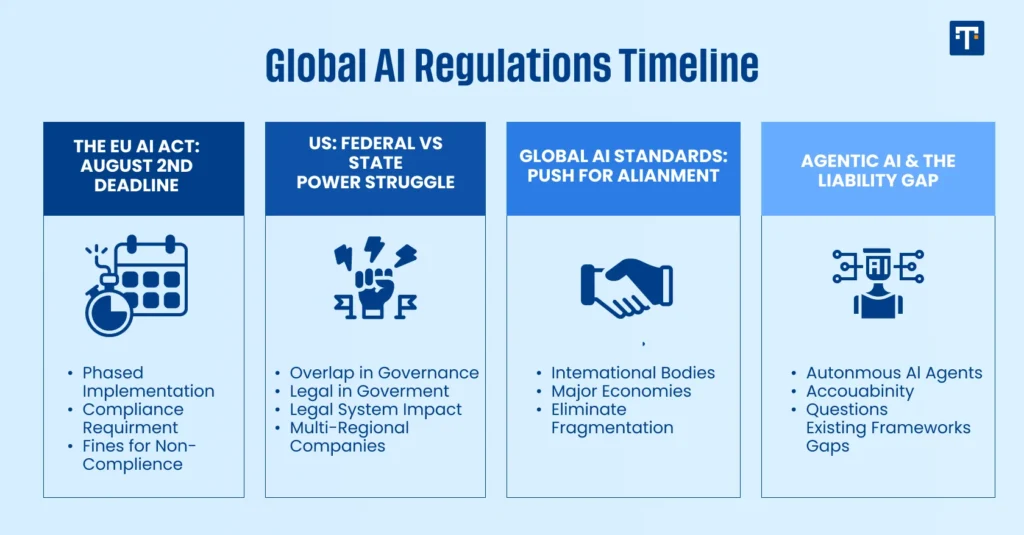
The EU AI Act entered into force on August 1, 2024. By February 2025, its prohibitions on manipulative AI, social scoring, and untargeted biometric scraping were already live. But the real teeth — the obligations for high-risk AI systems — were scheduled for August 2026. Then something happened that most coverage missed: the EU blinked.
In May 2026, the Council and Parliament reached a provisional agreement on the Omnibus VII simplification package. The European Parliament approved it on June 16, 2026. High-risk systems now face a staggered timeline: standalone systems must comply by December 2, 2027, while embedded safety components get until August 2, 2028. Watermarking obligations for AI-generated content were pushed to December 2, 2026. The EU added a ban on “nudifier” apps — AI systems that generate non-consensual intimate imagery — with the same December 2026 deadline.
Why the delay? Three reasons, all visible in the official justifications. First, medical device manufacturers, automotive firms, and industrial control system vendors argued that conformity assessment procedures require more time than the original timeline allowed. Second, Europe’s political mood shifted between 2023 and 2026: competitiveness concerns now weigh heavier against regulatory burden than they did when the Act was drafted. Third — and this is the part Brussels won’t say out loud — the standards and support measures weren’t ready. You cannot enforce what you cannot measure.
What “High-Risk” Actually Means
The AI Act defines high-risk systems across two annexes. Annex I covers AI embedded in products already regulated by EU safety legislation — medical devices, machinery, toys, vehicles, aviation systems. Annex III covers standalone systems used in critical infrastructure, education, employment, essential services (banking, healthcare), law enforcement, migration, and justice. If your AI makes or materially influences consequential decisions in any of these domains, you are high-risk.
The obligations are not suggestions. Risk management systems. Data governance. Technical documentation. Record-keeping. Transparency. Human oversight. Accuracy, robustness, cybersecurity. Conformity assessment. Registration in the EU database. Post-market monitoring. Incident reporting. Each of these has sub-requirements, and each requires evidence.
⚠️ The Fine Structure Nobody Talks About
The AI Act caps fines at €35 million or 7% of global annual turnover — whichever is higher. For general-purpose AI models with systemic risk, the Commission’s enforcement powers entered application on August 2, 2025. The first investigations are already underway. I have spoken with one provider who received a preliminary information request in April 2026. They had 30 days to produce training data documentation they had not yet created.
The Dual Compliance Trap
If you operate in financial services, you do not face the AI Act alone. The Digital Operational Resilience Act (DORA) runs parallel. AI-driven trading, fraud detection, credit scoring, and AML systems must comply with both AI Act obligations and DORA’s ICT risk management standards. Banks must assess third-party AI vendors for fairness and bias under the AI Act, then turn around and assess the same vendors for cybersecurity and resilience under DORA. The same duplication hits critical infrastructure operators under NIS 2.
This is not an accident. It is the natural consequence of writing AI-specific rules without rewriting sectoral frameworks. The compliance cost is real. For a mid-sized European fintech, I estimate the dual compliance burden at €400,000-€800,000 in first-year implementation costs, not including ongoing monitoring.
The United States: Fifty Laboratories, One Lawsuit
The United States still has no comprehensive federal AI law. Congress held hearings, floated proposals, and debated for years. Nothing binding passed. What emerged instead is messier, more volatile, and — for operators — more expensive than a single statute would have been.
The Federal Layer: Executive Orders and Voluntary Frameworks
The Trump administration issued three major AI executive orders during its second term. The first, in January 2025, revoked the Biden-era AI safety order and directed agencies to remove barriers. The second, in December 2025, created an AI Litigation Task Force to challenge state AI laws and threatened to pull federal funding from states with “onerous” AI legislation. The third, signed on June 2, 2026, established a voluntary framework for frontier AI model cybersecurity assessments.
This June 2026 order is worth understanding in detail because it reveals the administration’s actual strategy. It does not create mandatory licensing. It does not require pre-clearance. Instead, it establishes a voluntary process where developers of “covered frontier models” can provide the federal government with up to 30 days of pre-release access for cybersecurity and national security evaluation. The NSA, CISA, and Treasury will maintain a classified benchmarking process to determine which models qualify as “covered.”
Voluntary sounds soft. It is not. The order directs the Attorney General to prioritize criminal enforcement against anyone using AI for unauthorized computer access or cybercrime. It expands federal cybersecurity hiring. It creates an AI cybersecurity clearinghouse. And it sends an unmistakable signal: if you do not engage voluntarily, you may face involuntary attention later.
“In 2026, the story of AI will be less about dazzling new capabilities and more about whether democratic institutions can meaningfully steer the technology.” — Marc Rotenberg, Founder, Center for AI and Digital Policy
The State Patchwork: Where the Real Rules Live
While Washington issues executive orders, state legislatures are writing binding law. As of mid-2026, the most significant state frameworks are:
| Jurisdiction | Law / Regulation | Effective | Scope |
|---|---|---|---|
| California | Frontier AI Act (SB 53) | Jan 1, 2026 | Models trained >10²⁶ FLOPS; risk frameworks, incident reporting, whistleblower protections; penalties up to $1M/violation |
| California | Training Data Transparency (AB 2013) | Jan 1, 2026 | Generative AI developers must publish training dataset summaries |
| California | AI Transparency Act (SB 942) | Jan 1, 2026 | Watermarking and disclosure for AI-generated content |
| Colorado | SB 26-189 (replaced SB 24-205) | Jan 1, 2027 | Automated decision-making tech; consumer notices, 30-day explanations, human review rights |
| Texas | TRAIGA | Jan 1, 2026 | Government AI use; prohibits behavioral manipulation, social scoring, biometric ID without consent |
| Illinois | AI Video Interview Act | Feb 2026 | Employer notification, consent, data retention for AI-analyzed video interviews |
| New York City | Local Law 144 | In effect | Bias audits for automated employment decision tools |
If your organization uses AI in hiring, you are likely subject to overlapping requirements from NYC Local Law 144, Illinois video interview rules, Maryland and New Jersey restrictions, California civil rights regulations, and federal anti-discrimination statutes. There is no central registry. There is no unified compliance checklist. You must map each system against each jurisdiction where you have users or employees.
The Preemption Showdown
The December 2025 executive order directed the Department of Justice to sue states over AI laws deemed “burdensome.” The DOJ created a new Enforcement and Affirmative Litigation Branch specifically for this purpose. In early 2026, the administration began conditioning federal grant funding — including BEAD broadband program funds — on states agreeing not to enforce AI laws that conflict with federal objectives.
Here is what I got wrong when I first read the order: I assumed this would quickly invalidate state laws. It has not. Legal scholars at Ropes & Gray noted in March 2026 that “the viability of the administration’s legal theories is uncertain.” Congress has not passed preemption legislation. Executive orders cannot override state law on their own. The result is a prolonged legal standoff that leaves operators complying with state rules while watching federal courts.

China: The Layered Architecture Nobody Outside Compliance Reads
China does not have a single comprehensive AI statute. It has six binding regulations issued in four years, layered on top of three foundational data laws, translated into mandatory national standards by TC260, and enforced by at least five agencies with overlapping mandates. If the EU model is a cathedral, China’s is a city — dense, interconnected, and easy to get lost in.
The Three Regulatory Pillars
Algorithm governance began with the Algorithm Recommendation Provisions in March 2022. Any recommendation, ranking, or filtering algorithm that shapes the information environment must be registered with the Cyberspace Administration of China (CAC), labeled, and made explainable to users. As of early 2026, over 850 algorithms have been registered.
Content security is governed by the Deep Synthesis Provisions (January 2023) and the Generative AI Interim Measures (August 2023). Together, they cover all AI-generated text, images, video, and audio. Generated content must be filtered for illegal material at every stage of the pipeline. Outputs must be “true and accurate.” Providers must complete security assessments before public release.
Data governance rests on the 2021 trifecta: the Data Security Law, the Personal Information Protection Law, and the Critical Information Infrastructure Security Protection Regulation. Cross-border data transfer restrictions are the most restrictive globally. If your AI training data includes Chinese personal information or “important data,” you cannot transfer it overseas without security assessment.
The 2026 Acceleration
Three developments in 2026 significantly tightened the framework. First, amendments to the Cybersecurity Law took effect on January 1, 2026, explicitly bringing AI into national legislation for the first time. They mandate government support for algorithm R&D, require construction of training data infrastructure, and accelerate AI ethics rulemaking.
Second, on April 10, 2026, five central authorities — CAC, NDRC, MIIT, MPS, and SAMR — jointly issued the Interim Measures for the Administration of AI Anthropomorphic Interaction Services. These regulate virtual companions, emotionally responsive chatbots, and human-like AI engagement platforms. The regulation takes effect July 15, 2026. It prohibits “virtual companion” services to minors. It requires addiction-prevention mechanisms. It mandates algorithm filing, security assessment, and regulatory registration.
Third, TC260 published version 2.0 of the AI Safety Governance Framework in September 2025, twelve months after version 1.0. Where 1.0 was a declaration, 2.0 is an operational manual. It adds provisions for open-source AI governance, expands frontier AI risk coverage to include CBRN misuse scenarios, and explicitly calls for international collaboration on risk information sharing. The five-level risk classification system — grading AI by application scenario, intelligence level, and scale — now feeds directly into binding national standards.
💡 What Foreign Companies Get Wrong About China
You cannot use the same unmodified models you deploy elsewhere. China requires outputs to be “true and accurate,” which means content moderation layers that do not exist in Western deployments. You need a distinct compliance module, not an add-on to your EU framework. The “Law plus Standard” dual-drive approach means regulatory principles become measurable technical requirements faster than in any other jurisdiction.
The Compliance Cost Reality Check
In early 2026, I reviewed due diligence materials for three AI startups raising Series A. In each case, regulatory preparedness consumed 30-45 additional days of investor review. One founder told me their legal bill for a single state compliance memo exceeded their monthly cloud infrastructure spend.
The numbers from VerifyWise’s February 2026 analysis are stark. At seed stage, founders face 15-20% higher legal expenses before generating revenue. At Series A/B, annual compliance runs $200,000-$500,000 covering audits, data protection impact assessments, and risk management frameworks. Growth-stage companies need dedicated compliance officers at $150,000-$300,000 annually, plus support staff. Harvard Kennedy School research found that when fixed compliance costs increase by 200%, a startup’s operating margin can flip from 13% positive to 7% negative — while a tech giant barely notices.
This is the compliance trap: no standardized framework exists for budgeting AI compliance because regulations vary across jurisdictions and evolve faster than financial planning cycles. Engineers spend time on regulatory inquiries instead of product development. Opportunity costs accumulate during inspection delays. And because compliance costs often hide inside R&D or administrative expense lines, they are systematically underestimated.
The Investor Filter
Venture capitalists now treat regulatory preparedness as a core valuation input, not a secondary diligence item. The “compliance premium” — the additional cost and scrutiny founders must navigate to raise capital — is reshaping who gets funded. Companies with ISO/IEC 42001 certification, documented risk frameworks, and jurisdiction-specific legal opinions command higher valuations. Companies without them face extended timelines and lower terms.
What Actually Happens Next: Three Scenarios
I do not know which scenario will dominate. Nobody does. But I can tell you what each path requires from operators:
Scenario A: Regulatory Convergence (30% probability)
The EU AI Act inspires parallel frameworks in Latin America, Southeast Asia, and Africa. The US Congress passes a federal AI law that preempts state legislation. China’s TC260 standards become de facto global norms for technical implementation. Compliance becomes modular — one core framework, jurisdiction-specific add-ons.
Scenario B: Regulatory Fragmentation (50% probability)
State laws proliferate in the US. The EU and China maintain incompatible requirements. India, Brazil, and South Korea develop distinct national frameworks. Compliance becomes a full-time function requiring regional specialists. AI products launch in fewer markets due to compliance costs. Regulatory arbitrage — routing operations through low-regulation jurisdictions — becomes standard strategy.
Scenario C: Enforcement Collapse (20% probability)
Regulatory bodies lack technical expertise to assess AI systems. Fines are challenged successfully in court. Standards bodies cannot keep pace with model evolution. The gap between written rules and enforced reality widens until a major incident — a biased healthcare algorithm causing measurable harm, or an autonomous system failure — forces reactive, poorly drafted emergency legislation.

What You Should Do Before August 2026
If you build, deploy, or invest in AI systems, the next eight weeks matter more than the next eight months. Here is the action list I give to portfolio companies:
- Map your jurisdictional exposure. Do not assume you are only subject to your headquarters location. If you have EU users, the AI Act applies. If you have California employees, SB 53 and AB 2013 apply. If you have Chinese users, the CAC registration system applies. Create a jurisdiction-by-jurisdiction matrix.
- Classify your systems by risk tier. The EU’s four-tier framework is the most developed classification system. Use it as your baseline, then map against state-level definitions. A system that is “high-risk” in the EU may be “prohibited” in Texas or subject to algorithm registration in China.
- Document your training data. California’s AB 2013 requires published summaries. The EU AI Act requires data governance documentation. China requires training data infrastructure compliance. Start the documentation now, not when the request arrives.
- Implement watermarking. The EU deadline is December 2, 2026. California’s SB 942 is already active. China’s content labeling measures took effect in September 2025. If you generate synthetic media, you need technical labeling infrastructure.
- Build incident response capability. The EU requires notification of AI system malfunctions that could compromise safety or fundamental rights. The US June 2026 EO prioritizes criminal enforcement against AI-enabled cybercrime. You need a plan for when — not if — something goes wrong.
- Budget for dual compliance. If you are in financial services, healthcare, or critical infrastructure, you face overlapping frameworks. Do not budget for the AI Act alone. Budget for AI Act plus DORA, plus NIS 2, plus state laws, plus sectoral regulations.
Stay Ahead of the Regulatory Curve
The frameworks described here will change. Deadlines will shift. New prohibitions will emerge. The operators who survive are not the ones who read summaries — they are the ones who build compliance as a product function, not a legal afterthought.
For ongoing analysis of AI governance, enforcement actions, and practical compliance strategies, visit FutureNow — where we track what regulators actually do, not just what they announce.
Explore FutureNow Insights →The Hard Truth About Enforcement
I started this piece with a client question about delaying launch. Here is the answer I should have given more bluntly: regulation is not a storm to wait out. It is weather. The EU AI Act will be amended. US federal law will eventually pass. China’s comprehensive AI statute — under development since 2024 — will arrive. Each framework will be reinterpreted, litigated, and revised. The goal is not to achieve perfect compliance on launch day. The goal is to build systems that can adapt to requirements you cannot yet predict.
Marc Rotenberg was right: 2026 is the year of enforcement and red lines, not new declarations. The EU’s AI Office is staffing up. The FTC’s Operation AI Comply continues on a bipartisan basis. China’s CAC is processing algorithm registrations at scale. The question is no longer whether governments will control AI. They already are. The question is whether your organization noticed in time to prepare.
If you are reading this in June 2026, you have approximately six weeks before the EU’s high-risk system obligations begin their phased enforcement. You have state laws already active in California, Texas, Illinois, and New York. You have China’s anthropomorphic interaction rules taking effect in July. The time for speculation ended when the first enforcement letter was sent. The time for action is now.
Sources and Further Reading
This analysis draws on official regulatory texts, enforcement announcements, and expert commentary. Key references include the White House Executive Order on AI (June 2, 2026), the EU AI Act official portal, Tech Policy Press expert predictions (January 2026), VerifyWise US AI governance report (June 2026), China AI Governance Profile 2026, and Harvard Kennedy School analysis of AI compliance costs. For the global regulatory comparison matrix, see AskAjay.ai’s 2026 guide.
Last updated: June 20, 2026. Regulatory frameworks evolve rapidly. Verify current requirements with official sources before making compliance decisions. This analysis represents informed interpretation, not legal advice.