
The Meme That Accidentally
Changed Politics
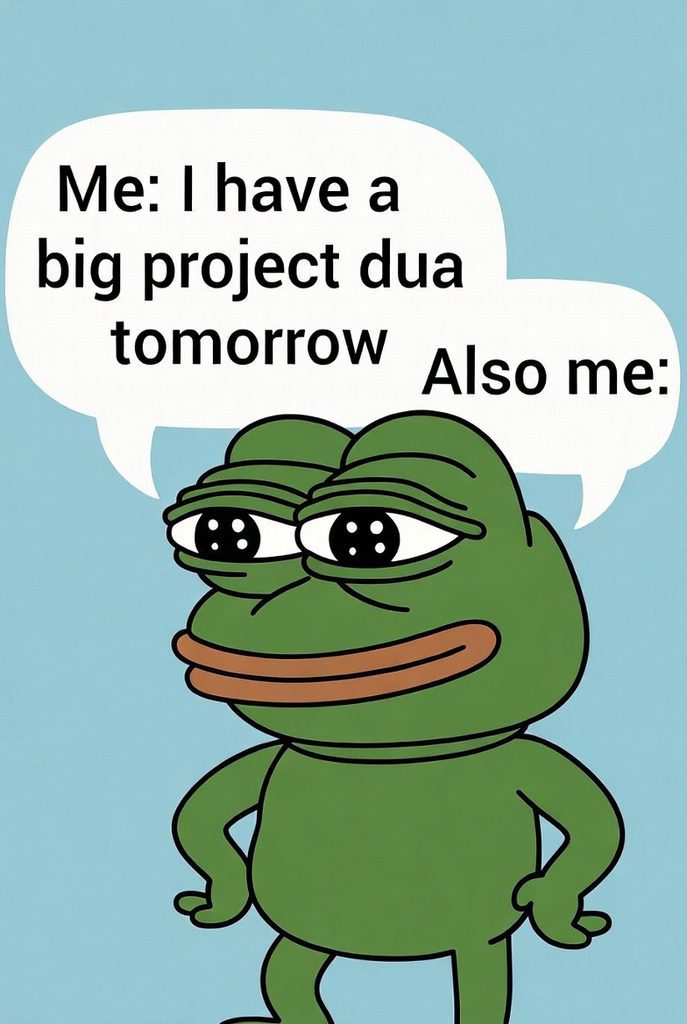
A cartoon frog drawn by a San Francisco artist in 2005 ended up inside a presidential campaign, on a hate-symbol registry, and — impossibly — on the protest signs of people fighting for democracy in Hong Kong. No one planned any of it. That’s the point.
In 2015, a 4chan user typed a plan into a message board. The goal was to turn a cheerful cartoon frog into the symbol of an American political movement. It worked. And nobody — not the frog’s creator, not the Anti-Defamation League, not Hillary Clinton’s campaign — could stop it in time. What follows is the story of how a meme hijacked a presidential election, was declared dead by its own creator, and then came back to life on the other side of the world fighting for democracy.
01 — OriginA Frog Who Just Wanted to Feel Good
Matt Furie was 25, living in San Francisco’s Mission District art scene, when he drew a frog named Pepe for a zine called Boy’s Club in 2005. The comic was four roommates — a wolf, a bear, a dog-muppet, and Pepe — doing what broke 20-somethings do: eat pizza, play video games, fart on each other. In one panel, Pepe is caught urinating with his pants around his ankles. Asked why, he shrugs. “Feels good man.”
That phrase, and that frog’s half-lidded smug expression, hit a nerve on MySpace by 2008 — before emojis existed. Pepe migrated to 4chan, where he became the internet’s face for every emotion that didn’t have one. He became a taxonomy of feeling: Sad Pepe, Smug Pepe, Angry Pepe, Wojak-adjacent Pepe staring into the void. By 2015, he was one of the most widely shared memes on 4chan and Tumblr — a blank canvas on which anyone could project anything. Which was precisely the problem.
A truly empty symbol is the most dangerous kind. Someone will always fill it. And in 2015, someone did — on purpose.
02 — WeaponizationThe Deliberate Theft
The story most people know goes like this: Pepe drifted toward the alt-right, got swept up in the 2016 election, and became a hate symbol almost by accident. That story is wrong in one crucial detail. It wasn’t an accident. As one white supremacist user admitted to The Daily Beast in 2016: “We basically mixed Pepe in with Nazi propaganda, etc. We built that association.” This was a coordinated information operation run from 4chan’s /pol/ board with an explicit goal: contaminate the meme so thoroughly that mainstream users would abandon it, leaving it as an exclusive signal of the fringe.
The goal wasn’t to win an argument. It was to own a symbol — and symbols, once owned, become propaganda that doesn’t need to declare itself.
The operational logic of the 4chan Pepe campaign, 2015The strategy exploited something media critics had not yet named: ironic plausible deniability. A Nazi Pepe is either a horrifying signal to fellow ideologues or a stupid joke — depending on who’s looking. Mainstream journalists who covered it appeared paranoid. People who laughed at it were, technically, just laughing at a cartoon. Documentary filmmakers Arthur Jones and Giorgio Angelini traced this dynamic in their 2020 film Feels Good Man: “The aesthetics of trolling, the culture jamming of trolling, the gaslighting of trolling, all moved off of these message boards and then out into the mainstream of our politics.”
By October 2015, Donald Trump retweeted a caricature of himself as Pepe at a presidential lectern. Whether Trump’s team understood the fringe connotations is still debated — and that ambiguity was the entire point. The image worked as a signal to those who were in on it, and as a funny cartoon to everyone else. Dual-channel communication at scale: the same image carrying two different messages to two different audiences simultaneously. This would go on to define the entire media strategy of the campaign.
For a deeper dive into how digital symbols become political weapons, see our analysis: How AI Is Rewiring the Language of Political Protest →
03 — Institutional FailureWhat Happens When Gravity Becomes Fuel
In September 2016 — approximately one year after the coordinated campaign began, and six weeks before the US presidential election — the Anti-Defamation League added Pepe the Frog to its database of hate symbols. The ADL was careful to note that the majority of Pepe usage remained non-bigoted, and that context mattered. The nuance was accurate. It was also largely irrelevant to how the designation landed in practice.
The designation achieved exactly what the 4chan campaign had been trying to do for months: it made Pepe officially controversial. Now every news article had to explain its dark history. Every campaign surrogate who used a Pepe image accidentally had to answer questions. Clinton’s campaign website published an article calling Pepe “a symbol associated with white supremacy.” They meant to warn people. What they actually did was certify, in the most official way possible, that a cartoon frog had become a front in the culture war.
In May 2017, on Free Comic Book Day, Matt Furie published a six-panel comic. In it, Pepe lay in a casket. His roommates — the wolf, the bear, the muppet — poured liquor on his face and drank the rest. A funeral. Furie’s attempt to symbolically kill his own creation and deny it to those who had stolen it.
The alt-right’s response was immediate: they drew Pepe rising from the dead as Jesus Christ. The funeral had made the symbol more powerful, not less.
The correct technique had been applied — denial of the symbol through its author’s own hand. The result was partial and perverse. The lesson: you cannot defeat a meme by treating it with the gravity of a political speech. The gravity is the fuel.
Furie had said in September 2016 — before any of this — that he thought it was just a phase. “I predict that his sly, lovable, and charming status will be intact as early as next week,” he told the Daily Dot. It was not a performance of calm. He genuinely didn’t understand that this time, the community had an ideological interest in permanence. By 2017, he had lost that bet by two years.
A 2025 study in Party Politics — using structural equation modeling on 240 survey participants — found that among politically cynical individuals, highly humorous memes significantly increased political engagement intention. The people most likely to act on a meme’s political message are precisely those who distrust the institutions trying to discredit it. Every official denunciation was, for that audience, an endorsement.
04 — The Full ArcA Symbol Changes Hands
Matt Furie publishes Pepe in his zine. The “feels good man” panel appears on MySpace. A chill frog dude. Deliberately apolitical.
Matt Furie / indie comicsPepe migrates to 4chan. Sad Frog, Smug Frog, Angry Frog proliferate. Katy Perry and Nicki Minaj tweet him. “Rare Pepes” emerge as collectibles.
Diffuse internet community4chan’s /pol/ board mixes Pepe with Nazi imagery. The stated goal: make the frog too toxic for “normies,” reserving it as an in-group signal.
4chan /pol/ — coordinated campaignA caricature of Trump-as-Pepe appears in the president’s feed. Dual-channel signal: dog whistle to the fringe, meme to everyone else. The campaign says nothing.
Signal crosses into mainstreamClinton’s campaign publishes an explainer. The ADL’s nuanced designation — most uses are fine, context matters — is flattened in media coverage. Official gravity amplifies fringe reach.
Institutions react — six weeks before the electionFurie publishes Pepe’s funeral on Free Comic Book Day. The alt-right draws Pepe rising as Jesus Christ. The funeral backfires completely.
Creator attempts reclamation — symbol grows strongerFurie’s lawyers file DMCA claims against The Daily Stormer, InfoWars ($15,000 settlement), and Richard Spencer. The Daily Stormer removes its Pepes. Legal wins; cultural loss continues.
Copyright law as reclamation toolPro-democracy protesters adopt Pepe as their mascot. He appears on Lennon Walls, protest signs, WhatsApp stickers. Furie emails a protester: “This is great news! Pepe for the people!”
Hong Kong protesters — deliberate reclamationPepe now carries simultaneously: pro-democracy meaning in HK, Twitch gaming culture emotes, residual alt-right use in the US, apolitical usage globally. No single actor controls it. No one ever will again.
Contested, distributed — permanently05 — The PivotHow a Frog Crossed the Pacific and Changed Sides
Here is what no mainstream analysis of Pepe gets right: the most important political act in the frog’s history did not happen in the United States.
It happened in Hong Kong in June 2019. The first pro-democracy marches against Beijing’s proposed extradition bill drew over a million people into the streets — the largest protest in the city’s history. Among the umbrellas and yellow hardhats, protesters began drawing a familiar face on their signs and Lennon Walls: Pepe. Not Nazi Pepe. Not Trump Pepe. Just Pepe — expressive, low-fi, easy to draw in a hurry, available on WhatsApp sticker packs that had circulated in Hong Kong for years with no political connotation whatsoever.
A symbol is not what it was. It is what the person holding it intends — and what the people watching it believe.
The operational lesson of Pepe the Frog, 2005–2019PhD researcher Andy Buschmann, embedded in the movement from June 2019, observed protesters consciously reclaiming Pepe from neo-Nazi groups to oppose what they called “ChinNazi.” It was not ignorance — many knew exactly what the frog had meant in the US. It was strategic. They were using the symbol’s radical flexibility against itself: if Pepe can mean anything, then in this protest, in this city, he means freedom.
When a young female first aider lost the use of an eye to a police projectile, protesters drew Pepe with a bandaged eye. Matt Furie received an email with the image. He wrote back: “This is great news! Pepe for the people!” The man who had killed his own character in a comic strip, spent two years in legal battles with neo-Nazis, and watched his creation become the most visible symbol of America’s online far-right — had just seen it rehabilitated by a democracy movement on the other side of the planet. He had not planned it. No one had. It happened because symbols do not belong to their creators. They belong to whoever is willing to act on them.
06 — The MechanismWhat Memes Actually Do to Political Power
The Pepe story is not primarily a story about a frog. It is a story about what happens when the infrastructure of political meaning-making leaves institutions and enters the network. For most of the twentieth century, political symbols were produced by campaigns, parties, and media organizations — entities with legal accountability, editorial standards, and known addresses. A symbol could be disowned, corrected, retracted. Brookings Institution researchers have documented how memes now spread political messaging, alter market dynamics, allow protest amidst censorship, and change how societies think about war — at speeds institutional communication cannot match.
A Dartmouth study analyzing 239,526 Instagram images during the 2024 presidential election found that meme format was a stronger predictor of engagement than whether or not the content was AI-generated. The structural form of a meme generates more attention than the content inside it. This is the discovery that political operatives understood in 2015 and that political scientists are still catching up to in 2026: the container is the message.
The same 2025 Party Politics study found that while humor in memes increased political engagement, it had a negative direct effect on attitude change among non-cynical audiences. Memes work differently on believers and non-believers. For believers, they solidify and accelerate. For non-believers, they energize engagement but rarely change minds. The polarizing function is the point, not a side effect.
This is the implication no one in the political class has fully reckoned with: memes are not persuasion tools. They are mobilization tools. They do not work by changing what people think. They work by changing how urgently people feel about what they already think — and then pointing that feeling at a target. For related analysis, see: The Algorithm Is the Ideology: How Feeds Shape Political Identity →
This is not a peripheral concern. A 2015 NATO Strategic Communications Centre paper titled “It’s Time to Embrace Memetic Warfare” defined it as “the competition over narrative, ideas, and social control in a social-media battlefield” — and called for it to be brought into mainstream military doctrine. NATO has since formalized cognitive warfare as a domain of competition. A 2025 study in the European Journal on Criminal Policy and Research found that Ukraine’s NAFO movement — using memes to delegitimize Russian propaganda narratives — represents perhaps the first successful state-adjacent memetic defense campaign, with victim-narrative tweets generating twice the retweets of heroism narratives. What 4chan did in 2015 by accident is now being formalized as doctrine.
07 — The Forward ProblemWhat Comes After Pepe
Pepe is no longer the center of meme-based political warfare. AI-generated images have fragmented the meme ecosystem into something faster, more personalized, and considerably harder to track. Dartmouth researchers coined the term “generative memesis” to describe a new dynamic: memes are no longer shared person-to-person but mediated by AI through customized, generated images. Their study of 239,526 Instagram images found partisan divergences that are structurally significant — Democrats used AI-generated content primarily for in-group solidarity, Republicans primarily for out-group attacks. Two different uses of the same tool, producing two different emotional outcomes.
Read together, this Dartmouth data and the 2025 Party Politics cynicism study point toward a dynamic neither paper states explicitly: by 2027, AI-enabled meme generation will allow any political actor with access to a consumer-grade image generator to produce targeted, emotionally calibrated visual content at a volume that no human editorial team can match. The bottleneck in political meme warfare is no longer creativity or production — it is distribution and narrative coherence. The organizations that maintain a legible emotional through-line across thousands of AI-generated variations will have an asymmetric advantage that conventional campaign advertising cannot neutralize.
For policymakers, the implication is structural: the regulatory frameworks being built in the US and EU to govern AI-generated political content are focused almost entirely on deepfakes — fabricated videos of real people saying things they didn’t say. Memes are not deepfakes. They do not claim to be real. Their power comes from emotional resonance, not factual accuracy. A regulation that targets the literal falseness of AI-generated political content will miss the mechanism by which memes actually influence political behavior entirely. See also: Why the EU AI Act Won’t Stop the Next Meme War →
08 — The Closing ArgumentWhat This Means If You’re Paying Attention
If you are a journalist: stop covering memes as curiosities. A meme that reaches 50 million people in 48 hours is not a feature story about internet culture. It is a primary political event requiring the same sourcing standards and accountability journalism you would apply to a campaign speech. The Pepe story was covered as a weird human interest story for at least 18 months before anyone in mainstream media understood it as a power transfer.
If you are in politics or communications: the counter to meme-based mobilization is not a fact-check. Fact-checks are read by people who already distrust the meme. The counter is a competing emotional narrative delivered in the same register — irreverent, shareable, low production cost. This is uncomfortable for institutional actors because it means competing on terrain where you have no natural advantage. The alternative is ceding that terrain. That is what happened in 2016.
If you are paying attention: the Hong Kong chapter is the one worth holding onto. A symbol that the alt-right had invested two years and enormous cultural capital in owning was stripped from them in a summer — not through legal action, not through platform moderation, not through a fact-check article — but by people on the other side of the planet who decided to mean something else with it. The alt-right never recovered Pepe. Matt Furie won. He just didn’t win the way he tried to.
Political symbols are not won through argument. They are won by whoever acts on them last, loudest, and in the most unexpected place.
The uncomfortable conclusion — the one this entire story builds toward and that no one in the political class wants to say plainly — is this: the people who understood memes as power in 2015 were right, and the people who treated them as jokes were wrong, and the asymmetry between those two groups shaped the political history of the following decade. A campaign staffer who dismisses AI-generated meme warfare as a fringe concern in 2026 is making the same category error as the Clinton staffer who dismissed Pepe as “just a phase” in September 2016. The election results will reflect it.
FAQCommon Questions
Sources & Further Reading
- Zhang, J. (2025). “When memes govern: A study of TikTok video memes in the 2024 US presidential election.” Party Politics. Sage Journals.
- Chang, H. et al. (2024). “Generative Memesis: AI Mediates Political Memes in the 2024 USA Presidential Election.” arXiv preprint. Dartmouth College.
- PACM HCI (2025). “Narratives of War: Ukrainian Memetic Warfare on Twitter.” Includes 2× retweet finding for victim narratives.
- Anti-Defamation League. “Pepe the Frog.” ADL Hate on Display database.
- Chatham House (2023). “The evolution of the Pepe the Frog meme.”
- Wikipedia. “Matt Furie.” (Sourced to multiple primary accounts.)
- Hong Kong Free Press (2019). “Hong Kong protesters transform alt-right Pepe the Frog into pro-democracy symbol.”
- Buschmann, A. (ICNC, 2019). “Why Do Hong Kong Protesters Use Pepe the Frog as an Icon for Freedom and Democracy?” (Field researcher embedded in movement.)
- The Daily Beast (2017). “The Creator of Pepe Is Winning His War on the Alt-Right.” Includes direct quote from white supremacist user.
- Fast Company (2020). “The twisted history of Pepe the Frog.” Interview with Feels Good Man directors Jones and Angelini.
- Brookings Institution (2025). “How memes are impacting democracy.” TechTank Podcast.
- Munk et al. (2025). “Digital Defiance: Memetic Warfare and Civic Resistance.” European Journal on Criminal Policy and Research.
- Wikipedia. “Memetic warfare.” Includes 2015 NATO StratCom paper definition.
- NBC News (2017). “Pepe the Frog creator wants to rebrand him as symbol of peace and love.”
- Artnet News (2022). “The True Story Behind the Origins of Pepe the Frog.” Full transcript interview.
- Inquisitr (2016). Includes Furie’s September 2016 “just a phase” quote from the Daily Dot.
The Scary Truth About Deepfake Celebrities: 7 Alarming Trends for 2026
How Memes Are Becoming the New Stock Market in 2026: The Complete Practitioner’s Framework
What If AI Became President?
The Future of Streaming Nobody Saw Coming: 9 Game-Changing Shifts Reshaping 2025
Why TikTok Trends Spread Faster Than Diseases: 2025 Best Guide!