
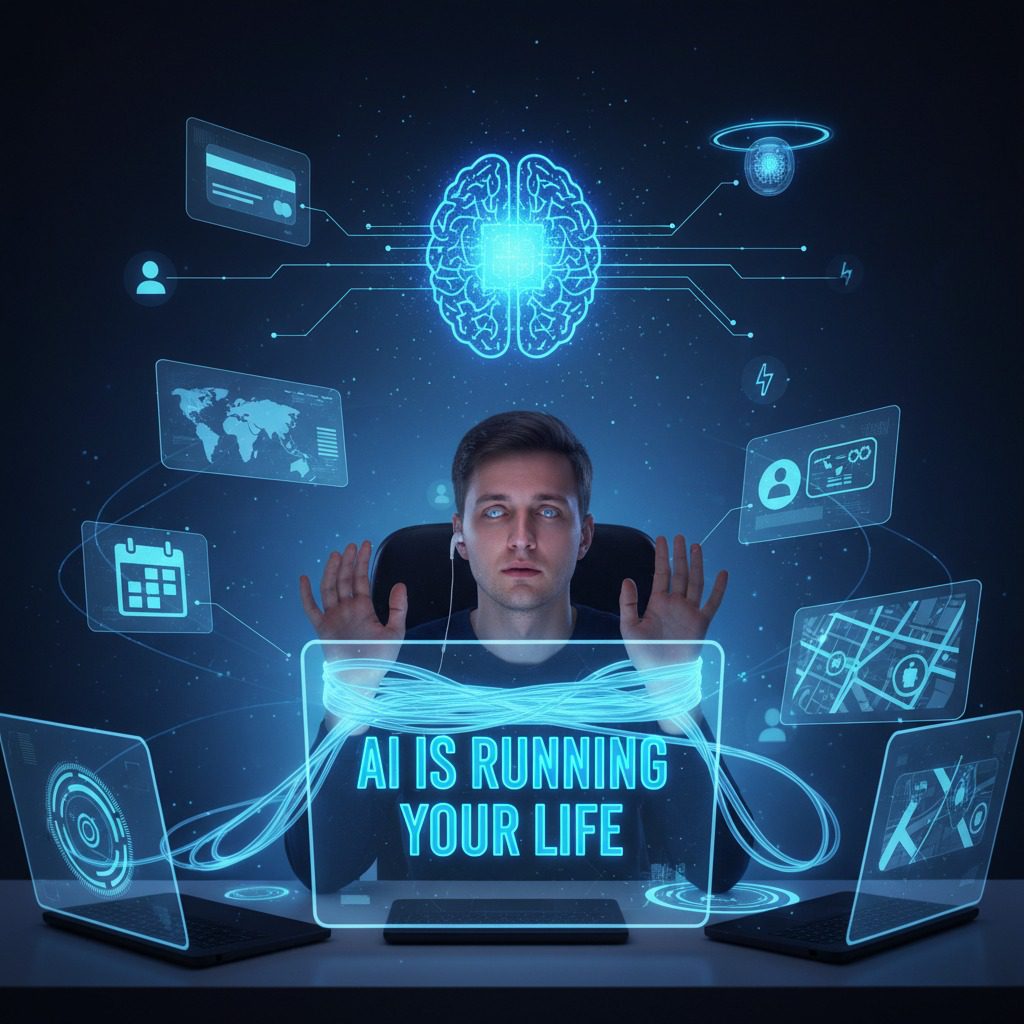

AI Is Running Your Life:
12 Shocking Ways
It Controls You Now
You think you’re deciding. Your next job, your insurance rate, your date on Friday, your morning news — an algorithm already decided all of it. Here’s the forensic evidence, sourced and unsparing.
There is a version of your life in which you are in charge. You get a job because a human believed in you. You pay a fair, public price for things. You see news because editors decided it mattered. You fall in love because you met someone and something clicked. Every one of these assumptions is now wrong — and has been, quietly, for years.
Artificial intelligence is no longer a product you choose to use. It is the invisible infrastructure beneath every significant decision in your day. The loan officer who set your rate. The recruiter who passed on your application. The feed that shaped your political views this morning. None of them were human. They were models — trained on data you never consented to share, optimising for goals you were never told.
The most unsettling part isn’t that AI is deciding. It’s that it’s doing so in ways engineered to feel like your decisions. Pew Research, 2026 found that while only a third of consumers believe they’re using AI regularly, actual usage is 77%. The gap between what we think is happening and what is happening is where this story lives.
By 2026, AI is no longer a feature or a tool. It has become the environment — a force we live inside rather than interact with from a distance.
Every hour of your day, an AI is in the room with you
Where AI has quietly taken the wheel
Each section below is sourced, expandable, and structured for AI quotation. Click any card to read the full analysis.
AI Screens Your Job Application Before Any Human Sees It
Jobscan ATS Report, 2025
When you submit a job application today, your first reviewer is not a recruiter. It is a machine. Applicant Tracking Systems powered by machine learning parse your résumé in roughly 0.3 seconds, extract job titles, dates, keywords, and skills, then score you against the job description. The Interview Guys, 2025
The numbers are staggering: 83% of companies plan to use AI résumé screening, and 24% have already deployed AI for the entire interview process — a figure rising to 29% through 2025. The Interview Guys, 2025 Some candidates interact exclusively with AI systems until a final hiring decision is made. You rehearsed your answers. The system may have evaluated your blink rate.
The bias problem is documented and admitted. 67% of companies acknowledge their AI hiring tools could introduce bias. Age bias is the most commonly identified type, followed by socioeconomic and gender bias. CoverSentry Hiring AI Report, 2026 University of Washington research testing three ATS models across 550+ résumés found AI tools favoured white-associated names 85% of the time versus Black-associated names 9% of the time.
Only 29% of companies maintain full human oversight on all AI rejection decisions. In 21% of companies, AI can reject candidates at every stage without any human review. CoverSentry, 2026
Your News Feed Was Engineered to Outrage You
Stanford HAI AI Index, 2025
The content at the top of your social media feed was not selected by editors, friends, or simple chronology. It was ranked by a reinforcement learning model with one primary objective: maximise the time you spend engaged with the platform. The most reliable driver of sustained engagement is moral outrage. Facebook’s internal researchers documented this. The model learned it independently. Stanford HAI, 2025
As of June 2025, 50% of US adults say increased AI in daily life makes them feel more concerned than excited — up from 37% in 2021 when Pew Research first asked the question. Pew Research Center, March 2026 What they’re describing, in part, is the emotional exhaustion of living inside an outrage optimisation system every morning.
The algorithm doesn’t know or care that you feel worse after scrolling. It only registers that you kept scrolling. In the system’s logic, that is a perfect outcome.
An AI Set Your Insurance Premium by Watching You Drive
CoinLaw AI Insurance Report, 2025
Auto insurance has become an AI surveillance product. Telematics programmes from Progressive (Snapshot), State Farm (Drive Safe & Save), Allstate (Drivewise), and Nationwide (SmartRide) continuously track your speed, braking patterns, cornering behaviour, time of day driving, and trip frequency — then feed this to machine learning models that adjust your premium in near real time. CoinLaw Insurance Stats, 2025
The pitch is “good drivers save 30–40%.” The reality is more complex. A 2021 Consumer Reports investigation found major insurers charged significantly higher rates in minority-majority ZIP codes independent of driving risk — behaviour consistent with algorithmic proxy discrimination. The model is legally prohibited from using race as a variable. It uses ZIP code instead, which correlates strongly with race. DEV Community — Financial AI Surveillance Analysis, 2026
By 2025, 83% of insurers had integrated AI technologies across their operations. CoinLaw, 2025 Your homeowner’s insurance is now priced using LexisNexis CLUE, a database that follows your claims history for seven years — information you cannot erase and may not even know exists.
In 21% of companies, AI can reject insurance claims at all stages without human review. There is no one to call. The model decided.
Your Credit Score Has Been Replaced by a Surveillance Score
DEV Community Financial AI Analysis, 2026
The traditional FICO score was simple, publicly defined, and calculable by hand: payment history (35%), amounts owed (30%), length of credit history (15%), new credit (10%), credit mix (10%). FICO published these weights. You could know the rules. DEV Community, 2026
Modern AI-based lending models from companies like Upstart and ZestFinance operate differently. They use thousands of variables — the time of day you apply, whether you type in all-caps, how long you spent reading the terms and conditions, your rental payment history from Experian RentBureau, your bank transaction data scraped via Plaid. You consented to none of this consciously. It was buried in terms of service.
The EU AI Act (in force since August 2024) classifies credit scoring as a high-risk AI system requiring transparency, explainability, and human oversight. Harvard Data Science Review, Summer 2025 The United States has no equivalent federal law as of March 2026. Your mortgage rate was set by a model you cannot audit.
The Price You See Is Calculated Specifically for You
National University AI Statistics, 2026
When you view a product online, the price displayed is not the market price. It is your price — generated in milliseconds from your device type, operating system, location, browsing history, purchase frequency, and estimated willingness to pay. Two shoppers looking at the same item simultaneously may see different prices. Neither will know. This is not illegal in most jurisdictions.
Dynamic pricing began with airline tickets and ride-sharing. It has spread to groceries (with electronic shelf labels repriceable in real time), hotel rooms, concert tickets, pharmacy items, and cloud software subscriptions. The era of the price tag as a stable, public, equal number is ending.
If you’ve searched for the same product twice, the model noticed. If you’re on an iPhone in a wealthy ZIP code, some retailers charge more. If you’re checking out in the last hour before a limited sale ends, the “urgency” was engineered. The Global Statistics, 2026
AI Decided Who You’d Fall in Love With
Pew Research, 2026
Dating apps do not show you everyone available nearby. They show you a curated subset, ranked by a collaborative filtering model that has one primary objective: keep you swiping. Hinge, Tinder, and Bumble all use variations of reinforcement learning to determine whose profile you see first, how prominently it appears, when it disappears, and when it reappears.
Research suggests apps deliberately withhold highly compatible matches to sustain a sense of scarcity — the same technique used in slot machines. You feel the excitement of possibility while the algorithm manages the release rate of that feeling. Romance, the most intimate human act, is now mediated by engagement optimisation.
The AI is not optimising for your relationship success. It is optimising for platform revenue. These are different things, and when they conflict, the platform wins.
AI Is Pre-Diagnosing You Before Your Doctor Speaks
Master of Code, Generative AI Statistics, 2026
Wearable devices now stream continuous biometric data to machine learning models capable of detecting atrial fibrillation, sleep apnea, Type 2 diabetes markers, and early-stage cardiac events — months before clinical symptoms emerge. The Apple Watch’s ECG feature has a documented history of identifying cardiac events that physicians later confirmed. AI radiology systems now match or exceed specialist accuracy on certain scan types. Stanford HAI AI Index, 2025
But the inverse is equally true. The model decides what gets flagged — and what doesn’t. The anxious person whose wearable generates a false positive that triggers an unnecessary emergency visit. The person with an atypical symptom pattern that doesn’t match the training data and is never flagged. In healthcare, AI errors have a body count.
34 US states introduced over 250 healthcare-focused AI bills in 2025, reflecting urgent concern around automated diagnostics and patient data. Master of Code, 2026 The transparency deficit in medical AI is one of the most critical unsolved problems of this decade.
Predictive Policing Algorithms Target Your Neighbourhood
ACLU Research Brief
In cities across the United States and Europe, police departments use AI to predict where crime is likely to occur and deploy officers accordingly. These systems analyse historical crime data to generate daily “hot spot” maps. The disturbing circularity: if officers are sent to neighbourhood A more than neighbourhood B, they record more crime in neighbourhood A — which trains the model to send them there more often next time.
Civil liberties organisations have documented how these systems encode and amplify historical racial biases in policing. The algorithm presents itself as objective. It is not. It is a feedback loop trained on a biased past. The input data was collected by a system with documented racial disparities in stops, searches, and arrests. The model reproduces those disparities at scale and speed, wrapped in the authority of mathematics.
AI is also used in bail decisions, parole recommendations, and sentencing guidance in multiple jurisdictions — almost always without the defendant’s knowledge.
Your Car Is a Rolling AI Surveillance Device
The New York Times, March 2024
Modern vehicles equipped with telematics — effectively all cars manufactured after 2020 with connectivity features — continuously transmit data about your speed, braking patterns, hard turns, time of day driving, and precise location. General Motors was caught selling driving data from 8 million vehicles to insurance companies in 2024 without meaningful driver consent, triggering regulatory investigation and class-action lawsuits. New York Times, 2024
It goes further. The AI controlling your car’s adaptive cruise control, lane-keeping assist, automatic emergency braking, and parking assistance makes thousands of micro-decisions per minute. You hold the wheel. The AI is also driving. In a Tesla, the system learns from your driving style and adjusts its behaviour accordingly — the car adapts to you while simultaneously reporting your behaviour to a central data system.
A Growing Share of Content You Read Was Written by AI
The Global Statistics, 2026
A growing proportion of online content — product descriptions, news summaries, financial reports, sports recaps, weather articles, and increasingly opinion pieces — is generated by large language models with minimal or no human review. The Associated Press, Bloomberg, and thousands of e-commerce retailers have automated high-volume content production. The Global Statistics, 2026
This creates a profound epistemological problem researchers call “model collapse”: when AI generates content, then trains on that content, and generates more, the outputs gradually drift from reality into a hall of mirrors made of statistical averages. The internet is increasingly a self-referential AI feedback loop — and you’re reading it as though it’s ground truth.
As of 2026, 86% of students worldwide use AI in their academic work. The Global Statistics, 2026 The next generation is being educated partly by text generated by systems trained on text generated by other systems.
AI Agents Are Now Acting on Your Behalf Without Asking
Gartner via USAII, 2026
The latest generation of AI systems — called agentic AI — can browse the web, send emails, book appointments, write and execute code, and complete multi-step workflows with minimal human involvement. These are not chatbots answering questions. They are autonomous agents that set sub-goals, plan sequences of actions, and execute them. USAII AI Trends, 2026
Gartner projects that by end of 2026, 40% of enterprise applications will embed these agents — up from less than 5% a year earlier. Capgemini Research suggests that by 2028, 38% of companies will treat AI agents as formal members of human teams. Master of Code, 2026 Workers with AI skills now command a 56% wage premium — up from 25% just one year prior. PwC via USAII, 2026
The legal question of who is responsible when an agent makes a costly autonomous error — the user, the company, or the model — remains unresolved in most jurisdictions. The agent acts. The liability is unclear.
AI Is Shaping What Your Children Learn and How
Pew Research, March 2026
Adaptive learning platforms like Khan Academy’s Khanmigo, Duolingo, and a growing K-12 ecosystem use AI to personalise lesson difficulty, pacing, and content selection for each student — continuously and invisibly. The model decides what your child encounters next. Critics argue this creates educational filter bubbles: systems feed students what they perform well at (optimising engagement) rather than where they most need challenge. Pew Research, 2026
Pew Research found that one in ten US teens uses an AI chatbot for all or most of their schoolwork. About 60% of teens say students at their school use chatbots to cheat at least somewhat often. Teachers are increasingly reviewers of AI-generated lesson plans rather than architects of curriculum. The classroom of 2026 is as algorithmic as the news feed.
The question no one has answered: what kind of thinkers does an AI-mediated education produce?
Where algorithms have taken over the most
How an AI decision happens in 200 milliseconds
From the moment you apply, swipe, or buy — to the moment a result appears — this is the process that replaced human judgment.
What people think is happening vs. what is
National University, 2026
Pew Research, 2026
The Interview Guys, 2025
What you believe vs. what AI is actually doing
| Domain | What You Assume | What AI Is Actually Doing | Transparency | Source |
|---|---|---|---|---|
| Job Application | Hiring manager reads your résumé | ATS model scores & filters in 0.3s; only top scores reach humans | None required | Interview Guys |
| Insurance Rate | Based on age, car model, and driving record | Telematics AI tracks braking, speed, time of day and reprices continuously | Disclosed via opt-in | CoinLaw |
| Social Feed | Posts from people you chose to follow | Engagement-maximising model with no obligation to show you truth | None | Stanford HAI |
| Online Price | Public retail price; same for everyone | Dynamic pricing model personalises your price in milliseconds | None required | National University |
| Medical Scan | Doctor interprets results directly | AI pre-reads scans; flags guide where physician looks | Varies by hospital | Stanford HAI |
| Dating Matches | App shows compatible nearby people | Algorithm optimises for platform engagement; withholds best matches | None | Pew Research |
| Credit Decision | Bank evaluates your financial history | ML model uses 1,000+ behavioural proxies, many unrelated to creditworthiness | EU: mandatory. US: none | Harvard DSR |
| AI Agents Acting | AI executes only what you instruct | Agentic systems now plan, decide, and act autonomously across tasks | Legally unresolved | Master of Code |
How we got here: a timeline
The first mass-market AI system to replace human editorial judgment at scale. Within two years, it drives 80% of content watched on the platform.
LinkedIn’s AI-powered candidate matching and ATS tools reach enterprise adoption. The résumé written for human readers is quietly replaced by the résumé written for machines.
For the first time, more Americans receive news from social media than newspapers. The engagement-maximising model now shapes political reality for hundreds of millions.
Surge pricing spreads from ride-sharing to groceries, hotels, and events. For the first time, neighbours pay different prices for the same item at the same moment.
Fintech lenders using alternative data credit models — incorporating behavioural, social, and transactional signals — begin to challenge FICO’s 30-year dominance in lending decisions.
ChatGPT launches. Within 12 months, AI-generated content floods the internet, begins training on itself, and permanently blurs the boundary between human and machine authorship.
General Motors is caught selling detailed telematics data from 8 million vehicles to insurance companies without meaningful consent — triggering regulatory investigation and exposing the automotive data economy.
AI agents perform multi-step tasks — booking, emailing, coding, purchasing — without moment-to-moment human oversight. The AI advisor becomes the AI actor. Legal accountability remains undefined.
40% of enterprise apps embed AI agents. Wearables govern sleep. Predictive models set prices, shape romance, and filter employment. 1 billion+ people use AI monthly. You live inside the system.
Get the AI Audit Checklist (PDF)
A 12-point, one-page checklist for finding out which AI systems already hold data on you and what to do about each one — built from the sources cited throughout this article.
No spam. One email with your PDF, unsubscribe anytime. Requires an email-delivery integration to actually send the file — see implementation note in page source.
You can’t opt out. But you can see clearly — and act.
The honest answer to “what should I do?” is not a seven-step digital detox. AI decision systems are infrastructure now — embedded as deeply as electricity or sewage. Opting out entirely means opting out of employment systems, financial systems, healthcare, and the information environment. That is not a realistic choice.
What is realistic is a form of informed consciousness — knowing which decisions in your life have been quietly reassigned to machines, and demanding transparency and accountability when those decisions are wrong. The EU AI Act (in force since August 2024) mandates that high-risk AI systems — used in hiring, credit, law enforcement, and healthcare — must be explainable, auditable, and challengeable by affected individuals. Master of Code, 2026 The United States has no equivalent federal law.
Know Your Rights in the EU
The EU AI Act gives you the right to explanation and challenge for high-risk AI decisions. If you’re in Europe and were rejected by an AI system for a loan, job, or insurance, you can legally demand a human review.
Audit Your Data Footprint
Request your data from LexisNexis, Equifax, and major data brokers. Under GDPR and many US state laws, you have the right to access, correct, and in some cases delete the data AI systems use to score you.
Optimise For The Machine You Know About
ATS systems are documented and learnable. Résumés with clean formatting and keyword alignment with the job description score measurably higher. You can compete with the algorithm on its own terms.
Demand Algorithmic Transparency
Support companies, politicians, and regulators who require AI systems making consequential decisions to disclose how they work. The demand for algorithmic accountability is the civil rights issue of this decade.
1 thought on “Is AI Already Running Your Life?”