


Your Inbox, Your Camera and Your Watch Are Already Running AI You Never Switched On
A federal judge just threw out the big Gmail-AI lawsuit. Apple Mail is still occasionally handing your scam emails a gold star. And Europe quietly gave its toughest AI rules another sixteen months before anyone has to prove they’re following them. None of these three things made it into the same article until now — and together they tell you more about where consumer AI actually stands in 2026 than any single headline did.
THE SHORT VERSION
- Gmail’s Gemini rollout triggered a real lawsuit in November 2025. On July 7, 2026, a federal judge dismissed it — not because the underlying facts were wrong, but because the plaintiffs couldn’t show they’d been concretely harmed. That’s a bigger deal for how AI defaults get challenged in court than most outlets reported.
- Apple’s on-device Mail summaries are exactly as private as Apple says they are, architecturally. They’re also still occasionally putting phishing emails at the top of people’s inboxes under a label called “Priority” — a problem that’s been documented since early 2025 and, as of mid-2026, hasn’t fully gone away.
- The EU just pushed its toughest AI obligations back sixteen months, to December 2, 2027, while the underlying edge-AI market keeps growing at roughly 20-22% a year. That gap — more capability, less oversight, at the same time — is the actual thread connecting everything in this piece.
- None of it requires you to become paranoid or to quit your phone. It requires about half an hour, twice a year, and this article tells you exactly where to spend it.
WHAT CHANGED IN THIS REBUILD — AUGUST 2026
Corrected the Gmail/Gemini timeline (October 2025 default-on, not a March 2026 rollout) and added the July 7, 2026 dismissal of Thele v. Google, which wasn’t public when the earlier version ran. Added the Apple Mail “trusted sender” phishing pattern, refined the EU AI Act section with the Council’s June 29, 2026 confirmation and its separate watermarking timeline, and refreshed the FDA and edge-AI market figures to their latest published releases. Full change log at the bottom of this page.
Before we startIs This Article For You?
Quick honesty check, because I’d rather lose you now than waste your time: this isn’t written for people who think all AI is a plot, and it’s not written for people already running a self-hosted mail server with PGP on everything. It’s for people who use Gmail or Apple Mail, own a decent camera phone, and maybe wear a smartwatch — and who want an answer that’s actually been checked against court filings and FDA data, not a screenshot with a red circle drawn on it.
KEEP READING IF YOU
- Use Gmail, Apple Mail, or Outlook every day
- Wear a smartwatch or fitness tracker
- Handle client, patient, or legal correspondence by email
- Want to know what’s on by default, and why it got that way
SKIP IT IF YOU
- Already audit your settings every quarter
- Run privacy-first, self-hosted tools exclusively
- Want silicon-level model architecture, not decisions
01Why These Three Stories Belong Together
Most AI coverage in 2026 is still chasing the same story: whose model beat whose benchmark this week, who shipped an agent that can book your flights. Fine, that’s real. It’s just not the AI that’s actually touching your Tuesday afternoon — the version of the story I laid out in more general terms in AI Is Already Running Your Life (You Just Didn’t Get a Vote). This piece is the specific, sourced follow-up: inbox, camera, watch, one at a time.
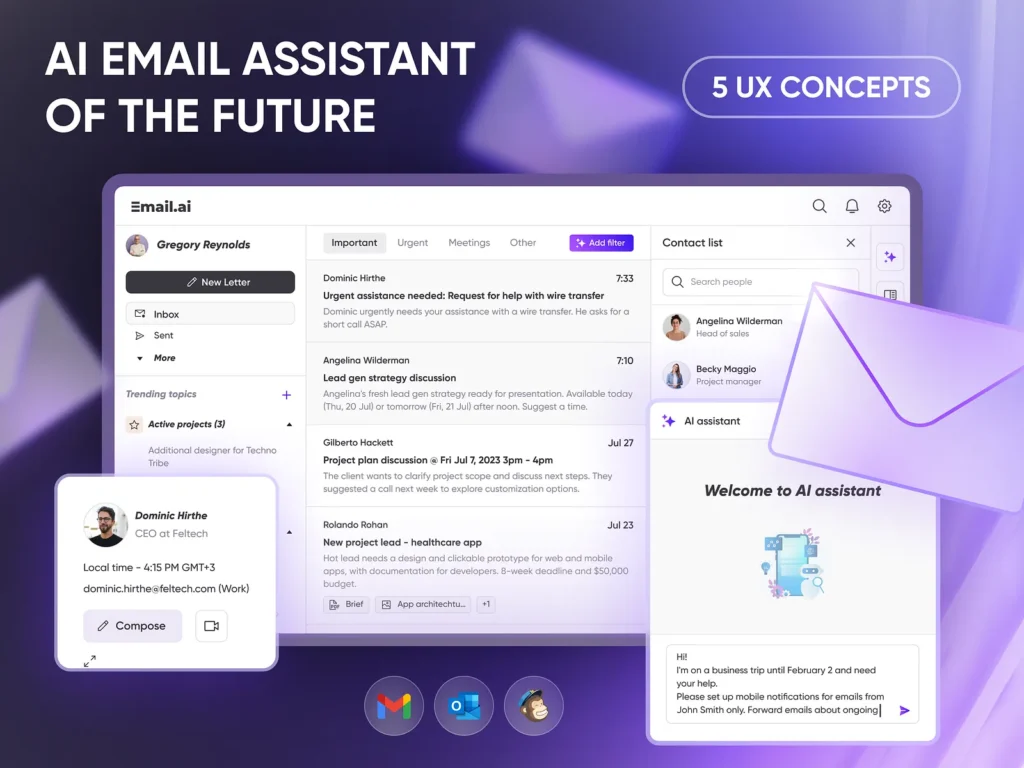
The AI shaping your day is the one deciding which email lands at the top of your inbox — including, on at least one platform, some of the phishing attempts. It’s the one in your watch that decided to buzz about your heart rhythm without asking permission first. It’s the one in your camera that’s already decided what “you” are supposed to look like before you’ve pressed the shutter. None of it asked in any meaningful way, and until this year, almost nobody had tested in court whether it needed to.
That test happened. It didn’t go the way most privacy advocates expected. And it happened in the same eight months that Europe quietly gave the entire category of software sixteen more months before its toughest oversight rules bite. I think those two facts, read together, tell you something true about 2026 that no single headline captured: the technology outran the referee, the referee just admitted it, and the one court case that tried to force a foul call got waved off on a technicality. Everything below is the evidence for that, plus what you can actually do about it this week.
02Gmail, Gemini, and the Lawsuit That Just Got Dismissed
Here’s the sequence in order, because I went back through the actual court docket for this one — most coverage either stopped following the story in November or never checked what happened after.
Google begins rolling out “Smart Features” prompts across Gmail, Chat, Meet and Drive — the setting that lets Gemini read message content to power summaries, drafts, and search. It had technically existed in some form for years.
Google flips Smart Features to on-by-default for Gmail, Chat, and Meet users outside the EU, UK, Japan, and Switzerland — where GDPR-style rules require opt-in instead. Reporting since has generally lined up on this date as the actual switch.
Thomas Thele and Melo Porter file Thele v. Google LLC in the Northern District of California, arguing the default-on switch let Gemini access years of private Gmail, Chat and Meet history without real consent — framed as unlawful wiretapping under California’s privacy statutes.
A separate, inaccurate claim goes viral: that Google had opted everyone into training Gemini on private email content. Google pushes back directly, and independent fact-checkers confirm the training claim doesn’t hold up — while also confirming the underlying Smart Features access is real and does require an active opt-out.
Gemini stops being a sidebar you can ignore. Google folds it natively into Gmail with auto-generated thread summaries, natural-language search, and free access to “Help Me Write” — described by more than one outlet as the biggest Gmail redesign in twenty years. In the US, it’s on by default; in the EEA, UK, Japan and Switzerland, it stays opt-in.
Judge Noël Wise, US District Court, N.D. Cal., dismisses Thele v. Google. Not on the facts — on standing. The court found the plaintiffs hadn’t shown a concrete enough injury from Gemini simply having the technical ability to process their data, and gave them 21 days to amend. As of this writing, no amended complaint has changed that outcome.
That last date is the part almost no consumer-facing coverage has actually sat with. It’s not that Google proved Gemini never touched anyone’s inbox — the court didn’t rule on that. It’s that a federal judge said, in effect: knowing a company gave an AI system default access to your private communications isn’t, by itself, enough to sue over. You need to show what specifically happened to you because of it. Bloomberg Law’s coverage of the ruling is worth reading in full if you want the legal reasoning, but the practical upshot for the rest of us is this: the “opt-out, not opt-in” pattern this article keeps describing just got a lot harder to challenge in federal court, at least until someone can point to a specific, provable harm.
Apple’s architecture, for comparison, reads better on paper — and mostly checks out on paper too. Apple’s own documentation states that Mail preview summaries are generated by on-device models, with anything heavier routed to Private Cloud Compute, a server tier Apple says discards your data once it answers your request and opens up to outside security researchers to verify that claim. An independent technical analysis of the system in 2026 broadly backed the architecture while noting the obvious limit: any AI system that summarizes your email has to decrypt and read it somewhere, even briefly, and no amount of clever infrastructure makes that step disappear.
03Apple Mail’s Phishing Problem, One Year On
This is the part of the story that’s aged the worst, and I say that as someone who wanted to write “Apple fixed this” and, after checking, couldn’t.
Starting around early 2025, users on Apple’s own community forums began reporting that the Mail app’s new AI-driven Priority inbox was doing something backwards: pinning obvious phishing and scam emails to the top of the inbox, under a label meant to signal “this one matters.” Security researchers looked into why. Cofense’s Joshua Bartolomie, who leads the firm’s global threat services, told reporters the model appeared to judge urgency mostly from a message’s wording and structure — the kind of “your account is at risk” phrasing scammers rely on — without adequately checking whether the sender’s domain and authentication actually matched who it claimed to be.
“My ‘priority’ box is exclusively and obviously spam and scams.”
— A user on Apple’s own community support forum, describing the issue in real time, February 2025That’s the kind of complaint that’s easy to write off as a launch-week bug. It wasn’t. As of mid-2026, independent write-ups covering Apple Intelligence in Mail still describe the same failure mode — a Priority system that reads urgency from tone rather than trust, and a separate “trusted sender” label that Apple Mail can display based on familiarity signals rather than actual verification, which security reporters have shown scammers exploiting directly by mimicking a sender’s branding closely enough to earn the badge. It’s the same underlying pattern I found across ranking systems more broadly while reporting The Apps That Track You Every Day (And What They Actually Do With It): a model optimized to feel helpful isn’t the same thing as a model built to verify anything.
None of this means turn Apple Intelligence off wholesale — the summarization is genuinely useful and stays on-device for the vast majority of requests, which is a real privacy advantage over a cloud-first competitor. It means treat “Priority” as a convenience label, not a security signal, and keep verifying senders the boring, manual way for anything involving money, passwords, or your Apple ID.
04Your Camera’s Neural Chip Is Already Editing the Photo
Before you’ve pressed the shutter, a dedicated neural processing unit has already classified the scene, segmented your subject from the background pixel by pixel, and — if the light’s bad — prepared to stack several exposures the instant you tap the button. That’s not a filter applied afterward. It’s baked into capture, and it happens whether or not you’ve ever opened a settings menu for it.
The pipeline, in plain terms
- Scene detection — the model decides what you’re photographing and picks a tone curve to match
- Subject segmentation — a neural mask separates you from the background, which is how portrait mode blurs the right thing without you tracing an outline
- Multi-frame fusion — night shots are several frames stitched together and denoised algorithmically, not one long exposure
All of this runs on the device — genuinely good for privacy, since raw frames don’t need to leave your phone. But the model’s aesthetic opinions get baked into every photo, and there’s no toggle on any major phone for “don’t beautify my food photos.”
If your phone photos look a little too polished compared to what your eyes actually saw, that’s not your imagination. It’s a model with fairly strong opinions about contrast and skin tone, applied automatically, every single time you tap the shutter.
05What Your Watch Is Actually Measuring — and How Well
Apple’s irregular rhythm notification has the most public evidence behind it of any consumer health-AI feature, mostly because Apple ran one of the largest cardiovascular studies ever conducted to get it cleared. In the sub-study submitted to the FDA, of people who got a notification while also wearing a medical-grade ECG patch, roughly 80% showed atrial fibrillation on the patch and 98% showed AFib or another clinically relevant arrhythmia. Apple has separately reported sensitivity around 88.6% and specificity around 99.3% for the feature. It’s not a diagnosis — it’s a screening tool, cleared specifically for people with no prior AFib diagnosis — but it’s a real, FDA-reviewed number, not a line from a marketing deck.
Source: FDA AI/ML-Enabled Medical Device List, via IntuitionLabs’ March 2026 analysis of the FDA’s own published dataset. Radiology accounts for roughly 76% of all clearances; cardiology devices like AFib detection are a much smaller slice. 2015–2022 figures are reconstructed from the FDA’s published year-by-year growth data.
The part getting less attention than the FDA count is the symptom-checker apps sitting next to that same health data on your phone. Usability research on these tools has found that people often don’t realize they’re talking to a probabilistic model guessing at likely causes from a symptom list, not a system retrieving settled medical fact — a distinction that matters quite a lot when you’re deciding whether a headache needs an ER visit or a nap.
06Your Map App, and Your Appliances
Google Maps and Apple Maps moved past turn-by-turn navigation years ago — routing now factors in live incidents, historical traffic patterns, and your own movement history. The genuinely good news here is easy to miss, because it rolled out gradually rather than as one announcement: since a phased update that ran through 2023 and 2024, Google’s Timeline (formerly called Location History) stores your movement data locally on your device by default, and retention for anything synced dropped from 18 months to 3. Location History itself is still off by default for new accounts, though it’s worth checking, since “off by default” and “off on your specific account” aren’t always the same thing after a few years of settings migrations — the exact drift I catalogued app-by-app in The Apps That Track You Every Day.
Let it drive
- Cities you don’t know well
- Long drives where live incident data actually saves time
Trust yourself
- Your own commute, after the first week or two
- Any drive you’d rather not have logged — check whether Location History is actually on before assuming it isn’t
Smart appliances are the least dramatic category here, and honestly the one doing the most uncomplicated good. Washing machines with vibration sensors classify fabric type and adjust the spin cycle so your sweaters survive the wash. None of that needs Wi-Fi — the model runs on a cheap embedded chip nobody ever announces at a keynote. The real question isn’t whether this helps (it does); it’s whether your specific unit is also phoning home, a question I dug into at the appliance level in The Dark Side of Smart Homes. If setup required a Wi-Fi connection and an account, check your router’s connected-devices list. If the appliance shows up there, it’s talking to someone, even if the companion app sits unopened on your phone forever.
07Sixteen Months, and Who’s Actually Watching
Here’s the part almost no consumer-tech article has connected to the rest of this story, because it happened in a Brussels press release most people never read — and it’s the actual argument of this piece, not a footnote tacked onto the end.
The trend making everything above possible is edge AI: running the model on your own device instead of shipping your data to a server somewhere. Grand View Research puts the global edge AI market at $24.9 billion in 2025, growing to roughly $30 billion in 2026, on its way to nearly $119 billion by 2033 — a compound annual growth rate above 21%. It’s not a niche category anymore. Microsoft’s Copilot+ PC certification now requires at least 40 TOPS of on-device neural processing just to qualify for the label, which is why practically every new laptop chip released this year ships with a dedicated neural engine built in.
Source: Grand View Research, Edge AI Market Size & Forecast Report, 2026, for confirmed 2025–2026 figures ($24.9B and $30.0B). 2022–2024 values are approximate, back-cast from the same published growth series; treat them as directional, not exact.
Edge AI is a genuine privacy upgrade in one specific sense: raw data doesn’t have to leave the device to get processed. It’s a transparency downgrade in a sense that gets far less attention. When a model runs locally and updates silently through a routine point release, there’s no practical way for an outside researcher — or you — to audit exactly what changed. A cloud model can, at least in theory, be probed by a third party sending it test queries. A model quietly retrained and pushed to your phone in a background update mostly can’t be, unless the manufacturer chooses to open the door, the way Apple has done with Private Cloud Compute’s research program.
Which is exactly the category of system the EU just gave more room to move in. The AI Act’s toughest rules — covering “high-risk” AI used in hiring, credit scoring, and biometric identification — were due to fully apply on August 2, 2026. On May 7, 2026, EU negotiators struck a provisional deal called the Digital Omnibus on AI, and the Council formally confirmed it on June 29, 2026: standalone high-risk systems under Annex III now get until December 2, 2027, and high-risk AI embedded in already-regulated products (Annex I — think medical devices and cars) gets until August 2, 2028.
None of the specific features in this article — the camera, the email sorting, the watch alert — fall into that formal “high-risk” bucket, so the delay doesn’t touch them directly, at least not on paper. But it’s the clearest available evidence that regulators are structurally behind the technology, not just being cautious about it on purpose. Edge AI is spreading into more devices at a 20%-plus annual clip depending on whose market data you trust, while the one binding mechanism built to keep pace with the highest-stakes uses of it just got pushed back a year and a half — on a proposal, worth noting, that took Brussels a full eighteen months of trilogue negotiations to actually finalize. That’s not a footnote. That’s the regulatory environment every feature in this article now operates inside, for at least the next year and a half.
08A 30-Minute Audit That Actually Works
Most advice on this topic collapses into “just use AI” or “turn everything off.” Neither is a real position, and neither survived contact with any of the reporting above. This is built around actual risk against actual benefit, feature by feature.
1. Map what’s on
List every place AI is enabled — Gmail, Mail, your watch’s companion app, your smart-home hub. For each one, ask: does it need to leave the device to work? If yes, that’s your exposure surface, full stop.
2. Run the sensitivity test
Would you be fine with a stranger reading whatever this feature processes? If you handle regulated data for work — legal, medical, financial — this question alone answers half of what follows.
3. Turn off what’s high-risk, low-value
Gmail: Settings → See all settings → General → Smart features and personalization. Apple Mail: Settings → Apps → Mail → Apple Intelligence on recent iOS, or System Settings → Apple Intelligence & Siri → Mail on Mac.
4. Keep what earns its exposure
On-device camera processing, on-device keyboard prediction, opted-in wearable health alerts — real value, contained downside, especially anything that’s confirmed to stay on-device rather than round-tripping to a server.
5. Put it on the calendar, twice a year
Defaults shift with nearly every OS release, and this article itself will need a re-check in a year. What you locked down in January can quietly reopen by the next major update.
| Feature | Value | Exposure | Call |
|---|---|---|---|
| Camera AI (on-device) | High | Low | Keep on |
| Watch health alerts (opted-in) | High | Medium | Keep, review cloud-sync settings |
| Gmail Smart Compose / categorization | Medium | High | Off if handling sensitive correspondence |
| Gemini native panel in Gmail | Depends on use | High | Review Gemini Apps Activity, decide deliberately |
| Mail Priority / summaries (Apple) | Medium | Medium | Keep, but never trust “Priority” as a security signal |
| Navigation (Maps) | High | Medium | Use it; confirm Timeline / Location History status |
| Connected appliances | Medium | Low if offline | Skip the Wi-Fi setup step if you can live without the app |
09Where This Article Could Be Wrong
- Defaults move fast, and this article is a snapshot. Gmail’s Smart Features and Apple’s AI settings have both shifted meaningfully within the past twelve months. Confirm current behavior in your own account before making a decision based on any specific menu path above.
- Thele v. Google isn’t necessarily final. The plaintiffs had 21 days from July 7, 2026 to file an amended complaint. If they did, or if a similar suit gets filed with better-documented harm, the legal picture described here could shift again within months, not years.
- The Digital Omnibus still needed formal publication. As of this writing, the Council had confirmed the political agreement, but formal adoption in the EU’s Official Journal was the last procedural step. It was expected before August 2, 2026, but “expected” and “done” aren’t the same word.
- Disabling AI content-analysis has real security costs, not just privacy benefits. The same scanning that powers Smart Compose also powers spam and phishing filtering on most platforms. There’s no clean “AI off, still fully protected” setting on Gmail or Apple Mail today.
- Direct, individual harm from camera or appliance AI is essentially undocumented. The real, evidenced concerns in this piece cluster around email and health data. That’s a statement about where the current evidence points, not a claim that other categories are risk-free.
FAQSix Questions Worth Answering
Did Google actually win the Gmail AI lawsuit?
Sort of, and it matters how. On July 7, 2026, Judge Noël Wise dismissed Thele v. Google LLC because the plaintiffs hadn’t shown a specific, concrete injury from Gemini having default access to their Gmail, Chat, and Meet content — not because the court found the underlying facts false. The judge gave the plaintiffs 21 days to file an amended complaint with more specific harm. It’s a real setback for that particular case, and a meaningful precedent for how hard it now is to challenge an AI default in federal court without pointing to a specific, documented consequence.
What actually changed with the EU AI Act in 2026?
The toughest rules — for standalone “high-risk” AI used in things like hiring and credit decisions — were due August 2, 2026, and got pushed to December 2, 2027 under the Digital Omnibus, confirmed by the Council on June 29, 2026. High-risk AI embedded in already-regulated products, like medical devices, moved to August 2, 2028. Core transparency labeling rules mostly still apply from the original August 2026 date, with one exception: watermarking obligations for systems already on the market got a shorter extension, to December 2, 2026. It’s a partial delay, not a full one — easy to misread from a headline alone.
How reliable is my smartwatch’s heart-rhythm alert, really?
For Apple’s irregular rhythm notification specifically: roughly 88.6% sensitivity and 99.3% specificity by Apple’s own reported figures, backed by an FDA clearance built on a study with over 400,000 participants. It’s a screening signal for people with no prior AFib diagnosis, not a diagnosis itself — treat a notification as “get this checked by a doctor,” not “you have AFib.”
Is Apple Mail’s phishing problem actually fixed yet?
Not fully, based on the most recent independent reporting available as of mid-2026. The underlying design choice — ranking urgency by a message’s wording rather than verifying the sender — hasn’t structurally changed, and reports of both misclassified “Priority” phishing and a separately misleading “trusted sender” label continue to surface. Treat both as convenience features, not security features, until Apple states otherwise.
How do I know if a “smart” appliance is sending data anywhere?
If setup required Wi-Fi and an account, assume it’s sending telemetry somewhere. The fastest check: open your router’s list of connected devices. If the appliance shows up there, it’s talking to someone, even if you never open its companion app again after day one.
Is any of this actually illegal?
Mostly not, yet, in the US — the Thele dismissal makes that clearer, not murkier. In the EU, it depends heavily on which regulatory tier a given system falls into and which of the newly staggered deadlines applies to it. Thele v. Google was the closest thing to a live legal test of these consumer-AI defaults, and as of this writing its outcome is a dismissal with a narrow door left open, not a final answer.
Last thingThe Trade-Off Nobody Names
Most writing on this topic lands on one of two endings: AI is a miracle, use all of it, or AI is surveillance, opt out of everything you can. Neither survives contact with the evidence in this piece.
What the record actually shows is that these systems were mostly built by people trying to make a real product better, and in a lot of ways it’s working — the photography genuinely is more impressive than it was three years ago, the AFib alerts have sent real people to real cardiologists, the routing works. What wasn’t prioritized to the same degree is what happens when it goes wrong at scale, and who’s actually positioned to catch that. A phishing email promoted to “Priority.” A default that quietly expanded a model’s reach into three years of message history. A regulatory deadline sliding sixteen months while the technology it’s meant to govern keeps shipping point releases every few weeks. And now, a federal court signaling that simply proving the access existed isn’t enough to force the question in front of a jury.
You can’t opt out of AI entirely and still carry a modern smartphone. What you can do is decide, on purpose, which parts of that trade you’re actually willing to make — instead of finding out years later that a default someone else picked has been running quietly the whole time, in a gap nobody was funded, or currently legally required, to check.
Thirty minutes. That’s what the audit above actually takes. It won’t close the regulatory gap — that’s not a settings-menu problem, and this article isn’t pretending otherwise. But it turns your part in this into a choice you made, instead of an accident someone else made for you.
More reporting like this — sourced, current, willing to say when a viral story got it half right and when a follow-up changed the ending — lives at FutureNow.