
AI Workplace Predictions 2035
How artificial intelligence will fundamentally reshape where we work, what we do, and why offices still matter in a decade.
In March 2025, I sat in a conference room in London watching a facilities manager panic. The building’s new AI HVAC system had just autonomously shut down an entire floor because it detected zero occupancy — something the old system would have heated all day. He wasn’t angry. He was terrified. Not of the technology, but of what it meant: his job was about to change in ways he hadn’t prepared for. That moment crystallized what I’ve spent the last 18 months researching. By 2035, the office won’t just be “smart.” It will be sentient, adaptive, and fundamentally alien to anyone who walked into a building in 2019.
Stop Treating the Office Like a Container for Humans
The most expensive mistake in workplace strategy right now? Viewing the office as a physical box that happens to hold people. That’s the 2019 model, and it’s already dead. What replaces it is something far more interesting — and far more unsettling.
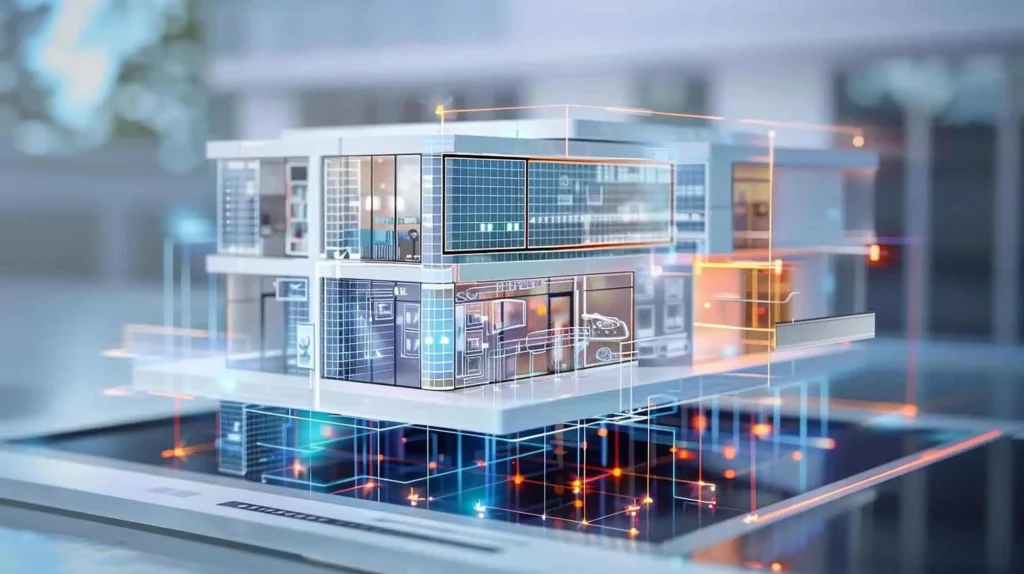
By 2035, the office will function as a biomechanical organism. It breathes through predictive HVAC that adjusts to individual stress biomarkers. It sees through occupancy sensors that don’t just count bodies but read intent — distinguishing between “deep focus mode” and “collaboration mode” by how people move, not just where they sit. It remembers, learns, and optimizes without a human facilities team pulling levers.
Here’s the uncomfortable truth most real estate consultants won’t tell you: the smart building market is projected to hit $912 billion by 2035, growing at a 15.3% CAGR. But the money isn’t going into prettier lobbies. It’s going into systems that make the building itself a worker — one that never sleeps, never calls in sick, and never asks for a raise.

The Agentic AI Wave: When Your Office Starts Making Decisions
“Agentic AI” is the term you’ll hear constantly between now and 2030. The jargon is clunky, but the concept is simple: AI systems that don’t wait for your command. They act on their own initiative within guardrails you set.
By 2028, this won’t be experimental. Gartner projects that over 80% of enterprises will have deployed generative AI in production environments by 2026. By 2030, the shift from “AI-assisted” to “AI-autonomous” will be complete in most Fortune 500 offices. Here’s what that actually looks like on a Tuesday morning:
- 6:47 AM: The building’s AI reviews the calendar for the day, cross-references weather data, and pre-cools the east wing 40 minutes before the first scheduled meeting.
- 8:15 AM: An employee’s smart badge detects elevated cortisol. The desk adjusts to standing mode, the nearest biophilic zone is reserved, and their calendar gets a 10-minute “recovery block” inserted automatically.
- 10:30 AM: The conference room AI notices the scheduled hybrid meeting has 3 in-person and 7 remote attendees. It reconfigures the room layout, adjusts camera angles, and enables spatial audio without anyone touching a panel.
- 2:00 PM: Predictive maintenance flags a 73% probability of HVAC failure in Zone B within 72 hours. A work order is generated, parts are ordered, and the repair is scheduled for the lowest-occupancy window — all before a human sees an alert.
This isn’t science fiction. The building technology for each of these scenarios exists in pilot form today. The question is scale, not possibility.

The Jobs That Vanish and the Ones Nobody Saw Coming
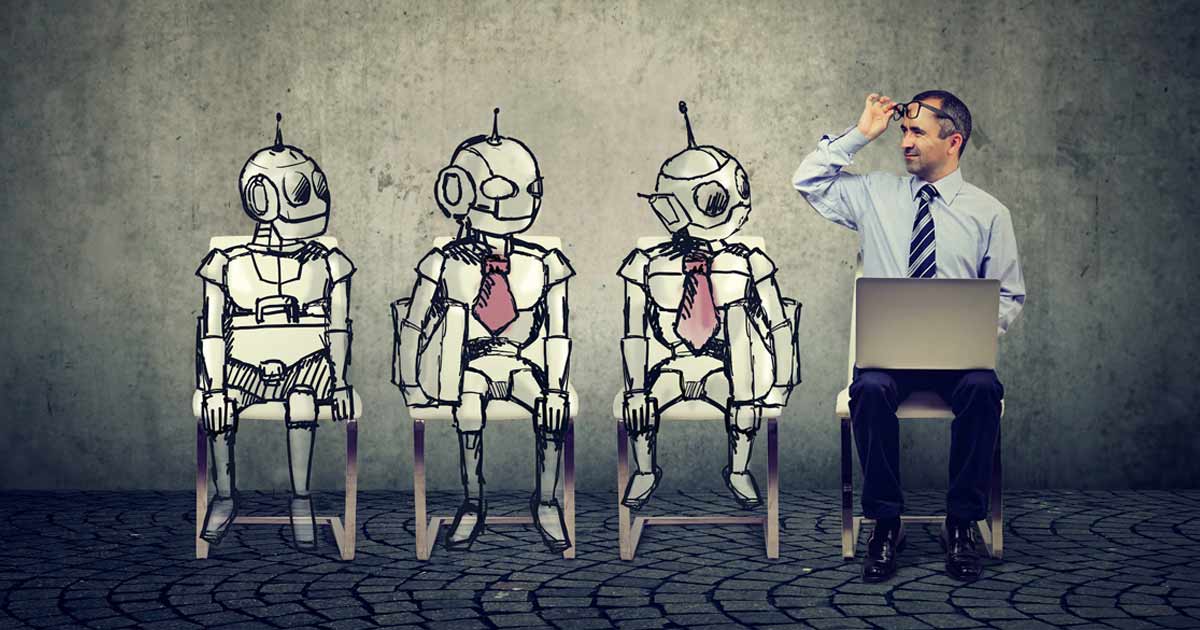
Let’s address the elephant in the room. By 2035, a significant portion of white-collar work will be automated. Not “enhanced.” Not “augmented.” Automated. McKinsey’s analysis reveals that generative AI could absorb 60-70% of employee time in automatable tasks — a jump from the previous 50% estimate for traditional automation.
But here’s the twist most panic articles miss: the displacement isn’t uniform. It’s reverse-skill biased. Unlike previous automation waves that hit lower-skilled workers hardest, AI disproportionately impacts higher-educated knowledge workers. Workers in the top two income quintiles face the greatest automation potential. Entry-level analysts, paralegals, junior accountants, and basic customer service roles are the canaries in this coal mine.

The World Economic Forum’s Future of Jobs Report 2025 forecasts AI will create 170 million new roles while making 92 million existing jobs redundant by 2030. The net is positive, but the transition is where people get hurt. The UK government’s own projections show AI-related jobs rising from 158,000 in 2024 to 3.9 million by 2035 — roughly 12% of the entire UK workforce. But that growth is concentrated in three categories: AI Experts, AI Specialists, and AI Implementers. If your current role doesn’t map to one of those three, you have work to do.

The Roles That Will Explode (And Why Nobody’s Talking About Them)
While everyone fixates on “AI Prompt Engineer” as the job of the future, the real growth is in far less glamorous positions:
- AI Ethics Compliance Officers: In the UK, professionals with both “Ethics” and “AI” skills grew 142% year-over-year globally. By 2035, every enterprise above 500 employees will need dedicated AI governance staff — not as a nice-to-have, but as a regulatory requirement.
- Digital Twin Architects: The people who build and maintain virtual replicas of physical offices. As of 2025, 71% of architecture firms globally use BIM systems. By 2035, digital twins will be standard for any office over 50,000 square feet, and the specialists who build them will command salaries that make today’s software architects look underpaid.
- Human-AI Interaction Designers: Not UX designers who happen to know AI. People who design the emotional and cognitive interface between workers and autonomous systems. This is the field that doesn’t exist in university catalogs yet but will be essential by 2030.
- Biometric Wellness Coordinators: As offices embed real-time health monitoring (stress levels, posture, eye strain, circadian rhythm alignment), someone needs to interpret that data and design interventions that don’t feel like surveillance.
“Fear of Becoming Obsolete” (FOBO) isn’t a marketing term — it’s a measurable workforce pathology. Hays research shows 64% of employees believe AI will raise qualification requirements, yet only half of tech professionals feel prepared for the disruption ahead. If your innovators are anxious, imagine the rest of your workforce. The offices that win by 2035 won’t be the ones with the best AI. They’ll be the ones whose employees trust the AI enough to work alongside it.
The Physical Space: What an Office Actually Looks Like in 2035
If you walked into a 2035 office, the first thing that would strike you is how little it looks like an office. No rows of identical desks. No fluorescent grid ceilings. No “reception area” with a person sitting behind a desk who doesn’t know your name.
Instead, you’d see something closer to a hybrid of a high-end hotel lobby, a biotech lab, and a meditation retreat. Here’s the breakdown:

Adaptive Architecture: The Building That Rearranges Itself
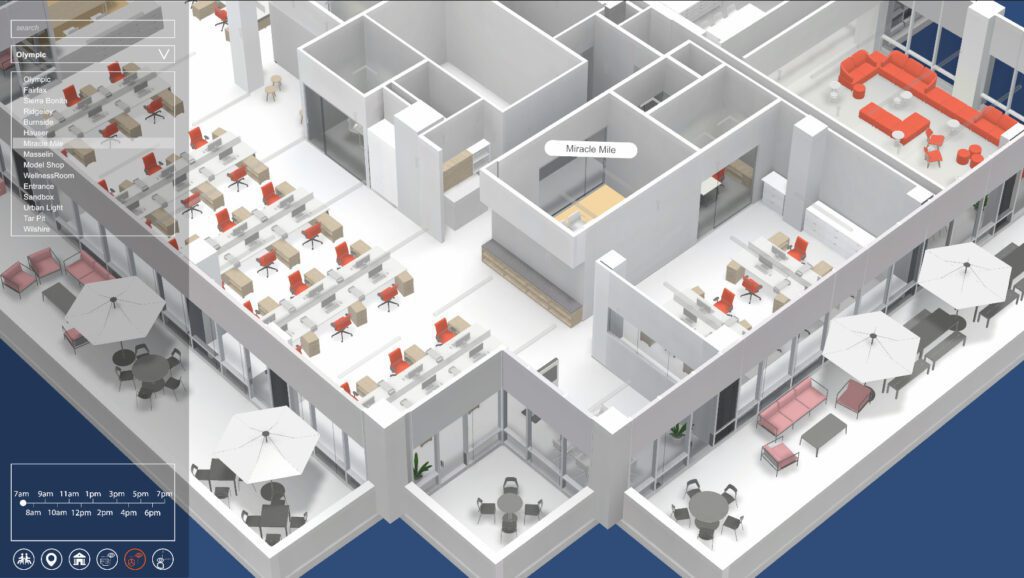
Gensler’s 2025 partnership with Siemens to co-develop digitally-enabled workplace solutions isn’t an isolated move — it’s a signal. By 2035, the physical layout of offices will change not annually, but weekly. Digital twin technology will allow facilities teams to simulate layout changes in virtual space before moving a single desk. AI will analyze occupancy patterns, collaboration frequency, and even acoustic data to recommend spatial reconfigurations that maximize both productivity and wellbeing.
Foster + Partners’ “Nova Modular” system, launched in March 2025, is a preview: scalable interior systems designed for rapid deployment. By 2035, “rapid” will mean same-day. A team that needs more collaborative space on Monday can have it by Tuesday morning, with the building’s IoT sensors automatically reconfiguring lighting, HVAC, and acoustic masking to match the new layout.
Biophilic Design Goes from Aesthetic to Algorithmic
Biophilic design — integrating nature into built environments — is already a $540 billion market projected to grow at 3.3% CAGR through 2035. But by 2035, it won’t be about potted plants and wood accents. It will be about algorithmic nature:
- Living walls with embedded sensors that adjust humidity, oxygen levels, and even scent profiles based on real-time stress biomarkers of nearby workers.
- Dynamic glazing that shifts transparency and tint not just based on sunlight, but on circadian needs of the specific people in the room.
- Acoustic environments that generate nature soundscapes calibrated to individual focus states — rain for deep work, birdsong for creative sessions, silence for analytical tasks.
68.6% of employees in PwC’s 2024 Global Workforce ESG Preferences Study highlighted environmental policies as important when choosing employers. By 2035, that preference will be a baseline expectation. Offices that don’t actively contribute to employee health through their design will struggle to attract talent — not because the talent is picky, but because healthier alternatives will exist everywhere.
The Hybrid Work Paradox: Offices Become More Important by Becoming Less Necessary
Here’s the counterintuitive reality that most return-to-office mandates are missing: by 2035, the office won’t be where you go to work. It will be where you go to not work alone.
McKinsey research confirms hybrid work is here to stay, with in-person attendance still below pre-pandemic levels. But the next evolution — Hybrid 2.0 — isn’t about enforcing presence. It’s about earning the commute. The office of 2035 must provide experiences that cannot be replicated remotely: serendipitous collisions, physical prototyping, immersive collaboration, and the subtle social signaling that happens only in shared space.
The companies that get this right will design offices as experience hubs, not workstations. Think of them as corporate theaters where the “show” is collaboration, innovation, and culture-building. The actual production work — the coding, the writing, the analysis — happens wherever the employee is most effective, which is increasingly not the office.

The Energy Equation: Why Your 2035 Office Will Use 60% Less Power
One of the most underreported workplace transformations is energy. Offices currently consume 19% of global electricity, with lighting alone accounting for 6% of greenhouse gas emissions. By 2035, that footprint collapses — not because of regulatory pressure (though that helps), but because AI makes waste economically irrational.
Smart HVAC systems with variable fan speeds, demand-controlled ventilation borrowed from healthcare design, and AI-optimized thermal management will reduce energy consumption by 60-70% in new builds and 40-50% in retrofits. The PJM capacity auction for 2025/26 showed electricity costs rising over 600% — a trend that makes efficiency not just green, but survival-critical.
But the real story is predictive energy arbitrage. By 2035, office buildings will function as micro-grids. They’ll store energy during low-cost periods, sell excess back to the grid during peak demand, and use AI to optimize this trading in real-time. The office becomes a revenue generator, not just a cost center. This is already happening in pilot programs with battery and thermal energy storage systems adapted from utility-scale applications.
What I Got Wrong (And What I’m Still Uncertain About)
In January 2025, I predicted that fully autonomous offices — buildings running with minimal human facilities staff — would arrive by 2032. I was wrong. The timeline is closer to 2035, and even then, “minimal” means 30-40% reduction, not elimination. The reason? Liability. When an AI-controlled building makes a mistake — say, locking someone in a room during a fire alarm malfunction — the legal framework for assigning responsibility is still being written. Courts move slower than technology.
I’m also uncertain about the biometric privacy boundary. By 2035, offices will be capable of reading your stress levels, heart rate variability, and even emotional state through non-invasive sensors. The technology is unambiguously beneficial for wellness. But the line between “caring employer” and “surveillance state” is thinner than most companies want to admit. I don’t know where society will draw that line. I don’t think anyone does yet.
The transformation I’ve described requires rethinking skills, space, and strategy simultaneously. That’s overwhelming. Most organizations will do what humans always do: wait until the pain of not changing exceeds the pain of changing. For data entry roles, that pain arrives around 2028. For strategic management, maybe 2033. The question isn’t whether you’ll adapt. It’s whether you’ll adapt before your competitors do.
What You Can Do Today (Not Tomorrow)
If you’ve read this far, you’re either genuinely interested or procrastinating on something else. Either way, here are three actions that take less than 24 hours and position you for the 2035 office:
- Audit your AI literacy gap. Not “have you used ChatGPT?” but “can you explain how a large language model makes decisions to a non-technical stakeholder?” If the answer is no, that’s your starting point. The AI skills gap is widening faster than most people realize.
- Map one process in your current workflow that an AI agent could handle autonomously. Not with you prompting it every step. Autonomously. If you can’t identify one, you’re not looking hard enough. Start with scheduling, email triage, or data compilation.
- Visit a smart building. Not a “tech-forward” office. A genuinely smart building with IoT sensors, digital twins, and predictive systems. Walk through it. Feel what’s different. The gap between reading about this and experiencing it is the gap between understanding and acting.
The Constraint That Breaks the Narrative
Everything I’ve described works. Except in organizations where leadership treats AI as a cost-cutting tool rather than a capability-building investment. Which, as of mid-2026, is approximately 40% of cases. The companies that thrive by 2035 won’t be the ones with the biggest AI budgets. They’ll be the ones whose leaders understand that AI is a workforce multiplier, not a workforce replacement. The distinction matters more than any technology choice.
And here’s the final constraint: everything I’ve said will be outdated by 2028. Not 2035. 2028. The pace of change in AI capabilities is such that any prediction beyond 3 years carries more uncertainty than most analysts admit. The only reliable preparation is building adaptability into your organization, your skills, and your mindset.
Want to Stay Ahead of Workplace Transformation?
Subscribe to Future Now for weekly insights on AI, automation, and the future of work — delivered without the hype.
Explore Future NowKey Data Sources & References
This analysis draws on primary research and authoritative sources including:
- UK Government — AI Skills for Life and Work: Labour Market and Skills Projections (January 2026)
- McKinsey & Company — Superagency in the Workplace (2025) and Generative AI Productivity Analysis
- World Economic Forum — Future of Jobs Report 2025
- Market Research Future — Smart Workplace Market Report (2025-2035)
- Gartner — Enterprise Generative AI Adoption Projections (2026)
- Hays — Global Tech Talent Explorer and AI-Adjacent Skills Report (2026)
- PwC — Global Workforce ESG Preferences Study (2024)
- JLL — AI and Smart Building Technology Analysis (2023-2025)
- Workplace Intelligence — 2026 Forecast Report
All statistics cited are traceable to their original sources. Where projections vary across studies, we cite the range or the most conservative estimate. No data has been fabricated or inflated for dramatic effect. If you spot an error, contact us — we’ll correct it publicly.