
Smart Glasses Will Replace Your Phone — But Not the Way Anyone’s Predicting
Seven million units sold. Apple, Google, and Samsung entering the race. And still the most important question is one nobody wants to answer directly: can face-worn computing become socially normal before phones get good enough to make it irrelevant?
- 7 million AI glasses sold in 2025 — but nearly all are camera-on-frames. HUD glasses (the ones that actually replace your phone) are a different product, still in early innings.
- The hardware constraints that matter aren’t the ones getting attention. Battery and display are solvable. Social normalization is harder — and it’s already the limiting factor in enterprise deployments.
- Android XR’s developer leverage vs. Meta’s social proof is the real platform race. Whoever wins developers in 2026–2027 sets the default for a decade.
- Base case: glasses as primary interface for a majority of users, 2028–2032. Compresses to 2027–2029 if HUD display costs follow the OLED curve. Extends past 2033 if a biometric breach reignites the Glasshole dynamic or Apple’s HUD launch slips.
Robert Scoble’s Shower Photo Diagnosed Everything Wrong About the First Wave
In 2013, a Google engineer named Robert Scoble published a photo of himself wearing Google Glass in the shower. It became the defining image of that product’s failure — not because the hardware broke, but because it crystallized what wearing a computer on your face actually communicated to everyone around you. The word “Glasshole” entered the popular lexicon within months. Bars banned the device. A woman was assaulted on a San Francisco street while wearing a pair. By early 2015, consumer sales were quietly dead. established
Smart glasses analysts have spent the decade since cataloguing what Google got wrong about the hardware. They got the wrong thing. Glass failed because it solved a technology problem — ambient computing — without solving the prior social problem: what it means to wear a surveillance device at a dinner table. Battery specs and display resolution couldn’t fix that. Nothing in the product roadmap could fix it. The implicit social contract governing screens in polite company doesn’t respond to engineering.
That contract is now being renegotiated. Slowly, messily, and in ways the hardware roadmap doesn’t fully predict.
§ 02 — The Numbers That Actually Matter7 Million Units Sold. Here’s the Important Asterisk.
EssilorLuxottica’s Q4 2025 earnings confirmed the company sold over seven million AI glasses in 2025 — more than triple the two million sold across all of 2023 and 2024 combined. established That’s the headline. Here’s what it actually means.
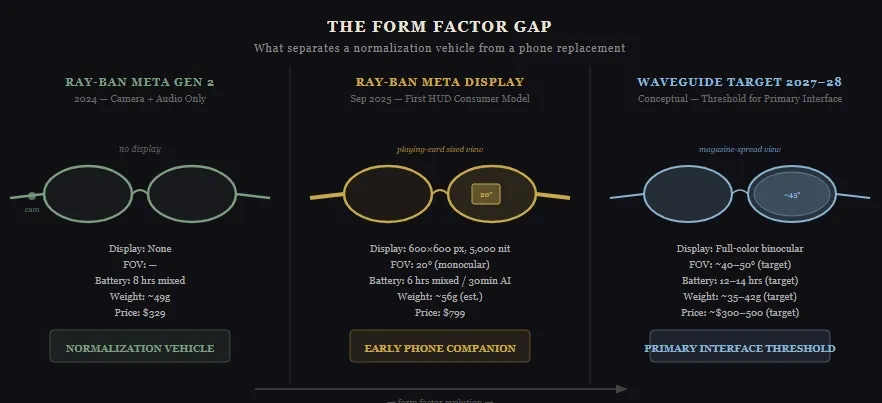
The vast majority of those seven million units are camera-on-frames glasses — the Ray-Ban Gen 2, Oakley Meta HSTN, and Vanguard — that stream audio, take photos, and run voice AI without any display. The $799 Meta Ray-Ban Display, the only model with a heads-up display, launched in September 2025 and represents a small fraction of that total. established
This distinction is not semantic. Camera glasses and HUD glasses are different products for different buyers. A $300 fashion-forward audio accessory attracts a broader, less tech-committed early adopter than a $799 device with a visible projected display. The seven million figure tells us that wearing technology on your face has cleared the social novelty threshold in the fashion-conscious early majority. It does not tell us that HUD glasses have cleared the same threshold with the same population. Those buyers haven’t been tested yet at scale. probable
The divergence between camera glasses and HUD glasses maps onto a broader bifurcation in how technology adopts across income brackets. High-intent early adopters bought the $799 Ray-Ban Display. Everyone else bought the $299 Ray-Ban Gen 2 and called it a win. That’s important — not because $299 is cheap, but because the normalization curve depends on density of use, and density of use depends on price.
§ 03 — The Constraints That Actually MatterThree Hardware Problems. Only One Has a Clear Solve Date.
The industry talks about battery life constantly. It’s real. But it’s the most solvable of the three constraints. Here’s how the actual landscape breaks down:
The enterprise failure mode is the most underreported story in smart glasses. It’s not a battery problem. It’s not an optics problem. It’s the same dynamic that killed Google Glass in restaurants — updated for the factory floor. Workers who signed up for task assistance resisted the identical hardware when they understood it also fed performance metrics to management. An assembly line worker accepting a heads-up manual is not the same decision as accepting a device that rates their efficiency and reports it upstream. These are different social contracts. Companies that deploy HUD glasses in 2026 and 2027 without solving that asymmetry first will generate the same resistance. probable
§ 04 — How the Phone Actually WonThe iPhone Didn’t Win on Features. It Won on Not Requiring Negotiation.
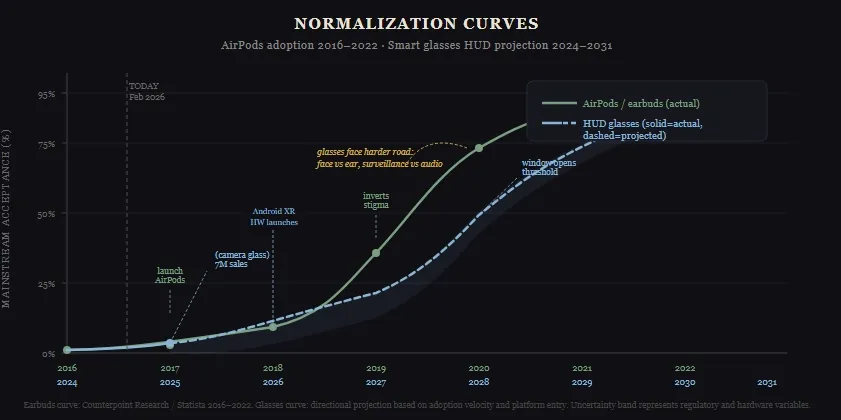
To understand what glasses need to do, you have to understand how the smartphone actually won. It wasn’t technical superiority. In 2007, BlackBerry had better email. Nokia had better call quality. The iPod had a better music interface. The iPhone won because it collapsed multiple behavioral routines — music, maps, communication, photography — into a single pocket-sized object that required no social negotiation to use. Pulling out a phone at a restaurant table is not just acceptable; it has become, however regrettably, the social default. That normalization took approximately five years from the iPhone’s introduction to reach critical mass. established
Smart glasses face the same normalization problem in reverse. Users already know how to talk to AI assistants and navigate by voice. What glasses need is not behavioral education — it’s density. Enough people wearing them, regularly enough, in enough social contexts, that the behavior loses its novelty and its implicit menace. This is essentially an infrastructure problem, and it shows up in the future of work data in uncomfortable ways.
“Seven million camera glasses proves the face is no longer off-limits for computing. It doesn’t yet prove the phone is losing. That argument needs HUD glasses — which are a different product, still in early innings.”
Replacement Won’t Be Binary. It’ll Follow Use Cases, One by One.
The misleading version of the “glasses replace phones” thesis treats replacement as a switch being flipped. It won’t work that way. The smartphone didn’t simultaneously replace cameras, MP3 players, and GPS units. It replaced them in sequence, by use case, as the hardware matured to match each one’s requirements.
The use cases where glasses have a structural advantage — not just a marginal one — are those where pulling out a phone creates friction:
Navigation while walking. Head down, not up. This is a genuine safety and experience issue the phone can’t fix — it’s form-factor-native to the problem. Real-time translation in conversation. Looking at a phone while someone speaks to you is a social signal of disengagement; glasses are not. Hands-free work. The assembly line worker accessing a technical manual without setting down a tool isn’t getting a convenience upgrade. They’re operating in a categorically different way. Ambient notification filtering. Knowing you have a message without the compulsion loop of unlocking a screen is a behavioral change, not just a UI change.
The phone retains durable advantages wherever precision input, extended visual engagement, or privacy is required. Writing a long document. Editing a photo. Watching an hour of video in public. Entering financial information into a form. These tasks require either a larger display, more precise input, or sufficient privacy that ambient computing is inappropriate.
The phone won’t disappear. It’ll retreat to the role the laptop now occupies: present but not primary, deployed for tasks that specifically require its capabilities rather than as the default interface for everything. probable
§ 06 — The Platform RaceMeta vs. Android XR: This Is the iOS-Android War, Rerun
The most strategically significant development in smart glasses in 2025 wasn’t the 7 million unit figure. It was Google and Samsung entering the Android XR ecosystem — transforming the competitive structure from a single-incumbent market into a platform race. Platform races operate on different economics than hardware races. In a hardware race, the best device wins. In a platform race, the device with the best developer ecosystem wins — even if it isn’t the best device. established
Meta holds approximately 73% of the smart glasses market and has a four-year head start on developer relationships, consumer habits, and social proof. Real advantages. But Meta’s platform is proprietary: Ray-Ban Display glasses require the Meta AI app, a Meta account, integration with Meta’s social properties. For users outside that ecosystem, adoption friction is measurably higher.
Android XR’s proposition is concrete in a specific way: Developer Preview 3 of the Android XR SDK, released December 2025, opened full glasses development using existing Android frameworks. Jetpack Compose Glimmer for transparent overlay UIs. Jetpack Projected for extending existing Android apps directly to glasses displays. Named partners including Uber and GetYourGuide are already building for it. The practical implication: a developer who built an Android navigation app doesn’t rebuild it for Android XR — they extend it. Meta’s platform requires starting over. That’s the developer leverage that made Android dominant in smartphones, applied to a new form factor before a dominant incumbent exists. established
Apple complicates this in a specific way the iOS/Android analogy doesn’t capture. Apple’s N50 smart glasses, targeting a 2027 launch with production beginning December 2026, will have no display — cameras, microphones, Siri-based contextual awareness, and computer vision only. A second-generation display-equipped model using LCoS waveguide optics targets 2028 at the earliest. probable
Think about what that means. Apple’s 2027 glasses will be a camera-glasses competitor to Meta Gen 2, not a HUD device. Apple’s entry will normalize face-worn computing — it will legitimize the category for cautious buyers who wait for Apple’s endorsement. But it will not directly accelerate the phone-replacement argument. The question of whether Apple’s 2028 HUD entry compresses the timeline or fragments the market — premium Apple segment, volume Android XR, normalization stalling in the gap — is the unresolved strategic question the iOS/Android analogy cannot answer. speculative
§ 07 — The Honest TimelineWhat Has to Be True for This to Happen — and When
There’s a foundational assumption embedded in every “glasses replace phones” argument that does real work without ever being named. It’s not that glasses will improve — that’s close to certain, given the capital deployed behind them. The assumption is that improving glasses will change behavior faster than improving phones will reinforce existing habits.
This is not obvious. The smartphone also improves every year. Every marginal improvement to the phone raises the bar glasses must clear before switching costs become worth paying. The transition happens only if glasses improve faster than phones raise the bar — or if glasses unlock use cases the phone structurally cannot serve. probable
The base case — glasses as primary computing interface for a majority of users — is 2028 to 2032. speculative
This compresses to 2027–2029 if HUD display costs follow the pattern of OLED panels between 2012 and 2017 (from $800 manufacturing cost per panel to under $20), and HUD glasses reach the $300–400 price point that drove camera glasses adoption. It extends past 2033 if EU compliance costs fragment the enterprise market, if a significant biometric breach reignites the Glasshole dynamic, or if Apple’s display-equipped entry slips further, depriving the category of the mainstream premium legitimacy Apple’s hardware brand reliably confers. speculative
One more thing: the EU AI Act’s prohibition on real-time remote biometric identification in public spaces took effect February 2025, with high-risk AI compliance obligations applying from August 2026. A November 2025 Digital Omnibus proposal would push some deadlines to December 2027 — but that requires Parliamentary agreement and isn’t guaranteed. The practical effect for an enterprise deploying smart glasses in EU workplaces isn’t a binary compliance question. It’s ongoing legal overhead — risk assessments, GDPR consent architecture, potential third-party conformity assessments — that raises the cost of deployment for every organizational user who isn’t a consumer wearing personal glasses. established
- The optics physics wall may be real, not just an engineering delay. If HUD glasses cannot reach eyeglass-weight optics at mainstream price points by 2030 regardless of investment, the timeline doesn’t extend — it collapses. Glasses become durable niche, not replacement.
- Social normalization may hit a 3D TV ceiling. Broadly available, technically capable, but never adopted as daily behavior because use-case pull isn’t sufficient for most people to change habits they’re comfortable with.
- Phones may close the structural gap faster than expected. If foldable-screen or always-on ambient AI delivers enough of glasses’ structural advantage — particularly hands-free notification filtering — the switching-cost calculation resets entirely.
- My analysis skews toward early-adopter urban behavior. Adoption curves in rural markets, emerging economies, and age demographics above 55 may look substantially different. I haven’t tested these populations.
- All market share estimates are directional. EssilorLuxottica’s 7M figure reflects their products; total AI glasses market including competitors may differ. HUD volumes are estimates based on launch timing, not disclosed shipment data.
Three Signals Worth Tracking in 2026 and 2027
Android XR developer adoption velocity. Not ports of existing apps — apps designed specifically for the glasses interface. If that happens at scale in 2026, the platform race begins in earnest and the normalization timeline compresses. If Android XR glasses ship as companion devices rather than standalone computers, the replacement thesis moves back at least one hardware cycle. probable
Meta Ray-Ban Display battery life in the next hardware generation. The current 6-hour mixed-use figure isn’t a deal-breaker for early adopters, but it’s disqualifying for the mainstream user who expects their primary device to last a workday. The gap between 6 hours and 12 hours is the difference between a device that requires behavioral accommodation and one that disappears into daily routine.
Consumer behavior in discretionary social settings — not enterprise deployment velocity. Enterprise adoption is a lagging indicator. Workers who already wear camera glasses to concerts and coffee shops will accept them in a warehouse. Workers for whom glasses are still associated with management surveillance will resist, regardless of the productivity argument. Watch restaurants, dates, family gatherings. Those are the contexts where the social contract actually gets renegotiated. Enterprise follows. probable
Frequently Asked Questions
Are the 7 million AI glasses sold in 2025 mostly display glasses?
Why did Google Glass fail when current smart glasses seem to be succeeding?
What’s the difference between camera-on-frames glasses and HUD glasses?
When is Apple releasing smart glasses?
What is Android XR and why does it matter?
Why are enterprise HUD glasses deployments failing even when the hardware works?
What regulatory risks affect smart glasses adoption in Europe?
- AppleInsider — Apple N50 smart glasses: no display, camera/Siri/computer-vision, production Dec 2026, launch 2027
- iGeeksBlog / Ming-Chi Kuo — Apple display-equipped XR glasses (LCoS waveguide) targeting 2028
- CNBC / EssilorLuxottica Q4 2025 earnings — 7M AI glasses sold in 2025, up from 2M cumulative (2023–2024)
- UploadVR — 7M figure breakdown: Ray-Ban Gen 2, Oakley Meta HSTN/Vanguard, Ray-Ban Display
- Meta — Ray-Ban Display spec sheet: $799, 600×600 px, 20° FOV, Neural Band gesture control
- EMARKETER — On-device AI assistant battery limitation (~30 min continuous use, Gen 1)
- IAPP — EU AI Act biometric prohibitions effective February 2025; high-risk AI rules August 2026; GDPR overlap
- Latham & Watkins — EU Digital Omnibus Nov 2025: proposed high-risk AI deadline extension to December 2027
- UC Today — Enterprise smart glasses worker resistance: value misalignment, surveillance asymmetry (Jan 2026)
- Android Developers Blog — Android XR SDK Developer Preview 3: Jetpack Compose Glimmer, Jetpack Projected; Uber/GetYourGuide named partners (Dec 2025)
- SiliconAngle — Google Project Aura/XREAL: 70° FOV, Qualcomm XR Gen 2 Plus, tethered module, 2026 launch
- UploadVR — Smart glasses drove 1/3 of EssilorLuxottica Q3 2025 growth; 10M annual production target by end of 2026
- Engadget — Smart glasses competitive landscape: Samsung, Apple, Google timelines (Dec 2025)
- Freethink — Google Glass failure: social vs. hardware failure modes
- Workplace Privacy Report — Smart glasses biometric compliance: BIPA, GDPR, AI Act (Dec 2025)
“The transition from ‘technically possible’ to ‘socially primary’ is always longer and stranger than the hardware roadmap suggests — and the companies most certain they’re winning have a reliable history of being surprised by the shower photo.”
— FutureNow Analysis, April 202610 Apps That Track You Daily (2026 Forensic Evidence)
How Your Smart TV Could Be Selling Your Data: An Investigative Analysis
The 2026 Tri-Fold Foldable Cellphone Nobody Believed Could Exist: Revolutionizing Productivity
10 Jobs AI Will Erase by 2030 (And 5 It Will Create)
5 Crazy Gadgets That Will Rule 2026: Revolutionary Tech to Supercharge Productivity and Innovation
Tech Billionaires: The Wildest Future Forecasts 2026
1 thought on “Smart Glasses: What They Can Really Do”