
These Scientific Phenomena Defy Logic — And Scientists Still Can’t Explain Them
Seven cracks in our understanding of the universe that have survived decades of scrutiny, two confirmed as recently as June 2025, and none close to resolution.
The Short Version
- Not philosophical puzzles — hard data anomalies. Every phenomenon here has been confirmed by multiple independent teams using different instruments. These aren’t fringe claims.
- The Hubble Tension hit 6σ in 2025. Two methods for measuring the universe’s expansion rate disagree by ~9%. JWST confirmed it’s not measurement error.
- The muon’s wobble doesn’t match theory. Fermilab’s final g-2 result (June 2025, 127 ppb precision) still diverges from Standard Model predictions — though the theoretical picture is complicated by competing calculation methods.
- The lithium problem remains open. Big Bang nucleosynthesis predicts 3–4× more lithium-7 than we actually observe. Nobody has a consensus explanation.
- Quantum entanglement is experimentally confirmed nonlocal. Bell’s inequality violations are loophole-free since 2015. The weirdness is real. The explanation isn’t.
- Realistic expectation: These anomalies may point to new physics, incomplete theories, or unknown systematics. We don’t know which. Anyone claiming certainty is guessing.
Table of Contents
- Why These Aren’t Just “Mysteries”
- The Hubble Tension — A 6σ Crisis in Cosmology
- The Muon Anomaly — The Particle That Won’t Behave
- The Lithium Problem — Missing Matter from the Big Bang
- Quantum Entanglement — Confirmed Nonlocality, No Mechanism
- Fast Radio Bursts — Milliseconds from Unknown Sources
- Ultra-High-Energy Cosmic Rays — Particles That Shouldn’t Exist
- The Hard Problem of Consciousness — The Explanatory Gap
- What Could Be Wrong — The Adversarial View
- Summary Table
- FAQ
- Final Thoughts
Physics textbooks give the impression that the big questions are mostly answered — that we’re filling in details around a well-understood framework. That impression is wrong, and the anomalies below are why.
What distinguishes the phenomena here from run-of-the-mill open questions is specificity. These aren’t vague areas of uncertainty. They’re precise numerical mismatches between what our best theories predict and what instruments actually measure. In several cases, the discrepancy has been confirmed by multiple independent teams with different methods, at different facilities, over decades. The signal isn’t noise. The problem is real.
I want to be careful not to oversell this. None of what follows guarantees that our fundamental theories are wrong — it’s possible, in some cases, that a sufficiently clever systematic error is lurking somewhere. But as of May 2026, those errors haven’t been found despite determined searching, and in some cases (the Hubble tension most clearly), we’ve explicitly ruled out the most plausible candidates. That’s worth taking seriously.
H₀ discrepancy: 67.4 vs. 73.0 km/s/Mpc (~9%)
The universe is expanding. That’s been known since Hubble’s observations in 1929. What should, by now, be a settled number — the rate of that expansion, called H₀ — is turning out to be one of the most contested measurements in all of physics.
Two methods exist for measuring H₀. The first uses the cosmic microwave background — light left over from the early universe — analyzed by the Planck satellite. It gives 67.4 km/s/Mpc. The second, called the distance ladder, builds up calibrations using Cepheid variable stars and Type Ia supernovae as cosmic mile-markers. The most precise distance-ladder measurement, from the SH0ES collaboration, gives 73.0 km/s/Mpc. These two numbers disagree by roughly 9% — and as of 2025, the discrepancy has crossed 6σ statistical significance.
A 6σ result means there’s less than a one-in-a-billion chance this is a statistical fluke. The most obvious alternative — that Cepheid measurements were corrupted by dust or stellar crowding — was directly tested by the James Webb Space Telescope in 2024–2025. JWST’s resolution confirmed the Hubble Space Telescope Cepheid data was accurate. Systematic error in the local measurement is no longer the leading candidate.
The European Commission found this important enough to award a €12 million Synergy Grant to the RedH0T project — specifically to investigate whether the standard cosmological model (ΛCDM) needs revision. The September 2025 “Tensions in Cosmology” conference in Corfu confirmed the problem has only deepened with new high-precision data from DESI, JWST, and ACT combined.
The two probability distributions for H₀ barely overlap. This is not a rounding disagreement — it’s a structural conflict between our model of the early and late universe.
What makes this especially uncomfortable is what a resolution might require. If neither measurement is wrong, the standard cosmological model — the ΛCDM framework that’s been the foundation of cosmology since the 1990s — may need fundamental revision. That could mean dark energy isn’t a cosmological constant, that there’s new early-universe physics we’ve missed, or something stranger still.
Fermilab final result: 127 ppb precision · June 3, 2025
Muons are essentially heavy electrons — 207 times more massive, with a lifespan of about 2.2 microseconds. Like electrons, they have a tiny internal magnet. The Standard Model predicts exactly how strongly that magnet should interact with quantum fluctuations in the surrounding vacuum. The prediction is extraordinarily precise — one of the most accurate in all of science.
The problem: Fermilab’s Muon g-2 experiment released its third and final measurement on June 3, 2025, achieving a precision of 127 parts per billion — surpassing the experiment’s original design goal set in 2012. The measured value of the magnetic anomaly is aμ = 0.001 165 920 705 ± 0.000 000 000 114 (stat.) ± 0.000 000 000 091 (syst.). The experimental result is consistent across all six years of data collection, which ended in July 2023.
Here’s where it gets complicated. Against the 2020 Standard Model theory prediction (compiled by the Muon g-2 Theory Initiative), the experimental result shows a 5.1σ discrepancy — almost certainly pointing to new physics beyond the Standard Model. But newer theoretical calculations using lattice QCD methods, published by the Budapest-Marseille-Wuppertal collaboration, come closer to the experimental value. That’s not resolution — it’s a new problem: two legitimate theoretical approaches now disagree with each other, meaning physicists aren’t entirely sure what the Standard Model actually predicts for this quantity.
“The anomalous magnetic moment of the muon is one of the most precisely measured quantities in physics, and it is great to see an experiment come to a definitive end with a precision measurement.” — Regina Rameika, U.S. DOE Associate Director for High Energy Physics, June 2025
The experiment is finished. The theoretical argument continues. Either way, something in our understanding of particle physics is off.
Predicted: ~4.7 × 10⁻¹⁰ · Observed: ~1.6 × 10⁻¹⁰ (factor of ~3)
Big Bang nucleosynthesis — the process by which hydrogen, helium, and trace elements formed in the first few minutes after the Big Bang — is one of the most precisely tested theories in cosmology. Its predictions for hydrogen, deuterium, and helium-4 match observations beautifully. Lithium-7 does not.
The theory predicts roughly three to four times more lithium-7 than we actually observe in the oldest, most metal-poor stars in the galaxy’s halo — a mismatch of 4–5σ (Fields 2011, Annual Review of Nuclear and Particle Science). What’s telling is that those same ancient stars — the “Spite Plateau,” named after the astronomers François and Monique Spite who identified the pattern in 1982 — show a remarkably consistent lithium abundance across a wide range of temperatures and metallicities. That consistency rules out the simplest astrophysical explanations: if stars were just burning off their lithium through normal stellar processes, you’d expect more scatter.
Proposed solutions have included new nuclear reaction rates, stellar diffusion models that sequester lithium below the photosphere, and various exotic physics scenarios involving particle decays in the early universe. None has achieved consensus. The problem has been open for over 40 years. Deuterium and helium-4 predictions remain in excellent agreement with observation — which is why a straightforward rejection of Big Bang nucleosynthesis isn’t the answer either. Something specific to lithium-7 is different, and nobody is sure what.
Bell inequality violation confirmed: Hensen et al. 2015 (Nature, loophole-free)
Quantum entanglement isn’t a mystery in the sense that we can’t demonstrate it. We’ve demonstrated it thousands of times. The mystery is deeper: there’s no mechanism for it that doesn’t break something fundamental in our understanding of physics.
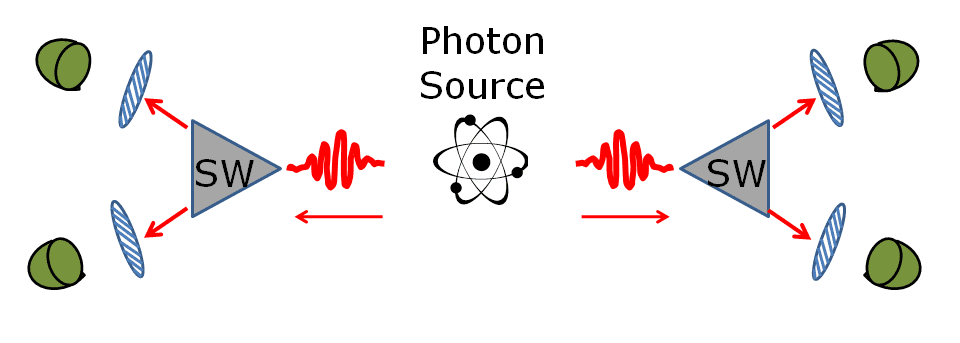
When two particles are entangled, measuring one instantly correlates with the other — regardless of distance. Einstein called this “spooky action at a distance” and spent years arguing it couldn’t be real, that there must be “hidden variables” carrying information between particles. Bell’s 1964 theorem showed that any hidden-variable theory imposes a mathematical limit on how correlated entangled particle measurements can be. Quantum mechanics predicts that limit is violated.
Experiment has repeatedly confirmed the violations. More importantly, the 2015 Delft experiment by Hensen et al. (Nature, 2015) was the first loophole-free Bell test — closing both the detection loophole and the locality loophole simultaneously. The result was unambiguous: nature violates Bell inequalities. Hidden local variables don’t exist. Reality is, in some precise technical sense, nonlocal.
What remains completely unexplained is why. Quantum mechanics provides the mathematical framework to calculate entanglement probabilities with extraordinary accuracy. It doesn’t explain what’s actually happening, or how a measurement here can be correlated with a measurement there instantaneously without any signal passing between them. The “no-communication theorem” prevents this from being used to transmit information faster than light — but that restriction itself requires explanation, not just assertion. Multiple interpretations of quantum mechanics exist (Copenhagen, many-worlds, pilot wave, relational QM), and they give genuinely different answers to what’s going on. None is provably correct.
CHIME catalog: 500+ FRBs detected · ~25 confirmed repeaters
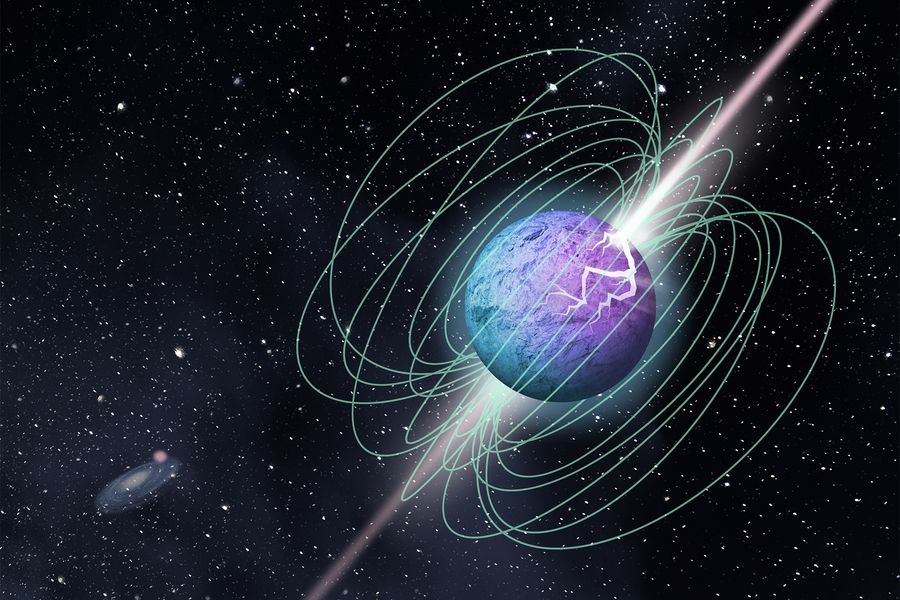
Fast Radio Bursts are among the most energetic phenomena in the observable universe. In a few milliseconds, some emit as much energy as the Sun produces in days — entirely in radio waves, from sources billions of light-years away. The CHIME radio telescope in British Columbia has catalogued over 500 of them since 2018, including roughly 25 that repeat.
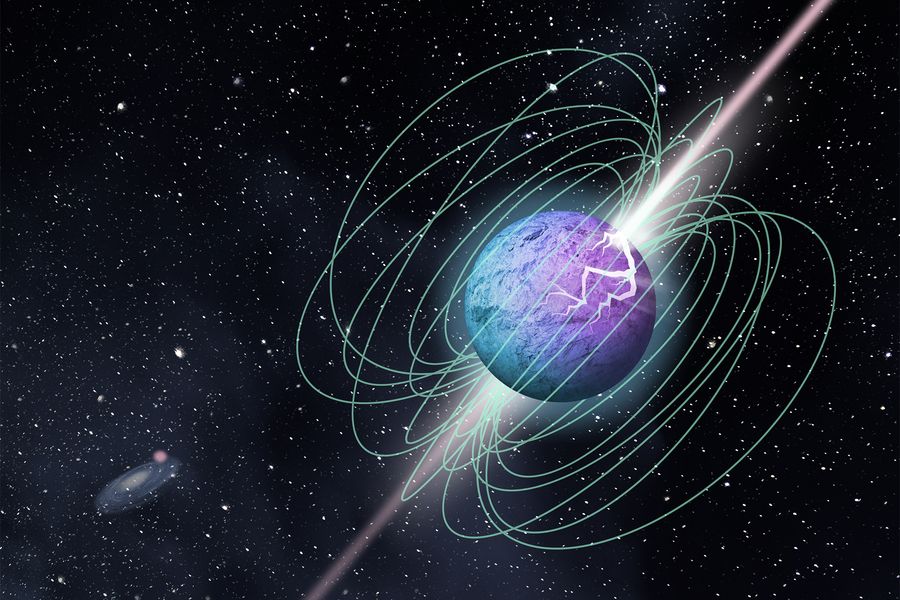
The leading hypothesis is magnetars — neutron stars with extraordinarily powerful magnetic fields. This became more plausible in April 2020, when astronomers detected an FRB-like burst from SGR 1935+2154, a known magnetar within our own galaxy — the first FRB with a confirmed source. That’s a significant step. The problem is that SGR 1935+2154 was, at that moment, orders of magnitude less energetic than the most powerful extragalactic FRBs. Whether a magnetar can produce the full range of observed FRB energies, and why some repeat while others apparently don’t, has no agreed answer.
The repeating FRBs complicate things further. FRB 121102A — the first confirmed repeater — has shown periodic activity windows and complex sub-millisecond structure within individual bursts, suggesting something more organized than a single catastrophic event. The morphology of its radio pulses doesn’t cleanly fit magnetar models as currently formulated.
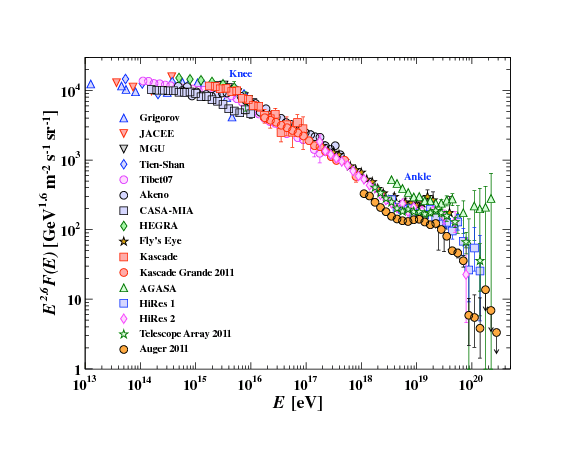
GZK threshold: ~5 × 10¹⁹ eV · Observed events: above 10²⁰ eV
In 1966, Greisen, Zatsepin, and Kuzmin independently predicted that cosmic ray protons above about 5 × 10¹⁹ electron volts would lose energy rapidly by interacting with photons in the cosmic microwave background. This means that any cosmic ray arriving at Earth above that energy — the “GZK limit” — must have originated within roughly 160 million light-years. Beyond that range, it simply can’t survive the journey at that energy.
The Pierre Auger Observatory in Argentina has detected cosmic rays above this threshold. Some significantly above it. The problem is that, when you scan the sky in the direction those particles came from, there aren’t obvious sources within the required distance that could plausibly accelerate particles to those energies. The particles are real — detected by an array of 1,600 water-Cherenkov detectors covering 3,000 km² — but their origin remains unclear.
Several explanations have been proposed: heavy nuclei rather than protons might behave differently; there might be exotic acceleration mechanisms in nearby active galactic nuclei; or — more speculatively — there might be new physics at extreme energies. Auger’s composition data suggest the particles are heavier than protons, which changes the energy-loss calculation somewhat. But it doesn’t fully resolve where they came from or how they got there.
No peer consensus on mechanism · Chalmers 1995 formulation still stands
This one sits in a different category from the others. The Hubble tension is an anomaly in a number. The hard problem of consciousness is an anomaly in the very structure of scientific explanation.
Neuroscience has made genuine progress on what David Chalmers called the “easy problems” of consciousness — explaining attention, memory formation, behavioral control, the neural correlates of various conscious states. Functional explanations are possible. What remains completely opaque is why any of this is accompanied by subjective experience at all. Why does processing information feel like something? Why isn’t it all just information processing in the dark, with no inner light?
This isn’t a question that better brain scanning will resolve. The challenge is explanatory, not empirical: no account of neural firing patterns or computational processes seems, even in principle, to explain why there is “something it is like” to be a conscious entity. The explanatory gap between objective, third-person descriptions of physical processes and first-person subjective experience has resisted every attempt to close it since Chalmers formalized the problem in 1995.
Proposed solutions range from illusionism (consciousness is a sophisticated cognitive illusion — but then who’s being fooled?) to panpsychism (consciousness is a fundamental feature of the universe, like mass or charge) to integrated information theory and global workspace theory, neither of which fully closes the gap. As of 2026, the debate among philosophers and neuroscientists is not converging.
⚑ What Could Be Wrong — The Adversarial View
- The Hubble tension could still be systematic. Multiple independent teams have looked and found nothing — but “we haven’t found it” isn’t the same as “it doesn’t exist.” A subtle calibration issue in the distance ladder affecting all methods simultaneously can’t be ruled out with certainty.
- The muon g-2 situation is genuinely murky. The experimental result is solid. The theoretical prediction is not — two competing calculation methods (data-driven vs. lattice QCD) give different answers for what the Standard Model actually predicts. Until theorists agree, the significance of the discrepancy is uncertain.
- FRBs may have a mundane explanation not yet modeled. The magnetar hypothesis has real supporting evidence. It’s possible we’re one good magnetar model away from the mystery evaporating.
- The “hard problem” may not be a scientific question at all. Some philosophers argue it rests on confused intuitions about explanation — that a complete neuroscientific account of consciousness would dissolve the problem, not solve it. That’s a minority view, but not an indefensible one.
- New physics isn’t the only explanation. Every one of these anomalies has at least one conventional-physics proposal on the table. The conventional proposals haven’t won — but they haven’t been definitively eliminated either.
Summary Table — The Seven Anomalies
| Phenomenon | Significance | Best hypothesis | Status |
|---|---|---|---|
| Hubble Tension | 6σ (2025) | New early-universe physics / ΛCDM revision | OPEN |
| Muon g-2 anomaly | 5.1σ (vs. 2020 SM) | New particle interactions beyond SM | CONTESTED |
| Lithium-7 problem | 4–5σ | Unknown early-universe process | OPEN · 40+ yrs |
| Quantum nonlocality | Loophole-free (2015) | No hidden local variables (confirmed) | MECHANISM UNKNOWN |
| Fast Radio Bursts | 500+ confirmed | Magnetars (partial fit) | PARTIAL |
| UHECR above GZK | Observed >10²⁰ eV | Heavy-nucleus composition / exotic AGN | OPEN |
| Hard problem of consciousness | No empirical metric | IIT / GWT / panpsychism / illusionism | STRUCTURALLY OPEN |
Frequently Asked Questions
Does the Hubble tension mean the Big Bang theory is wrong?
Not necessarily. The Big Bang is supported by multiple independent lines of evidence — CMB, light element abundances, large-scale structure. The tension suggests something may be incomplete or wrong in the standard ΛCDM model built on top of it: perhaps the nature of dark energy, or physics in the early universe we haven’t accounted for. Abandoning the Big Bang entirely would require explaining all that other evidence away, which nobody has managed.
Is the muon g-2 anomaly definitely new physics?
Not yet — and the June 2025 final Fermilab result, while precise, complicated the picture. Two different theoretical methods for predicting the Standard Model value now disagree with each other, not just with experiment. Until that theoretical dispute is resolved, the significance of the experimental anomaly is genuinely uncertain. It’s a strong hint, not a confirmed discovery.
How is quantum entanglement possible if nothing travels faster than light?
The honest answer is we don’t fully know. What we do know is that no information can be transmitted using entanglement — the no-communication theorem rules that out, which is why it doesn’t violate special relativity in a practical sense. But why correlated measurements arise at all, with no signal between them, remains unexplained by any physical mechanism. The math works; the picture doesn’t.
Why hasn’t the lithium problem been solved in 40 years?
Because every proposed solution breaks something else. Nuclear reaction rates that fix lithium-7 tend to break the deuterium prediction. Stellar diffusion models that could hide lithium below the photosphere can’t explain the remarkable uniformity of the Spite Plateau. The problem is unusually constrained — whatever the solution is, it needs to be very specifically about lithium-7, while leaving the other BBN predictions intact.
Could dark matter explain multiple anomalies simultaneously?
Possibly. Some theoretical work tries to connect the Hubble tension to new dark-sector physics, and early-universe dark matter interactions could in principle affect BBN predictions. But these are speculative connections — no specific dark matter model has been shown to resolve any of these anomalies while remaining consistent with all other observations. It’s an active research direction, not a solution.
Are any of these anomalies close to being resolved?
FRBs are probably the closest — the magnetar hypothesis has real empirical support and better models could plausibly account for the full energy range in the next few years. The muon g-2 situation depends on theoretical progress in QCD calculations, which is ongoing. The Hubble tension, lithium problem, and quantum nonlocality are structurally harder and don’t have obvious near-term resolution paths.
Should non-physicists care about any of this?
Probably yes, for one reason: the Hubble tension in particular suggests that the universe may work differently from what our standard model describes, which affects everything from estimates of the universe’s age to its ultimate fate. The hard problem of consciousness arguably matters for how we think about AI, mind, and moral status. The others are more narrowly technical — fascinating, but unlikely to change daily life regardless of how they resolve.
Final Thoughts
There’s a version of this article that ends with breathless speculation about paradigm shifts and revolutionary new physics. I’ve tried to avoid that, because the honest position is more uncomfortable: we have several precise, well-confirmed anomalies, a few plausible hypotheses for each, and no consensus solutions. That’s not a setup for a revelation — it’s just the actual state of the field.
What I find genuinely striking about this list is the diversity of it. The Hubble tension and lithium problem are both cosmological but likely have different causes. The muon anomaly is particle physics. Quantum nonlocality is foundational to all of physics but doesn’t obviously connect to the cosmological issues. FRBs are astrophysics. Consciousness is philosophy of mind bleeding into neuroscience. These aren’t seven versions of the same problem — they’re seven independent places where our frameworks break down.
That’s either very bad news for the coherence of physics, or an extremely interesting clue that we’re missing something large. My instinct, for whatever it’s worth, is probably the latter. But instincts in physics have a poor track record, including among physicists.
More from FutureNow
- Dark Matter in 2026: What We Actually Know vs. What We Assume
- Quantum Computing — Separating Real Progress from Marketing
- How AI Is Changing the Pace of Scientific Discovery
- How Old Is the Universe? Why the Answer Keeps Changing
- The Neuroscience of Consciousness: What We Know and What We Don’t
- The Standard Model at Its Limits — Where Particle Physics Goes Next
We Live in a Simulation: Weird Physics Theory Suggests
25 Strange Science Facts That Scientists Still Can’t Explain
How Gen Alpha Will Work in the Metaverse in 2026
Science Discoveries That Shouldn’t Exist(But Do)
Scientific Theories That Sound Fake(But Might Actually Be True)