
Behavioral Science · Habit Formation · 2025
15 Behavioral Nudging Mistakes Silently Destroying Your Results
Small, intentional design choices can reshape routines that last decades — or completely unravel them. Here’s exactly where people go wrong, what the research actually says, and how to fix it.
Let’s start with an uncomfortable truth: most of us who’ve tried to use behavioral nudging to reshape our habits — whether for ourselves, our teams, or the people we design products for — have been doing parts of it wrong. Not catastrophically wrong, necessarily. But wrong in ways that quietly erode the effects over weeks and months until one day the behavior just… stops happening.
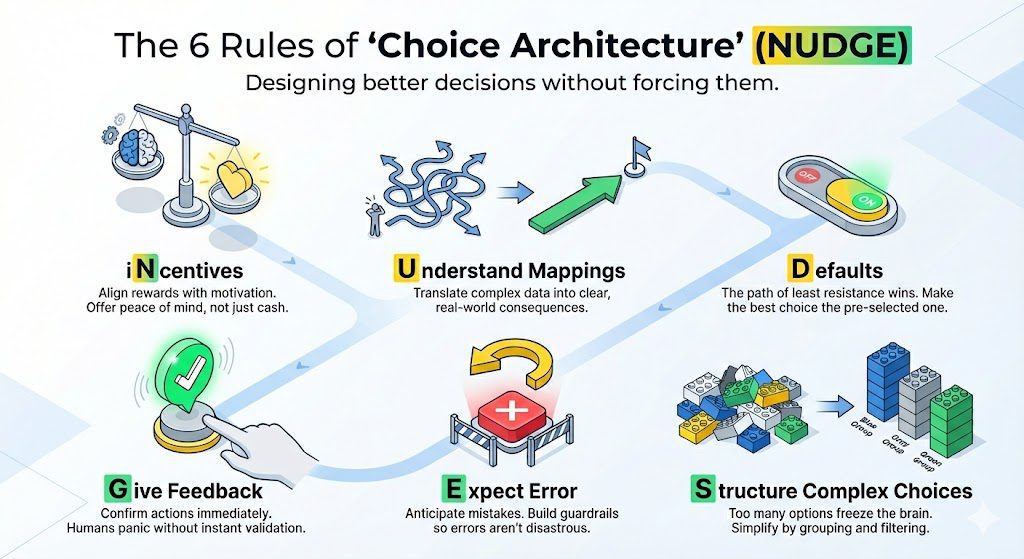
Nudge theory, formally introduced by Richard Thaler and Cass Sunstein in their 2008 book and refined across thousands of field experiments since, has an almost seductive simplicity to it. Move the salad to the front of the cafeteria. Make the default option the one you want people to choose. Send a reminder at the right time. It sounds effortless. And sometimes it is. But the devil, as always, is in the details.
A 2021 meta-analysis published in PNAS, covering 209 independent studies, found that roughly 15% of nudge interventions backfire outright — they actually move behavior in the opposite direction from the intended one.1 That number rises dramatically when the nudge is poorly timed, poorly contextualized, or mismatched with the person’s existing motivations.
This piece covers the 15 most consequential mistakes — the ones behavioral scientists flag in their own literature, the ones that show up in failed organizational rollouts, and the ones that quietly sabotage individual habit-change attempts every day. Each comes with what the evidence actually says, a real-world illustration, and a clear way forward.
Treating the Nudge as the Whole Plan
When a shortcut becomes a substitute for strategy
This is probably the most pervasive mistake in both personal habit-change attempts and organizational behavior programs. Someone reads a book on behavioral economics, learns that placing fruit at eye level increases healthy eating, and concludes that the nudge is the intervention. It isn’t. It’s one lever in a larger system.
A 2024 paper in the Journal of Business Research by researchers at Prague University of Economics put it plainly: most nudges “give the impression that they could be picked up off the shelf and applied successfully anywhere.” They can’t. The paper identifies three structural failures that follow from this mistake: no comprehensive behavioral change framework behind the nudge; overemphasis on immediate effects at the expense of deep motivational change; and a tendency among managers to reach for nudges as low-effort solutions to complex, deep-rooted problems.2
Think about it this way: if someone doesn’t drink enough water because they genuinely forget, a hydration reminder app works. But if they don’t drink enough water because they’re chronically stressed and reaching for coffee instead, the reminder just adds friction they’ll eventually ignore. The nudge has to fit the actual cause of the behavior gap.
The Fix
Before designing any nudge, spend ten minutes diagnosing the real barrier. Is it forgetting? Friction? Motivation? Competing habits? A nudge addresses forgetfulness and friction well. It does almost nothing for deep ambivalence. Map the barrier first, then choose your tool.
Ignoring Context Dependency
The same nudge in a different environment is a different nudge
Habit formation and behavioral nudging are profoundly contextual in ways that most people dramatically underestimate. A 2025 review in Trends in Cognitive Sciences by Buabang, Donegan, Rafei, and Gillan at Trinity College Dublin frames it neurologically: habits live in stimulus-response associations tightly bound to specific environmental cues.3 Displace the cue, and you displace the behavior — often without understanding why.
Phillippa Lally’s landmark UCL research (and her more recent work at the University of Surrey’s Habit Application and Theory Research group) underlines this repeatedly. In a 2022 analysis, context-specific habit measures showed clearer patterns of habit growth than context-free ones — meaning a habit practiced in one precise environment doesn’t automatically generalize to others.4
Real Case
The Office Redesign That Killed the Healthy Eating Program
A mid-sized consultancy spent significant resources nudging employees toward healthier lunch choices — better positioning in the cafeteria, reduced-friction ordering for salads, social norm messaging. It worked reasonably well. Then they moved offices. The new building’s cafeteria had a different layout, different foot traffic patterns, different ambient cues. Within eight weeks, the gains had largely reversed — not because the employees had changed their intentions, but because the contextual cues that supported the habit no longer existed.
This aligns directly with the habit discontinuity research: habits encoded in one physical context don’t automatically transfer. The transition was an opportunity to reset context-specific cues, but nobody thought to do it.
The Fix
Design nudges to be context-specific and document the environmental cues explicitly. When environments change — new home, new office, new schedule — treat it as a moment to actively reinstall cues rather than assuming the habit will follow.
Living by the 21-Day Myth
One of behavioral science’s most persistent and harmful misconceptions
The “21 days to form a habit” figure has survived in popular culture for decades, originating from a loose reading of plastic surgeon Maxwell Maltz’s 1960 observations about patient adjustment times. It has nothing to do with habit neuroscience. At all.
Phillippa Lally’s 2010 study — the most rigorous real-world investigation to date, tracking 96 participants over 84 days — found the average time to reach behavioral automaticity was 66 days, with a range of 18 to 254 days.5 In a 2026 interview with the University of Surrey, Lally was characteristically direct: “It is sometimes frustrating when a finding… is taken out of context. No. I mean for someone somewhere for one habit yes, but for most people most of the time, no.”6
| Behavior Type | Approximate Formation Range | Key Variable |
|---|---|---|
| Simple dietary (e.g., glass of water after breakfast) | 18–40 days | Low complexity, clear cue |
| Moderate exercise (e.g., 15-min walk before dinner) | 55–90 days | Physical effort, weather variability |
| Complex skills (e.g., 50 sit-ups, deliberate practice) | 90–254 days | High effort, competing habits |
Source: Lally et al. (2010), European Journal of Social Psychology; ranges derived from full participant data.
The Fix
Stop setting 21-day or 30-day checkpoints as tests of whether a habit “worked.” Design for 60–90 day minimum windows for anything more demanding than a tiny dietary change. Missing a day or two doesn’t matter — Lally’s research confirmed this — but premature abandonment almost always does.
Over-Relying on Defaults Without Understanding Their Limits
The most powerful nudge tool also has a significant shadow side
Default settings — the pre-selected option in any choice — are legitimately the most robust nudge tool behavioral economists have. Opt-out organ donation systems, automatic retirement savings enrollment, pre-checked privacy settings: the evidence for their power is overwhelming. But “most robust in the right conditions” has a crucial qualifier.
The same 2024 Journal of Business Research analysis that critiques shelf-and-apply nudging points out that defaults can actively prevent people from engaging with a decision at all — from learning, from developing preferences, from building the kind of reflective understanding that creates durable change.2 A firm that pre-selects a health insurance plan for employees via default, for example, “may prevent employees from considering alternative plans that better suit their needs” — and from developing the financial literacy to make better decisions in future.
The Fix
Use defaults as the first step, not the only step. Pair them with brief education that helps people understand what they’ve been enrolled in and why. The goal is to move from “the system chose this for me” to “I understand and endorse this choice” — which is what creates genuine durability.
Triggering Psychological Reactance
The backfire effect that turns your nudge into resistance
Psychological reactance is what happens when people feel their freedom of choice is being threatened — they respond by asserting that freedom, often by doing the opposite of what’s being nudged. It’s not irrational. It’s deeply human. And it’s one of the most documented failure modes in the nudging literature.
A 2023 randomized controlled trial published in Ecological Economics found a striking effect: nudging people who already intended to eat sustainably — after they’d made a green pledge — produced worse sustainable food choices compared to letting them choose on their own.7 The nudge was experienced as redundant and controlling, and it backfired. Cambridge Core research confirms: nudges backfire “when citizens view them as agency-reducing, with one’s intrinsic motivation moderating these differences.”8
The reactance risk is highest when: the person already has strong intrinsic motivation in the domain; the nudge is perceived as coming from a party with misaligned interests; or the nudge is made visible (people resist more strongly when they know they’re being nudged).
The Fix
For highly motivated people, nudges should support agency rather than direct it. Offer commitment devices, tracking tools, and friction reduction rather than prescriptive prompts. If you’re designing for an audience that already cares about the outcome, your job is to make the path easier, not to tell them which path to take.
“Nudges are means to influence the will formation of people to make specific choices more likely. Health-enhancing nudges fail because we cannot know which choices enhance individual health — properly understood in a holistic way.” — Thomas Schramme, University of Liverpool · Health Care Analysis, 2023
Removing the Nudge Before the Habit Has Formed
Behavioral effects decay when the scaffolding comes down too early
Field experiments on nudge persistence reveal something important and widely ignored: behavioral responses to nudges occur immediately when the nudge is present, but decay gradually when it’s removed — and the decay takes longer the longer the nudge was in place.9 This is the structure of scaffolded behavior, not genuine habit formation.
A field experiment studying real-time feedback on energy consumption found this pattern precisely: behavior changes appear fast, plateau while the nudge persists, and erode after it’s withdrawn. The researchers’ conclusion is pointed: understanding this decay structure has “important implications for designing behavioral interventions and evaluating their long-term social impacts.”
The NBER working paper by Allcott and colleagues, analyzing 38 natural field experiments, found that energy reductions from nudges did persist in some cases — but primarily when the nudge led to technology adoption, not habit formation per se. The habit and the technology change are not the same mechanism.10
Common Pattern
The Corporate Wellness App Plateau
Organizations roll out a wellness app that nudges employees to move, drink water, and log meals. Engagement is strong for 60 days. The vendor presents data showing a 34% increase in reported healthy behaviors. The program is deemed a success. Nudge delivery is reduced. Within 90 days, self-reported behaviors have returned to 80% of baseline levels. The nudge was doing the work; the habit never actually formed.
The Fix
Treat the nudge as scaffolding that needs a gradual fade-out, not a sudden removal. Design explicit “habit transfer” phases where the person is helped to internalize the cue-routine-reward loop before external supports are withdrawn. Consider whether you’re measuring behavior change or habit formation — they’re different things with different timelines.
Getting the Reward Timing Wrong
Dopamine operates on milliseconds; most habit rewards operate on weeks
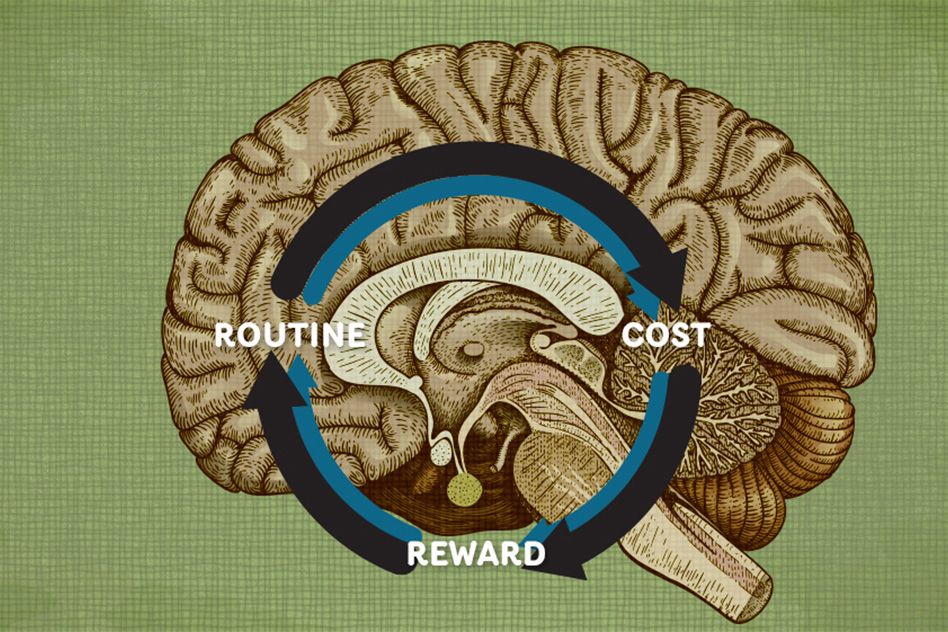
The neuroscience here is unambiguous. Habit formation is driven by the dopaminergic reward system, which responds to immediate feedback. Not “you’ll feel better in three months.” Not “you’ll thank yourself in five years.” Now. The basal ganglia — the brain region most implicated in habit encoding — learns from immediate reward signals, not long-deferred ones.3
Yet most habit-change attempts offer primarily delayed rewards: weight loss, improved fitness, financial security, career advancement. These are real and valuable outcomes. They’re just neurologically disconnected from the moment of behavior execution, which is when the reward signal needs to arrive to reinforce the habit loop.
This is why “temptation bundling” — pairing a mildly unpleasant habit behavior with an immediately enjoyable reward (like only watching your favorite show while exercising) — shows consistent empirical support. It closes the temporal gap between the behavior and the reward the brain actually responds to.
The Fix
Identify an immediate, intrinsically enjoyable reward that can be attached to or closely follow the target behavior. This doesn’t need to be elaborate: a specific coffee you only allow yourself after your morning pages, a particular playlist only for workouts, a brief self-acknowledgment ritual after completing the behavior. The brain needs to learn the pattern, not just the distant outcome.
Designing One Nudge for Everyone
Individual variation in habit formation trajectories is enormous
Lally’s research found a range of 18 to 254 days to form habits across participants attempting similar behaviors. That’s not a rounding error. That’s a 14-fold difference in formation time for what looks, on paper, like the same task. Individual variation in habit formation is massive and almost entirely ignored in population-level nudge design.
A 2024 systematic review in the Journal of Medical Internet Research, analyzing digital behavior change intervention designs, noted that “context detective” approaches — interventions that adapt to the individual’s actual behavioral context using location, timing, and behavioral event data — showed superior effectiveness compared to fixed-schedule interventions.11 The review found that personalized, just-in-time nudges consistently outperformed blanket nudges.
The Fix
Where possible, allow nudge timing, frequency, and format to adapt to observed behavioral patterns rather than fixed schedules. At minimum, acknowledge individual variation in communications: “Most people take 60–90 days — your timeline may differ and that’s completely normal” does genuine work in preventing premature dropout.
Stacking Too Many Nudges at Once
Cognitive load is a finite resource; overwhelmed systems default to inaction
There’s an enthusiasm problem in behavioral design: once someone discovers that nudges work, they tend to add more of them. More reminders, more commitment devices, more social comparison, more prompts to plan, more reframing. The logic feels sound — each nudge is individually validated, so more should produce more change.
In practice, nudge stacking creates cognitive load that consumes the very mental resources needed for deliberate behavior change. Research on decision fatigue and ego depletion — while the latter concept has faced replication challenges — broadly confirms that the capacity for self-directed behavior change is not unlimited within any given day or context. A 2024 AIHCP review on behavioral health noted that deeply ingrained old behaviors are particularly resilient to change attempts precisely because they’ve been automated, reducing cognitive load — while new habit attempts require active cognitive effort that can be depleted.12
The Fix
Serial, not parallel. Focus on one behavioral target at a time until it shows strong signs of automaticity, then move to the next. For organizational programs, sequence rollouts rather than launching everything at once. Three well-supported habits formed over a year outperform twelve half-formed ones.
Ignoring Stress and Cognitive State
Habits go offline under pressure — and most nudges aren’t designed for that
Under elevated stress, the balance between goal-directed behavior and habit-driven behavior shifts dramatically toward habits — specifically old habits. The neuroscience is clear: stress activates the hypothalamic-pituitary-adrenal axis, which suppresses prefrontal cortical function and increases reliance on striatal, habit-based behavior systems.3 In simpler terms: when you’re stressed, you revert to what you’ve always done, regardless of your intentions.
This creates a structural problem for behavioral nudging. Most nudges assume a reasonably available deliberate processing capacity. They present options, reframe choices, send reminders that require the person to notice and respond. But under stress — the very condition under which most people most want to change behaviors — those nudges land in an environment of reduced deliberate processing. The bad habits don’t need deliberate processing; they just run.
Documented Pattern
Why Deadlines Destroy Healthy Eating Nudges
Research consistently finds that healthy eating nudges — even well-designed ones — lose effectiveness during high-stress periods like project deadlines, financial strain, or interpersonal conflict. This isn’t a willpower failure. It’s a predictable neurological response: the stress response shifts behavioral control from prefrontal goal-directed systems (where the nudge is operating) to basal ganglia habit systems (where the old behavior lives). The nudge isn’t reaching the right system.
The Fix
Design nudges with stress-state robustness in mind. This means: making the desired behavior the path of least resistance structurally (defaults, friction removal), not just informationally. A food environment where the healthy option requires no decision-making survives stress; a reminder app that requires active response does not.
Social Norm Nudges Aimed at the Wrong Comparison Group
Norms only nudge when the reference group is one you actually identify with
“Most of your neighbors use 20% less energy than you” works when you care what your neighbors think of you. It works less well when “neighbors” means people three miles away you’ve never met. Social norm nudges — one of the most widely deployed category of behavioral interventions — have highly variable effects that correlate strongly with how much the recipient identifies with the comparison group.
The PNAS meta-analysis found “decision information” nudges (which includes descriptive social norms) showed meaningfully smaller effect sizes than “decision structure” nudges like defaults.1 Part of this is because norm nudges are more susceptible to individual differences in values, social identity, and context.
The Fix
Make the comparison group as specific and proximate as possible: “people in your department,” “people your age who do your type of work,” “people who chose the same plan you started with.” Generic population norms are weaker. Peer comparisons with identifiable social groups are stronger — but require more careful data handling.
Skipping the Implementation Intention
Vague intentions don’t become behaviors; specific plans do
Peter Gollwitzer’s decades of research on implementation intentions — “if-then” plans that specify exactly when, where, and how a behavior will occur — is among the most reliably replicated findings in behavioral science. Meta-analyses consistently show that implementation intentions more than double the likelihood of acting on an intention compared to having the intention alone.
The mistake most behavioral nudgers make is prompting the intention without the plan. “Remember to exercise this week” is a cue. “I will do 20 minutes of exercise at 7am on Tuesday and Thursday in my living room before coffee” is an implementation intention — and it is significantly more likely to produce the behavior, because it creates a specific if-then association that the brain can run automatically when the cue context appears.
The Fix
Any nudge that aims to install a behavior should prompt the formation of a specific implementation intention. “When and where will you do this?” is not an optional reflective exercise. It’s the mechanism that makes the nudge stick. Build it into the nudge design itself: not just “try this” but “when will you try this, where, and what will trigger it?”
Measuring Behavior Instead of Habit Strength
Behavior can look like a habit long before it actually is one
This is a measurement and evaluation error that has significant downstream consequences. Most behavioral programs measure behavior frequency — did the person exercise three times this week? Did the employee complete the training? But behavior frequency is not the same as habit strength, which is characterized by automaticity: doing the behavior without conscious deliberation, in response to a contextual cue, with reduced cognitive load.
Someone can complete a behavior consistently for 90 days because of strong external motivation, intensive accountability structures, or high situational salience — and drop it entirely when those conditions change, because the automaticity never actually formed. Lally’s research measured automaticity directly via self-report items like “I do it automatically,” “I do it without thinking,” and “I’d find it hard not to do” — these are fundamentally different from frequency counts.
| What You’re Measuring | What It Actually Tells You | Durability Signal? |
|---|---|---|
| Behavior frequency (times/week) | Compliance under current conditions | Weak |
| Self-reported automaticity (“I do it without thinking”) | Degree of habit formation | Strong |
| Behavior maintenance post-nudge removal | Whether habit or nudge was driving behavior | Strong |
| Behavior in novel contexts | Whether habit generalized beyond original cue | Partial |
| Engagement with tracking app | App habit, not necessarily target behavior | Misleading |
The Fix
Add automaticity measurement to any serious habit-change or nudge program. The Self-Report Habit Index (SRHI) developed by Verplanken and Orbell is validated and freely available. At minimum, periodically remove the nudge trigger for a week and observe whether behavior persists. That’s your actual habit measure.
Confusing Friction Removal With Friction Addition
Reducing barriers to good habits and adding barriers to bad ones are not symmetrical
Friction is one of behavioral design’s most powerful tools. Reducing friction for desired behaviors and adding friction for undesired ones are both effective, but they operate through different mechanisms and have different failure modes. Most designers understand this in theory; far fewer apply it with precision in practice.
Removing friction works best when the barrier is truly logistical: the healthy food isn’t available, the gym is inconvenient, the sign-up process is complicated. In these cases, removing the barrier unlocks latent motivation. But when the barrier is motivational — the person doesn’t actually want the behavior — reducing logistical friction produces only marginal and temporary improvements.
Friction addition (making bad habits harder: putting your phone in another room, keeping junk food out of the house, logging every purchase) works best when the undesired behavior is impulsive rather than deliberate. It creates a pause in the automatic response chain that allows goal-directed processing to intervene. But it fails when the person is strongly motivated toward the undesired behavior — they’ll simply absorb the friction.
The Fix
Diagnose whether the barrier is logistical or motivational, and whether the undesired behavior is habitual or temptation-based. Logistical barriers → friction removal. Impulse-driven bad habits → friction addition. Deep ambivalence or high-reward temptations → values work, not friction design.
Confusing Behavior Change With Habit Formation
The most fundamental — and most common — conceptual error in the field
This is where everything comes together, and where the most foundational error in behavioral nudging lives. Behavior change and habit formation are related but genuinely distinct phenomena, and conflating them is responsible for a large share of the disappointment people experience when “nudges that worked” eventually don’t.
Behavior change is producing a new behavior, potentially once, potentially repeatedly, through conscious effort, external prompting, or situational support. Habit formation is the process by which that behavior becomes automatic — encoded in stimulus-response associations that fire without deliberate intention. A nudge reliably produces behavior change. It produces habit formation only if it’s designed to facilitate the development of automaticity over time.
The 2025 review in Trends in Cognitive Sciences frames this neurologically as the transition from goal-directed (prefrontal, deliberate) to stimulus-driven (striatal, automatic) behavioral control.3 This transition takes time, requires repetition in stable contexts, and doesn’t happen just because a behavior occurs repeatedly — the repetition needs to be context-paired for automaticity to encode.
Habit formation goal: “I want this person to automatically reach for their gym bag on Tuesday, Thursday, and Saturday mornings, without needing to decide to do so.”
These require different designs, different timelines, and different success metrics.
Many corporate wellness programs, personal development apps, and public health interventions are measuring behavior change while hoping for habit formation. They get the former and report success; then the funding cycle ends, the support structures are removed, and the behaviors evaporate — leaving everyone confused about what went wrong. What went wrong is that the program achieved its stated goal (behavior change) but not its actual desired outcome (durable habit).
The Fix
Define your goal explicitly at the start: are you trying to change a behavior once or a few times, or are you trying to install a self-sustaining automaticity? If the latter, design for habit formation specifically: stable contexts, consistent cues, immediate rewards, gradual fading of external supports, and automaticity measurement. Build for the day when the nudge is gone.
| # | Mistake | Severity | Core Fix |
|---|---|---|---|
| 01 | Nudge as the whole plan | Critical | Diagnose the real barrier first |
| 02 | Ignoring context dependency | Critical | Design context-specific cues; reinstall after moves |
| 03 | 21-day myth | High | Design for 60–90 day minimum windows |
| 04 | Over-relying on defaults | High | Pair defaults with education and engagement |
| 05 | Triggering reactance | Critical | Support agency, don’t prescribe for motivated people |
| 06 | Removing nudge too early | High | Gradual fade-out; habit transfer phase |
| 07 | Wrong reward timing | High | Attach an immediate reward to the behavior |
| 08 | One nudge for everyone | High | Adaptive / personalized delivery where possible |
| 09 | Too many nudges at once | Medium | One habit at a time, serial not parallel |
| 10 | Ignoring stress states | High | Structural nudges over informational ones |
| 11 | Wrong social comparison group | Medium | Proximate, specific, identifiable peer groups |
| 12 | No implementation intention | High | Prompt specific when/where/how plans |
| 13 | Measuring frequency not automaticity | Medium | Use SRHI; test behavior after nudge removal |
| 14 | Friction confusion | High | Match tool to barrier type |
| 15 | Confusing behavior change with habit | Critical | State goal explicitly; design for automaticity |
Behavioral nudging, done well, is genuinely one of the most powerful tools available for reshaping human behavior. The research base is solid, the mechanisms are reasonably well understood, and the field continues to produce high-quality evidence. The problem isn’t the tools; it’s the shortcuts people take in using them.
The 15 mistakes above share a common thread: they all involve underestimating complexity. They treat context as interchangeable, timelines as short, people as homogeneous, behaviors as identical to habits, and nudges as complete solutions rather than one component of a design system. That underestimation is expensive — not just in terms of wasted effort, but in terms of the trust erosion that happens when behavioral interventions are tried, appear to work, and then visibly collapse.
The optimistic reading — and it’s a realistic one, not a cheerful gloss — is that avoiding these mistakes isn’t especially difficult once you know them. It requires a bit more upfront diagnosis, a bit more patience with timelines, and a bit more precision about what you’re actually measuring and what you’re actually trying to achieve. None of that is beyond any thoughtful person or organization.
The science of habit formation is accelerating. The January 2025 Trends in Cognitive Sciences review explicitly forecasts “a rapid influx of new insights into intentional behavioral change” including “new opportunities for personalization.” We’re in a genuinely exciting moment for this field. But the foundation has to be right — and that means taking the failure modes as seriously as the success cases.
Start by diagnosing the real barrier. Design for automaticity, not just behavior. Give it time. And build for the day when the nudge is gone.
Sources & References
- Szaszi, B., Goldstein, D.G., Soman, D., & Michie, S. (2021). The effectiveness of nudging: A meta-analysis of choice architecture interventions across behavioral domains. PNAS, 118(39). doi:10.1073/pnas.2107346118
- Houdek, P. (2024). Nudging in organizations: How to avoid behavioral interventions being just a flash in the pan. Journal of Business Research, 182, 114781. Full PDF
- Buabang, E.K., Donegan, K.R., Rafei, P., & Gillan, C.M. (2025). Leveraging cognitive neuroscience for making and breaking real-world habits. Trends in Cognitive Sciences, 29(1), 41–59. doi:10.1016/j.tics.2024.10.006
- Diefenbacher, S., Lally, P., et al. (2022). Habit formation in context: Context-specific and context-free measures. British Journal of Health Psychology. UCL Discovery
- Lally, P., van Jaarsveld, C.H.M., Potts, H.W.W., & Wardle, J. (2010). How are habits formed: Modelling habit formation in the real world. European Journal of Social Psychology, 40, 998–1009. doi:10.1002/ejsp.674
- University of Surrey (2026). Does it really take 66 days to form a habit? We asked the expert, Dr Pippa Lally. surrey.ac.uk
- Immediate backfire? Nudging sustainable food choices and psychological reactance. (2023). Ecological Economics. ScienceDirect
- Do nudges crowd out prosocial behavior? (2021). Behavioural Public Policy, Cambridge Core. cambridge.org
- How nudges create habits: theory and evidence from a field experiment. Queen’s University Economics. Full PDF
- Allcott, H., et al. (2022). Do the Effects of Nudges Persist? Theory and Evidence from 38 Natural Field Experiments. Review of Economic Studies. NBER Working Paper 23277
- Zhu, Y., Long, Y., Wang, H., Lee, K.P., Zhang, L., & Wang, S.J. (2024). Digital Behavior Change Intervention Designs for Habit Formation: Systematic Review. Journal of Medical Internet Research, 26, e54375. PMC11161714
- AIHCP Behavioral Health Certifications. (2025). The Psychology Behind Forming Habits. aihcp.net
- Schramme, T. (2023). Why Health-enhancing Nudges Fail. Health Care Analysis. PMC10902068
- Sunstein, C.R. (2017). Nudges That Fail. Behavioural Public Policy, 1(1), 4–25.
- Frontiers in Behavioral Neuroscience (2025). Habits and temptation: automaticity vs. immediate outcome value. doi:10.3389/fnbeh.2025.1683756
More From FutureNow
Deeper reading on behavioral science, habit formation, and decision architecture
Micro-Habit Engineering: 11 Facts That Will Change How You Approach It