


Why Viral Influencers Are
Quitting the Internet
The exits aren’t random. Five structural cracks are breaking the people who built everything — and the ones walking away cleanest are the ones who saw it coming two years ago.
Why viral influencers are quitting the internet: it’s not just burnout. Organic reach collapsed from 20% to 2% in five years. Almost half of creators earn under $10K/year. AI flooded feeds with synthetic content — killing audience trust. And the identity cost of performing publicly, every day, without a break? It’s not survivable long-term for most humans.
The creators who exit cleanly had one thing in common: they built something the algorithm can’t touch. Email lists. Paid communities. Equity in brands. The ones you’re watching disappear right now? They didn’t.
Why viral influencers are quitting the internet — the gap between the performance and the person behind it, 2026
01 — Definition What “Quitting the Internet” Actually Means (Most Headlines Get This Wrong)
Here’s what almost every article about influencer exits misses: they’re not disappearing. They’re migrating.
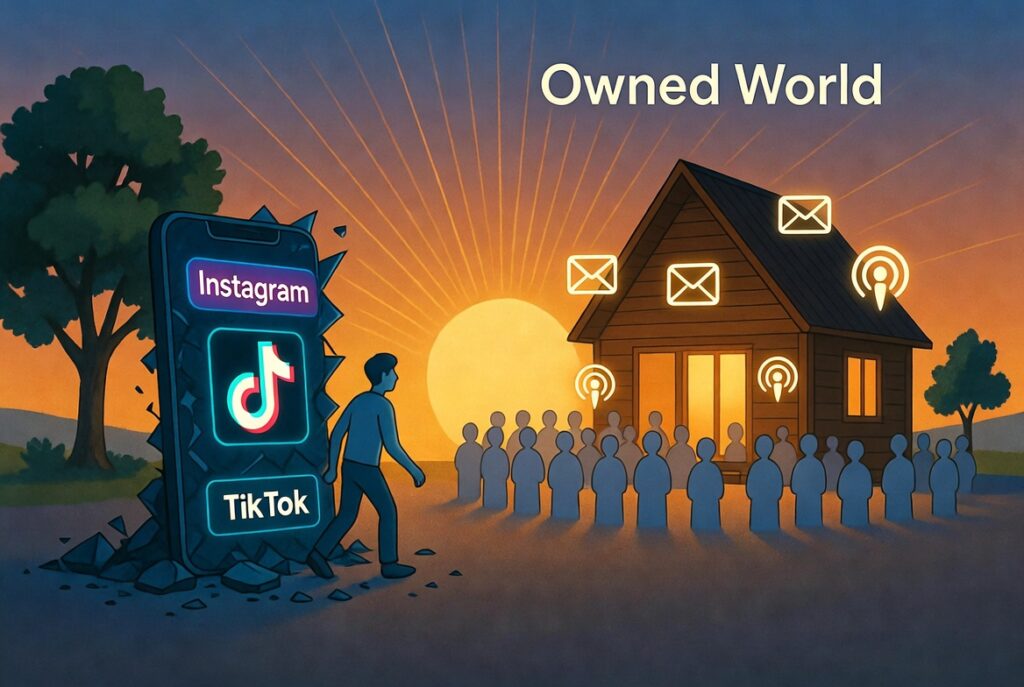
“Quitting the internet,” in creator terms, means walking away from algorithmic platforms — TikTok, Instagram, YouTube — not from digital existence entirely. The ones who announce they’re leaving? Most reappear on Substack three months later. Or in a private podcast. Or running a paid community of 2,000 people who actually pay for access. That’s not quitting. That’s a pivot with better economics and better sanity margins.
Burnout and strategy can look identical from the outside. Both result in less posting. Both produce farewell videos. The difference is what comes after. When Addison Rae shifted her brand integrations toward YouTube long-form in 2026 and dropped a six-track EP that debuted in Spotify’s Global Top 50, that wasn’t a breakdown. She rebuilt on ground she controls. When top creators started negotiating equity stakes in brands instead of per-post fees — that’s not desperation. That’s the smarter play, six years too late for most.
The central argument you’ll keep seeing throughout this piece: viral influencers are not quitting because they can’t handle success. They’re quitting because the economics and the human cost of platform-dependent creation became structurally unsustainable — and the smartest ones understood that before it broke them.
There’s a reason the media doesn’t frame it this way. “Creator has strategic pivot” doesn’t get clicks. “Influencer melts down” does. Keep that in mind every time you see a new exit story.
02 — The Framework The Three-Phase Failure Pattern Nobody Actually Explains
Almost every creator exit follows the same sequence. Phase 1 creates the vulnerability. Phase 2 is where the money problem starts. Phase 3 is where the person runs out. You can short-circuit all three — but only if you see the pattern before you’re already in it.
Standard creator advice is: post consistently, niche down, engage with your audience. Fine. What it skips completely is the power structure baked into every major platform.
Organic reach dropped from roughly 20% of a creator’s audience to around 2% over the past five years — that figure came out at SXSW 2026 from creator economy infrastructure researchers, and nobody in the room disputed it. Think about what that means. A creator with 500,000 followers is reaching maybe 10,000 people per post. Not because they performed badly. Because the platform redesigned distribution around paid promotion and watch-time signals — while the creator was busy making content.
The creators who understood this early built off-platform audiences from day one: email lists, podcasts, owned communities. The ones who focused entirely on follower count? By 2025 they had massive audiences they couldn’t reliably reach. That is a miserable position to be in. Especially when you’ve spent three years of your life getting there.
This is where the actual exits originate. Not from burnout — from the money running out while the burnout hits.
The creator economy looks lucrative from the outside. The reality, from the Influencer Marketing Factory’s survey of 1,000 US creators in January 2026, is stark: 48.7% of creators earn under $10,000 per year. Only 5.7% clear six figures. That’s not a failing industry — it’s the exact shape of every attention economy since the printing press. The top tier captures enormous value; everybody else subsidises the ecosystem with their labour and their sleep.
Here’s how the trap works: you go viral, gain followers, start getting brand partnership offers. Those offers feel like stability. They’re actually the most volatile income structure possible — entirely dependent on follower count, engagement rate, algorithm visibility, and brand sentiment, any of which can evaporate overnight. A 2024 peer-reviewed study in the Journal of Occupational Health found that creators earning under $10,000 from their content showed the lowest levels of positive affect — the financial stress and the time stress compound each other into something really hard to come back from.
This one has nothing to do with money or algorithms. Honestly, it’s the one I find most underreported.
A 2024 peer-reviewed study — Beyond the filter: Impact of popularity on the mental health of social media influencers (PMC) — found that with a growing follower count, creators increasingly lose privacy and feel compelled to maintain a specific image or lifestyle, constantly monitoring their own actions and behaviours. The line between person and persona collapses. Slowly. Then suddenly all at once.
Licensed therapist Barbara Guimaraes, founder of Mental Nesting, put it simply in January 2026: “People aren’t just taking short breaks from social media. They’re actually choosing to post less or step back — not as a detox, but as a real boundary.” That word “boundary” is doing a lot of work. What it means in practice: they want their life back. The part that doesn’t get filmed.
03 — The Numbers The Data Most Creators Never See Coming
These aren’t industry estimates. These are the specific numbers from named 2025–2026 research that explain why the exits are accelerating.
The number that changes everything: Instagram was identified as the primary burnout platform by 71% of surveyed creators — and over half said resources from the platforms themselves were no help at all. The platforms create the problem and offer nothing to solve it. That’s not an accident. (Source: Awin Group via MarTech Series)
The Creator Resilience Stack: What Survives Platform Collapse
After analysing the career trajectories of creators who exited cleanly versus those who crashed, a consistent pattern emerged. Four assets determine whether a creator survives a platform disruption. Most creators have one. The ones who made it cleanly had three or four.
Owned Contact
Email list, SMS, podcast RSS — audience you can reach without asking the algorithm’s permission.
Recurring Revenue
Subscriptions, long-term brand deals, equity stakes — income that doesn’t reset to zero each month.
Owned IP
A course, a book, a product, a proprietary framework — something with a price tag that you control.
Identity Boundary
A clear separation between the performing self and the private self. Sounds soft. It’s structural.
04 — Critical Mistakes Two Mistakes That Are Quietly Ending Creator Careers Right Now
One of these contradicts the most common advice in the creator space. That’s exactly why it matters.
Optimising for Follower Count When Engagement Rate Is the Actual Revenue Driver
The precise name for this mistake: treating vanity metrics as business metrics.
LTK CEO Amber Venz Box called this directly at the close of 2025: “I think that 2025 was the year where the algorithm completely took over, so followings stopped mattering entirely.” The creator obsessing over crossing 1 million followers while neglecting their 50,000 highly engaged existing followers has optimised the wrong variable entirely. And done it for years.
The root cause isn’t stupidity. It’s interface design. Every platform UI is engineered to treat follower count as status — the like counter, the subscribe button, the milestone celebration banners. These are behavioural conditioning mechanisms that train creators to optimise for what the platform profits from, not what generates income.
The evidence that this has fully shifted: Linqia‘s State of Influencer Marketing 2026 found that 92% of marketers now plan to work with both macro and micro influencers — with the micro tier (5,000–100,000 followers) valued specifically for engagement depth, not reach. That’s the industry finally admitting follower counts were the wrong benchmark the whole time. Took a decade.
Posting 7× per week chasing follower milestones. 200K followers, 0.3% engagement, $0 email list, one brand deal that expires in 60 days.
Posting 3× per week. 80K followers, 4.2% engagement, 8,000-person email list, two long-term brand contracts worth $42K/year combined.
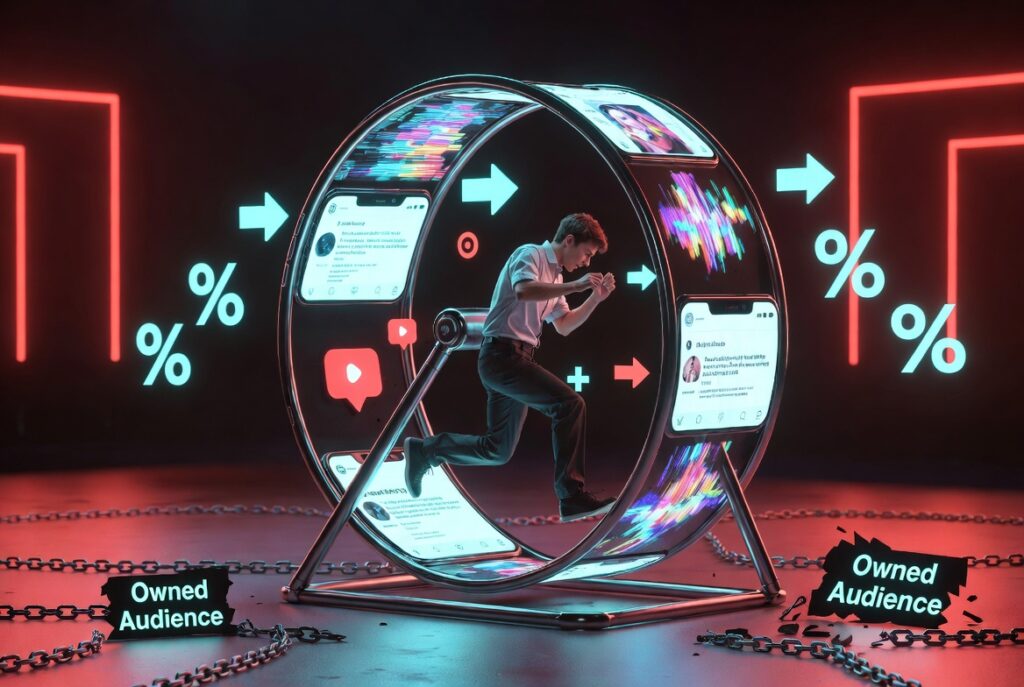
Confusing Content Volume With Business Development — The Treadmill That Looks Like Work
More precisely: posting consistently as a substitute for building an audience asset.
A creator who posts seven days a week for three years on Instagram and ends up with 200,000 followers owns absolutely nothing that can survive a platform shutdown, a policy change, or an algorithm update. A creator who posts three days a week and spends the remaining time building an email list, a podcast, or a paid community? They own something that compounds. Completely different economic structure.
The platform rewards frequency with distribution — more posts equals more algorithm exposure equals more followers, in theory. In practice, this creates a content treadmill that crowds out the strategic thinking needed to build anything durable. Andrew Selepak, media professor at the University of Florida, identified the anxiety layer driving this: creators face constant fear of being judged, cancelled, or losing income over a single post. That anxiety accelerates the frequency-at-all-costs behaviour — because the next post always feels like the one that might finally fix the reach problem. It never does.
Organic reach is at 2%. Building an owned audience is the only structural fix that actually works.
05 — What Works Now What Actually Works in 2026 — With the Mechanism Behind Each
The single most important shift of 2025–2026
Audiences are actively choosing trust over scale. And AI made this happen faster than anyone predicted.
Consumer enthusiasm for AI-generated creator content dropped from 60% to 26% between 2023 and 2025, according to a Billion Dollar Boy and Censuswide survey. Meanwhile, AI flooded platforms with synthetic content that looks human. The result is a paradox that directly benefits real creators: trust in authentic humans increased precisely because the contrast became so stark. Audiences know the feed is full of AI slop. The creator who isn’t slop is suddenly more valuable than they’ve been in years.
“If you asked me at the beginning of 2025, ‘Is trust in creators going to go up or down?’ I would have probably said down, because people understand it’s an industry. But actually, AI pushed people to rotate trust toward real humans with real life experiences.” — Amber Venz Box, CEO of LTK, December 2025 (via TechCrunch)
What no longer works: the spray-and-post approach of frequent short-form content with broad appeal. Instagram image posts declined 6.41% from 2024 to 2025. Reels volume grew 3.8%. That’s not a preference shift — it’s platform infrastructure. Creators who haven’t adapted their format are losing visibility regardless of quality.
Direct Audience Ownership Over Platform Growth
The most resilient creator businesses in 2026 operate across owned channels. This became undeniable when TikTok faced its US ban threat in early 2025 — creators who had no off-platform audience were suddenly entirely exposed, with zero options. The ones who’d been building email lists and podcasts? They watched the drama from a comfortable distance.
Micro-Influence Depth Over Macro-Influence Reach
Influencer ads now deliver nearly 2× the click-through rate of standard brand ads with 25% lower cost-per-click, per Sprout Social’s 2026 data. The mechanism is trust: a smaller creator with a tightly aligned audience converts better than a mega-influencer with a broad, loosely connected following. This has concrete career implications — the 45.6% of creators earning $10,000–$100,000 annually are mostly micro and mid-tier, and they’re growing faster in revenue than the top tier.
Long-Term Brand Alignment Over One-Off Campaigns
44.9% of creators surveyed by the Influencer Marketing Factory in January 2026 now say they prioritise stability and deeper brand alignment over individual sponsored posts. The financial picture: a creator earning $2,000 per one-off post who transitions to a $30,000 annual brand partnership has not just earned more — they’ve eliminated the perpetual pitch cycle, the monthly income uncertainty, and the mental overhead of constant deal-chasing.
| Creator Tier | Annual Earnings | % of Creators | Biggest Risk | Resilience |
|---|---|---|---|---|
| Micro (10K–50K) | Under $10K | 48.7% | Algorithm-only income | Fragile |
| Mid-tier (50K–500K) | $10K–$100K | 45.6% | Revenue concentration | Building |
| Macro (500K+) | $100K+ | 5.7% | Identity/burnout threshold | Viable |
| Top 1% | $1M+ | <1% | Credibility erosion | Strong |
Source: Influencer Marketing Factory, 1,000 US creators, January 2026. Earnings cross-referenced with EMARKETER 2026 forecasts.
06 — Tools & Sources What to Use, What to Trust, and One Source to Approach Carefully
Sources worth trusting: EMARKETER for creator economy revenue forecasts (transparent methodology, used by brand teams — treat as directional). Sprout Social Index for consumer behaviour benchmarks. Influencer Marketing Factory for income distribution data — their annual report combines surveys with analysis of 5 million creator accounts.
07 — Action Plan Your First 30 Days: Specific Actions That Actually Compound
Not a to-do list. Not “think about your strategy.” These are daily actions with time estimates, each building something the algorithm can’t touch.
Week 1–2: Foundation
Success metric, end of Week 2: You know your three best-performing content formats. You have a revenue dependency score. You have at least one owned channel with at least one subscriber. That’s the actual foundation.
Week 3–4: Execute
08 — FAQ Frequently Asked Questions
Understand the difference between a platform audience and an owned audience — and accept that you cannot treat them as the same thing. Your platform followers are borrowed. The platform controls who sees your content, when, and under what conditions. An owned audience — email subscribers, podcast listeners, paid community members — is yours regardless of algorithm changes. The creator exits you’re watching happen almost exclusively among people who built entirely on platforms and discovered, too late, that they owned nothing of their own.
Meaningful off-platform traction typically takes 6–12 months to feel significant — but the compounding starts on day one, not month six. The Influencer Marketing Factory’s January 2026 survey found that 51.5% of creators achieved earnings growth year-over-year in 2025. The pattern among those who grew was consistent: diversified revenue, owned channels, long-term brand relationships. The visible results are slow. The direction of change is immediate. Those are not the same thing, and conflating them is what makes most people give up too early.
Treating content output as a business strategy rather than a sales channel. Posting frequently generates platform visibility — but it does not build a business unless it’s connected to owned assets: a list, a product, a community. An Awin Group survey found 72% of creators cite constant platform changes as their leading anxiety driver. Those changes only feel catastrophic if your entire business is platform-dependent. Creators who treat posting as top-of-funnel, not as the destination itself, are materially more resilient. It’s a subtle reframe, but it changes every decision you make.
It’s most valuable for beginners, because the habits formed in the first 12 months determine the next five years. A beginner who starts with one owned channel alongside one platform will never face the trapped feeling that drives the exits you’re reading about. The creators quitting in 2026 largely built their businesses between 2017 and 2022 — before the structural risks were visible. You have the advantage of watching the pattern play out completely before you repeat it. That’s a genuinely unusual position. Use it.
Ask one question at the end of each month: if this platform disappeared tomorrow, what would I still have? If the honest answer is “not much,” that’s your signal. The measurable proxy for durability is the ratio of owned-channel growth to platform-follower growth. If your email list grows by 5% when your Instagram grows by 5%, you’re building something real. If your Instagram grows 20% and your email list is still at zero — you’re building someone else’s business, not yours. Run the revenue exposure audit in the action plan above. It takes 30 minutes and produces uncomfortable clarity immediately.
📚 Verified Data Sources (2025–2026 Only)
- Influencer Marketing Factory — 2026 Creator Economy Report, survey of 1,000 US creators, January 2026
- Beyond the filter: Impact of popularity on mental health of influencers — PMC, 2024 peer-reviewed study
- 80% of Content Creators Are Burnt Out — Awin Group Survey via MarTech Series
- In 2025 Americans detoxed from social media. In 2026, they’re quitting entirely — Straight Arrow News, January 2026
- A ‘quiet revolution’: Why young people are swapping social media for brick phones — CNBC, February 2026
- Social media follower counts have never mattered less — TechCrunch, December 2025
- FAQ on the creator economy: How marketers can stand out in 2026 — EMARKETER, January 2026
- Creator Economy News: April 2026 Trends — MediaBistro (2% organic reach figure, SXSW 2026 data)
The Platform Isn’t Permanent.
Your Audience Can Be.
The creators who exit cleanly had one thing in common: they built something the algorithm can’t touch. The 30-minute revenue audit is where that starts.
Run Your Revenue Audit →Why TikTok Trends Spread Faster Than Diseases: 2025 Best Guide!
Scientists Revived Viruses Frozen for 48,500 Years. Here’s the actual science.
The Weirdest Internet Challenges of 2026
The Meme That Accidentally Changed Politics