
The Organisms That Actually Eat Plastic — and the Ones That Just Hold It
A fungus from Ecuador’s rainforest digests polyurethane without oxygen. A birch tree locks microplastics in its roots. A meadow of seagrass traps more plastic than any lab — and is vanishing faster than it can be replaced. Here is what each mechanism actually does, and what none of them can.
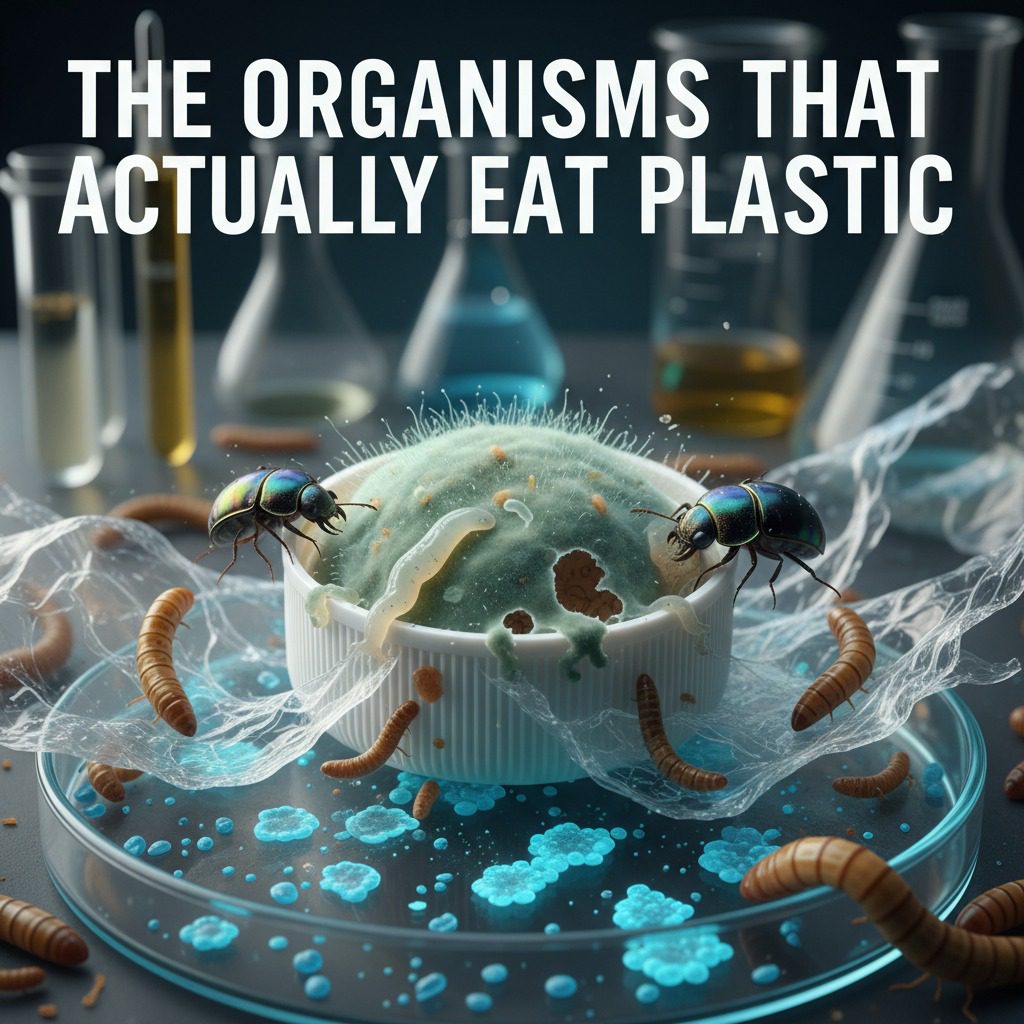
Somewhere in the deep, airless layers of an Ecuadorian landfill, a fungus is eating plastic. Not slowly, not symbolically — it is metabolizing polyurethane foam as its sole carbon source, the same way a human body metabolizes a meal. This is not a metaphor. It is a peer-reviewed laboratory finding that upended what scientists thought possible about biological plastic degradation. The organism, Pestalotiopsis microspora, does something no other known fungus had previously demonstrated: it breaks down polyurethane even without oxygen — which means it can function in the suffocating depths of compacted waste where no sunlight, no air, and no conventional remediation method can reach.
That discovery was not the end of the story. It was closer to the opening sentence. In the years since, researchers in Berlin found silver birch trees drawing microplastic beads into their root tissue from contaminated soil. Seagrass meadows along the coasts of China, Spain, and India were shown to trap microplastics at concentrations up to 600% higher than surrounding unvegetated seafloor — not by chance, but through a precise biological mechanism involving biofilm formation, leaf-surface adhesion, and the slow sinking of plastic-laden organic matter into sediment.
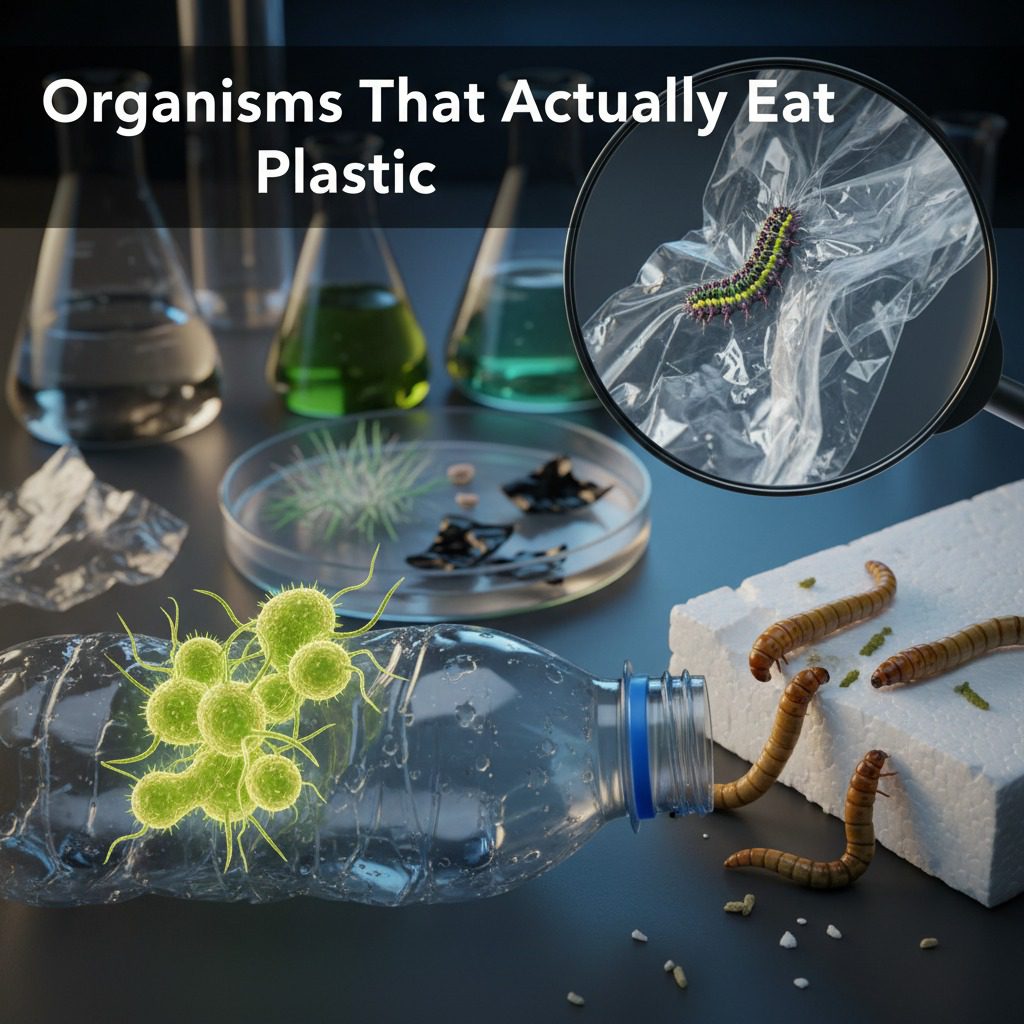
Taken together, these three findings describe something quietly remarkable: a set of organisms — a fungus, a tree, and an aquatic plant — that each interact with synthetic polymers by entirely different mechanisms, each with different limitations, and each pointing toward a different frontier of remediation science. Understanding what distinguishes them is more useful than grouping them under the banner of “nature’s solution to plastic,” which none of them, individually or collectively, are.
“The gap between waste generated and waste managed is where biology is now being asked to step in — not as a complete solution, but as a mechanism that conventional engineering cannot replicate.”
Editorial synthesis, based on OECD Global Plastics Outlook data
The urgency of that request is real. Global plastic production has reached approximately 460 million metric tons per year, with over 40 percent used as single-use packaging. Between 4.8 and 12.7 million metric tons enter the ocean annually. Terrestrial soils carry microplastic concentrations estimated at four to 23 times higher than marine ecosystems — a fact that receives almost no public attention relative to ocean plastic coverage. OECD modeling projects that without significant policy change, environmental plastic accumulation will continue growing through at least 2060.
The Fungus That Digests What Nothing Else Can Reach
The discovery of Pestalotiopsis microspora began not in a laboratory but in a forest. Yale University’s annual “Rainforest Expedition and Laboratory” course takes students to Yasuní National Park, Ecuador — one of the most biodiverse regions on Earth. In 2011, student researcher Jonathan R. Russell and a team led by molecular biochemistry professor Scott Strobel collected fungi living inside the tissues of rainforest plants and screened them for the ability to degrade synthetic polymers. P. microspora is an endophyte: it lives inside plant tissue without harming its host, producing enzymes that can break down the host’s structural molecules. Those same enzymatic capabilities, it turned out, transfer to polyester polyurethane.
The mechanism is specific. P. microspora secretes a serine hydrolase enzyme that attacks the ester bonds in polyurethane’s polymer chain, cleaving the long molecular links into smaller fragments the fungus can absorb as carbon and energy. In laboratory tests published in Applied and Environmental Microbiology, two isolated strains achieved approximately 50% clearance of a liquid Impranil DLN polyurethane suspension in five days — compared to 15 days for Aspergillus niger, the previously leading plastic-degrading fungus. By day 16, the cultures were visually transparent: the suspension had been substantially consumed.
That distinction matters more than it might first appear. Impranil DLN is a liquid polyurethane dispersion — the enzyme has unrestricted access to dissolved polymer throughout the medium. Solid, compacted polyurethane foam, the form it actually takes in a landfill, presents a far smaller reactive surface: the enzyme can only act where it physically contacts the material, and a compressed foam block offers a fraction of the surface area of the same polymer dissolved in liquid. The 50%-in-five-days figure is a real and important result, but it describes the best case, not the landfill case. No published study has yet shown the same clearance rate against solid foam, and that gap is the central open question standing between this discovery and any real deployment.
More importantly, both strains maintained this activity under anaerobic conditions. Landfills compact waste under enormous pressure, eliminating oxygen from all but the shallowest layers. The plastics that persist for decades — sometimes centuries — do so precisely because the conditions that accelerate natural decomposition do not exist at depth. A remediation organism that requires oxygen faces a hard boundary at the surface of a compacted landfill. P. microspora faces no such barrier — the same kind of biochemical resilience that has let researchers find active microbial life in some of the most oxygen-poor, sunlight-starved environments on the planet.
The failure case is the one most coverage omits. P. microspora is not a general-purpose plastic eater. It targets polyester polyurethane specifically — the polymer in foam mattresses, construction insulation, and shoe soles. Polyethylene, polypropylene, PET, and PVC — the plastics that constitute the majority of consumer waste — are not substrates it has been shown to degrade. A landfill contains many plastic types; P. microspora addresses one. The most realistic near-term application is controlled industrial bioreactors processing shredded polyurethane waste from specific waste streams, not open-environment landfill deployment.
“No fungus had previously been shown to break down polyurethane with zero oxygen present — these strains did it in the dark, airless conditions a landfill actually provides.”
Editorial synthesis, based on Russell et al., Applied and Environmental Microbiology, 2011
How Trees Pull Microplastics Into Their Roots
While the fungal story involves active chemical digestion, the birch tree story involves something more passive — and in some ways more surprising. Plants evolved root systems to absorb water, dissolved minerals, and organic molecules small enough to pass through cell membranes. A microplastic bead — a solid, chemically inert fragment between five and fifty micrometers in diameter — should simply sit in the soil.
It does not. In a 2022 paper in Science of the Total Environment, researchers from the Leibniz Institute for Freshwater Ecology introduced fluorescently tagged microplastic beads to the soil of potted silver birch saplings. After five months of normal growth, they examined root cross-sections using confocal laser scanning microscopy. Microplastic particles appeared in between 5 and 17 percent of root cross-sections — incorporated directly into root tissue, not merely adhering to the surface.
Lead author Kat Austen was explicit: this was a pilot study. Two trees, one growing season, one particle size range. What it establishes is a proof of concept: birch roots, growing close to the surface where microplastic concentrations in agricultural soils are highest, can physically incorporate microplastic into their tissue. This is the first documented instance of woody plants doing so.
The sequestration logic follows from birch’s existing deployment in phytoremediation. Silver birch is already used to rehabilitate polluted industrial land because it sequesters heavy metals and industrial pollutants into its tissue. Planted in grids over contaminated agricultural land — where plastic mulching and sewage sludge application concentrate microplastics — a birch stand could draw particles from the top soil layer over years of growth. The caveat: the particles remain in the tree. Disposal of harvested birch biomass would require its own management protocol, to avoid simply transferring contamination elsewhere. No study has addressed that lifecycle yet.
All figures from controlled laboratory conditions. Real-world rates are expected to be substantially lower due to solid substrate, competing microorganisms, and environmental variability.
Eelgrass figure reflects suspended particle removal from seawater, not chemical degradation — different mechanism from the fungal and bacterial rates above. The P. microspora figure reflects a liquid polyurethane suspension (Impranil DLN), not solid foam; real-world clearance of compacted landfill foam has not been measured at this rate.
What Are the Aquatic Plants That Catch Plastic?
The seagrass story is neither digestion nor root uptake. It is something architecturally different: physical capture mediated by biology. And it operates at a scale that dwarfs both laboratory systems described above.
Seagrass meadows — beds of marine flowering plants found in shallow coastal waters across every ocean — trap and accumulate microplastics through two interlocking mechanisms. The first is mechanical: dense canopy structures slow water flow, causing suspended particles to settle. A 2020 flume study by de los Santos, Krång, and Infantes at the University of Gothenburg showed that eelgrass canopies retain microplastics in proportion to canopy density.
The second mechanism is biological. A study published in Environmental Pollution (2022) demonstrated that microplastics adhere to eelgrass leaves and stimulate biofilm formation — a community of microorganisms that coats both the leaf surface and the plastic particle, increasing its density until it sinks as aggregated organic matter. Two specific bacteria isolated from eelgrass — Vibrio and Exiguobacterium — reduced suspended microplastics by 95.7% and 94.5% respectively by accelerating biofilm formation.
Across real meadows, the effect is measurable and large. Studies from the South China Sea found microplastics enriched 1.3 to 17.6 times in seagrass sediments compared to adjacent unvegetated seafloor. Research along the southeast coast of India found seagrass beds retained up to 600% more microplastics than surrounding bare areas. A 2021 paper on Mediterranean Posidonia oceanica found up to 1,470 plastic items per kilogram of plant material in beached seagrass remains — the meadow accumulates plastic and periodically purges it onto shore as the plant material decomposes.
The failure case, as the lead researcher Eduardo Infantes stated directly: “I don’t believe there is a way to extract or remove the microplastics trapped in the sediment from the meadows.” The sediment holds plastic as long as the meadow holds the sediment. When seagrass dies — through eutrophication, warming, or coastal development — the accumulated plastic re-enters the water column. Seagrass is simultaneously one of the most powerful natural microplastic sinks on Earth and one of the most threatened marine ecosystems — in some regions, meadows are declining at up to 7% per year.
| Organism | Mechanism | Plastic targeted | Destroys plastic? | Environment | Readiness |
|---|---|---|---|---|---|
| Pestalotiopsis microspora | Enzymatic digestion (serine hydrolase) | Polyester polyurethane only | Yes | Landfill, anaerobic zones | Bioreactor |
| Silver birch (Betula pendula) | Root tissue uptake | Microplastics 5–50 μm | No — sequesters | Contaminated surface soil | Pilot study |
| Eelgrass (Zostera marina) | Canopy trapping + biofilm sinking | Suspended microplastics (mixed) | No — concentrates | Shallow coastal marine | Field-confirmed |
| Mangrove root biofilm | Microbial biofilm on root surfaces | PET, PS microplastics | Partial | Tropical coastal sediment | Under study |
The Evidence Gap: What These Organisms Cannot Do
The polymer specificity problem is the first hard wall. The plastics that dominate global waste — polyethylene (PE, plastic bags and film), polypropylene (PP, packaging and textiles), and PET (drink bottles) — are not substrates that P. microspora targets. Different polymer chemistries require different enzymatic keys. The discovery of PETase in Ideonella sakaiensis established that PET degradation by microorganisms is possible, but PETase and P. microspora‘s serine hydrolase are distinct enzymes for distinct substrates. No single organism has been shown to digest the full range of common plastic polymers. Researchers at Duke University are using directed evolution to optimize Pseudomonas stutzeri for faster PET degradation, and CRISPR-based approaches are engineering novel degradation pathways — but no engineered organism capable of tackling mixed plastic waste at field scale currently exists.
The rate problem is equally constraining. Even under optimal laboratory conditions, P. microspora achieves 50% clearance of polyurethane suspension in five days. Real-world plastic waste is not dissolved in liquid medium; it is solid, irregularly shaped, and embedded in complex chemical environments. Rhodococcus ruber, one of the most studied plastic-degrading bacteria, degrades polyethylene at roughly 0.86% per week under lab conditions — a rate that would require years to make a meaningful dent in a landfill’s polyethylene content. The enzymatic degradation of crystalline polymers like high-density PE is additionally constrained by surface accessibility: the enzyme can only attack what it can physically contact, and crystalline polymer regions present far fewer accessible bonds than amorphous regions.
Finally, there is the scale asymmetry. The OECD estimates a total environmental plastic pool of 263 teragrams (263 million metric tons) across terrestrial and marine systems as of 2015 — a figure that has grown substantially since. Scaling any biological system to engage meaningfully with hundreds of millions of tons of dispersed contamination requires engineering infrastructure, ecological safety assessment, and regulatory frameworks that do not yet exist for any of these approaches.
This chart is a conceptual illustration, not a modeled projection — no dataset tracks “remediation capacity” on a common scale, and the curves are schematic representations of the argument, not plotted measurements. The trend each curve represents is grounded in real findings: seagrass decline rates and the Swan Lake sediment-loss data from Frontiers in Marine Science 2025, and the engineered-organism timeline from Duke Bass Connections 2025–2026 and the OECD Global Plastics Outlook.
A Synthesis No Single Source States: The Remediation Debt Problem
Read the three biological systems together and a pattern emerges that none of these sources individually names but that all three jointly imply.
Each system addresses a different plastic fraction: P. microspora targets anaerobic landfill waste; birch phytoremediation addresses surface soil contamination; seagrass meadows capture suspended marine microplastics. In principle, these are complementary — not overlapping — domains of intervention. An integrated biological remediation strategy would deploy different organisms in different ecological contexts, not ask any single species to solve everything.
But here is what the combined evidence implies for 2030 that no source explicitly states. The loss of natural plastic-sequestration capacity is accelerating faster than the development of engineered replacements. Seagrass meadows are declining globally — in some regions at 7% annually — and each hectare lost releases its accumulated microplastic stock back into the water column. A 2025 study on Swan Lake, China, found that degraded seagrass beds had 38.7% lower microplastic stocks in sediment than healthy ones, representing plastic that had re-entered the ecosystem. Meanwhile, the bioengineered replacements — the optimized Pseudomonas stutzeri being developed at Duke, the CRISPR-modified degradation pathways under investigation — are at minimum five to ten years from any field deployment, and likely further.
The organisms already managing plastic at scale are not the laboratory organisms being developed. They are the wild ecosystems being destroyed. The coastal cities that will face the sharpest remediation debt in 2030 are not those that failed to invest in new biotechnology. They are the ones that permitted seagrass meadow destruction while waiting for engineered solutions that have not arrived.
“The organisms already managing plastic at scale are not the ones being engineered in laboratories. They are the wild ecosystems being destroyed faster than we are building replacements.”
Author synthesis — drawing on Zhao et al. 2022; Frontiers in Marine Science 2025; Duke Bass Connections 2025–2026
What This Means — for Scientists, Policymakers, and the Rest of Us
These findings require a specific kind of attention — one that holds scientific promise and practical limitation in the same hand, without resolving the tension prematurely into either breathless optimism or dismissive debunking. If this kind of quiet, counterintuitive biology appeals to you, it sits alongside a broader run of unresolved scientific puzzles that keep surfacing in fields far from plastic pollution.
For researchers and biotechnologists: The most actionable near-term investment is in industrial bioreactor applications for organisms like P. microspora, rather than in open-environment deployment. Controlled processing of specific plastic waste streams — polyurethane foam from mattress recycling facilities, for example — is a solvable engineering problem with existing biological tools. The enzyme engineering frontier — optimizing serine hydrolases, PETase variants, and oxidoreductases for broader polymer specificity — is where the five-to-ten-year opportunity lies. Research consortia including Duke’s Bass Connections program and teams using CRISPR-based approaches are laying groundwork now that will define deployment options in the early 2030s.
For coastal policymakers and conservation managers: The seagrass data changes the economic argument for coastal ecosystem protection in a specific and previously underappreciated way. Seagrass meadows are not only carbon sinks and fish nurseries; they are operating microplastic remediation infrastructure, at no cost, right now. A coastal development assessment that factors in microplastic sequestration value alongside existing carbon credit and biodiversity valuations would almost certainly reach a different cost-benefit conclusion than one that ignores it. The economic case for protecting existing natural remediation capacity is stronger than it has ever been, and the data to make it now exists.
For everyone else: The most honest message from this body of research is also the most uncomfortable one. Funding bioremediation research while simultaneously permitting the drainage of coastal wetlands and the clearance of microplastic-absorbing vegetation is not a strategy. It is a contradiction. The organisms nature has already equipped to manage plastic contamination are being destroyed faster than humanity is building the engineered replacements.
Research Timeline: How the Evidence Accumulated
None of these findings arrived at once, and none arrived from the same lab. The picture assembled here is the product of five separate research efforts spanning fifteen years and three continents. Expand each entry for the specific claim, source, and what it added to the picture.
Frequently Asked Questions
What organism actually “eats” plastic — and what does that mean precisely?
Can plants actually break down plastic, or just trap it?
What types of plastic can biological organisms degrade?
How fast do plastic-degrading organisms actually work?
Why does seagrass loss matter for plastic pollution specifically?
Are plastic-eating organisms safe to release into the environment?
Sources
- Russell JR et al. (2011). Biodegradation of Polyester Polyurethane by Endophytic Fungi. Applied and Environmental Microbiology. doi:10.1128/AEM.00521-11
- Austen K et al. (2022). Microplastic inclusion in silver birch root tissue. Science of the Total Environment, 808, 152085.
- Zhao L et al. (2022). Eelgrass and its epiphytic bacteria facilitate the sinking of microplastics. Environmental Pollution, 292, 118337.
- Sanchez-Vidal A et al. (2021). Seagrasses provide a novel ecosystem service by trapping marine plastics. Scientific Reports.
- de los Santos CB, Krång A-S, Infantes E. (2020). Microplastic retention by marine vegetated canopies. Environmental Pollution.
- Duke University Bass Connections. (2025–2026). Bioremediation of Plastic Pollution to Conserve Biodiversity.
- Frontiers in Marine Science. (2025). Dual mobilization of buried microplastics driven by seagrass degradation.
- Global Society Earth. (2025). A plastic-eating fungus in the Amazon: promise, hype, and hard questions.
- Horton AA et al. (2017), cited via UNEP. Estimate of terrestrial vs. marine microplastic discharge (4–23×).
- OECD. Global Plastics Outlook: Policy Scenarios to 2060.
- ScienceDirect. (2024). Potential strategies for bioremediation of microplastic contaminated soil. Environmental Science and Ecotechnology.
1 thought on “The Organisms That Actually Eat Plastic”