


People Are Paying to Live
Like It’s 1995 — Here’s Why
Vinyl is outselling streaming formats on physical media. Film cameras are back in production. Dumb phones are a Gen Z status symbol. This isn’t a trend. It’s a reckoning — and it says something uncomfortable about where we’ve ended up.
What You Need to Know in 2 Minutes
- Billions in spending, not a niche quirk. US vinyl sales crossed $1.04 billion in 2025 — the first time since 1983. The global vinyl market hit $2.1B. Film camera manufacturing has expanded for the first time in decades. The nostalgia economy is measurable and growing.
- Gen Z is the engine. Counterintuitively, it’s the most digitally native generation leading the charge. They didn’t experience the 90s — they’re choosing it as a deliberate alternative to the present.
- The psychology is backed by science. Studies published in peer-reviewed journals show nostalgia measurably increases wellbeing, reduces anxiety, and buffers psychological pain. It’s not escapism — it’s a coping mechanism.
- Digital burnout is a real crisis. Deloitte’s 2025 global survey found 40% of Gen Z feel stressed or anxious most or all of the time. 86% of Gen Z workers report burnout. The retreat to analog isn’t irrational — it’s a rational response to documented distress.
- Brands are paying attention. Starbucks spent $1 billion trying to recreate the 90s “third place.” Gap returned to its archive aesthetic. The nostalgia signal is so strong it’s restructuring corporate strategy.
- Warning: not everything old was better. This piece is honest about the limits of the nostalgia pull — and why uncritical romanticism of the past is its own trap.
- Next step: Read on for the full picture — market data, psychology research, real cases, and what this actually means for how we choose to live now.
There’s a 24-year-old in Brooklyn right now developing her film photos from last weekend. Her iPhone is home, charging. The pictures she took — 36 exposures, Kodak Gold 200, nothing deleted — won’t be ready for four days. She’s already looking forward to it.
About two thousand miles away, a software engineer in Austin has a Nokia feature phone in his pocket and a Technics turntable in his living room. He still has a smartphone, buried in a desk drawer. He uses it for work. Everything else — music, navigation, conversations with friends — runs on something slower, quieter, more deliberate.
These aren’t eccentrics. They aren’t Luddites. And crucially, they’re not even doing it cheap — film development costs $20 to $30 a roll now, a decent turntable setup runs $300 to $600, and the premium “dumb phones” from brands like Punkt or Light cost more than a budget Android. People are paying a premium to escape the present. The question worth sitting with is: why?
The short answer is that the present has become genuinely exhausting. The longer answer is more interesting, more economically significant, and — depending on your perspective — either a deeply hopeful signal or a moderately alarming one.
01. The Numbers Don’t Lie — This Is a Real Economic Shift
Before getting into the psychology, it helps to understand the scale. The nostalgia economy isn’t a cultural footnote. It’s moving serious money.
In March 2026, The Guardian reported that US vinyl record sales crossed $1.04 billion in 2025 — the 19th consecutive year of growth and the first time annual vinyl revenue had breached the billion-dollar mark since 1983. The same year, IMARC Group pegged the global vinyl market at $2.1 billion, projecting growth to $3.6 billion by 2034 at a 6.5% CAGR. That’s not a niche. That’s an industry rebuilding itself from near-extinction.
Film photography is following a similar arc. The global film developing service market was valued at roughly $1.2 billion in 2024, according to DataHorizzon Research, and is growing at a 4.5% CAGR through 2033. Kodak reported a 20% surge in film stock sales in 2024. Pentax released its first new film camera in 21 years. More than 150 new analog photography retail stores opened globally between 2022 and 2024, and Reddit’s r/analog community has grown to 1.5 million members.
The secondhand clothing market, per ThredUp and GlobalData, is projected to reach $77 billion by 2025, growing 11 times faster than the broader retail clothing sector. Much of that growth is driven by younger consumers hunting vintage 90s and Y2K pieces.
| Category | Market Size / Scale | Key Metric | Trend |
|---|---|---|---|
| Vinyl Records (US) | $1.04B revenue (2025) | 19 consecutive years of growth | ↑ Strong |
| Vinyl Records (Global) | $2.1B (2025) | CAGR 6.5%, forecast $3.6B by 2034 | ↑ Strong |
| Film Photography | $1.2B developing market (2024) | Kodak film sales +20% (2024) | ↑ Growing |
| Dumb Phones (Global) | $10.6B+ market (2024) | 1.1B units sold globally (2024) | ↑ Surging niche |
| Secondhand Apparel | $77B projected (2025) | 11× growth vs. broader retail | ↑ Strong |
| Instant Cameras | Part of ~$1.8B film mkt (2033 est.) | Polaroid purchases +15% (2024) | ↑ Steady |
There’s also something worth noting about who’s driving this. When vinyl’s comeback first started in the mid-2000s, it was mostly Gen X reclaiming their youth. Now, the demographic center of gravity has shifted. Market data from 2025 shows that Generation Alpha — kids aged 1 to 16 — now has 46% engagement with vinyl or CDs. That’s a generation that has never known a world without streaming services, choosing to buy physical music anyway.
02. Why Now? The Perfect Storm
Nostalgia is nothing new. Every generation eventually romanticizes its youth. But several things are converging right now that make this wave qualitatively different from anything before it.
Digital Overload Has Reached a Breaking Point
The average American now spends more than five hours per day on their phone. According to Deloitte’s 2025 Gen Z and Millennial Survey, which polled over 23,000 respondents across 44 countries, 40% of Gen Z report feeling stressed or anxious most or all of the time. Nearly half — 47% — rate their mental wellbeing as fair or poor. MetLife’s 2025 Employee Benefit Trends Study found Gen Z workers are 44% more likely to report burnout than the average employee.
Those aren’t abstract statistics. They describe a generation that grew up inside a machine optimized to keep them engaged, and is now paying real psychological costs for it. Research cited across multiple public health studies links heavy social media use to a 66% increase in depression among teenagers, with people spending over three hours daily on social platforms twice as likely to experience mental health issues.
“Romanticizing the past isn’t a trend for Gen Z — it’s survival. We’ve come of age in a constant state of crisis.”
Rachel Janfaza, The Up and Up — December 2024The Post-Pandemic Identity Shift
COVID-19 shook loose a lot of unexamined assumptions about modern life. Locked at home, many people rediscovered older, slower pleasures — sourdough bread, jigsaw puzzles, backyard gardening — and found they liked them. When restrictions lifted, some of those behaviors stuck. The pandemic was also, psychologically, a period of enormous dislocation. Research consistently shows nostalgia intensifies during periods of instability and transition, when the mind reaches for what it knows was solid.
The “Bottleneck Generation” Problem
This is perhaps the least-discussed factor. Millennials and Gen Z face housing costs, student debt, and cost-of-living pressures that make genuine adult milestones — homeownership, starting a family, financial security — feel further away than they did for previous generations. When the present feels precarious and the future feels inaccessible, the past (real or imagined) fills the gap.
As Rachel Janfaza wrote in late 2024, progressive and conservative young people alike are looking backward — the American Dream has become, for many, something that feels like an artifact rather than a plan. High rents, student debt, and impossible housing markets have left a lot of people feeling like the promise of adulthood was made and then quietly revoked.
The Paradox of Infinite Choice
Spotify has over 100 million tracks. Netflix has thousands of titles. Instagram has more content than any human could watch in ten lifetimes. And somehow, a lot of people feel less satisfied, less engaged, and less moved by the music and movies they consume now than they did when their options were physically limited. Psychologists call it the “paradox of choice” — too many options reduces the meaning of any single selection. A vinyl record, by contrast, demands commitment. You chose it, you paid for it, you put it on, and you listen to it through. That constraint is, paradoxically, part of the pleasure.
03. The Science Behind Why the Past Feels Better
For a long time, psychologists treated nostalgia as something mildly pathological — a form of homesickness, a refusal to engage with the present. That view has been largely revised. The research accumulated over the past decade is considerably more interesting.
A 2024 study published in Social Psychological and Personality Science (University of Southampton) found that nostalgia reliably increases psychological wellbeing through a mechanism called “collective effervescence” — the potent sense of connection to others and feeling that an experience is special or meaningful. In six studies using both measurement and experimental designs, nostalgia consistently led to higher wellbeing via this pathway. The effect held even when controlling for other known mediators.
Earlier research compiled in Frontiers in Psychology found that nostalgia increases optimism, inspiration, social efficacy, and feelings of purpose in life. It makes older adults feel more youthful and more optimistic about their health. People’s written accounts of nostalgic memories frequently contain themes of both appreciation for the past and hopefulness about the future. Far from being backward-looking, nostalgia appears to be, in some real sense, a forward-looking emotion.
A remarkable 2025 study published in Humanities and Social Sciences Communications (Nature) went further: nostalgic reflection improved pain threshold and increased pain tolerance in experimental subjects. The researchers concluded that nostalgia can function as a psychological analgesic — a substitute, in some circumstances, for other ways of managing distress.
Psychologists draw a meaningful line between personal nostalgia (longing for your own past) and historical nostalgia (preferring an era you didn’t live through). The former is generally associated with wellbeing benefits. The latter tends to correlate with dissatisfaction with the present, and can sometimes tip into idealization or cynicism. Many people operating in the current analog revival are doing something interesting: they’re experiencing a kind of hybrid — borrowing the aesthetics and pace of an era they may barely remember, without claiming the era was objectively better in all respects.
None of this means nostalgia is a cure-all, or that retreating to analog is a sound solution to structural problems. The same research base notes that historical nostalgia in particular can be accompanied by a cynical or distorted view of the present, colored by trauma or adverse experiences. Therapists are cautious about confusing the comfort of nostalgic reverie with actual forward movement. But as a coping mechanism in a genuinely difficult moment, the science suggests it’s doing real work.
04. Vinyl: The Clearest Example of the Whole Shift
If you want one data point that captures everything about the nostalgia economy, it’s vinyl. A format declared commercially dead in the early 1990s — when CDs had won and digital was waiting in the wings — has now, in 2025, outsold CDs in dollar terms for three consecutive years in the US. The RIAA reported 47.9 million vinyl units sold in the US in 2024, up 8.6% year-over-year. Independent record stores now account for roughly 40% of all vinyl sales — not Amazon, not Target.
What makes this genuinely unusual is who’s buying. Taylor Swift, Sabrina Carpenter, and Kendrick Lamar were among 2024’s top vinyl sellers. Post Malone served as Record Store Day ambassador in 2025. These aren’t legacy acts appealing to aging fans — they’re current artists releasing current music in a format that demands deliberate listening. The buyers are often people in their 20s who have never had a turntable before, choosing to invest $200–600 in a setup they don’t technically need.
The Independent Record Store Renaissance
When Napster arrived in 1999 and iTunes followed in 2003, most independent record stores were predicted to disappear within a decade. Hundreds did. But by 2025, those that survived had developed something the digital ecosystem couldn’t replicate: a space where people come specifically to browse without an algorithm, to get recommendations from a person who actually knows what they’re talking about, and to spend an hour deciding on something to take home.
The revival has been substantial enough that major pressing plants — which themselves nearly went extinct — have had to expand capacity. Key Production reported 50% growth in vinyl manufacturing in H1 2025 alone. Lead times at some plants stretch to 9–12 months as demand consistently outpaces supply.
Part of what’s happening here is a reaction to what streaming culture does to music. When any song is one tap away and infinite, individual songs stop feeling significant. Vinyl restores significance through friction. You have to want the record enough to buy it, carry it home, handle it carefully, put it on properly, and listen to it in sequence. That whole experience — the ritual of it — is precisely what streaming optimized away. Turns out a lot of people miss the ritual.
As one cultural analysis put it: “You’re not just consuming an album. You’re holding an era of it. You’re choosing cover art, liner notes, color variants, shelf space, the whole ritual.” That’s not a complaint about technology — it’s a description of what people discovered they were missing once technology took it away.
05. Film Cameras — Intentional Imperfection in an Age of Infinite Retakes
Digital photography solved a genuinely annoying problem: you no longer had to waste film on bad shots. But in solving it, it created a different problem — one that’s harder to name but that millions of people are now acting on. When every photo is free and instantly reviewable, the act of taking a photo loses its weight. You can take 200 shots of your dinner, pick the best one, filter it four times, and post it. You’ve technically “captured” the moment. But did you experience it?
Film forces a different relationship with moments. Each frame costs something — money, attention, the knowledge that you only have 36. You can’t review the shot immediately. You have to commit, wait, and accept whatever comes back from the lab. That constraint changes how people shoot, and arguably how they see. As multiple photographers describe it, shooting on film forces intentionality that digital simply doesn’t require.
The industry data backs up the cultural signal. Kodak’s 2024 film stock sales surged 20%. Harman Photo introduced its Phoenix 200 film in 2023, releasing an updated version in July 2025 based on photographer feedback. Pentax launched the Pentax 17 — its first new film camera in 21 years — in 2024. Leica reissued the M6 at $5,900 body-only, and found buyers. Reddit’s r/analog has 1.5 million members. These are not small numbers for a format that was supposed to be museum-bound.
| Film / Camera Brand | Development (2023–2025) | What It Signals |
|---|---|---|
| Kodak | +20% film sales (2024); expanded Gold 200 to 120 format | Industrial confidence in long-term demand |
| Pentax | Pentax 17 released (2024) — first new film camera in 21 years | Manufacturers re-entering abandoned markets |
| Harman Photo | Phoenix 200 launched 2023; updated to v2 July 2025 | New entrants finding commercial viability |
| Fujifilm Instax | Surpassed 7M unit sales in Asia-Pacific alone (2023) | Instant photography becoming mainstream |
| Leica | M6 reissued at $5,900; found immediate buyers | Premium segment thriving alongside mass market |
| Lomography | Launched LomoChrome Color ’92 in 2025 | Companies literally branding for 90s nostalgia |
There’s also a social dimension. The instant-review culture of digital photography — where every image is immediately optimizable, filterable, and shareable — creates a specific kind of anxiety. Film sidesteps the whole feedback loop. You can’t check the likes on a photo you haven’t developed yet. For a generation that grew up with that feedback loop as a constant background hum, the absence of it feels, by many accounts, like relief.
06. The Dumb Phone: Status Symbol for the Burned-Out Generation
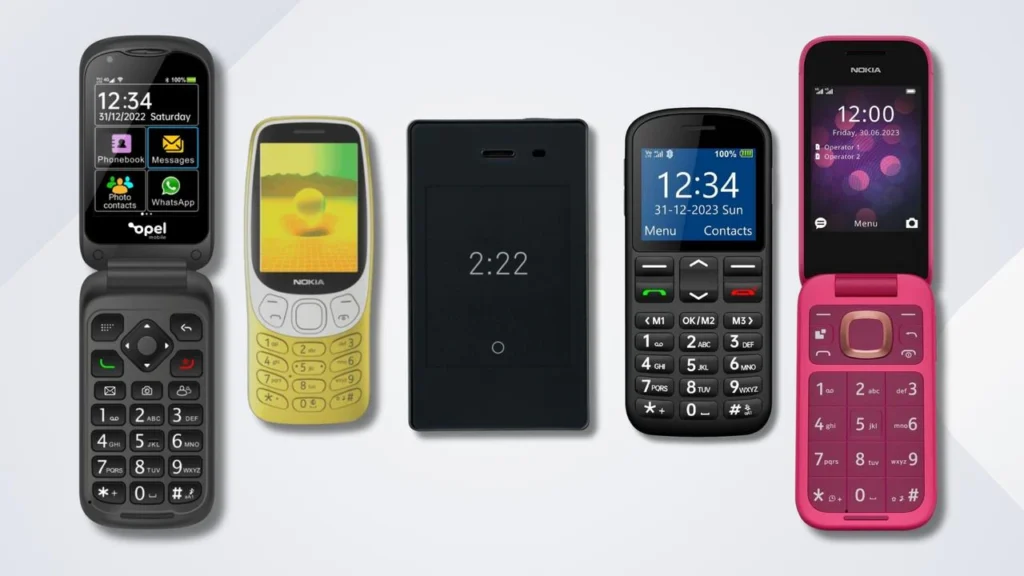
The term “dumb phone” is doing a lot of work here and deserves unpacking. What people in the digital detox movement are buying ranges from simple Nokia feature phones at $20–45 to premium minimalist devices like the Punkt MP02 ($400+) and the Light Phone ($300–400). The latter sold 50,000 units in 2024 in Europe alone. The HMD Barbie Phone — a collaboration with Mattel — triggered a 117% surge in mentions when it launched in August 2024. The hashtag #BringBackFlipPhones had accumulated 59.8 million views on TikTok by late 2024.
According to Counterpoint Research, dumb phones accounted for 1.1 billion device sales worldwide in 2024 — about 15% of total global handset sales, worth approximately $3.2 billion. UK-specific sales were projected to grow 21% year-over-year in 2025. YouGov data suggests 38% of UK adults would consider downgrading to a basic phone for at least part of the year.
The €400 Phone That Does Almost Nothing
The Punkt MP02 is a $400 European phone that makes calls and sends texts. No social media apps. No camera. An 18-day battery life. It sold 50,000 units in Europe in 2024 to buyers who could absolutely afford a flagship smartphone but chose not to use one.
Its buyers aren’t people who can’t afford better technology — they’re people for whom “better technology” is the problem. Punkt’s marketing doesn’t use the word “nostalgia” anywhere. It talks about focus, presence, and ownership of your own attention. That framing tells you something important about how this market has evolved. It’s not primarily about going back. It’s about opting out.
What’s interesting is that the dumb phone revival is split between two quite different purchasing motivations. One group — often Gen Z consumers — is drawn by aesthetics, the Y2K look, the TikTok-approved coolness of a flip phone as a fashion statement. Another group — often 30-to-45-year-old professionals — is making a more deliberate choice about attention, mental health, and what their technology does to them over a workday. Both groups are spending real money. The first group is romanticizing an era; the second group is solving a problem.
Many purchases are secondary phones. People keep a smartphone for work and navigation, but carry the feature phone as their social device on weekends. It’s an unusual kind of consumer behavior — buying two phones precisely to reduce usage — but it’s become common enough that it’s now a recognized market segment.
07. Y2K Fashion — When the Thrift Store Becomes the Department Store
Of all the nostalgia-economy categories, fashion is perhaps the most economically significant in raw dollar terms, and the one that’s most directly reshaping how retail works.
The secondhand apparel market has moved well beyond fringe. ThredUp’s data shows it growing at eleven times the rate of the broader clothing sector, projected to reach $77 billion by 2025 — up from $36 billion in 2021. According to TheRealReal’s data, demand for vintage grew 118% year-over-year among Gen Z shoppers, faster than any other generation. More than half of younger shoppers (53%) plan to increase secondhand purchases over the next five years.
The specific aesthetic demand is heavily 90s and early-2000s: low-rise jeans, chunky belts, platform shoes, oversized denim, tech fleece, athletic-casual hybrid looks. Much of what Gen Z considers vintage was sitting in their parents’ closets — a “generational closet transfer” that platforms like Depop, Poshmark, and Grailed have built billion-dollar businesses facilitating.
“Your junk could be Gen Z’s treasure. The resurgence of Y2K fashion is driven partly by a 20-year fashion cycle — and partly by millennials’ parents downsizing their homes.”
MarketBeat, August 2025The sustainability angle matters here too. For a significant portion of secondhand shoppers, the choice is as much ethical as aesthetic. The apparel and footwear industry accounts for roughly 10% of total climate impact — more than all international flights and maritime shipping combined. Buying 90s Levi’s from a thrift store instead of new fast-fashion jeans is both nostalgic and environmentally deliberate. Those two motivations reinforce each other.
Brands are aware of all this. Gap, after years of struggling, is stabilizing by returning to 90s heritage aesthetics — their archive hoodies and mid-decade denim, plus collaborations like a 2024 tie-up with Palace that made them “cool again to the hype crowd,” in the words of one retail analyst. Asics is riding the “silver runner” Y2K aesthetic with the Kayano 14. Every brand with a 90s archive is rummaging through it.
08. What Big Brands Are Actually Doing About It
The corporate response to the nostalgia wave is revealing — both because of how it’s playing out and where it’s falling short.
Starbucks is the most striking example. In September 2025, CEO Brian Niccol unveiled a $1 billion restructuring plan: shutting over 100 North American locations, eliminating 900 non-retail jobs, and remodeling 1,000+ stores. The explicit goal was to restore the 1990s “third place” — the warm, communal hangout between home and work that originally built the brand. The company had spent years building mobile-only, frictionless, algorithm-optimized pickup stores. It had, in trying to be maximally efficient, stripped out the thing people actually wanted.
Niccol’s quote to analysts is worth sitting with: the mobile-only format had been “overly transactional and lacking the warmth and human connection that defines our brand.” A billion dollars to undo what technology did to a coffee shop. That’s a remarkable admission.
Barnes & Noble is experiencing something similar in the other direction — it’s thriving by leaning into the experience that Amazon can’t replicate: browsing, discovery, handwritten staff recommendations, the texture of a physical bookstore. The chain now has locations in every US state, and analysis from Placer.ai named it one of the top retail brands to watch in 2025. Where digital convenience has flattened experience, physical presence is winning back relevance.
The corporate nostalgia trap is mining aesthetics without understanding the underlying need. Slapping a 90s logo on a product doesn’t address why people are drawn to the 90s. Carat’s analysis frames it well: streaming won the convenience war but lost the relevance battle. What people missed wasn’t the inconvenience of going to a shop — it was the communal experience of experiencing something at the same time as everyone else. Brands that understand this don’t just mine nostalgia. They create new shared moments that will become the nostalgia of the future.
09. The Honest Tension — Not All Nostalgia Is Healthy or Accurate
Any honest treatment of this subject has to include the pushback, because there’s valid pushback to include.
The 1990s, as an era, was substantially better than the present in certain respects — housing was more affordable relative to income, there was less always-on professional expectation, and social media hadn’t yet invented new categories of anxiety. But it was also worse in ways that selective nostalgia tends to forget. Economist John Cochrane has written bluntly about this: health outcomes were worse, cars were less safe, information was far more expensive and harder to access. The nostalgia for a simpler time sometimes quietly omits the parts that were genuinely harder.
There’s also a psychological warning embedded in the research. As The Conversation summarizes, “historical nostalgia” — preference for an era you didn’t live through, or a selective reconstruction of one you did — often correlates with deeper dissatisfaction with the present, and can reflect pain, trauma, or adverse experiences rather than genuine appreciation for the past. When nostalgia tips from “I value what that pace of life offered” into “the world was simply better then and is irredeemably broken now,” it stops being a coping mechanism and starts being a trap.
The vinyl record enthusiast who genuinely loves music as a tactile, intentional experience is doing something different from the person who has convinced themselves that streaming destroyed culture. The film photographer learning to see more carefully is doing something different from the one who believes all digital images are fundamentally hollow. The dumb phone user reclaiming their attention is doing something different from the one who thinks smartphones are a conspiracy. The behavior looks the same from the outside — but the underlying motivation matters.
And there’s an access dimension that doesn’t get discussed enough. Premium dumb phones, vinyl setups, and film photography are not cheap. They’re options available to people with disposable income who are choosing friction as a lifestyle. For people who can’t afford that choice, the “analog revival” can look like a hobby of the comfortable. That’s not a reason to dismiss the trend — but it’s a reason to be precise about what it represents.
10. What Comes Next
The honest answer is that the nostalgia economy is probably here to stay, but its character will evolve. A few trajectories seem reasonably clear.
Analog revival formats will continue to grow, but slowly, as niches rather than mainstream replacements. Vinyl will not kill streaming. Film cameras will not end the iPhone. What they will do is establish a permanent, commercially significant segment of consumers who want deliberate, physical, friction-rich alternatives for specific parts of their lives. That market is real enough to sustain manufacturers, retailers, and entire cultural ecosystems.
The corporate nostalgia play will get more sophisticated — or will fail. Starbucks’ billion-dollar bet on the third place is a meaningful experiment. If it works, it will validate that what people are actually buying when they buy nostalgia is human connection and shared experience, not just aesthetics. If it doesn’t work, it will probably mean the company got the diagnosis right but the prescription wrong.
The digital wellness angle will increasingly merge with the nostalgia signal. The people buying dumb phones aren’t primarily making a fashion statement — they’re managing a mental health problem. As the evidence around screen time, anxiety, and social media harm continues to accumulate, and as regulation catches up (multiple countries are now restricting smartphone use in schools), the analog revival will get a structural tailwind that goes beyond aesthetics.
And Gen Alpha — now the youngest cohort, raised by millennials who themselves went through this reckoning — will likely arrive at adulthood with different assumptions about technology’s proper role in daily life than any generation before them. 46% of them are already engaging with vinyl and CDs. That’s a data point worth paying attention to.
Frequently Asked Questions
Is the nostalgia economy just a Gen Z trend, or is it broader?
It’s broader, though Gen Z is driving much of the current energy. Millennials are participating heavily in vinyl, secondhand fashion, and the dumb phone movement. Gen Alpha is now showing early engagement with physical media. The initial wave of vinyl’s comeback in the 2000s was largely Gen X; the current wave has multiple generational inputs. What’s distinctive about Gen Z’s participation is that they’re nostalgic for an era they didn’t actually experience, which points to something cultural and psychological rather than purely autobiographical.
How much does getting into vinyl actually cost?
A basic but decent entry-level setup — a turntable like the Audio-Technica AT-LP120 and a pair of powered speakers — runs $300–600. Individual vinyl records vary widely: new releases typically cost $25–35, used records from $5–25, and collectibles anything from $50 into the hundreds. You can start a meaningful collection for $400–500 all-in. The ongoing cost (new records, occasional maintenance) is comparable to a streaming subscription if you’re selective about what you buy.
Is film photography actually making a commercial comeback, or is it a small niche?
It’s a real, growing market — not massive, but substantial. The global film developing service market was valued at $1.2 billion in 2024, growing at 4.5% annually through 2033. Kodak increased film production 20% in 2024 and has launched multiple new stock variants. More than 150 new analog photography retail stores opened worldwide between 2022 and 2024. It remains a niche compared to digital, but it’s a commercially viable niche that manufacturers and retailers are actively investing in.
Why are Gen Zers nostalgic for the 90s if they didn’t live through them?
Partly through cultural transmission — 90s media, fashion, and music are omnipresent on TikTok and YouTube, mediated through older generations. But the deeper reason is that the 90s represent, in the Gen Z imagination, a pre-algorithm world: before social media performance anxiety, before infinite scroll, before the constant feedback of likes and follower counts. The 90s aren’t appealing because Gen Z remembers them — they’re appealing as a symbol of what life might feel like without the specific pressures of the digital present.
Do dumb phones actually improve mental health?
The evidence on reducing screen time generally is supportive, though specific to dumb phones it’s limited. Research consistently links reduced social media use to improvements in sleep quality, anxiety levels, and self-reported happiness. A 2025 Florida survey using the GAD-7 anxiety measure found Gen Z reports the highest anxiety levels of any age group, with significant correlations to social media use. Whether a dumb phone is the right mechanism for reducing that use depends entirely on the individual — many people carry both phones, which somewhat undercuts the benefit.
Is buying secondhand vintage actually more sustainable?
Generally, yes. The fashion industry accounts for roughly 10% of total climate impact. Buying a secondhand garment avoids the production emissions and water use of manufacturing a new one. The sustainability benefit is real, though it’s complicated by factors like shipping, cleaning, and what people do with the clothes they’re replacing. The main caveat is that “sustainable” secondhand consumption can become unsustainable in volume — buying 20 vintage pieces isn’t meaningfully better than buying 20 fast-fashion pieces.
What’s the difference between healthy nostalgia and unhealthy nostalgia?
Psychologists draw a distinction between personal nostalgia (longing for your own past) and historical nostalgia (preferring an idealized era). Personal nostalgia is consistently linked to wellbeing benefits. Historical nostalgia — especially when it tips into “the world was simply better then” — can correlate with dissatisfaction, cynicism, and avoidance. The useful question isn’t “which era was better?” but “what specific value does this object or practice offer me right now?” That reframe keeps nostalgia as a resource rather than a retreat.
Is the nostalgia economy accessible to everyone, or is it a luxury trend?
Honestly, there’s a class dimension that often goes unacknowledged. Premium dumb phones ($300–400), vinyl setups ($400+), and film photography ($20–30 per roll developed) are choices available to people with disposable income. Entry-level participation is possible more cheaply — basic feature phones cost $20, used records are affordable, thrift stores are genuinely inexpensive — but the premium end of this market is distinctly accessible to a specific income bracket. That doesn’t invalidate the trend, but it’s worth being clear about.
Why are brands spending so much money chasing this aesthetic?
Because the nostalgia signal is measurable and financially significant. Starbucks’ $1 billion restructuring to recreate the 90s third place, Gap’s return to its heritage aesthetic, Leica reissuing a classic film camera, Asics marketing the Kayano 14 specifically to Y2K aesthetics — all of these are data-driven decisions. Companies that identify where consumer sentiment is moving and position accordingly tend to gain market share from those that don’t. The risk is mining aesthetics without understanding the underlying need, which is human connection and deliberate experience, not just the look of the era.
Will streaming music decline as vinyl grows?
Unlikely in any meaningful sense. Vinyl growing to $3.6 billion by 2034 is significant for the specific market, but streaming generates vastly more revenue globally. What’s more likely is that physical formats stabilize as a meaningful premium segment — the way craft beer stabilized alongside mass-market lager — without displacing the dominant format. Many vinyl buyers are also active streaming subscribers. The behavior isn’t either/or for most people; it’s “streaming for discovery and convenience, vinyl for the experience.”
What does the rise of analog nostalgia mean for AI and future technology?
It’s a signal worth watching. If people are paying a premium to escape frictionless, optimized, algorithmically curated experiences, it suggests there’s real consumer demand for technology designed with deliberate constraints — or for spaces and objects deliberately free of technology. This has implications for how future AI products might be designed: not more capability poured on top, but thoughtful choices about when to remove capability. The analog revival is, among other things, a market test of what “enough” looks like when people get to choose.
Final Thoughts — Something Real Is Happening Here
It would be easy to dismiss the nostalgia economy as a passing aesthetic phase, driven by algorithm-amplified trends and corporate exploitation of collective anxiety. Some of it is exactly that. But the aggregate picture is harder to dismiss. Nineteen consecutive years of vinyl growth. Billions of dollars flowing into secondhand fashion. A generation choosing to develop film and carry feature phones not because they’re cheap but because they want something specific that the digital world stopped providing.
What’s specific is hard to fully articulate, but the research comes close: meaning, connection, intention, the feeling that an experience actually happened rather than passed through you. The 90s aren’t literally better. But the pace they represent — one where not everything was instant and available and optimized and perpetually scrollable — is something a lot of people are willing to pay to approximate.
That’s not regression. It’s a correction. And corrections, when they’re driven by genuine human need rather than manufactured sentiment, tend to stick.
More from FutureNow
futurenow.click — Future of culture, technology & economy
About
The Scary Truth About Deepfake Celebrities: 7 Alarming Trends for 2026
The Flying Bike Shocking the World in 2026
I Quit the Internet for 30 Days — Here’s What Happened
Why NASA Might Be Quiet on the 3I/ATLAS Interstellar Discovery
We Might Not Need Sleep by 2050 — Here’s Why
The Meme That Accidentally Changed Politics
Digital Art Boom 2025: Why Pixels Are Selling for Millions Overnight
5 Crazy Gadgets That Will Rule 2026: Revolutionary Tech to Supercharge Productivity and Innovation
15 Behavioral Nudging Mistakes Silently Destroying Your Results
Micro-Habit Engineering: 11 Facts That Will Change How You Approach It