
AI Predictions 2030: What Actually Happened
Quick Answer
As of August 2026, AGI timelines have compressed further and faster than 2025 forecasts assumed — most major forecasters now cluster around 2029–2033 rather than 2030–2040. Data center investment has nearly quadrupled past earlier estimates, from roughly $1.7 trillion to $6.7 trillion projected through 2030. The “jobs apocalypse” narrative has not played out at the economy-wide scale predicted — Sam Altman himself has said the broad white-collar collapse he once warned about “is not coming” — but a real, measurable contraction has hit new-graduate hiring specifically: SignalFire’s 2026 State of Tech Talent Report puts entry-level hiring at major tech firms down 65% since 2019. And despite heavy hype, zero AI-designed drugs have received FDA approval as of mid-2026, though Takeda’s zasocitinib just cleared two pivotal Phase 3 trials and could be the first to file.
The 2026 Scorecard
Before the deep dive, here’s how the major 2025-era predictions are tracking, rated against verifiable data available as of mid-2026.
What we no longer emphasize, and why
The earlier version of this piece included several colorful, near-term predictions that we’ve either dropped or downgraded to clearly-labeled speculation here: a specific claim that “the first fully AI-run $1 million business” would emerge by late 2026, and a claim that generative, real-time interfaces would broadly replace static app menus within the year. Neither is verifiable against institutional data as of mid-2026 — they were single-practitioner forecasts (from UX researcher Jakob Nielsen) presented with more confidence than the source material supported. We kept the parts of his 2026 predictions with visible early evidence (the agent economy, AI-assisted weather and security work) and clearly labeled them as opinion. The rest we cut rather than repeat uncritically.
The AGI Timeline: Compressing Faster Than the 2025 Forecasts Assumed
In 2020, the Metaculus forecasting community’s median estimate for artificial general intelligence sat roughly fifty years out. That number has collapsed almost every year since — and the collapse accelerated through early 2026. Tracking data from independent forecast-monitoring projects shows that between January and April 2026, essentially every major forecaster who updated their public timeline moved it earlier, not later, including the Metaculus community itself, Anthropic CEO Dario Amodei, and forecaster Peter Wildeford.
| Source | Current estimate (mid-2026) | Notes |
|---|---|---|
| Metaculus community (aggregate, ~1,900 forecasters) | 25% by 2029, 50% by 2033 | Down from a 2020 median of ~2070 |
| Dario Amodei / Anthropic (OSTP submission) | Late 2026 – early 2027 for “powerful AI” | Narrower definition than full AGI |
| Samotsvety Forecasting (Jan 2026 update) | ~50% by early 2030s | Structured, track-recorded forecasting team |
| Combined dashboard (multiple sources, July 2026) | Median 2031 (80% CI: 2027–2044) | Aggregates Metaculus, Kalshi & expert surveys |
The Task-Horizon Curve Is Still Bending Upward
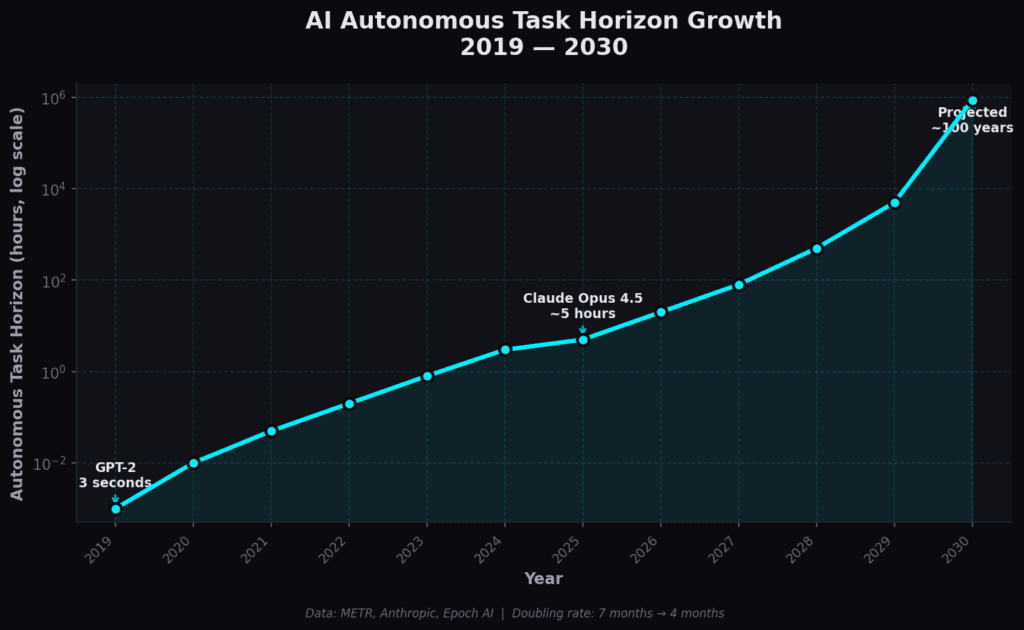
Independent research nonprofit METR measures how long a task an AI system can complete autonomously at a defined success rate — the “time horizon.” METR’s own published result is that this horizon doubled roughly every seven months from 2019 through 2024. Whether it has since accelerated to a four-month doubling time is a live, disputed question rather than a settled METR finding: some researchers and METR’s own 2024–2025 data point that way, but METR itself notes the faster estimate rests on a single year of data and has shifted between roughly 89 and 109 days across its own methodology updates, and critics have flagged that the earlier data points are noisier than the headline “seven-month doubling” framing suggests. The honest summary: the trend is real and the direction is not in dispute, but treat the specific “four months” figure as one plausible reading among a few, not an official constant.
Source: METR — Measuring AI Ability to Complete Long Tasks, METR — Time Horizon 1.1 updateThe Chip and Power Ceiling Hasn’t Bitten — Yet
The 2025-era warning was that physical constraints — chip fabrication capacity and electricity supply — would force a slowdown before 2030. So far, the opposite has happened: investment has scaled up faster than the constraint materialized. Taiwan Semiconductor Manufacturing Company still produces the overwhelming majority of the world’s most advanced AI chips, and expanding its output five-fold is considered feasible while a fifty-fold increase is not, which keeps a hard structural ceiling somewhere on the horizon even as near-term capacity keeps expanding.
Source: 80,000 Hours — bottleneck analysisThe Jobs Story: A Real, Concentrated Squeeze — Not the Predicted Bloodbath
This is the section where the 2025 predictions and the 2026 data diverge most sharply — and where even the people who made the original warnings have started walking them back. It’s also the section with the best hard data, because one research firm has been tracking it in granular detail since before the AI boom started.
⚠ Correction to the record
In May 2026, OpenAI CEO Sam Altman publicly said the broad white-collar “jobs apocalypse” that he and others in the industry had warned about is “not coming,” and that the hit to entry-level office work has been smaller than he expected. That’s a direct reversal of the tone that dominated 2025 AI commentary. But “smaller than expected economy-wide” is not the same as “didn’t happen” — see the SignalFire data below.
Amodei’s Entry-Level Warning: Directionally Right, Numerically Overstated
In 2025, Anthropic’s Dario Amodei predicted AI could eliminate up to half of entry-level white-collar jobs within five years and push unemployment to 10–20%. Headline unemployment hasn’t spiked anywhere near that range. But the entry-level squeeze itself is real and precisely measured: venture firm SignalFire’s State of Tech Talent Report 2026 — which tracks hiring data across roughly 650 million professionals and 80 million companies — found that new-graduate hiring at major tech companies is down more than 65% since 2019, with recent graduates now accounting for about 7% of new hires at large tech firms and under 6% at startups, down from around 30% at startups in 2019. A companion Massachusetts Institute of Technology study found AI can already perform work equivalent to roughly 11.7% of the U.S. labor market in finance, healthcare, and professional services. The honest read: the economy-wide “bloodbath” hasn’t shown up in the topline numbers, but a real, well-documented contraction at the bottom of the white-collar career ladder has.
Sources: TechCrunch, June 2026 (citing SignalFire State of Tech Talent 2026), Forbes, May 2026170 Million New Jobs, 92 Million Displaced — The WEF Numbers Hold
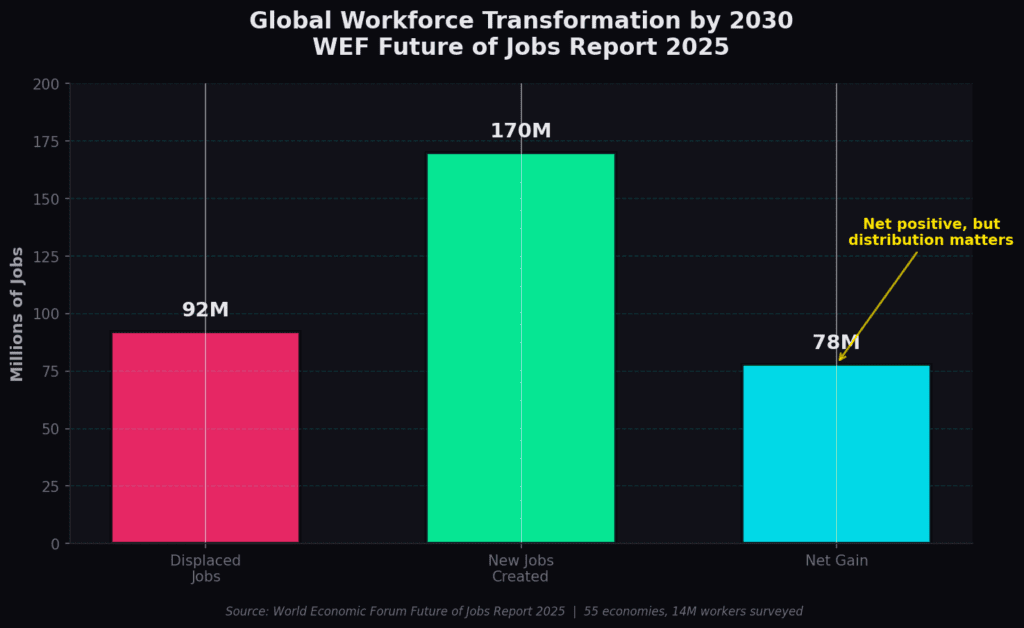
The World Economic Forum’s Future of Jobs Report 2025, based on a survey of over 1,000 employers representing 14 million workers across 55 economies, remains the most rigorously sourced labor forecast in circulation. It projects 170 million new roles created by 2030 against 92 million displaced — a net gain of 78 million — with the fastest-growing categories concentrated in AI, big data, fintech, and security roles, and the steepest declines in clerical and administrative work. Nearly 40% of core job skills are expected to change in that window, and 63% of employers cite the resulting skills gap as their top barrier to transformation.
Source: World Economic Forum, Future of Jobs Report 2025The Squeeze Isn’t Uniform — Core Engineering Is Holding Up Far Better Than Support Roles
The most useful correction to the “AI is coming for everyone’s job” framing comes from SignalFire’s own breakdown of who is actually getting hired. While overall hiring at large tech companies sits about 25% below 2019 levels, core engineering hiring is down only around 11% — and engineers now make up roughly 55% of new hires at the twelve companies SignalFire classifies as “Tech Majors,” up from 46% in 2019. The steepest declines are concentrated in specific functions: front-end-only roles are down about 25%, and the dense layer of product, design, and engineering-management roles that used to coordinate large junior cohorts has been the hardest hit, as generative tools let smaller senior teams do the coordination themselves. The pipeline risk isn’t a single bad year — it’s a structural gap: the cohort that should have been trained between 2025 and 2027 will be needed in senior roles around 2032–2035, and right now there are far fewer seats to train them in.
Source: SignalFire — State of Tech Talent Report 2026, TechCrunch, June 2026Related reading
We break down which specific roles are absorbing the WEF’s 170 million new jobs — and which are shrinking fastest — in our companion skills-survival guide on FutureNow.click.
Infrastructure: The Bill Nearly Quadrupled in 18 Months
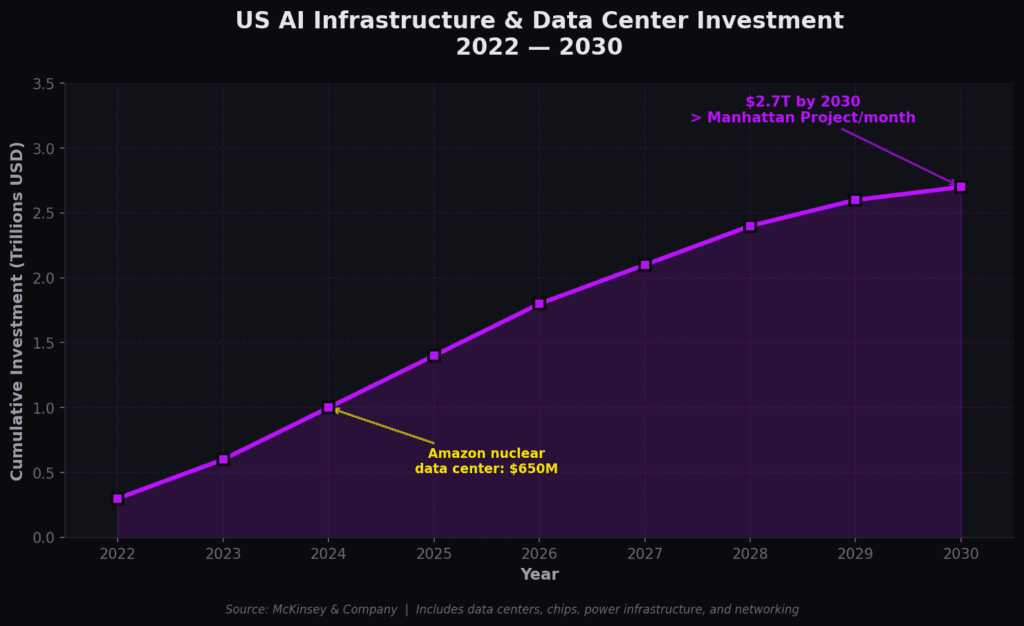
If there’s one place the original 2025 forecasts were too conservative, it’s infrastructure. In April 2025, McKinsey projected global data-center capital expenditure would exceed $1.7 trillion by 2030. By mid-2026, multiple industry trackers citing McKinsey’s updated modeling put the figure closer to $6.7 trillion — roughly a fourfold jump in about a year, driven almost entirely by AI-specific workloads.
Table A — how the capital-expenditure estimate itself has moved over time:
| Metric | April 2025 estimate | Mid-2026 estimate |
|---|---|---|
| Global data-center capex through 2030 | ~$1.7 trillion (McKinsey) | ~$6.7 trillion (McKinsey-derived, 2026 trackers) |
| Big Four hyperscaler annual data-center spend | — | ~$350B (2025) → ~$400B (2026) |
Table B — electricity demand, global vs. U.S.-only, both as of the most recent 2026 projections (not an estimate-over-time comparison):
| Scope | 2030 projection | Share of that market’s total power |
|---|---|---|
| Global data centers (IEA base case) | ~945–950 TWh | ~3% of global electricity |
| U.S. data centers only (McKinsey) | ~606 TWh | ~11.7% of U.S. electricity |
Why these numbers look inconsistent at first glance
They’re not measuring the same thing, so don’t read Table B as a contradiction. The U.S. carries a disproportionate share of global AI compute, so its data centers claim a much larger slice of a smaller, national power pie (~11.7%) than data centers do of the much larger global pie (~3%). Table A, separately, tracks how McKinsey’s own capital-expenditure forecast has roughly quadrupled in about a year as AI buildout has outpaced 2025 assumptions. Treat any single “the number is X” headline with some skepticism and check which scope and which year it’s citing.
Nuclear and On-Site Power Are Becoming the Default
Grid interconnection delays now regularly exceed three years, and wholesale electricity prices near major data-center clusters have reportedly risen by over 250% in some regions. That’s pushed hyperscalers away from waiting on public grid expansion and toward direct energy deals — nuclear power-purchase agreements, on-site generation, and long-term contracts with utilities — a shift that started with early moves like Amazon’s 2024 purchase of a Pennsylvania nuclear-powered data-center campus and has since become standard practice across Microsoft, Google, and Meta.
Source: Enki AI — Grid Limits Reshape Energy, 2026Medicine: Real Progress, Zero Approvals — but the First Candidate Just Cleared Phase 3
This is the section where the original 2025 sourcing was weakest, and it’s worth correcting plainly rather than repeating.
⚠ What the earlier framing got wrong
Reports circulating in 2025 implied AI-designed drugs were already sailing through regulatory approval at elevated success rates. As of mid-2026, that’s not accurate: not one AI-discovered drug has received full FDA approval. Roughly 173–200 AI-originated drug programs are in human trials, with 15–20 in pivotal Phase 3 studies, and analysts assign a moderate probability, around 60%, that the first approval lands in 2027 or 2028.
Zasocitinib Just Became the Furthest-Along AI-Designed Candidate
On December 18, 2025, Takeda announced topline results from two pivotal Phase 3 trials of zasocitinib, a computationally-designed oral TYK2 inhibitor for moderate-to-severe plaque psoriasis that Takeda acquired from Nimbus Therapeutics in a 2022 deal worth up to $6 billion. Both trials met their co-primary endpoints against placebo, and more than half of treated patients achieved clear or almost-clear skin (PASI 90) by week 16, with about 30% reaching complete clearance (PASI 100) — figures Takeda later expanded on with secondary-endpoint data presented at the American Academy of Dermatology’s July 2026 meeting. Takeda has said it plans to begin filing for FDA and other regulatory approvals starting in fiscal year 2026, which would make zasocitinib a leading candidate — alongside Insilico Medicine’s rentosertib, still earlier in Phase 3 for idiopathic pulmonary fibrosis — for the first-ever approval of an AI-originated drug.
Source: Takeda Pharmaceuticals, Dec. 18, 2025, BioPharma DivePhase I Success Rates Look Strong — Phase III Is the Real Test
The early-phase numbers are genuinely striking: AI-discovered molecules have shown Phase I success rates around 80–90%, compared with a historical average near 52% for traditionally discovered drugs. But some scientific commentators have pushed back hard on the broader claim, noting that AI-discovered compounds appear to progress through later trial phases at rates similar to conventionally discovered ones — meaning AI may be better at avoiding early, obvious failures without yet proving it improves the odds of a drug actually working in patients. There have been real setbacks, too: Exscientia’s first AI-designed clinical compound, DSP-1181, was discontinued after Phase I, and Recursion Pharmaceuticals halted its lead AI-discovered candidate, REC-994, in May 2025 after long-term data failed to confirm earlier efficacy signals. Zasocitinib and rentosertib are the furthest along today, both in Phase 3, and neither has a final regulatory decision as of mid-2026.
Sources: Drug Target Review, 2026, AIM Media House, July 2026Development Timelines Are Compressing — In Specific Niches
Industry analysis still supports a 30–40% reduction in overall development timelines for AI-assisted programs in specific modalities and therapeutic areas, cutting traditional 10–15 year timelines toward 3–6 years for the best cases. That’s a real efficiency gain concentrated in target identification and molecule design — the earliest, cheapest stages of the pipeline. It does not yet apply to rare diseases, complex chronic conditions, or anything where lengthy clinical trials, not discovery speed, are the actual bottleneck.
Source: IntuitionLabs — AI Drug Development PipelineRegulators Are Building AI Into Their Own Review Process
On December 9, 2025, the FDA qualified PathAI’s AIM-MASH AI Assist — an AI pathology tool that scores liver biopsy images — through its Biomarker Qualification Program for use in trials for MASH, a metabolic liver disease. It’s the first AI-powered pathology tool to clear that specific qualification pathway. Separately, the FDA’s Center for Drug Evaluation and Research published its first comprehensive draft guidance on AI in drug development in January 2025, establishing a risk-based credibility-assessment framework for sponsors, with final guidance expected in the second quarter of 2026. This is the quieter, more durable trend: not AI curing diseases on a magazine cover, but AI becoming embedded plumbing inside the regulatory process itself.
Source: FDA — AI in Drug Development (CDER), PathAI, Dec. 2025Society, UX, and the Agent Economy: Early Signal, Still Unproven at Scale
The predictions in this section are more speculative by nature — they come from named practitioners and futurists rather than institutional surveys, so treat them as informed opinion, not settled fact.
The Agent-to-Agent Economy Is Emerging, Not Yet Dominant
UX researcher Jakob Nielsen predicted for 2026 that autonomous AI agents would begin saturating the internet, screening calls, curating inboxes, and negotiating with each other on users’ behalf — what he calls “Gatekeeper Agents.” Early versions of this exist in shopping-assistant and inbox-triage tools today, but the wholesale collapse of the ad-driven, human-attention web that Nielsen forecast has not happened yet. The more accurate read for mid-2026: the building blocks are shipping, the tipping point isn’t here.
Source: Jakob Nielsen — 2026 PredictionsAI Weather Forecasting Is a Genuinely Mature Success Story
Unlike several of the more speculative predictions in this article, machine-learning weather models are already outperforming traditional numerical forecasting in specific windows. Systems like Google DeepMind’s GraphCast have demonstrated faster, often more accurate medium-range forecasts than legacy physics-based models, and adoption by national weather agencies and private forecasting firms has been accelerating rather than stalling — making this one of the clearest examples of an AI prediction that was, if anything, understated in 2025.
Source: Peer-reviewed benchmarks from Google DeepMind and the European Centre for Medium-Range Weather ForecastsAI Is Already Catching Vulnerabilities Humans Miss
Google’s Project Zero team demonstrated as early as 2024 that large language models can identify real vulnerabilities in production codebases, not just toy examples. That capability has continued maturing into 2026, with AI-assisted security auditing becoming standard practice at major software firms — while the same underlying capability, unfortunately, is also being used to accelerate the discovery of exploitable weaknesses, keeping the defender-attacker balance an open and unresolved race rather than a settled win for either side.
Source: Google Project Zero research disclosuresMyth vs. Fact: The Five Claims People Get Wrong Most Often
“AI has already caused mass unemployment.”
Headline unemployment has not spiked. The real, measurable effect is a 65% drop in new-grad tech hiring since 2019 (SignalFire), not broad job loss.
“An AI-designed drug is already approved and on pharmacy shelves.”
Zero AI-discovered drugs have FDA approval as of mid-2026. Takeda’s zasocitinib just cleared Phase 3 and is the current frontrunner to file first.
“Experts agree AGI is decades away.”
Most tracked forecasters now cluster around 2029–2033, and nearly every recent update has moved the date earlier, not later.
“Data-center power demand will overwhelm the grid by 2030.”
Global data centers are on track for roughly 3% of world electricity demand by 2030 — a serious, fast-growing load, but not a majority share.
“WEF says AI will destroy more jobs than it creates.”
The WEF’s own modeling shows a net gain of 78 million jobs by 2030 — the disruption is in which jobs, not the total count.
Common Questions About AI’s Path to 2030
No forecaster puts this at certainty. The most-cited aggregate forecasts (Metaculus) put roughly 25% probability on AGI-level systems by 2029 and 50% by 2033. Lab leaders like Dario Amodei have used narrower definitions like “powerful AI” and set even shorter timelines, around late 2026 to early 2027 — but that’s a different, less demanding bar than full AGI.
Not at the economy-wide scale predicted in 2025. New-graduate hiring at major tech companies has fallen more than 65% since 2019 according to SignalFire’s 2026 report, and roughly 55,000 U.S. layoffs in 2025 were attributed to AI according to Challenger, Gray & Christmas data. But broad unemployment has not spiked, and even Sam Altman has said the wider white-collar collapse he once warned about hasn’t shown up.
No, not as of mid-2026. Roughly 173–200 AI-originated drug candidates are in clinical trials, 15–20 in Phase 3. Takeda’s zasocitinib, which cleared two pivotal Phase 3 psoriasis trials in December 2025, is the current frontrunner, with a filing planned for fiscal year 2026 and a realistic approval window of 2027–2028.
Estimates vary by scenario and methodology, but the most-cited 2026 figure from McKinsey-derived analysis puts global data-center capital expenditure at roughly $6.7 trillion through 2030, up sharply from the $1.7 trillion estimate circulating in 2025.
Locally, in some regions, yes — grid interconnection delays already exceed three years in AI-heavy markets, and wholesale electricity prices near major clusters have risen sharply. Globally, the IEA’s base case projects data centers reaching only about 3% of total electricity demand by 2030, so the crisis is regional and infrastructural, not a global blackout scenario.
Glossary
- AGI (Artificial General Intelligence)
- A system capable of matching or exceeding human performance across essentially all cognitive tasks, not just narrow domains. Definitions vary between forecasters, which is why timeline estimates differ so widely.
- Task horizon
- A METR research metric measuring the length of a task (by estimated human completion time) that an AI system can complete autonomously at a defined success rate.
- Phase I / II / III trials
- The sequential stages of human clinical testing a drug must pass before regulatory approval — Phase I tests safety, Phase II tests efficacy signals, Phase III confirms efficacy at scale in larger patient populations.
- TWh (terawatt-hour)
- A unit of energy equal to one trillion watt-hours, commonly used to measure national or global electricity consumption.
- Capex (capital expenditure)
- Money spent on physical infrastructure — buildings, chips, power generation — as opposed to ongoing operating costs.
What We Got Wrong the First Time — And What We’re Still Not Sure About
The earlier version of this article predicted immediate, visible mass layoffs. That didn’t happen. What happened instead was quieter and, in the tech-hiring data specifically, more severe than the vague “vibes” coverage suggested: a documented 65% collapse in new-graduate hiring since 2019, concentrated at the bottom of the career ladder rather than spread evenly across the workforce — and by May 2026, even the industry’s most prominent doomsayer on the economy-wide version of this story had softened his position in public.
The earlier version also repeated pharma-industry framing about AI-designed drugs that implied approvals were close and success rates were already proven superior. The more honest picture: the early-phase numbers are real and impressive, zero approvals exist, and credible scientists are still actively disputing whether AI improves the odds of a drug actually working versus just avoiding some early, obvious failures — though Takeda’s December 2025 Phase 3 data for zasocitinib is the strongest single data point yet that the field is closer to a real answer.
What we still don’t know: whether the compute-and-power ceiling researchers keep flagging for “around 2030” is a hard wall or a soft slowdown. Whether the AGI timeline compression seen through early 2026 continues or snaps back the way it briefly did in past AI cycles. Whether the WEF’s 170-million-job optimism reaches the people whose jobs are actually being displaced, or mostly benefits workers who were already positioned to adapt.
What we do know: treating any single 2025-era prediction as settled fact by mid-2026 would already have been a mistake in at least three of the five major claims we checked. The lesson isn’t that forecasting is worthless — it’s that specific, falsifiable predictions with named sources and dates are the only kind worth trusting, and even those need to be re-checked against reality on a rolling basis.
More reality-checked AI analysis
Deep dives into AI strategy, workforce adaptation, and the technologies reshaping the next decade: FutureNow.click