
MIND-BLOWING AI · REALITY CHECK
Can AI Really Predict Your Next Thought
A number from a real 2017 brain-imaging study keeps getting recycled into headlines that imply something it never showed. Here’s the actual research, what it measured, and how far the science has genuinely come by 2026.
If you’ve seen a headline claiming an AI can “predict your next thought” with some suspiciously precise accuracy figure attached, there’s a good chance it traces back — directly or through several rounds of copy-paste — to one real study. It’s a legitimate piece of science. It is also almost never described accurately once it leaves the press release.
This article does two things. First, it runs down the actual research behind the number, with links to the original sources so you can check every claim yourself. Second, it lays out where brain-decoding AI genuinely stands as of late 2026 — which is a lot more interesting, and a lot more limited, than the viral version suggests.
“This AI can predict your next thought — and it’s 87% accurate.”
A 2017 Carnegie Mellon study used fMRI scans of people reading simple sentences, then tested whether a model could match a held-out sentence to its correct brain-activity pattern out of the candidates in the same dataset — not read an arbitrary, spontaneous thought in real time. The 87% figure is real. The “predict your next thought” framing is not what was tested.
Where the 87% number actually comes from
The figure traces to a study led by cognitive neuroscientist Marcel Just and computer scientist Tom Mitchell’s collaborators at Carnegie Mellon University, published in Human Brain Mapping and funded by the U.S. Intelligence Advanced Research Projects Activity (IARPA). CMU’s own research news office described the result in June 2017: researchers built a computational model that could identify complex thoughts — sentences like “the witness shouted during the trial” — from fMRI brain-activation patterns.
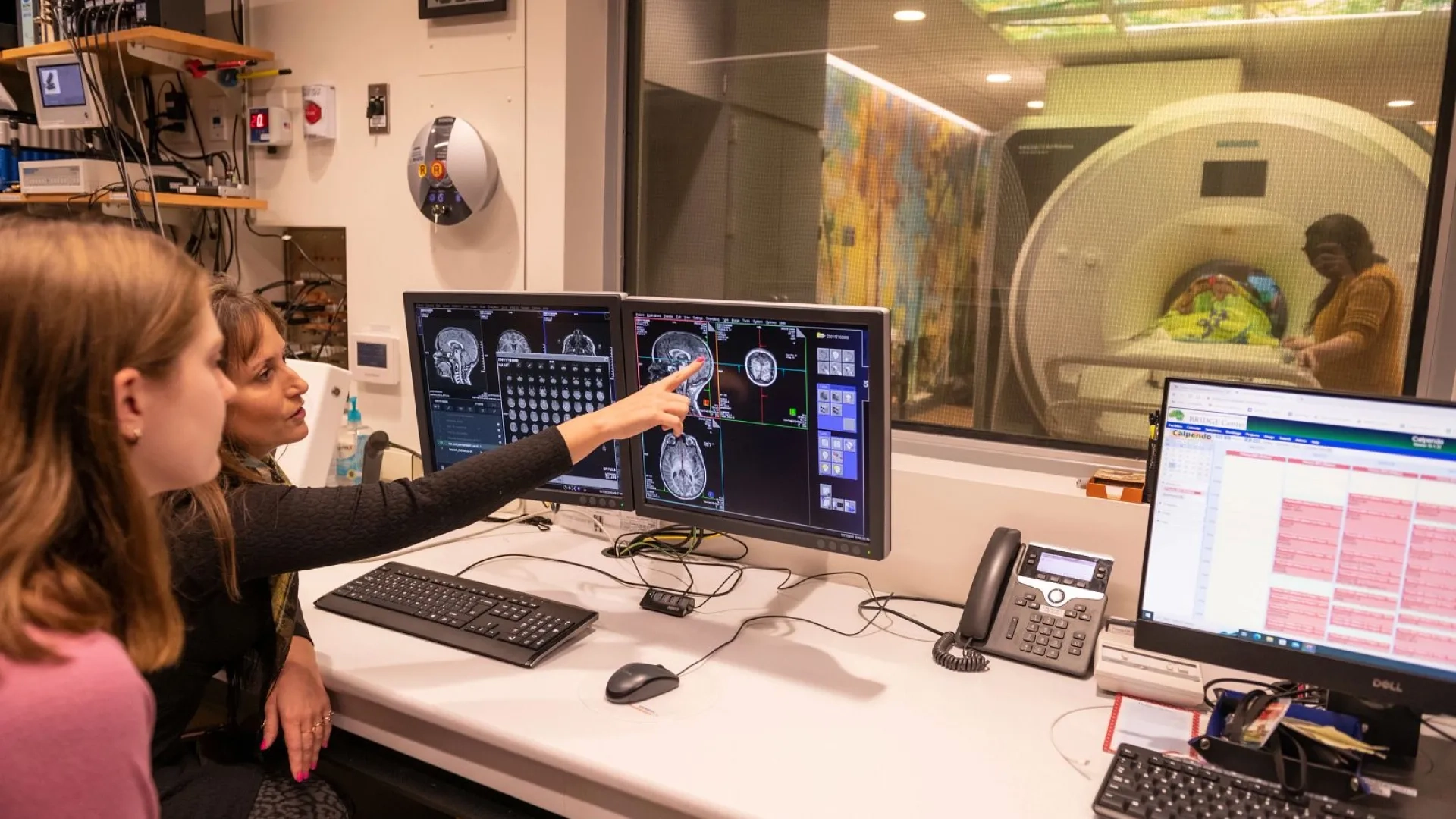
Here’s the part that gets lost in translation: the model was trained on 239 sentences and then tested on a 240th sentence it hadn’t seen, matching the held-out sentence’s predicted brain pattern against the real one with 87% accuracy. That’s a leave-one-out classification task inside a known, closed set of sentences the researchers themselves wrote — not open-ended mind reading of whatever a person happens to be thinking about on a given afternoon. The researchers’ own stated next goal, as CMU quoted Just, was far more modest than “read your mind”: decoding the general topic someone is thinking about, like geology versus skateboarding.
The claim resurfaced in mainstream coverage the following year. A February 2018 World Economic Forum article repeated the 87% figure alongside a separate, unrelated CMU project that generated images from brain signals — folding two different studies into one “mind-reading AI” narrative. That’s the version that keeps circulating, nearly a decade later, now often stripped of the year, the sample size, and the fact that it was a forced-choice match, not free recall.
The “accuracy” numbers you’ll see quoted are not measuring the same thing
Part of why these claims spread so easily is that “brain decoding accuracy” sounds like one metric. It isn’t. Different studies test wildly different tasks — closed-set classification, letter-by-letter typing, full sentence reconstruction — and then get flattened into the same breathless framing. Here are four real, sourced figures, and what each one actually measured:
Four real “accuracy” figures, four different tasks
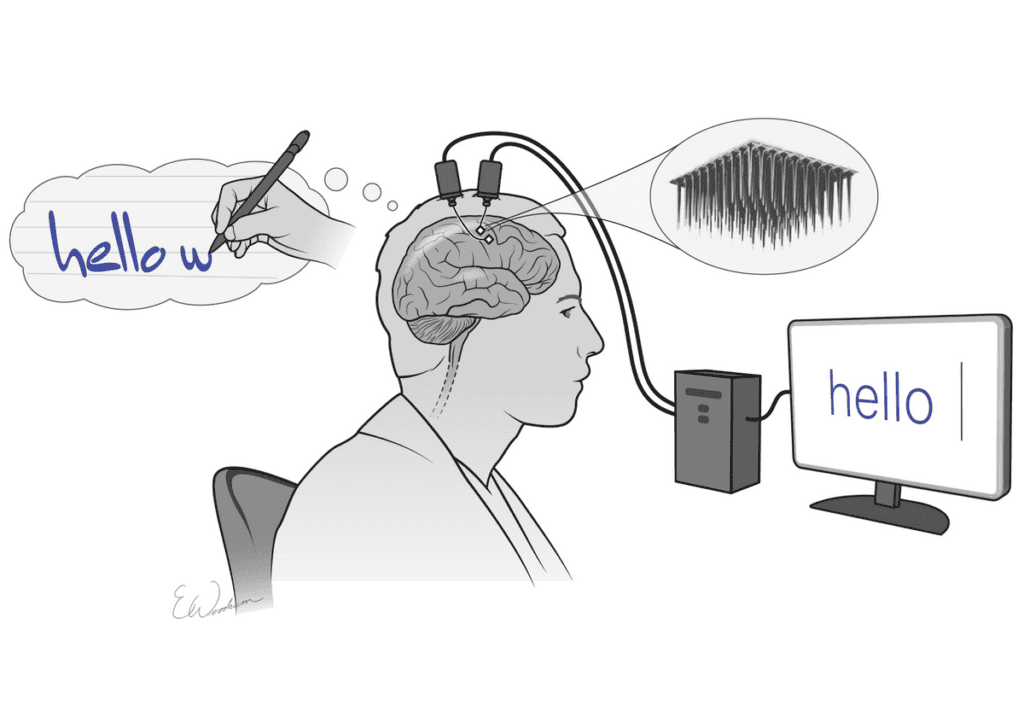
What’s actually behind each bar: the CMU figure is closed-set sentence matching in healthy volunteers (Just et al., 2017). The attempted- and inner-speech figures come from an implanted motor-cortex BCI tested in people with ALS or paralysis, decoding attempted versus silently imagined speech at different accuracy levels, as reported by a Cell-published study covered by Forbes in August 2025. The typing figure is Meta AI’s non-invasive Brain2Qwerty system, which used MEG scalp recordings to guess which key a person was typing, and mostly confused visually or spatially adjacent keys like K and Z. Stacking these on one chart is common in “mind-reading AI” roundups. Doing it honestly means saying, loudly, that a percentage without its task, population, and method attached tells you almost nothing.
What has genuinely improved since 2017 — and what hasn’t
The unglamorous truth is that the most important developments since the CMU study aren’t about the headline number going up. They’re about the field slowly solving problems that closed-set lab demos never had to face.
From matching known sentences to generating open text
In 2023, a University of Texas at Austin team led by Alexander Huth and then-PhD student Jerry Tang published a genuinely bigger leap: a semantic decoder that generated continuous, open-vocabulary text from fMRI activity — not picking the right answer from a known list, but producing new word sequences that captured the gist of a story a participant was hearing, imagining, or even watching silently. It’s a real jump from classification to generation, published in Nature Neuroscience.
The catch nobody puts in the headline
The UT Austin decoder needed many hours of that specific person’s brain data, collected while they listened to podcasts inside an fMRI scanner, before it worked on them at all. And the researchers explicitly tested whether a decoder trained on one person would work on someone else. As Science reported, it didn’t. Huth’s team has since worked on narrowing that gap — a 2025 Current Biology follow-up describes methods to transfer a decoder across participants using shared story and movie data — but as of the most recent published results, a general-purpose, walk-up-and-decode-anyone’s-mind system does not exist.
The 2026 development: a foundation model for brain response
The most significant recent step is Meta FAIR’s TRIBE model, described in reporting in early 2026: a transformer trained on large pools of fMRI data from people watching movies and listening to podcasts, reported to achieve roughly a 70-fold increase in spatial resolution over earlier decoding models and to generalize in zero-shot fashion to new people and new stimuli without retraining. That’s a real advance toward the “works on someone new” problem. It is still built on fMRI — a machine that costs on the order of a million dollars, requires the subject to lie still inside it, and offers none of the portability a genuine real-world “read your thoughts” product would need.
The real progression, in order
Each step solved a real, specific limitation of the one before it. None of them removed the need for either a scanner the size of a room or an invasive implant.
Why a real “predict your thoughts” gadget still doesn’t exist: the Decode Triangle
Every brain-decoding approach on the market or in a lab right now trades off between three properties, and no current system has all three. It’s worth naming this plainly, because it’s the actual reason the sci-fi version of this technology keeps not arriving on schedule:
The Decode Triangle
Every real method clusters toward one or two corners, never all three. Moving toward “works without cooperation” — the part that would make covert mind-reading possible — is also where the least research investment exists, because it’s the use case with no legitimate clinical or research justification.
Every method above also shares one more trait that doesn’t fit on the triangle: every study cited here was run on a volunteer who agreed to sit in the machine and think about specific, structured stimuli on request. Huth’s own team, per Science’s reporting, has said openly that they were unsettled by how well the decoder worked on a cooperating, trained subject — and reassured, in the same breath, that it failed completely on anyone else’s untrained brain. That failure mode is doing more work in protecting people’s mental privacy right now than any policy is.
A separate confusion worth clearing up: brain decoding is not the same thing as an LLM “predicting your next word”
A lot of “AI reads your mind” anxiety gets cross-wired with a completely different, much more familiar technology: large language models, which do generate text by predicting the statistically likely next token. That process has nothing to do with scanning anyone’s brain — it’s pattern-matching over the words you’ve already typed, not a readout of a thought you haven’t expressed yet. Commentary on this distinction has become its own small genre; one recent analysis put it well by noting that “just predicting the next word” is technically accurate about the mechanism but has become nearly useless as an explanation of what the systems actually do in practice. Conflating that autocomplete process with fMRI-based neural decoding — two unrelated technologies that both get called “AI” — is a big part of why headlines about either one tend to run hotter than the underlying research supports.
A five-point check for the next “mind-reading AI” headline you see
- 01Is it a closed-set match or open generation? Picking the right answer from a known short list is a fundamentally easier task than producing free text — and “accuracy” means very different things in each.
- 02Was it tested on a cooperating, trained volunteer, or someone new? Every system in this piece needed the subject’s willing participation, and most needed hours of that specific person’s data first.
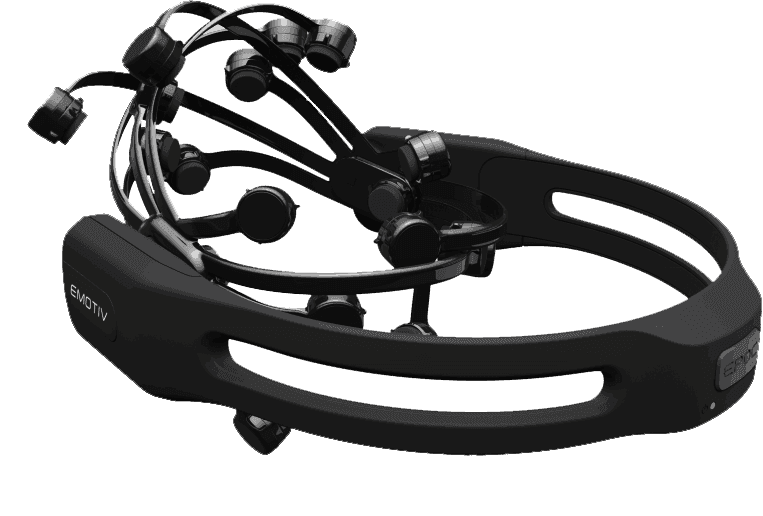
- 03What hardware was involved? “AI decodes brain signals” covers everything from a scalp EEG headband to a surgically implanted electrode array to a room-sized fMRI scanner — wildly different in cost, invasiveness, and real-world usability.
- 04Is the population representative of you? Several of the most eye-catching decoding results, including the highest accuracy speech figures, come from clinical trials in people with ALS or paralysis who have electrodes implanted for medical reasons — not from healthy people wearing a consumer gadget.
- 05Does the original source even use the word “predict” the way the headline does? As this piece shows, a single number can travel years and multiple rewrites away from the study that produced it.
Frequently asked questions
Is the “87% accurate” mind-reading AI claim fake?
No — the number is real and comes from a legitimate, peer-reviewed 2017 Carnegie Mellon study published in Human Brain Mapping. What’s misleading is the framing that grew up around it, which implies real-time reading of arbitrary spontaneous thought rather than the closed-set sentence-matching task the study actually ran.
Can any AI currently read a person’s thoughts without their cooperation?
Not based on any published research reviewed here. Every decoding system in this article, from the 2017 CMU study through Meta’s 2026 TRIBE model, was tested on volunteers who agreed to participate and, in most cases, spent hours generating training data specifically for that system.
What’s the difference between fMRI decoding and an EEG headset?
fMRI measures blood-flow changes deep in the brain with strong spatial detail but requires an expensive, room-sized, immobile scanner. EEG measures electrical activity at the scalp with much finer timing but coarser spatial resolution, using portable, comparatively cheap equipment — which is why most consumer neurotech wearables use EEG rather than fMRI.
Do consumer EEG wearables marketed for focus or meditation actually read thoughts?
No. Those devices generally track broad signal patterns associated with states like relaxation or alertness — not the semantic content of specific words or sentences a person is thinking. That’s a fundamentally different, much coarser signal than the language-decoding research covered in this article.
Does a brain decoder trained on one person work on someone else?
Historically, no. University of Texas at Austin researchers explicitly tested this with their semantic decoder and found it did not transfer to an untrained person. More recent work, including a 2025 Current Biology study from the same lab and Meta’s 2026 TRIBE model, is specifically aimed at closing that gap, with partial success reported so far.
Is predicting the next word in an LLM the same as reading a thought?
No. A large language model predicts likely next tokens based on text you’ve already provided — it has no access to, or model of, your neural activity. Brain decoding is a separate field entirely, using imaging or implanted hardware to read biological signals.
What real-world application is closest to working today?
Speech-restoration BCIs for people with ALS or paralysis are the most clinically advanced application, with implanted systems reportedly decoding attempted speech at high accuracy in trial settings, per Cell-published research covered by Forbes in 2025. These remain invasive, individually calibrated medical devices, not consumer products.
Should I be worried about employers or advertisers reading my mind?
Based on the current published research, there is no technology capable of covertly decoding an unwitting, untrained person’s specific thoughts. The realistic near-term privacy concerns around neurotech center more on data from consumer wearables (attention, mood, arousal signals) than on anything resembling verbatim thought-reading.