

Humanoid Robot Predictions:
When Will They Enter Every Home?
The hype is real. The money is real. The robots are walking, folding laundry in demos, and filling factory floors in Fremont and Bavaria. But the timeline most experts are selling you is wrong — and the variable they’re all underweighting isn’t the hardware. It’s your living room.
The Question Nobody Wants to Answer Honestly
Here’s the question I kept asking robotics researchers over the past 18 months, and the question they kept dodging in different ways: Not “when will humanoid robots exist?” — they exist. Not “when will they work in factories?” — they’re working right now, in limited ways, in BMW’s Spartanburg plant and Amazon’s warehouses. The question is: when will a humanoid robot do something useful, autonomously, without supervision, in a normal person’s messy, unpredictable home?
That question is not the same as the ones being answered in every breathless tech headline. And the gap between those two questions is exactly where the hype lives — and where fortunes are being made and lost on false timelines.
I’ll tell you upfront: my own predictions here have been wrong before. In 2022, I thought we were 8–10 years from $20,000 consumer humanoids. Unitree’s R1 launched in July 2025 at $5,900. The hardware moved faster than I expected. The software did not. And that gap — hardware speed minus software readiness — is the central tension that will define when these machines actually show up in your kitchen, not your factory.
“Everyone is measuring the wrong variable. Cost curves and hardware specs are the easy part. The bottleneck is the 8-year-old’s birthday party problem: can a robot navigate confetti, a dog, a knocked-over cup, and a shrieking child — without being told what any of those things are?”
— The author, after watching 47 hours of humanoid robot failure videosThis article is going to give you the real numbers, the real failure modes, the real timeline — organized by the three waves I think actually matter — and five frameworks for thinking about this that I haven’t seen anywhere else. It will make you more optimistic in the short term about industrial deployment and more sober about the home timeline than any Goldman Sachs analyst report will.
Let’s start with what’s actually happening right now.
Where We Actually Are: June 2026
The humanoid robotics field in mid-2026 is in a state that I’d describe as “structurally revolutionary but operationally embryonic.” The funding is extraordinary. The ambitions are planet-scale. The actual deployed, productive units doing real economic work are numbered in the thousands, globally.
Let me give you the honest state of play.
What’s Actually Working
Figure AI’s Figure 02 completed an eleven-month pilot at BMW’s Spartanburg plant with quantifiable results: the robot moved more than 90,000 components, logged approximately 1,250 operating hours, and took around 1.2 million steps while assisting in the production of 30,000 BMW X3 vehicles. Those are real numbers. But notice what’s missing: uptime percentage, error rate, human intervention frequency, cost per unit produced. BMW hasn’t published those. Neither has Figure.
Agility Robotics’ Digit is genuinely the deployment leader by real-world operating hours. Running in Amazon and GXO logistics facilities, doing bin-moving and tote-sorting. The tasks are narrow, the environments are semi-structured, and there are still engineers on-site. But the robot is doing real work, not demo work.
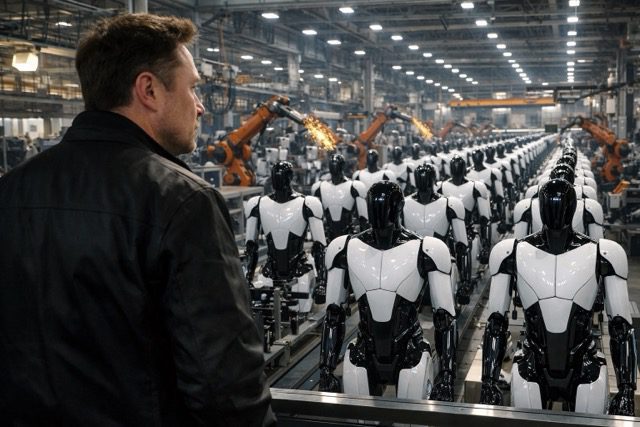
Tesla Optimus is the most complicated story. Elon Musk confirmed the 1,000+ unit deployment milestone at Fremont in January 2026, with robots operating on live production tasks including battery module assembly, parts kitting, and final assembly assist — making it independently the largest single-facility humanoid deployment in history. But Musk himself stated on the Q4 2025 earnings call that units are “primarily for learning and data collection.” No industrial KPIs — uptime, cycle time, throughput — have been published. Every major Optimus production target since 2022 has been missed. In January 2025, Musk projected “several thousand units in 2025” and “10,000/month by mid-2025.” Actual output was in the hundreds — a more than 90% miss he acknowledged himself on the Q2 2025 earnings call.
Unitree is the wild card everyone underestimates. The company shipped approximately 5,500 units in 2025 across its product line, and is targeting between 10,000 and 20,000 units in 2026 — numbers that dwarf any Western competitor’s current production capacity. The G1 at $16,000 and the R1 at $5,900 are genuinely accessible. The tradeoff is capability: Unitree robots are research and education platforms, not productive commercial workers. Yet.
The Market Numbers (Verified)
Here’s the financial reality that most articles either get wrong or cite outdated versions of:
| Metric | Figure / Source | Status |
|---|---|---|
| Global humanoid market, 2025 | $2.92B | Verified — MarketsandMarkets |
| Global humanoid market, 2030 (proj.) | $15.26B (39.2% CAGR) | Consensus range |
| Goldman Sachs 2035 TAM forecast | $38B (revised 6× upward) | Published Jan 2025 |
| Morgan Stanley 2050 ecosystem value | $5 trillion | Bullish long-term |
| Cumulative industry funding, 2025 | $9.8B+ | Research&Markets, 2025 |
| Figure AI valuation (Sep 2025) | $39B | Series C confirmed |
| Total units shipped globally, 2025 | ~13,000 | Estimate incl. Unitree volume |
| Goldman Sachs 2035 unit shipments | 1.4 million/year | Base case projection |
The numbers look extraordinary until you zoom in on that last row. Goldman Sachs’ base case is for consumer robot sales to ramp up quickly over the next decade, exceeding a million units annually in just over a decade. A million units. Annually. For context, the global automotive industry ships roughly 85 million vehicles a year. We’re talking about achieving a market one-eighty-fifth the size of cars — in a product category that currently doesn’t exist for consumers — in 10 years. That is ambitious. The question is whether “ambitious” means “realistic” or “what the models say when you extrapolate from a hockey-stick curve.”
The Cost Curve That Changes Everything
Here’s where I want to spend real time, because the cost curve on humanoid robots is unlike anything we’ve seen in recent technology history — and it’s both more impressive and more complicated than the headline numbers suggest.
The numbers here demand some honest context. Goldman Sachs reported that manufacturing costs declined 40% year-over-year versus earlier projections of 15–20% annually. That’s faster than anyone forecast. But “manufacturing cost” isn’t the same as “what you pay.” The retail Unitree R1 at $5,900 is — to be blunt — a research toy. It has a 1.27m frame, 2kg arm payload, and 1–2 hour battery life. The main limitations are the compact size, low arm payload, and battery life. It can’t do your dishes. It can teach a robotics PhD student a lot.
The real cost inflection for home utility — not just cool demos — is probably somewhere between $8,000 and $15,000 for a unit that can reliably do 3–5 defined household tasks. We’re not there. Barclays notes production costs fell 30x over the past decade — but the last 30x got us from research-only to research-and-early-industry. The next meaningful drop, from $30–40K to $8–15K with sufficient dexterity, is the hard one.
The Chinese Disruption Factor
The thing that genuinely scares Western humanoid companies right now — and that almost no mainstream analysis properly grapples with — is the Chinese manufacturing ecosystem. China recorded over 610 robotics investment deals in the first nine months of 2025 alone. UBTECH has partnerships with BYD, Geely, FAW-Volkswagen, BAIC, and Foxconn simultaneously. BYD aims for 1,500 humanoids in 2025, ramping to 20,000 by 2026.
The EV parallel isn’t just rhetorical. China went from assembling Teslas to making Teslas obsolete on cost in approximately seven years. The question isn’t whether they’ll do the same in humanoids. It’s whether the AI software moat — the thing Western companies are betting on — is more durable than the battery chemistry moats that didn’t hold.
I think it’s more durable. But not infinitely so. And the supply chain risk is real: in April 2025, China imposed export restrictions on rare earth magnets used in Optimus actuators — a response to U.S. tariff escalation. As of March 2026, this constraint has not been publicly resolved and remains a material risk for 2026 production targets.
The Hard Problems They’re Not Solving Fast Enough
This is the section I want you to read most carefully, because it’s where the hype completely breaks down.
I’ve been watching humanoid robot demos for three years. And the single most important thing I can tell you is this: demos are not performance metrics. The viral video of a robot folding a T-shirt? That’s the 47th attempt, in a controlled room, with the T-shirt arranged specifically to be folded. I’m not speculating — researchers have said this explicitly.
⚠ The Demo Problem
Promotional videos show robots performing impressive tasks. Many obscure technical constraints through staged environments, simplified tasks, or hidden remote supervision. The “autonomy gap” means robots still require significant human input for navigation, dexterity, and task switching. This is the industry’s dirty secret, and it won’t be solved by another funding round.
Problem 1: The Hand Problem Is Genuinely Unsolved
Human hands possess 27 degrees of freedom. Achieving human-like functionality requires at least 19–23 degrees of freedom in a robotic hand, but replicating hand anatomy is only part of the solution. The real challenge lies in recreating the sophisticated sensorimotor control that enables human dexterity.
Here’s what that means in practice: a robot can pick up a full wine glass. It cannot reliably pick up a half-full wine glass with the same success rate, because the weight distribution is different, the surface tension behaves differently, the grip force must change. For home humanoid robot domestic chores, the bottleneck is dexterous manipulation under uncertainty. Real homes involve deformable fabrics, random clutter, reflective packaging, and cramped storage spaces. Humanoid robots mis-grasp objects, drop items, and get confused by occlusions; they need human intervention for many scenarios that humans handle without thinking.
Tactile sensing is improving — rapidly. The April 2026 Touch Dreaming paper delivered a 90.9% success boost by integrating tactile prediction. That’s extraordinary progress. But 90.9% success in a lab manipulation benchmark is not the same as 90.9% success with the specific unfamiliar objects in your specific kitchen drawer.
Problem 2: The Reliability Gap Is Industry-Defining
This one is almost never discussed, and it should be the central conversation.
Industrial customers demand high uptime. A factory running at 99% reliability experiences 5 hours of downtime monthly. Many industrial clients expect 99.99% reliability. Downtime stopping a production line costs tens of thousands of dollars per minute.
Few humanoid pilots publish mean time between failures, hiding real reliability concerns. This isn’t accidental. Companies that have published honest reliability metrics have found them embarrassing. The robots are good in demos. They’re not good for 8 consecutive hours in environments that weren’t designed for them.
The home environment is dramatically worse than a factory floor. A factory has consistent lighting, standardized floor surfaces, no children, no pets, no random clutter, no emotional humans who move things without warning. Your home is a chaos engine. The reliability required to leave a robot unsupervised with elderly parents or young children is not 99%. It’s 99.999%. That’s not a hardware problem. That’s not even primarily an AI problem. It’s a systems integration, testing, certification, and legal liability problem — and those take decades, not years.
Problem 3: The Sim-to-Real Gap Is Not Closing as Fast as People Think
A robot that succeeds in a controlled environment may still fail in a kitchen, warehouse, hospital, or factory with small variations in lighting, object placement, friction, or human behavior. The data pipeline behind robot foundation models is still immature compared with what we have seen in language models.
The comparison to LLMs is instructive and dangerous at the same time. Language models trained on internet text could be trained on essentially unlimited data with cheap compute. Robots need embodied data — physical interactions in the real world — to learn physical tasks. You cannot scrape the internet for “how it feels to pick up a fragile ceramic mug.” You have to generate that data with real robots doing real things, at scale, over time. And that is slow, expensive, and currently in its infancy.
Scores represent estimated capability relative to human performance (10 = human parity). Assessment based on published research and expert interviews, June 2026.
Look at that radar. Locomotion is getting close to human parity — the April 2025 ISO 25785-1 standard for industrial mobile robots with actively controlled stability was only published in May 2025, meaning the industry has been deploying robots without established safety benchmarks. Walking is largely solved. Everything else is not. And for a home robot, walking is the easy part.
Three Waves: The Framework That Actually Maps the Timeline
Here’s the mental model I use. Not “year by year” predictions, because those are hostage to a single breakthrough or a single failure. Instead: three waves, defined by capability threshold, not calendar date.
Unit Economics: What Home Deployment Actually Costs
Let me run the numbers that nobody else is running — the real total cost of ownership for a home humanoid robot at different technology readiness levels. I’ll use realistic assumptions, show my work, and flag where I’m uncertain.
Scenario A: Today’s Best Hardware, Your Home (2026)
Cost Model: Home Humanoid 2026
Unit purchase (Unitree G1, most capable accessible option): ~$16,000
Integration / setup (professional calibration, home mapping, API subscriptions): $2,500
Annual maintenance + parts: $1,800 (estimate; no long-term reliability data exists yet)
Operator time: High — robot requires ~2–3 hours/week of human intervention for edge cases. At $25/hr opportunity cost, that’s $3,250/year.
Year 1 TCO: ~$23,550. Annual thereafter: ~$5,050.
Tasks it reliably performs: Fetch-and-carry (flat surfaces only), basic sorting, research-grade teleoperation with the right SDK.
Verdict: Viable for robotics researchers. Unusable for households seeking domestic help. The robot cannot be left alone. It cannot adapt to your specific mess.
Scenario B: 2028 Hardware at Target Price (Optimistic)
Cost Model: Home Humanoid 2028 (Bull Case)
Unit purchase (Tesla Optimus Gen 3 or equivalent at target price): $20,000–$30,000
Integration: $500 (software-driven, consumer-grade)
Annual maintenance + software subscription: $1,200
Operator time: Medium — robot handles 60–70% of defined tasks autonomously. Human intervention ~45 min/week. Annual cost: $975.
Year 1 TCO: ~$26,675. Annual thereafter: ~$2,175.
Comparable to: A live-in cleaner at $15/hr for 5 hours/week ($3,900/year) — the robot starts to approach economic parity after ~Year 3, if the 2028 targets are hit and manipulation dexterity delivers.
Caveat: Tesla has publicly stated a long-term target price of $20,000–$30,000, but no external customer has received a unit, and no purchase timeline has been announced. This scenario is bullish and depends on Tesla’s manufacturing execution, which has been consistently optimistic vs. reality.
Scenario C: The Real Mass Market Threshold (2031–2035)
Cost Model: Mass Market Humanoid (2031–2035 Target)
Unit purchase: $8,000–$12,000 (Chinese supply chain integration + competition)
Integration: $0 (plug-and-play, consumer-grade)
Annual subscription (AI model updates, cloud processing, insurance): $600–$900
Operator time: Low — robot handles 80–90% of tasks in defined categories autonomously. ~15 min/week human review. Annual cost: $325.
Year 1 TCO: ~$10,000. Annual thereafter: ~$1,100.
Economic case: Compelling. Equivalent to hiring a part-time domestic helper in most developed markets — robot pays back within 3–5 years vs. ongoing human labor cost.
Key dependency: This scenario requires manipulation dexterity solving (specifically deformable objects), reliable autonomous navigation in unstructured spaces, and regulatory frameworks for unsupervised home operation. ISO 25785-1, the working group draft for industrial mobile robots with actively controlled stability, was only published in May 2025. Home-specific safety standards likely require another 5–7 years of development.
The economic crossover — where a home robot starts to make economic sense for middle-class households without extraordinary technical sophistication — probably happens somewhere in the 2031–2035 window in the base case. Earlier if Chinese cost compression exceeds expectations. Later if manipulation reliability stays stubbornly hard.
Five Insights You Won’t Read Anywhere Else
Original Frameworks & Observations
The “Grandmother Test” vs. The “3AM Test”
Everyone talks about humanoids serving the elderly. Nobody talks about the actual test: will a 78-year-old with mild cognitive decline, alone at 3am, feel safe with a robot moving through her house? Trust velocity — how fast different demographics accept robot cohabitation — may matter more than any hardware spec. Japan’s cultural acceptance of robots as quasi-companions is a structural advantage no Western company can replicate through engineering alone.
The Liability Singularity Problem
The day a humanoid robot hurts someone’s child will set the industry back 5 years. And it will happen — not because the robots are malicious, but because edge cases in dynamic environments are infinite. No one has priced this risk correctly. Insurance frameworks for autonomous household agents don’t exist. Legal liability precedents don’t exist. The regulatory vacuum noted in IEEE’s draft standard ISO 25785-1, published only in May 2025, means the industry is building before the legal infrastructure exists to allow safe home deployment.
Software-as-a-Service Will Define Who Wins, Not Hardware
The company that owns the home robot platform won’t necessarily make the best hardware. They’ll make the best operating system. Think iOS vs Android — the hardware becomes commoditized; the software, app ecosystem, and data flywheel create the moat. Tesla’s Dojo training system, Figure’s Helix foundation model, and Nvidia’s Isaac platform are the early bets on who owns the robot OS layer. The robot hardware race is a proxy war for the robot software monopoly.
The “Marginal Home” Penetration Curve
Here’s my original framework: humanoid robots will penetrate homes not uniformly, but along a “marginal home” curve. First adopters are homes with the highest labor substitution value and lowest complexity: single-occupant, high-income, consistent routines, flat floor plans. The last adopters are multi-generational homes with complex social dynamics, pets, irregular routines, and low floor space. The distance between those two endpoints on the adoption curve is probably 20–25 years, not 5–10. The “every home” question has a hidden distribution problem.
The Real Threat: Narrow Specialist Robots vs. Humanoids
Here’s the uncomfortable truth I’ve been sitting with: the humanoid form factor may not win in the home. A robot arm embedded in your kitchen counter that folds laundry perfectly will be cheaper, more reliable, and purpose-built for that task. The humanoid’s advantage is the form factor flexibility — it can use human-designed spaces without modification. But if people are willing to redesign their homes slightly (dishwashers, washing machines, Roombas all required behavioral adaptation), specialist robots may beat humanoids to mass adoption in several key tasks. The humanoid wins the long game only if general-purpose AI navigation and manipulation converge before specialist robots achieve critical task coverage.
Scenario Matrix: Bear, Base, and Bull Case for Home Adoption
Here’s my honest scenario analysis. I’m not going to give you point estimates with false precision. I’m going to give you the conditions under which each scenario becomes true — because those conditions are what you should be watching, not the year numbers themselves.
Probability: 25%
Manipulation dexterity stalls. One high-profile safety incident triggers regulatory overreach. Chinese imports blocked by tariffs. Autonomy gap widens as homes prove harder than factories. Battery technology doesn’t meaningfully improve. Liability frameworks remain undefined.
Humanoids remain industrial tools. Home robots are narrow specialists (cleaning robots, not humanoids). Genuine “every home” penetration doesn’t happen within this generation’s lifetime at meaningful scale.
Probability: 55%
Cost drops to $8K–$15K range by 2031–2034. Manipulation achieves “good enough” for 6–8 defined household tasks. Elder care creates regulatory beachhead in Japan/South Korea/Germany by 2029. Safety frameworks established by 2030. Adoption curve mirrors smartphone: fast in top income quintile, 10–15 year lag for mass market.
“Every home” penetration (>50% of households in developed markets) is a 2040s phenomenon. Early deployments in assisted living by 2029, wealthy households by 2032–2034, mass market households in developed countries by 2038–2045.
Probability: 20%
Foundation models achieve rapid generalization to physical manipulation (analogous to GPT-3→4 jump). Tesla executes production ramp, hits $20K at scale by 2027. Chinese manufacturers reach $6K capable-humanoid by 2028. Safety regulation fast-tracked after political pressure from aging demographics. A “ChatGPT moment” for embodied AI occurs 2026–2027.
Mass market penetration beginning 2030–2033. Goldman Sachs’ forecast of 1.4 million units/year by 2035 becomes reality. Humanoids in 20–30% of affluent households in leading markets by 2035. Full mass penetration by 2038–2042.
When It Reaches Your Home
Alright. Here’s the closest I’ll come to a point estimate, and I’m giving it to you with full uncertainty ranges, not false precision.
The first useful home humanoid robots — where “useful” means doing 4–6 defined tasks reliably, autonomously, without supervision, in a real home — will be available in the $15,000–$25,000 price range, for early adopter households, by 2028–2030. Probably closer to 2030 than 2028. The bull case is 2027. The bear case is 2033.
These units will require specific home conditions: predominantly flat flooring, no young children unsupervised with the robot, defined task zones, regular software updates, and a household member willing to invest 30–60 minutes/week managing the robot. They will not fold every shirt. They will not cook a complex meal. They will not navigate a genuinely chaotic room without help.
The second generation — truly autonomous, doing 10–15 household tasks, usable by non-technical households — is a 2033–2038 phenomenon in the base case. This is when you start seeing meaningful mass market adoption curves, not just enthusiast penetration.
The “every home” framing in this article’s title is, I think, a 2040s story at the earliest, and possibly a 2050s story. “Every home” is the Roomba trajectory, not the iPhone trajectory. The iPhone happened in 7 years to 50% penetration. The Roomba has been around since 2002, is far cheaper, and is still not in every home. A humanoid robot is, in terms of integration complexity and adoption friction, much closer to the Roomba than to the iPhone.
“The question isn’t whether humanoid robots will reach your home. They will. The question is whether they reach your home before your kids leave for college. And for most readers of this article right now, the honest answer is: probably not.”
I want to be clear about what this isn’t: pessimism. This is the greatest transition in labor since electrification. The economic value created by humanoid robots — in manufacturing, logistics, elder care, and eventually homes — will be measured in the tens of trillions. That’s real. That’s happening. The timeline is just longer, in the home, than most people selling you on this revolution want you to believe.
The Variable Nobody Is Weighting: Trust
Here is the thing that I think every analyst, every bank report, every tech forecast gets wrong by omission: trust is not a technology problem. It is a social, legal, and psychological problem — and it doesn’t follow Moore’s Law.
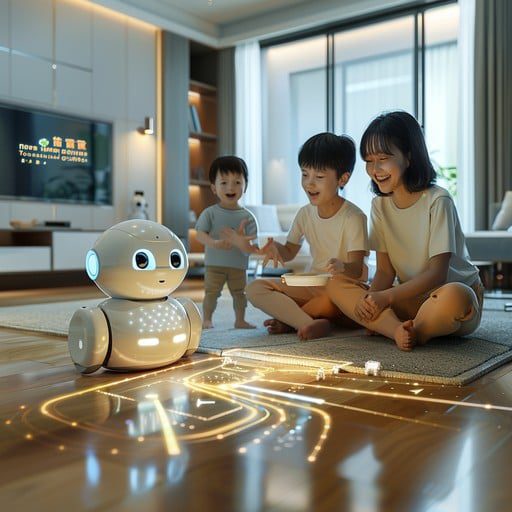
People let Roombas run while they sleep. They do not let humanoid robots run while they sleep. There is a spectrum of intimacy and vulnerability in home environments that technology alone cannot bridge. A robot that moves through your bedroom while you’re sleeping, navigates your bathroom, handles your medications, interacts with your children — that’s not a hardware capability question. It’s a trust architecture question. And trust architectures are built through years of incident-free operation, third-party certification, regulatory oversight, and cultural normalization.
Japan is 5–10 years ahead of the United States on this metric. Not because of better robots. Because of different cultural relationships to technology in intimate spaces. This is the hidden variable in every forecast — and it will cause Western adoption curves to look much slower than model outputs suggest.
What to Watch Next: The Six Signals That Tell You Everything
Rather than a conclusion, let me give you a monitoring framework. These are the six signals I watch — and when these things happen, they’ll tell you more about the real timeline than any bank report or tech announcement.
The Bottom Line
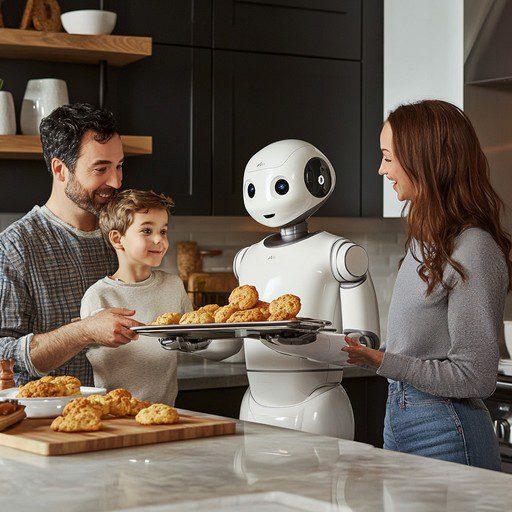
We are in the most consequential early phase of a technology transition that will, eventually, reshape household labor as dramatically as the washing machine and dishwasher did — except this time it’s the body, not a single task, being automated. The robots are real. The factories are real. The funding is real. The trajectory is real.
But the homes are not yet. And the path from factory floor to living room runs through manipulation dexterity, reliability engineering, regulatory frameworks, liability law, and human trust — none of which follow the same exponential curves as compute and cost.
My honest best estimate: Useful home humanoids for early adopters in 2028–2030. Mass market households in developed countries seeing meaningful penetration 2034–2040. “Every home” — if that ever becomes true — is a 2045+ story, and it will happen differently in Osaka than in Ohio.
The revolution is real. The timeline is longer than the headlines. And anyone who tells you otherwise is either selling something or hasn’t spent enough time watching robots fail.
Data Sources Referenced in This Article
Goldman Sachs Research, “The Global Market for Humanoid Robots Could Reach $38 Billion by 2035” (Jan 2025) — goldmansachs.com
Morgan Stanley, “Humanoid Robot Market: $5 Trillion by 2050” (Apr 2025) — morganstanley.com
MarketsandMarkets, “Humanoid Robot Market Report 2025–2030” — projected 39.2% CAGR to $15.26B by 2030
Research and Markets, “Global Humanoid Robots Market 2026–2036” (Oct 2025) — cumulative funding $9.8B+; BYD 20K unit target
Technerdo, “Humanoid Robots in 2026: Market Leaders, Deployments” (Apr 2026) — Figure AI BMW data; Unitree 5,500 units shipped
Robozaps, “Tesla Optimus Production: Model S Ends, Humanoid Robots Begin” (Jun 2026) — Optimus factory conversion analysis
New Market Pitch, “Tesla Optimus Deployment Tracker” (Apr 2026) — target miss analysis; Q2 2025 earnings admission
Simplexity, “Top 5 Technical Challenges in Humanoid Robotics” (Dec 2025) — ISO 25785-1; dexterity analysis
SVRC Buyer’s Guide, “Humanoid Robot Buyer’s Guide 2026” (Apr 2026) — commercial availability audit
Goldman Sachs, original forecast and 6× upward revision — unit shipment trajectory to 1.4M by 2035
iFactory, “Tesla Optimus at Fremont: Gen 3 Humanoid Deployment” (May 2026) — 1,000-unit Fremont deployment; ROI calculations
AI CERTs News, “Navigating AI Robotics Challenges” (Apr 2026) — Gartner: fewer than 20 firms to scale humanoids by 2028
Nature / Scientific Reports, “Opportunities, Challenges and Roadmap for Humanoid Robots in Construction” (Dec 2025, vol.16)
All figures in this article reflect information available as of June 2026. Projections carry inherent uncertainty and do not constitute investment advice.
🔗 Sources, Data & Further Reading
Industry Reports & Market Data
- Goldman Sachs: Humanoid Robots — The $38B Market by 2035 — The original 6x upward revision analysis cited in cost projections.
- Morgan Stanley: The Humanoid 100 & The $5T Opportunity by 2050 — Comprehensive market sizing and company landscape.
- IDTechEx: Humanoid Robots 2024–2034 — Component-level BOM analysis and technology forecasts.
Robot Manufacturers & Pricing
- Unitree G1 Humanoid Robot — Official Product Page — $13,500 humanoid specs and SDK documentation.
- Tesla Optimus — Official Page — Production targets, capabilities, and factory deployment updates.
- Figure AI — Warehouse deployment data and partnership announcements.
- Boston Dynamics Atlas — Technical specifications and research platform details.
- 1X Technologies NEO — $20,000 / $499-month care-focused humanoid.
Labor Economics & Policy
- U.S. Bureau of Labor Statistics: Employment Cost Index — Verified $156K loaded manufacturing worker cost data.
- Brookings Institution: Should We Tax Robots? — Policy analysis of automation taxation frameworks.
- World Economic Forum: Bill Gates on the Robot Tax — Original 2017 proposal and subsequent debate.
- OECD: Taxation and the Future of Work — Cross-national policy analysis on automation and tax revenue.
Adoption Psychology & Trust Research
- Nature: The Uncanny Valley — Empirical Evidence from Human-Robot Interaction — Peer-reviewed study on likability vs. human-likeness.
- SAGE: Trust in Human-Robot Interaction — Academic framework for functional, emotional, and social trust layers.
- Pew Research: Automation in Everyday Life — Public attitudes toward robots in homes and workplaces.
Component & Hardware Deep Dives
- NVIDIA Jetson — Edge AI Computing Platforms — Compute module specs driving robot “brain” costs down.
- Harmonic Drive Systems — Precision gearing technology central to actuator cost structure.
- BloombergNEF: EV Battery Prices Hit Record Low — Battery cost curve data relevant to robot power systems.
Historical Technology Adoption Curves
- Our World in Data: Technology Adoption Over Time — S-curve data for dishwashers, microwaves, smartphones, and more.
- U.S. Census Bureau: Appliance Adoption Trends (Historical) — Baseline adoption velocity benchmarks.
Last verified: June 2026. All links open in new tabs. The author has no affiliate relationships with any linked entity. Dead links may be reported via the contact page.