
Scientific Theories That Sound Fake
(But Might Actually Be True)
From the idea that you never truly die to the possibility that reality is a two-dimensional projection, physics and biology have produced some genuinely jaw-dropping ideas — and the evidence behind several of them is far stronger than you’d expect.
“The universe is not only stranger
than we suppose — it is stranger
than we can suppose.”
The Short Version
- The problem this guide solves: Separating genuinely serious scientific hypotheses from pseudoscience — because some theories that sound insane are being actively studied in peer-reviewed journals.
- The Holographic Principle is mainstream physics, not fringe thinking. Physicists at Utah State published a novel test of it in Physical Review Letters in April 2025.
- Panspermia — the idea that life hitched a ride on space rocks — gained serious momentum after a 2024 Nature Ecology & Evolution study pushed back the age of life’s common ancestor to 4.09–4.33 billion years, raising the question of whether Earth had enough time for life to start from scratch.
- Many Worlds (the idea that every quantum event spawns a branching universe) is no longer a fringe interpretation — it’s treated seriously in the Stanford Encyclopedia of Philosophy and among leading physicists like David Deutsch.
- Biocentrism and Quantum Immortality sit further along the speculation spectrum — philosophically interesting, scientifically contested, and almost certainly impossible to test with current tools.
- The Simulation Hypothesis received a major challenge in late 2025 when physicists at UBC Okanagan published a mathematical argument (using Gödel’s incompleteness theorems) that the universe cannot be algorithmic. The debate continues.
- Realistic expectation: None of these will be definitively proven tomorrow. But several are driving real experimental programs and reshaping how physicists think about reality.
- Next step: Read with healthy skepticism. These are live scientific debates, not settled fact — and that’s exactly what makes them worth your attention.
Table of Contents
- Why Science Keeps Sounding Like Science Fiction
- The Holographic Universe: Reality as a 2D Projection
- Many Worlds: Every Possible Thing Is Happening Right Now
- Panspermia: Life Arrived From Space
- The Simulation Hypothesis: We Live Inside a Computer
- Biocentrism: Consciousness Creates the Universe
- Quantum Immortality: You Never Actually Die
- The Fine-Tuning Problem: The Universe Was Built for Us
- Side-by-Side: How These Theories Stack Up
- FAQ
- Final Thoughts
Why Science Keeps Sounding Like Science Fiction
There’s a particular kind of discomfort that comes from reading a proper physics paper and realizing it describes something your brain categorically refuses to accept as real. Parallel universes. A reality encoded on a two-dimensional surface. Life seeded from comets. These ideas don’t come from pulp novels — they come from university press releases, peer-reviewed journals, and physicists with chairs at Oxford and MIT.
The reason so many frontier theories sound fake is, I think, fairly simple: our intuitions evolved for the African savanna, not for quantum scales or cosmic distances. We are spectacularly ill-equipped, by design, to grasp what the universe is actually like at its edges. What strikes us as absurd is often just unfamiliar.
That said, “sounds strange” and “is true” are very different categories. Several of the ideas below are genuinely mainstream science. Others are serious hypotheses being worked on by credentialed researchers but remain deeply contested. And a couple are, frankly, more philosophical than scientific — fascinating thought experiments that may never be testable. I’ve tried to be clear about which is which throughout.
Every theory discussed here has appeared in peer-reviewed literature or has been seriously engaged with by working scientists. “Serious scientific engagement” does not mean the theory is correct — it means it’s worth understanding. Where a theory is speculative, I say so directly.
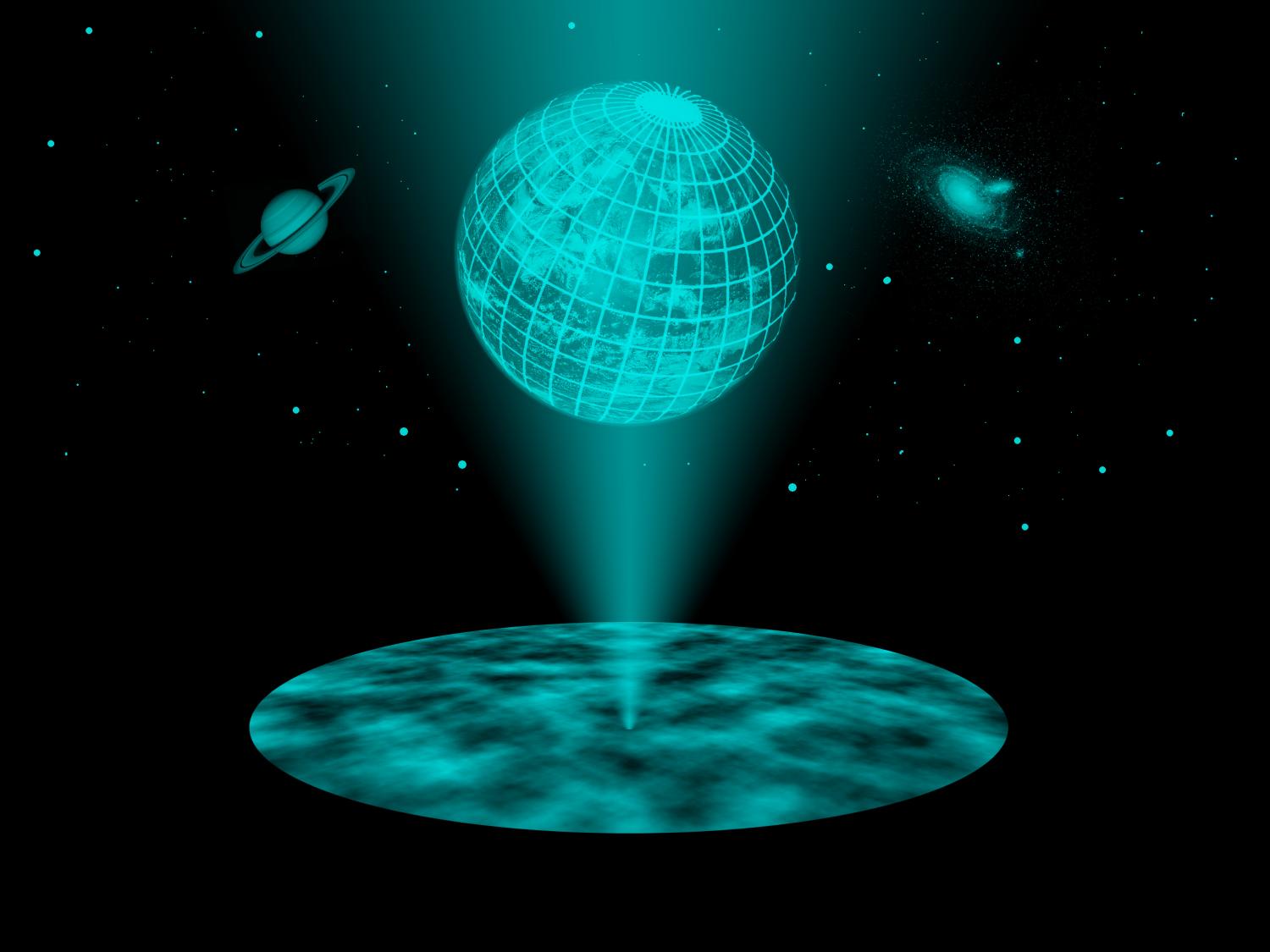
Here’s a sentence that should stop you cold: the three-dimensional world you experience right now — the depth of the room, the distance to the horizon — may be a projection of two-dimensional information encoded on a distant cosmic boundary. Not metaphorically. Literally.
The holographic principle was first proposed by Nobel laureate Gerard ‘t Hooft in 1993 and later formalized by Leonard Susskind using string theory. The core idea comes from thinking about black holes and information: when something falls into a black hole, where does the information about it go? Physicists realized the answer might be that it’s stored on the black hole’s two-dimensional event horizon — and if that’s true for black holes, it might be true for the entire universe.
“What we perceive as three-dimensional may just be the image of two-dimensional processes on a huge cosmic horizon.” — TU Wien (Vienna) research statement on holographic principle in flat spacetime
What makes this genuinely exciting rather than just philosophically interesting is that it’s become a working mathematical framework. The AdS/CFT correspondence — a specific form of the holographic principle developed by Juan Maldacena in 1997 — has been used to solve otherwise-intractable problems in quantum physics. It works. Not as metaphor, but as a computational tool. That doesn’t prove we live in a hologram, but it does mean the mathematics is internally consistent and productive.
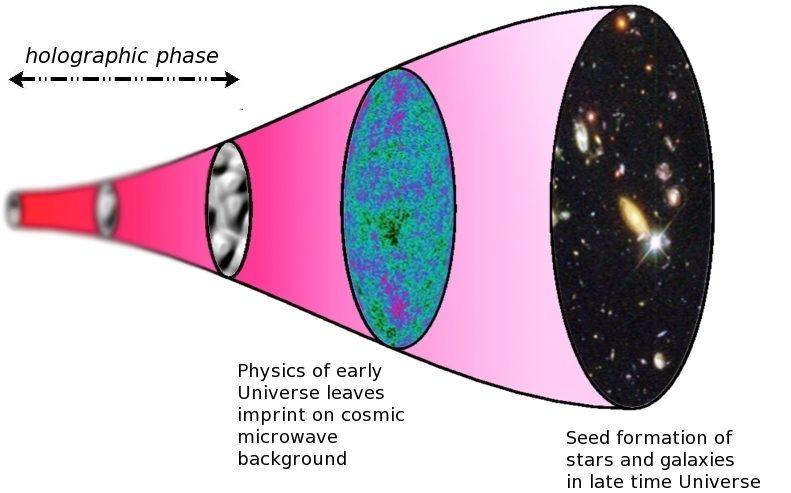
In January 2017, a UK-Canadian-Italian research team published findings in Physical Review Letters claiming observational support from the cosmic microwave background — the faint afterglow of the Big Bang. They found that a holographic explanation of certain irregularities in that afterglow fits the data at least as well as the conventional inflation model. This is not proof. It is, however, evidence serious enough to publish in a flagship physics journal.
More recently, in May 2025, physicists at Utah State University published a novel experimental test of the holographic principle in Physical Review Letters, describing their mathematical model as “the apparatus of an experimental physicist” — a way to make concrete predictions about quantum gravity. The research was supported by the National Science Foundation.
The holographic principle doesn’t mean reality is “fake.” It’s a statement about how information is organized and stored — not that our experiences are illusory. The projection is still real; it just might have an unexpected source.
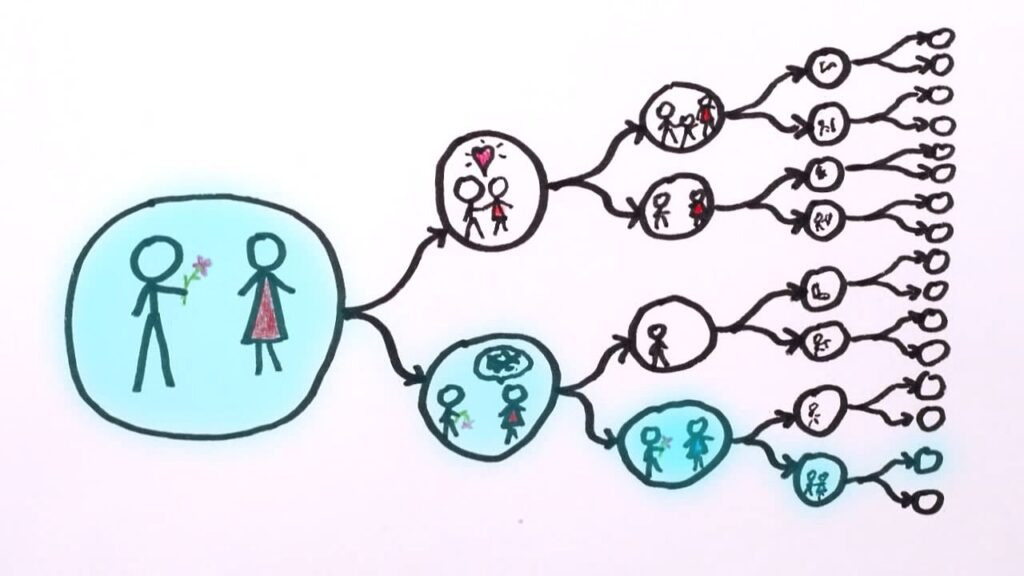
When physicists measure a quantum particle — say, an electron’s spin — it seems to randomly “choose” one of its possible states. The standard explanation (the Copenhagen interpretation) says the other possibilities simply cease to exist. But in 1957, a Princeton graduate student named Hugh Everett III proposed something far more radical: they all happen. Every possible outcome occurs, in its own branching universe.
This is the Many-Worlds Interpretation, and it sounds like something cooked up specifically to sell blockbusters. The thing is, it’s become one of the most seriously debated interpretations in modern physics. As of the Summer 2024 edition of the Stanford Encyclopedia of Philosophy, it receives extensive treatment alongside the Copenhagen interpretation — not as an outlier, but as a genuine contender for how quantum mechanics actually works.
The appeal isn’t philosophical whimsy. Many Worlds solves the “measurement problem” — the deeply uncomfortable question of why observation seems to collapse quantum possibilities into one outcome — without requiring any special physics for the moment of observation. The math of quantum mechanics, taken at face value without any additional collapse postulate, naturally produces an Everettian branching structure. Physicists like David Deutsch at Oxford and Max Tegmark at MIT have argued for years that this parsimony makes Many Worlds the most defensible interpretation.
A 2024 review in Quantum Reports (MDPI) noted the Many-Worlds interpretation has been “gaining legitimacy in recent years,” with Deutsch, Tegmark, Susskind, and others advocating for it as the view most consistent with quantum formalism. The paper observed that the neo-Everett interpretation has moved from marginal to mainstream in the interpretational debate.
What’s genuinely hard to accept — even for those who take the math seriously — is the ontological weight of it all. Every time a particle interacts with anything, the universe multiplies. These branches are real, but permanently inaccessible to each other. You cannot, by any means, communicate with your other-universe self. Which renders the theory, in some ways, difficult to test — and that remains its biggest scientific weakness.
Many Worlds explains the math elegantly but replaces one mystery (wavefunction collapse) with another (an infinity of unobservable universes). Whether “elegance” is a reliable guide to truth in physics is itself an open question.
“Science’s most important attribute is not that it produces truths — it’s that it identifies when our intuitions are wrong.”
The theory of panspermia — that life, or at least the chemical precursors to it, can travel between worlds aboard meteorites or comets — has spent decades hovering awkwardly between serious science and the fringe. In the last two years, it’s migrated firmly toward the former.
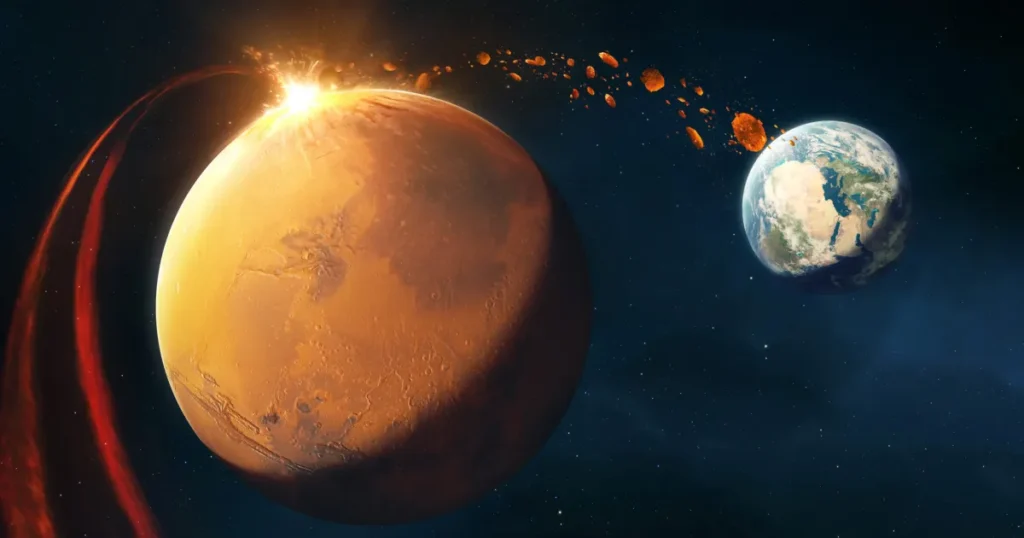
The key development is timing. A 2024 study published in Nature Ecology and Evolution pushed back the estimated age of LUCA — the Last Universal Common Ancestor of all life on Earth — to between 4.09 and 4.33 billion years ago. Earth itself formed roughly 4.5 billion years ago. That means complex life capable of having a common ancestor appears to have emerged within about 200 million years of the planet becoming habitable. To put that in perspective: it took humans roughly 200 million years just to go from small shrew-like mammals to modern primates.
The speed of life’s appearance on Earth is, frankly, one of the most puzzling facts in biology. Either life started almost instantly once conditions permitted — implying it’s actually easy to get going — or it arrived already partially assembled from somewhere else. Both explanations are remarkable.
“If life arose so quickly on Earth, was it truly a spontaneous event, or did it arrive from elsewhere already partially assembled?” — Ancient Origins, discussing the 2024 LUCA study, December 2025
The 2017 detection of ‘Oumuamua — the first confirmed interstellar object to pass through our solar system — and subsequent modeling work have shown that rocky ejecta from planetary systems can travel significant distances. A 2024 arXiv study by David Cao and colleagues estimated the conditional probability of panspermia for Earth specifically, finding it plausible — if low — as a life-seeding mechanism, and noting that ‘Oumuamua’s detection confirmed interstellar objects reach us regularly.
There’s also chemical evidence. Scientists at MIT published research in Nature Geoscience in 2025 identifying a potassium isotope imbalance in Earth’s oldest rocks — the first direct chemical signature linking Earth’s current geology to its pre-Moon-impact primordial state. Work is ongoing to understand what early-Earth chemistry was actually capable of.
Where panspermia gets genuinely speculative is the “directed” variety — Francis Crick’s 1973 proposal that an advanced alien civilization deliberately seeded Earth with life. There’s no evidence for this. But the passive version — hardy microorganisms surviving in rocks ejected by asteroid impacts and eventually landing on Earth — is a legitimate ongoing research programme, not a conspiracy theory.
Nick Bostrom’s 2003 simulation argument is probably the most-discussed “outrageous” scientific hypothesis of the past two decades. In its simplest form: if posthuman civilizations can run realistic ancestor simulations, and if there are many such civilizations, then the vast majority of conscious observers are simulated. Therefore, we probably are too.
Elon Musk has called the odds of us living in “base reality” one in billions. Several physicists have taken the hypothesis seriously enough to analyze it empirically — including Silas Beane, who proposed in 2014 that a simulated universe might show lattice-like structures in high-energy cosmic rays.
But 2025 brought a significant challenge. A team led by physicists Mir Faizal and Lawrence Krauss published a paper in the Journal of Holography Applications in Physics arguing, via Gödel’s incompleteness theorems, that the universe cannot be a simulation. Their core claim: any simulation must be algorithmic, but quantum mechanics appears to include genuinely non-algorithmic processes — meaning reality, at its foundation, cannot be running on a program.
“Any simulation is inherently algorithmic — it must follow programmed rules. But since the fundamental level of reality is based on non-algorithmic understanding, the universe cannot be, and could never be, a simulation.” — Dr. Mir Faizal, UBC Okanagan, November 2025
This is a mathematical argument, not an experimental one, and it has drawn criticism. Commentators noted that the argument relies on contested assumptions about what quantum randomness really is and whether “non-algorithmic” processes truly exist or just appear to. The simulation hypothesis is not dead — but it’s now got a serious mathematical challenge to answer.
Separately, astrophysicist Franco Vazza published a Frontiers in Physics paper in 2025 running the numbers on the computational resources needed to simulate the observable universe at any useful resolution. The conclusion: it’s not just technologically impossible today — it appears to violate known physical limits by many orders of magnitude. Plausible future civilizations couldn’t do it either, at least not with physics as we understand it.
Robert Lanza — a stem cell biologist, regenerative medicine pioneer, and TIME Magazine’s one of the “100 Most Influential People” — has spent years arguing for a theory of everything he calls biocentrism. The premise is that consciousness isn’t a byproduct of the physical universe. It’s the precondition for it.
Lanza draws on the double-slit experiment — one of quantum mechanics’ most famous puzzles — in which particles appear to behave differently when observed versus unobserved. His argument: this isn’t a technical quirk; it’s a fundamental clue that observation (consciousness) is prior to physical reality, not posterior to it. The universe doesn’t produce minds — minds produce the universe.
This isn’t just philosophy of science in a coffee shop. Lanza has published across multiple books co-authored with serious collaborators, including theoretical physicist Matej Pavsic. Michio Kaku has spoken warmly of the framework. The basic philosophical lineage connects to serious quantum mechanics debates stretching back to Bohr, Heisenberg, and the role of the observer in measurement.
But it’s worth being honest about where biocentrism stands in mainstream science: contested to skeptically received. Most physicists would argue that “observation” in quantum mechanics doesn’t require consciousness — any interaction with the environment suffices for wavefunction decoherence. The double-slit result doesn’t actually require a mind, just an entanglement with the measuring apparatus. Biocentrism’s inference from quantum weirdness to consciousness-as-fundamental is a leap that most physicists don’t follow.
Biocentrism is a genuinely interesting lens for thinking about the observer problem in quantum mechanics. As a scientific theory in the falsifiable sense, it currently lacks mechanisms that distinguish it from alternatives. That may change — or it may remain in the space between physics and philosophy indefinitely.
This one is a direct descendant of Many Worlds, and it’s either the most comforting or the most unsettling idea in this article depending on how you think about it. Physicist Max Tegmark proposed it in the late 1980s as a thought experiment: if Many Worlds is true, then every time you come close to dying, there is always at least one branch of the wavefunction in which you survive. Your subjective experience — by definition — can only ever be in a branch where you’re alive. The universe doesn’t kill you; it just changes the branch you’re in.
“I suspect that when I get old, my brain cells will gradually give out… so that I keep feeling self-aware, but less and less so, the final ‘death’ being quite anti-climactic, sort of like when an amoeba croaks.” — Max Tegmark, reflecting on quantum immortality’s implications
The logic, if you accept Many Worlds, is not obviously wrong. It’s actually straightforward: you cannot experience your own non-existence. Therefore, in the space of all branches, you will always find yourself in one where you’re still around to observe. This is the quantum version of a philosophical point known as the anthropic principle — applied to individual survival rather than the universe’s fine-tuning.
However, almost everything after that basic logic gets extremely complicated very fast. Consciousness is not well-understood by neuroscience. The notion of “personal identity” persisting across quantum branches is philosophically fraught — what counts as the same person in a branching universe? And the theory is, functionally, untestable: you can’t do the experiment without risking your life, and there’s no way to confirm you’ve “survived into another branch” rather than just gotten lucky.
Tegmark himself treats quantum immortality as a thought experiment rather than a guide to personal risk-taking. He has been quite clear that even if the many-worlds logic is coherent, it provides no practical basis for discounting danger — because the branches where you survive horrible accidents may involve severely diminished quality of life.
This is perhaps the most intellectually uncomfortable theory on this list precisely because it can’t be dismissed as easily as it sounds. The physical constants that govern our universe — the gravitational constant, the strength of the electromagnetic force, the mass of the electron — are extraordinarily precisely calibrated for the existence of complex chemistry and, therefore, life.
Change the fine-structure constant (which governs how strongly photons interact with charged particles) by a few percent and stable atoms don’t form. Change the cosmological constant — the energy density of empty space — by any significant fraction and the universe either collapses instantly or expands so fast that matter never clumps into stars and galaxies. The physicist Lee Smolin has estimated that a random selection of constants would produce a universe hospitable to life with a probability of roughly one in 10229.
There are three mainstream explanations. First: pure chance — we’re here to observe it because only a life-permitting universe can produce observers, so the question is selection-biased. Second: the multiverse — there are so many universes with different constants that some will inevitably be fine-tuned by chance, and we’re in one of them. Third: there’s a deeper law we haven’t found yet that constrains the constants to these values.
None of these explanations is obviously correct, and none is obviously wrong. What makes fine-tuning genuinely interesting scientifically is that it’s not a fringe concern — it’s a live research problem discussed in mainstream cosmology journals and has driven the development of the string theory landscape and eternal inflation models.
Fine-tuning is a scientific observation, not a theory. The theories are the various explanations for it — multiverse, deeper law, anthropic selection. All three are live hypotheses in modern cosmology.
Side-by-Side: How These Theories Actually Stack Up
| Theory | First Proposed | Current Status | Testable? | Key Evidence | Biggest Challenge |
|---|---|---|---|---|---|
| Holographic Universe | ‘t Hooft, 1993 | Mainstream Physics | Partially (CMB data, AdS/CFT) | 2017 CMB study; 2025 PRL test; AdS/CFT mathematical utility | No direct proof our universe is AdS-type |
| Many Worlds (MWI) | Everett, 1957 | Serious Contender | Indirectly (predicts no wavefunction collapse) | Preferred by some leading physicists; consistent quantum formalism | Branches permanently inaccessible; unfalsifiable in practice |
| Panspermia | Anaxagoras (~5th c. BCE); modern: Arrhenius, 1903 | Actively Researched | Yes (meteorite analysis, future Mars samples) | 2024 LUCA age study; ‘Oumuamua detection; amino acids in meteorites | No confirmed extraterrestrial organisms yet |
| Simulation Hypothesis | Bostrom, 2003 | Contested / Under Challenge | Barely (high-energy cosmic ray lattice test proposed) | Bostrom’s probabilistic argument; discrete spacetime hints | 2025 Gödel-based mathematical refutation; computational impossibility |
| Biocentrism | Lanza, 2007 | Speculative / Contested | Very difficult | Double-slit observer paradox; quantum measurement problem | Decoherence explains observer effect without consciousness |
| Quantum Immortality | Tegmark, late 1980s | Thought Experiment | No | Logical consequence of MWI + anthropic principle | Unfalsifiable; consciousness across branches undefined |
| Fine-Tuning / Multiverse | Carter, 1974; Weinberg, 1987 | Mainstream Problem | Multiverse itself: debated; fine-tuning: documented | Precision measurements of physical constants; string landscape | Multiverse branches unobservable; verificationism concerns |
FAQ: Questions Readers Actually Ask
Are any of these theories actually accepted by mainstream science?
Yes — the holographic principle is treated as mainstream theoretical physics and is used as a working mathematical tool in quantum gravity research. The fine-tuning problem is universally acknowledged. The Many-Worlds interpretation is taken seriously by many prominent physicists, including at Oxford and MIT, though it’s far from a consensus view. Panspermia is an active area of astrobiology research. The others are more speculative.
What’s the difference between a theory that “sounds fake” and actual pseudoscience?
A legitimate scientific theory — even an outrageous one — makes predictions that could, in principle, be falsified by experiment or observation. Pseudoscience doesn’t. Several theories here (Many Worlds, Quantum Immortality) are at the edge of this boundary, which is exactly why they generate intense philosophical debate. The simulation hypothesis and biocentrism have struggled most with this criterion.
Did physicists really prove the universe isn’t a simulation in 2025?
A team at UBC Okanagan published a mathematical argument using Gödel’s incompleteness theorems in November 2025 claiming exactly that. However, “proof” is a strong word — the paper has been critiqued for its assumptions about quantum indeterminacy, and the debate is ongoing. It’s a significant challenge to the simulation hypothesis, not a definitive burial.
What is the LUCA study and why does it matter for panspermia?
The Last Universal Common Ancestor study, published in Nature Ecology and Evolution in 2024, pushed back the estimated age of the ancestor of all life on Earth to 4.09–4.33 billion years ago. Since Earth formed roughly 4.5 billion years ago, this suggests life appeared extraordinarily quickly — possibly within just 200 million years of conditions becoming habitable. The speed of appearance raises the question of whether life had enough time to originate here from scratch.
Is quantum immortality dangerous to believe in?
Yes, potentially. Even its originator Max Tegmark has been clear that the logic of quantum immortality should not influence real-world risk decisions. Surviving in “another branch” is not something you can choose or control, and branches where you survive near-fatal events may involve extreme suffering or disability. Treating it as a basis for cavalier behavior would be a serious mistake.
How is the holographic principle actually used in physics if it’s so speculative?
It’s used mainly through the AdS/CFT correspondence — a specific mathematical duality that lets physicists translate intractable problems in one description of reality into solvable ones in another. It has been applied to problems in condensed matter physics, nuclear physics (understanding quark-gluon plasmas), and quantum information. It works as a calculation tool regardless of whether the universe is “really” a hologram.
What’s the strongest argument against Many Worlds?
Two main ones. First, the probability problem — it’s not entirely clear what “probability” means in a theory where all outcomes happen. If every result occurs in some branch, how do we recover the Born rule (the formula that tells us how likely quantum outcomes are)? Second, and related: Many Worlds proliferates an almost incomprehensible infinity of unobservable entities. Occam’s razor cuts both ways — the theory eliminates collapse but multiplies universes without limit.
What would actually confirm panspermia?
Finding microorganisms on Mars or another body in our solar system with the same biochemical signature as Earth life (same DNA/RNA system, same amino acid chirality) would be strong evidence. Finding life on Mars or Europa with an entirely different biochemistry would actually suggest life is common but independent — not panspermia. Sample return missions from Mars and forthcoming Europa studies will be crucial.
Is biocentrism the same as intelligent design?
No — the theories are philosophically distinct. Intelligent design proposes a deliberate creator. Biocentrism proposes that consciousness (not necessarily a personal God) is fundamental to the structure of reality. Lanza explicitly frames biocentrism as emerging from quantum physics, not theology, though critics argue the philosophical conclusions outpace the evidence either way.
Why does the fine-tuning problem matter if there’s no agreed explanation?
Because it reveals the limits of what current physics can explain. If the constants of nature had to take specific values for us to exist, and we have no physical theory that predicts those values, that’s a genuine gap in our understanding. The fine-tuning problem motivates some of the most ambitious ongoing research in theoretical physics — string theory, the landscape, eternal inflation — regardless of which solution turns out to be correct.
Can any of these theories ever be definitively proven or disproven?
Some potentially yes — panspermia could be confirmed by sample-return missions; certain versions of the holographic principle could be tested through gravitational wave detector noise patterns. Others are structurally much harder: Many Worlds and quantum immortality involve branches that are by definition inaccessible, so they may remain in a permanent state of being neither confirmed nor definitively ruled out. This is a genuine limitation, and it’s worth acknowledging.
Final Thoughts: Why the Weird Theories Deserve Your Attention
The theories in this article span a fairly wide spectrum — from “actively used as a mathematical tool by working physicists” (holographic principle) to “fascinating thought experiment that may never be testable” (quantum immortality). What they share is that they emerged from taking physics and biology seriously and following the implications wherever they lead, even when the destination feels absurd.
History suggests that’s not always the wrong move. Continental drift was dismissed for decades. Quantum mechanics, when first introduced, seemed too strange to be describing anything real. The idea that bacteria cause disease was once met with the same incredulity we now reserve for parallel universes. Some of today’s outrageous theories will turn out to be wrong. But a few, almost certainly, will eventually seem as obvious as the round Earth.
What I take from all of this isn’t that anything goes in science — quite the opposite. The rigorous demand for evidence and falsifiability is what separates the theories here from the ones that belong in a horoscope column. But it’s also what keeps physics honest about how much it doesn’t know. The universe is genuinely, provably strange. The theories that sound fake are, in many cases, our best current attempt to describe it accurately.
That’s not a reason to believe everything you read. It’s a reason to stay curious.
Continue Exploring on FutureNow
Vaidman, L. (2024). “Many-Worlds Interpretation of Quantum Mechanics.” Stanford Encyclopedia of Philosophy. Summer 2024 Edition. | Cao, D. et al. (2024). “The Implications of ‘Oumuamua on Panspermia.” arXiv:2401.02390. DOI: 10.48550/arxiv.2401.02390 | Faizal, M., Krauss, L. et al. (2025). “Consequences of Undecidability in Physics on the Theory of Everything.” Journal of Holography Applications in Physics, 5(2). DOI: 10.22128/jhap.2025.1024.1118 | Vazza, F. (2025). “Astrophysical constraints on the simulation hypothesis.” Frontiers in Physics, 13:1561873. DOI: 10.3389/fphy.2025.1561873 | Utah State University (2025). “Bridging Worlds: Physicists develop novel test of the Holographic Principle.” Physical Review Letters, April 6, 2025 | University of Southampton et al. (2017). “Substantial evidence of holographic universe.” Physical Review Letters | Vaidman, L. (2024). “The Many-Worlds Interpretation of Quantum Mechanics: Current Status.” Quantum Reports, 6, 142–146. MDPI | MIT / Nie, N. et al. (2025). Potassium isotope signature in ancient Earth rocks. Nature Geoscience
We Live in a Simulation: Weird Physics Theory Suggests
Authoritative Sources & Further Reading
Linking policy: All external links open in new tabs, point to peer-reviewed journals, university repositories, or official research institutions. No affiliate links. Last verified May 2026.
Why We Dream: 5 Competing Scientific Explanations (And Why None Fully Satisfy)
These Scientific Phenomena Defy Logic — And Scientists Still Can’t Explain Them
Weird Scientific Mysteries Scientists Still Don’t Understand
Virtual Reality Teacher: The Weirdest Future Career