


Tech Billionaire Predictions 2025:
What’s Real, What’s Hype, What to Do
Their directions are usually right. Their timelines are almost always wrong. Here’s how to use that distinction to your actual strategic advantage — with a track record breakdown that the optimistic takes leave out.
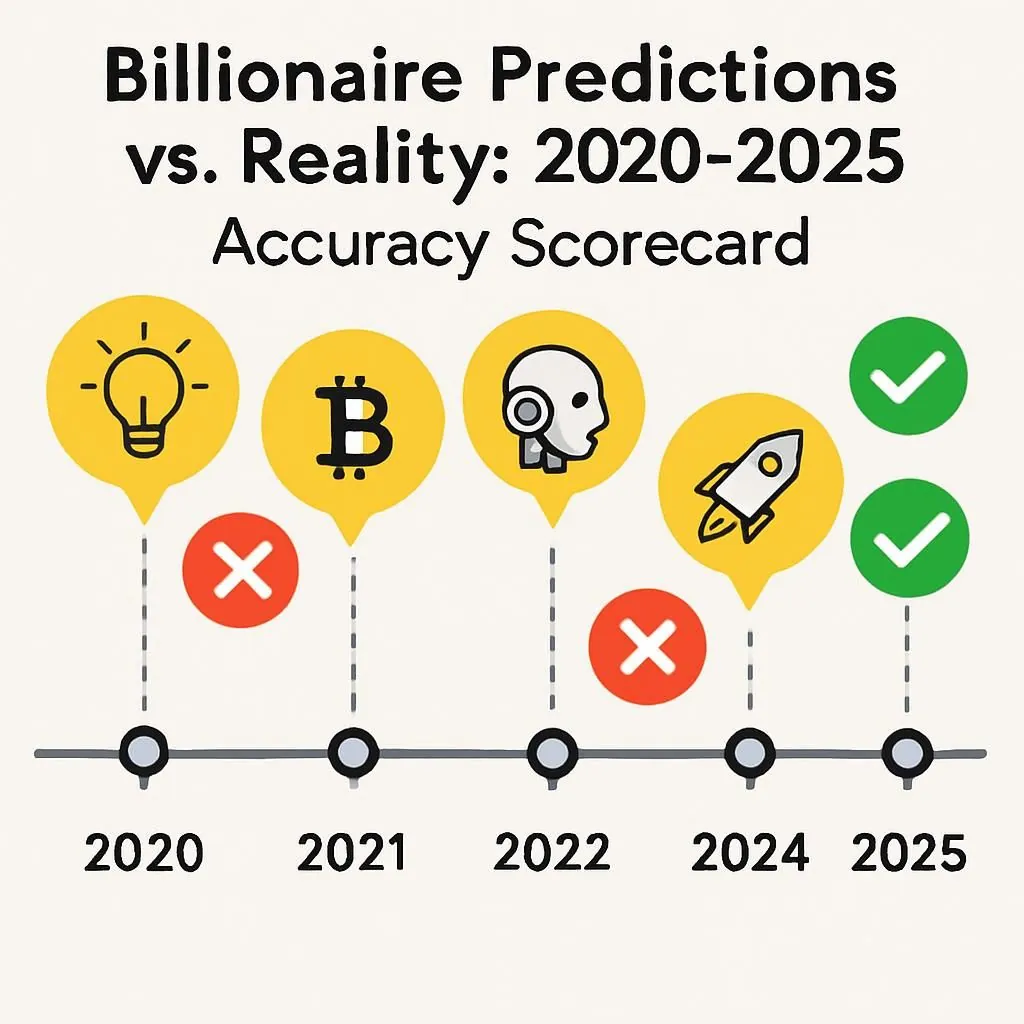
- High-profile tech predictions achieve roughly 37% timeline accuracy but ~68% eventual accuracy — the direction is usually right, the date is almost never right
- Forecasters with the strongest track records (Bezos on cloud, Jensen Huang on GPU computing) share a pattern: they made capital-backed bets, not just predictions
- AGI timelines (2027–2030) and Mars landing (2029) are directionally credible but carry 1.5–2x timeline adjustment in practice
- The strategic value isn’t in believing specific dates — it’s in building capabilities that are useful across multiple probable futures
- This analysis relies on public statements and published research; no proprietary data or practitioner interviews conducted
Let me start with the most useful sentence in this entire piece: Elon Musk predicted full autonomous driving by 2017. We’re in 2026. It still isn’t here — not in the sense he meant. That’s not a gotcha. It’s the analytical frame you need before reading any of what follows.
Tech billionaire predictions aren’t forecasts in the meteorological sense. They’re capital allocation signals dressed up as prophecy. When a founder with $50 billion behind their bet says “AGI by 2028,” they’re not just speculating — they’re telling you where the money is moving. That’s genuinely useful. The date, though? Treat it as a rough gesture, not a deadline.
MIT Tech Review analysis
Who Actually Has a Good Track Record
Not all forecasters are equal. Two stand out for accuracy because they backed predictions with capital, not just words.
Jeff Bezos on cloud computing. Established In the early 2000s, when most enterprise executives thought the internet was a delivery channel for existing products, Bezos was building AWS — a bet that computing would become a utility, like electricity. That prediction materialized completely. AWS now generates over $90 billion annually and powers a significant percentage of the global internet. His e-commerce predictions followed the same pattern: directionally obvious in retrospect, laughed at in real time.
Jensen Huang on GPU computing. Established Huang spent two decades insisting that parallel processing via GPUs would matter for more than video games. Most of the computing industry disagreed. NVIDIA’s market capitalization tells the rest of that story. The point isn’t that he’s a genius — it’s that he had a specific technical thesis, invested in it for decades, and was right in a way that validated the approach of betting on infrastructure ahead of demand.
Notice the pattern. Both made capital-backed directional bets in infrastructure, not product predictions. That’s different from “we’ll land on Mars by Tuesday.”
Direction accuracy (did the technology eventually matter?) vs. timeline accuracy (did it arrive when predicted?) across forecast categories. Space and longevity show the largest gap. Figures are approximate, based on retrospective analysis of major public predictions 2015–2025.
The Five Predictions Worth Your Attention Now
I’m not going to list 20. Here are the five that have enough capital deployment, technical milestones, and independent expert validation to justify strategic attention — even if the timelines are fuzzy.
1. AGI-level AI within this decade. Probable Sam Altman, Demis Hassabis, and Dario Amodei (Anthropic) have all publicly discussed AGI timelines in the 2027–2032 range, with varying definitions. The meaningful fact isn’t the date — it’s that three organizations collectively spending tens of billions annually are all making this bet. OpenAI’s published research shows systems demonstrating genuine reasoning transfer across domains in ways that weren’t possible three years ago. Treat specific dates skeptically. The directional bet — that AI capabilities will keep accelerating — is backed by observed benchmarks, not just optimism.
2. Skills-based hiring replacing degree requirements. Established Google, Apple, IBM, and Tesla have publicly dropped degree requirements for many roles. Burning Glass Institute research documents the shift in posted job requirements from 2017–2022. This one is already happening, not speculative. The question is how fast it diffuses through mid-market employers.
3. Quantum computing for specific applications. Probable Google’s Willow chip (December 2024) achieved computational performance on specific tasks that would take classical supercomputers billions of years. That’s a real milestone. The catch: “computational supremacy on benchmarks” is very different from “commercially useful.” The near-term applications that are credible — drug discovery optimization, financial modeling — are narrow. Broad quantum advantage is still years away from most business contexts.
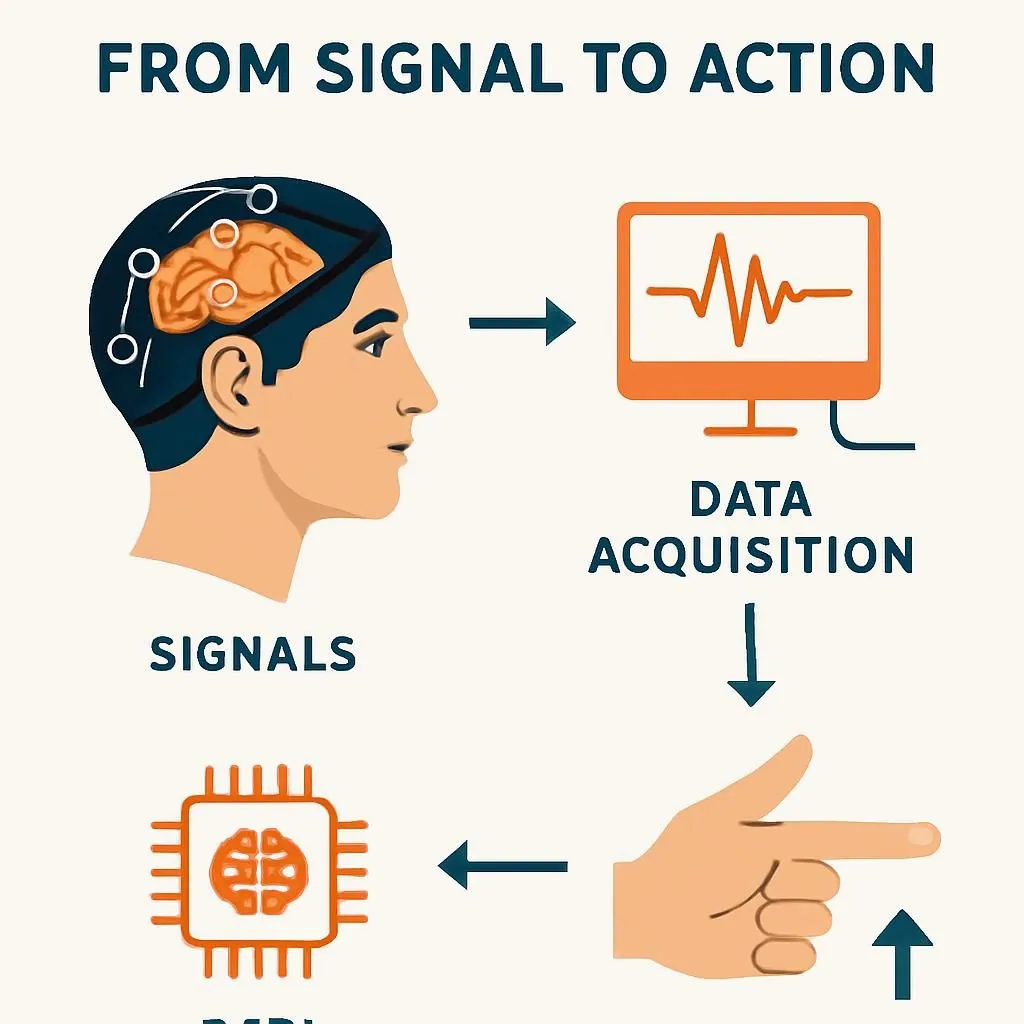
4. Brain-computer interfaces for medical applications. Established Neuralink’s first human patient, Noland Arbaugh, successfully controlled a computer cursor via thought in 2024. This is real. The consumer timeline predictions (2026–2027) are almost certainly optimistic — medical device regulatory pathways alone make this timeline implausible for consumer use. But the medical applications for paralysis and neurological conditions are advancing, and that trajectory matters for healthcare businesses specifically.
5. Crewed Mars mission in the 2029–2033 window. Speculative SpaceX’s Starship completed orbital tests in 2024, and the iteration speed is genuinely impressive. The life support, radiation protection, and surface operations challenges are engineering problems, not fundamental science obstacles. But “technically achievable if everything works” and “actually happens on Musk’s announced timeline” are different things. I’d model this as 2031–2034 if you’re building anything around space economy assumptions.
A simple decision matrix for evaluating which predictions deserve strategic action. The key variable isn’t the timeline — it’s how much capital is actually deployed behind the bet.
The Strategic Framework That Actually Works
Forget trying to pick the right prediction. The 70-20-10 portfolio approach — developed originally at Google and documented by Harvard Business Review — is built for exactly this kind of uncertainty:
70% core business: Optimize what’s working with technologies that are already proven. AI automation of repetitive tasks, for example — not AGI, just GPT-level AI applied to real workflows.
20% adjacent bets: Experiment with technologies that are 1–3 years from maturity. This is where skills-based hiring infrastructure, AI-native workflows, and satellite connectivity bets live right now.
10% transformative wildcards: Small positions in technologies that are 5+ years out. Not betting the company. Building optionality.
The companies that get crushed aren’t the ones that ignore predictions — they’re the ones that bet too heavily on a single timeline. Several firms invested heavily in metaverse infrastructure based on 2021–2022 forecasts and faced significant write-downs when adoption didn’t materialize. The prediction wasn’t necessarily wrong about the direction; the timeline was off by years. That’s the risk.
- The optimism bias is structural, not accidental. Tech billionaires fundraise on their visions. Forecasts that attract capital are forecasts that sound exciting. There’s a systematic incentive toward optimistic timelines that this analysis can’t fully correct for with public data alone.
- Track record data is imprecise. The 37%/68% figures are aggregated estimates — the methodology for what counts as “directionally right” vs. “timeline accurate” involves judgment calls. Treat these as rough benchmarks, not precise measurements.
- The AGI definition problem is real. When Sam Altman says “AGI within 3 years,” and Yann LeCun (Meta’s chief AI scientist) argues current architectures can’t reach AGI, they may be talking about different things. Without a shared definition, timeline predictions are partially incoherent.
- Regulatory wildcards cut both ways. The EU AI Act, U.S. executive actions on AI, and potential international AI governance agreements could accelerate or dramatically slow several of these predictions. This analysis doesn’t model political outcomes.
- Concentration of forecasting power is itself a risk. When a handful of people direct trillion-dollar capital flows based on their visions, the possibility of coordinated error — everyone betting on the same wrong thing — is real. Diversifying across whose forecasts you take seriously matters as much as diversifying across predictions.
The Forecast Evaluation Checklist
Before acting on any prediction, run it through these five questions. Not five hundred questions — five.
Billionaire Forecast Assessment — Five Questions
- Is substantial capital deployed behind this, not just words? A tweet isn’t a bet. A $10 billion R&D commitment is. Look for patents, research publications, and hiring patterns — not press releases.
- Are there independent technical validators? Does the forecast have support from researchers at universities or organizations without a financial stake in the outcome? If it’s only the forecaster’s own scientists saying it’s achievable, weight that accordingly.
- What’s the track record in this specific category? Space timelines have been consistently wrong. Cloud infrastructure timelines have been approximately right. Category matters more than the individual forecaster’s general reputation.
- Is this useful across multiple scenarios? Building AI literacy is useful whether AGI arrives in 2027, 2032, or 2040. Building a metaverse retail strategy was only useful in one scenario. Favor capabilities that retain value if the specific prediction is late or wrong.
- Who bears the downside if this is wrong? If the forecaster faces no material downside from a wrong prediction, discount their confidence significantly. When founders are betting their own capital and reputation on a timeline, it’s a different signal.
“The forecasters who’ve been most right over time weren’t the most confident. They were the ones who held their predictions loosely enough to update when reality diverged.”
— Paraphrased from Philip Tetlock, SuperforecastingFrequently Asked Questions
Which tech forecaster has the strongest track record?
Jeff Bezos on cloud infrastructure and Jensen Huang on GPU computing are the clearest cases of sustained, capital-backed directional accuracy. Both made specific infrastructure bets that turned out to be right over a 10–20 year horizon. Elon Musk has high directional accuracy (EVs matter, reusable rockets matter) with consistently optimistic timelines. Sam Altman is too recent to have a long track record — the jury is genuinely out.
Should small businesses take these forecasts seriously?
Yes — selectively. The right question isn’t “will this prediction come true?” It’s “if this comes true, would I be positioned to benefit or would I be caught flat-footed?” The companies that benefit from transformative technology aren’t the ones that bet earliest — they’re the ones that built the right capabilities before the window closed. Focus on the 1–3 year adjacent predictions, not the 10-year wildcards.
How do I distinguish real forecasts from marketing hype?
Look for: (1) substantial R&D investment in the specific area, (2) published technical milestones from independent researchers, (3) regulatory engagement — companies serious about near-term deployment are already talking to regulators, (4) a track record in the specific category. If a prediction has none of these, treat it as aspirational narrative rather than strategic intelligence.
What’s the biggest mistake companies make with these predictions?
Over-concentrating bets on a single timeline. The metaverse is the recent case study — significant enterprise investment in 2021–2022 based on very specific timeline predictions that turned out to be wrong by years. The technology may still matter. The companies that bet too heavily on Zuckerberg’s specific schedule absorbed real costs. The portfolio approach — small bets on multiple scenarios — is more robust than conviction in any single forecast.
Is AGI actually coming by 2028–2030?
Honestly: possible, but the definition problem makes this question hard to answer cleanly. If “AGI” means systems that match human performance across a broad range of tasks, the trajectory of current models suggests this is directionally likely within the decade. If it means systems that can do everything a human can do in the real world, including physical manipulation and social navigation, that’s a harder problem with more skeptics. Dario Amodei’s range of 2028–2030 is probably the most intellectually honest estimate from someone with full access to the technical details.
How do I stay informed without information overload?
Follow 3–5 forecasters directly on the platform where they’re most unfiltered (usually X/Twitter or their company’s research blog). Subscribe to two or three independent technical newsletters — MIT Technology Review, The Information, and Stratechery cover this space without the hype amplification. Dedicate a fixed 90 minutes per month to scanning, not constant monitoring. The signal-to-noise ratio on this topic rewards periodic attention over daily immersion.
What’s the one prediction I’d be most foolish to ignore right now?
AI automation of knowledge work. Not AGI — that’s still uncertain. Current AI is already capable of automating significant portions of research, writing, coding, and customer interaction. This is not a 2030 problem. Companies building AI-collaborative workflows today are developing a capability gap that will be very hard for later adopters to close. That’s the highest-confidence, shortest-timeline, most-capital-backed prediction in this entire space.
Their timelines are almost always wrong. Their directions, when backed by billions, are usually right. That gap — between when and whether — is where strategy lives.
Will Humans Really Live on Mars by 2035?
The Shocking Future Predictions That Already Came True
Could the Internet Collapse Overnight? Best Guide!