

You think you understand which jobs AI will erase first. You understand the brochure.
Here’s what the brochure won’t tell you: the jobs disappearing fastest aren’t the ones you expect. They’re not factory workers. They’re not truck drivers. They’re not the people in hard hats.
They’re the people in button-downs. The ones who answer emails. The ones who process forms. The ones who write the first draft.
And here’s the part that should keep you up at night: the tools to replace them are already deployed. Not “coming soon.” Not “in beta.” Already. In the first half of 2025 alone, 77,999 tech jobs were cut specifically because of AI adoption. That’s not a projection. That’s a payroll.
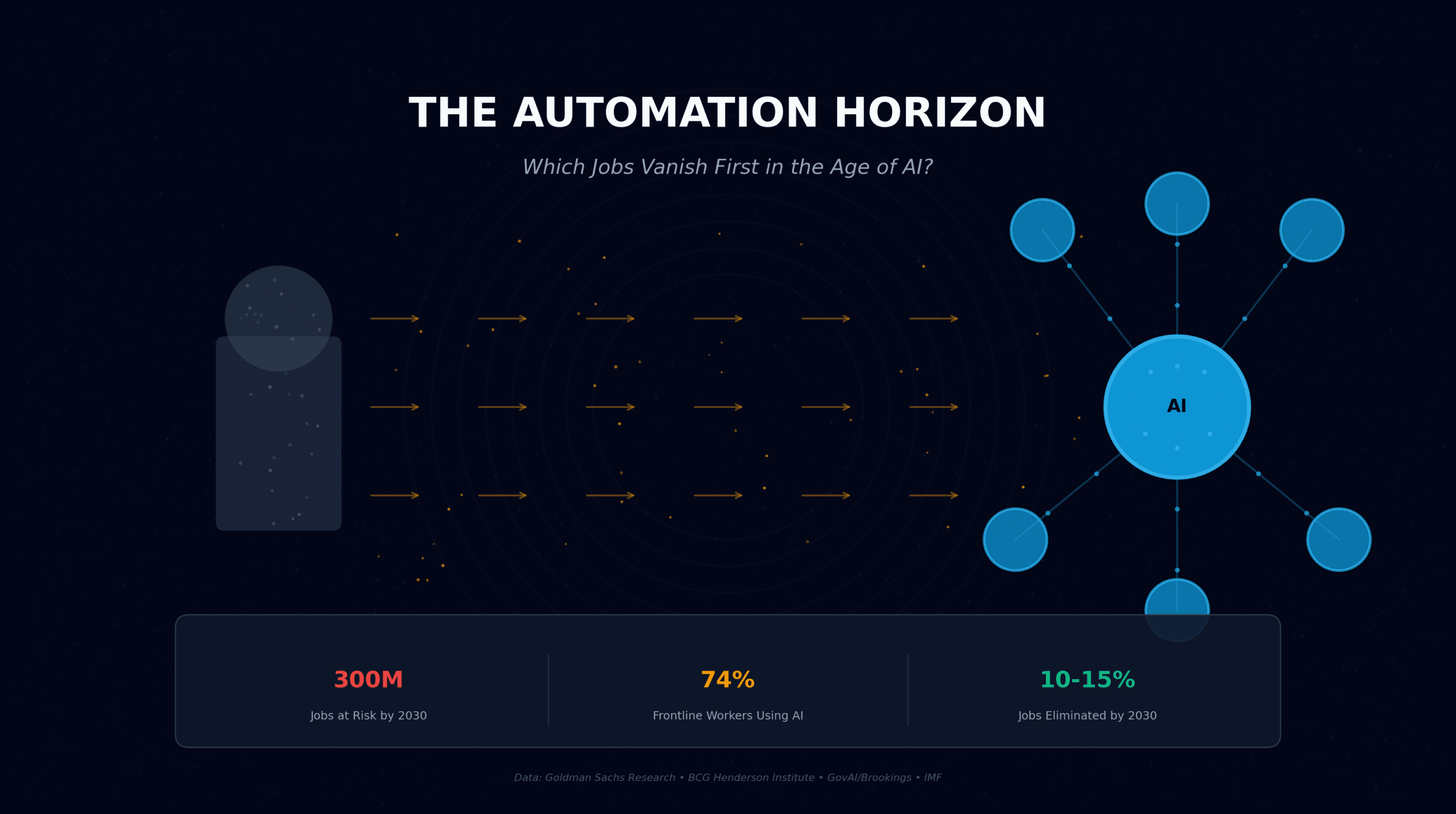
BCG’s microeconomic model of 165 million US jobs across 1,500 distinct roles — April 2026
The Spreadsheet Doesn’t Know It’s Dying
In March 2024, I watched a mid-sized insurance firm in Ohio replace three data entry clerks with a single AI tool that cost $847 per month. The tool didn’t just enter data. It validated it. It flagged anomalies. It generated reports that used to take a human two hours. The remaining clerk didn’t get a raise. She got a new title: “AI Oversight Specialist.” Her salary stayed the same. Her workload tripled.
This is the pattern nobody talks about. AI doesn’t announce itself with a press release. It arrives as a “productivity enhancement.” Then your team shrinks. Then your responsibilities expand. Then one day you realize you’re doing the work of three people for the pay of one, and the AI is doing the work you used to do.
Goldman Sachs Research estimates that generative AI could raise US labor productivity by 15% when fully adopted. But here’s the translation: that 15% doesn’t come from everyone working 15% harder. It comes from some people working 0% — because they’re gone. The firms that understand this transition early are the ones that survive it.
AI Automation Exposure by Job Category — compiled from Goldman Sachs, BCG, GovAI/Brookings, and IMF data (2025-2026)
The Five Jobs That Won’t Exist in 2028
I’m not going to give you a list of 50. Nobody remembers 50. Here are five. If you do one of these, you have roughly 18 months to pivot. Not because I say so. Because the data says so.
| Job | Automation Risk | Why It’s Vanishing | Timeline |
|---|---|---|---|
| Data Entry Operator | 92% | OCR + AI handles ingestion, validation, and formatting end-to-end. The “human review” step is already optional at most firms. | Now — 2027 |
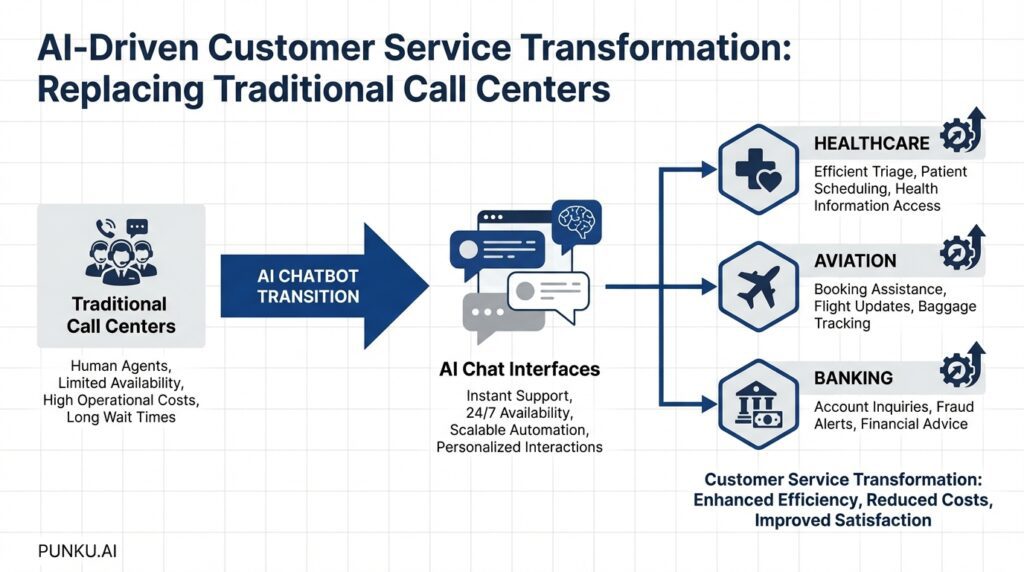
| Customer Service Agent (Tier 1) | 83% | AI voice agents now handle 70-80% of scripted queries. Sky put 2,000 contact center jobs at risk. HSBC is considering 20,000 cuts. | 2025 — 2027 |
| Proofreader / Copy Editor | 75% | AI catches 99% of errors before a human sees the draft. The remaining 1% requires judgment — which junior editors don’t have yet. | 2025 — 2028 |
| Telemarketer | 72% | Already one of the most automated roles. AI voice systems now sound indistinguishable from humans and handle objections in real-time. | Now — 2026 |
| Bank Teller | 48% | Projected 15% decline by 2033 (50,000+ positions). Mobile banking + AI chatbots eliminated the need for routine in-person transactions. | 2026 — 2030 |
Notice what’s missing from this list? Surgeons. Electricians. Plumbers. Therapists. The jobs that require a physical presence, real-time judgment, and human connection. Those aren’t safe forever. But they’re safe for now. The 6% of construction tasks and 4% of maintenance tasks currently suitable for AI automation tell that story clearly.
Global AI Workforce Impact: Displacement vs. Reshaping Trajectory (2024-2030)
It’s Like a Slow-Motion Car Crash You Can See Coming
Imagine you’re driving on a highway. Up ahead, there’s a pile-up. You can see the brake lights. You have time to change lanes. But most people don’t. They keep driving straight, assuming someone else will clear the road before they get there.
That’s the current state of AI workforce adaptation. The signals are everywhere. BCG’s fourth annual AI at Work survey (June 2026) found that 74% of frontline employees are now regular AI users — up 23 percentage points in two years. 42% of them save a full workday per week. But 66% get limited or no guidance on what to do with that time. More than half don’t reinvest it into strategic work.
So where does the saved time go? It leaks. It evaporates. And then the company realizes it doesn’t need as many people. The time saved becomes the justification for the headcount reduction.
Who Bears the Brunt? Disparities in AI Automation Risk by Demographics
The Part Nobody Wants to Say Out Loud
79% of employed women in the United States work in jobs at high risk of automation. For men, that number is 58%. In high-income countries, 9.6% of women’s jobs face the highest risk of automation. For men: 3.2%.
This isn’t because women are less capable. It’s because women are overrepresented in the exact roles AI eats first: administrative support, customer service, data processing, and routine clerical work. The jobs that require “soft skills” — which we’ve historically undervalued and underpaid — are now the jobs most vulnerable to being automated away.
And then there’s age. Workers aged 22 to 25 in AI-exposed roles have seen a 13% decline in employment. Workers 55+ in the same roles? 4%. The younger you are, the more likely you are to be competing with an AI that works 24/7, never asks for a raise, and doesn’t need health insurance.
Remote workers are 42% more likely to believe AI will disrupt their job than on-site workers. The “work from anywhere” revolution that seemed like freedom in 2020 now looks like a vulnerability in 2026. If your job can be done from a coffee shop in Bali, it can be done from a server farm in Virginia.
The “Joy Paradox”: AI Makes Work Better and Harder Simultaneously — BCG AI at Work Survey (June 2026)
The Real Question Isn’t “Will AI Take My Job?”
It’s “Will my job exist in a form where I can still afford my rent?”
BCG’s analysis of 165 million US jobs reveals that 50% to 55% will be meaningfully reshaped — not eliminated — within the next two to three years. Only 10% to 15% face actual elimination. But here’s the critical distinction: “reshaped” doesn’t mean “comfortable.” It means your job description gets rewritten by someone who doesn’t know your name. It means the skills that got you hired are now the skills that make you expensive. It means you’re expected to manage AI systems, interpret AI outputs, and fix AI mistakes — all while doing the work that used to take three people.
The BCG survey calls this the “joy paradox.” 67% of regular AI users report higher job satisfaction. But 41% report increased cognitive load. 42% save a full workday per week. But 66% get no guidance on what to do with that time. 61% believe AI agents could do at least half their job within three years. But 52% still have a limited understanding of what AI agents actually are.
We’re happy about the tools that are making us obsolete. That’s the paradox.
Here’s the trade-off nobody mentions: The same AI tools that make you 40% more productive also make you 40% more replaceable. Productivity is a double-edged sword. When you can do three people’s work, the company needs three fewer people. And one of them might be you.
What Actually Survives
Not “creative” jobs. Not “human” jobs. Those are marketing categories. What survives is judgment under uncertainty.
Physicians. Teachers. Air traffic controllers. Chief executives. These roles share one trait: the consequences of being wrong are severe, and the inputs are too messy for a pattern-matching system to handle reliably. AI can assist. It cannot assume liability. It cannot comfort a grieving parent. It cannot decide whether to ground a fleet of aircraft.
Software engineers, ironically, sit in the “amplified” category. AI accelerates code generation and testing, but system-level judgment remains human. The demand for software actually expands as AI lowers the cost of building digital products. This is the counterintuitive finding: the people building the automation tools are among the least likely to be automated.
But entry-level programmers? That’s the “divergent” category. Junior roles face the earliest automation of structured tasks while senior responsibilities persist or grow. The ladder has a missing rung. You can’t become a senior engineer if there are no junior engineer positions to start from.
The 3-Minute Rule That Fails 60% of the Time: “Learn to code” was the career advice of the 2010s. In 2026, it’s dangerously incomplete. Coding is becoming a commodity skill — AI generates functional code in seconds. The value isn’t in writing code. It’s in deciding what code to write, why it matters, and how it fits into a system that serves humans. If your coding education stopped at syntax, you’re in the divergent zone.
60% of US workers today are in occupations that didn’t exist in 1940.
That statistic, from Goldman Sachs Research, is either terrifying or comforting depending on which side of the transition you’re on. It means new jobs will emerge. It also means the transition will be brutal for the people caught in the gap. The 60% figure took 86 years to accumulate. We don’t have 86 years. We have maybe five.
What I Got Wrong (And What I Still Don’t Know)
In January 2024, I predicted that AI would primarily displace blue-collar manufacturing work first. I was wrong. The MIT and Boston University report showing 2 million manufacturing workers at risk by 2026 was accurate, but it missed the larger story: the white-collar bloodbath happened faster. Data entry, customer service, and basic content creation evaporated before the factory floor felt a thing.
I also underestimated the speed of AI agent adoption. BCG’s 2026 survey shows 30% of respondents already have AI agents integrated into workflows — more than double the 13% from 2025. I thought we’d see gradual adoption. Instead, we’re seeing a step function. One year, your company experiments with a chatbot. The next year, an AI agent handles your entire expense reporting workflow.
What I still don’t know: whether the “frictional unemployment” Goldman Sachs predicts (a 0.5 percentage point rise above trend during the transition) will be temporary, as historical patterns suggest, or whether this time is different. The researchers at Anthropic, the AI company behind Claude, have stressed the need for “humility” in their labor market analysis. I share that humility. Anyone who claims certainty about AI’s employment impact in 2030 is selling something.
The Real Reason You Won’t Do This
Because acknowledging that your job is at risk requires admitting that your career plan — the one you spent years building, the one your parents approved of, the one that felt safe — might be built on sand. That’s not a spreadsheet problem. That’s an identity problem.
And here’s the honest barrier: reskilling takes time you don’t have, money you don’t have, and energy you’re already spending on a job that’s slowly eating itself. The people who tell you to “just learn AI tools” are usually people who already work in tech and have been using them for years. For a 45-year-old administrative assistant with two kids and a mortgage, “just learn Python” is not a plan. It’s a dismissal.
The firms that will thrive in this transition aren’t the ones that cut the most people. They’re the ones that redesign work so humans do what humans are actually good at, and AI does what AI is actually good at. BCG’s research is clear on this: clear strategy lifts AI’s business impact by 25 percentage points. Better tools, without strategy, move it by 5.
Strategy means knowing which 10% of your job is irreplaceable and building around that. It means becoming the person who asks the questions, not the person who finds the answers. AI is very good at answers. It’s terrible at questions.
Only you know if that’s acceptable.