


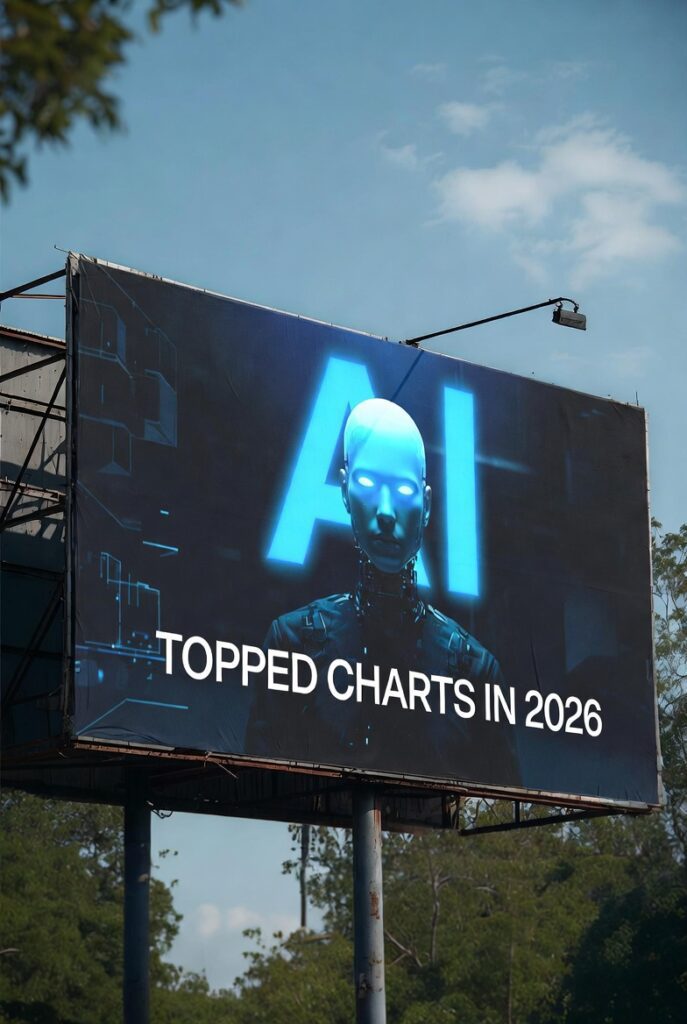

Status as of October 18, 2026. First published in April 2026 and rebuilt against current reporting. Biggest changes: the lawsuits are not over (Sony and Universal filed new suits against Suno and Udio this summer and fall), Suno launched licensed v6 models, a Munich court ruled against Suno, and YouTube Music added AI labels. A full change log is at the bottom.
A song credited to an AI act reached No. 1 on a Billboard chart in November 2025. Almost a year on, the three major labels are still in court over how it was made possible, and the fight has changed shape. Some labels have become licensing partners. Others are suing again. Regulators, charts, and streaming services are writing rules while the lawsuits run.
This is a status report on where things stand today, what the numbers show, and what to watch next.
Key takeaways
- The chart win was real but narrow. “Walk My Walk” by Breaking Rust topped Billboard’s Country Digital Song Sales chart, which counts paid downloads, for the week of November 8, 2025.
- The lawsuits did not end. They split. Warner has settled with both Suno and Udio, and Universal has settled with Udio. Sony and Universal are still suing Suno, and Sony is still suing Udio.
- Licensing now runs alongside litigation. Suno launched its licensed v6 models on September 9, 2026. Nine days later, Sony and Universal filed a new suit arguing v6 still carries the taint of the old models.
- Upload volume is exploding, but listening is not. Deezer receives about 75,000 fully AI-generated tracks a day (44% of its deliveries), yet they account for only 1-3% of streams, and Deezer reports that up to 85% of streams on those tracks in 2025 were fraudulent.
- Rules are arriving from three directions at once: a German court (July 31), Australian chart eligibility (August 31), and AI labels on YouTube Music (October 14).
What actually happened with Breaking Rust
“Walk My Walk” reached No. 1 on Country Digital Song Sales for the week of November 8, 2025. Spotify credits, as reported by a Canadian radio outlet, list a human, Aubierre Rivaldo Taylor, as the creator, while Breaking Rust itself is an AI-generated persona. So the accurate description is not “no human was involved.” A person made the track with AI tools and released it under a fictional artist.
Two details keep the story in proportion. The chart tracks paid downloads, not streaming or overall consumption, which makes it far easier to move than a streaming chart. And Billboard acknowledged it was one of at least six AI acts to chart in a few months, so this was a trend before it was a headline.
It still mattered, because it was the moment AI music stopped being a novelty and became a business question. Whether you believe the chart position reflects genuine demand or a well-run promotion campaign, it reached a Nashville audience that never asked for it.
The lawsuit scorecard, October 2026
The common summary that the labels settled and the story ended is wrong. Here is the status of each front.
| Case | Status | What is established vs. alleged | Why it matters |
|---|---|---|---|
| Universal v. Udio | Settled October 29, 2025 | Settlement announced by the parties; terms not public. | Udio rebuilt around licensed music and switched off downloads. As of mid-October 2026 the promised licensed service had no launch announcement in the coverage I found. |
| Warner v. Udio | Settled November 2025 | Settlement announced; terms not public. | Udio now has deals with Universal, Warner, Merlin, and Kobalt. |
| Warner v. Suno | Settled November 25, 2025 | Settlement and licensing deal announced by the parties. | Suno agreed to replace its models with licensed ones, tie downloads to paid accounts, let Warner artists opt in to likeness and voice use, and buy Songkick. |
| Sony v. Udio | Ongoing | Claims are allegations; no merits ruling reported. | Sony filed a second suit on July 20, 2026 over roughly 30,000 additional recordings. It is now the only major still fighting Udio. |
| Universal and Sony v. Suno | Ongoing (D. Mass.) | The v6 claims are the labels’ allegations; Suno says v6 was trained on licensed data. | A new suit followed on September 18, 2026, targeting Suno’s v6 models. On October 14, the labels asked a court to force DistroKid to disclose how many AI tracks it distributes. |
| GEMA v. Suno (Munich) | GEMA largely won at first instance, July 31, 2026 | A court decision, but first instance only and appealable. | Reported as the first European ruling on a generative music tool. The court considered six works and earlier Suno models; damages are unquantified, and Suno has said it disagrees and can appeal. |
Sources for each row are listed at the end. The headline figure that circulated in early coverage, “$500 million,” does not appear in the reporting I could trace to the complaints. Under U.S. law, a copyright owner who qualifies can elect statutory damages instead of proving actual losses. The range is $750 to $30,000 per work, rising to as much as $150,000 per work for willful infringement. Multiplied across tens of thousands of recordings, that is how outlets reach billion-dollar headlines. Those are theoretical ceilings that a plaintiff can seek, not amounts any court has awarded, and the allegations in the complaints are claims, not findings.
Timeline at a glance
| Date | Event |
|---|---|
| June 2024 | Sony, Universal and Warner sue Suno and Udio |
| Oct 29, 2025 | Universal settles with Udio |
| Nov 2025 | Warner settles with Udio (announced Nov 19) and Suno (Nov 25); Breaking Rust tops the download chart (week of Nov 8) |
| Jan 13, 2026 | Bandcamp bans music made wholly or substantially with AI |
| Jun 2026 | Suno announces a $400M Series D at a $5.4B valuation |
| Jul 20, 2026 | Sony files a second suit against Udio |
| Jul 31, 2026 | Munich court rules for GEMA against Suno |
| Aug 31, 2026 | ARIA chart exclusion of wholly AI recordings takes effect |
| Sep 9, 2026 | Suno launches v6 on licensed Warner, BMG and Believe data |
| Sep 18, 2026 | Sony and Universal sue Suno over v6 |
| Oct 14, 2026 | YouTube Music AI labels roll out; labels seek DistroKid subpoena |
What the labels got wrong, and what they got right
The usual verdict is that litigation was too slow, because the technology shipped before the courts could rule. There is truth in that. But it misses what the labels actually did.
They did not pick litigation or licensing. They picked both. One reading that fits the pattern of deals, and it is a hypothesis rather than a stated strategy, is that licenses have gone to companies willing to keep generated output inside a walled platform, while the fights continue with companies that allow wider distribution. Other factors, including each company’s training data and negotiating position, surely matter too. The pattern is visible in the deals: Udio disabled downloads after its Universal settlement, and Warner’s Suno deal restricts downloads to paid accounts.
That makes where the output goes a live dispute alongside the older one over how the models were trained. Training claims have not gone away. Universal and Sony are reportedly at an impasse with Suno over exactly this: sharing and distributing generated tracks beyond the service. It also explains the September lawsuit. Suno’s v6 models were trained on licensed catalogs from Warner, BMG and Believe, and Suno’s product chief said plainly that the data excludes Universal and Sony recordings. Sony and Universal allege that the new models still descend from outputs of the old ones, and Suno disputes that v6 is tainted. In effect, the labels’ position is that a license signed today does not cure training done earlier; that is their legal argument, not a court finding.
Where I think the labels have a genuine strategic problem is the evidence they need. U.S. fair use weighs four statutory factors: the purpose of the use, the nature of the works, how much was taken, and the effect on the potential market. The fourth is only one factor, but it is the one where evidence about AI music flooding platforms matters. That is why the DistroKid subpoena matters: the labels told the court that how much AI music reaches platforms, and what it earns, is relevant to Suno’s fair-use defense, and that Suno itself does not hold that data.
Now compare that with Deezer’s data (detailed below): enormous upload volume, small consumption. That cuts both ways. It supports the labels’ story about industrial-scale dumping, and it weakens any simple claim that AI tracks are displacing human ones in actual listening. I am describing a tension, not predicting an outcome, and Deezer’s figures cover one platform and only the tracks it detects.
The numbers behind the headlines
| Metric | Figure | Source and caveat |
|---|---|---|
| Fully AI tracks uploaded to Deezer daily | ~10,000 (Jan 2025) to ~30,000 (Sep 2025) to ~60,000 (Jan 2026) to ~75,000 (Apr/Jun 2026) | Deezer’s own detection; counts only fully AI-generated tracks it detects |
| Share of Deezer daily uploads | ~44% (of all tracks delivered daily) | Deezer, April 2026 |
| Share of Deezer streams from fully AI tracks | 1-3% (of total platform streams) | Deezer, as reported April 2026; one platform |
| Share of those AI-track streams flagged fraudulent | Up to 85% (of streams on fully AI tracks, 2025) | Deezer; an upper figure, not a typical rate; demonetized and excluded from royalties |
| Suno paid subscribers / annualized revenue | 2 million / ~$300 million | Company-reported, February 2026 |
| Suno valuation | $5.4 billion (Series D, announced June 2026) | Up from $2.45 billion in November 2025; a negotiated financing figure, not an audited one |
| Suno songs generated per day | 7 million+ | Reported by Forbes; company-sourced |
Treat the Suno figures as company-reported. Treat Deezer’s as a platform’s own measurements, which are the best public data available but come from a company that sells itself on AI detection.
These numbers are not one synchronized dataset. The upload counts are snapshots over time (the 75,000 figure was announced April 20, 2026). The “1-3% of streams” figure describes current consumption of fully AI tracks Deezer detects, while the “up to 85% fraudulent” figure is Deezer’s finding for 2025 streams of those tracks. “Fully AI-generated” is Deezer’s detection category, so AI-assisted music is not counted.
With those limits, the gap is still striking: a large share of what arrives on Deezer is AI-generated, while very little of what gets played is. If you run a platform, that gap is the core problem. If you are an artist, it is one way your release can get buried under volume even when listeners rarely hear the AI tracks.
Can listeners tell the difference?
A November 2025 survey commissioned by Deezer and run by Ipsos asked 9,000 adults in eight countries to listen to three tracks, two AI and one human. 97% failed to identify the AI tracks correctly. The same survey found:
- 80% said fully AI-generated music should be clearly labeled
- 69% said payouts for fully AI music should be lower than for human-made music
- 52% felt uncomfortable not being able to tell the difference
Read it with the right caveats. The sample was online, the test used three clips, and it was commissioned by a company with a commercial interest in detection. It does not show that AI music is better or that listeners prefer it. It shows that identification by ear is unreliable.
Preference is a separate question, and the evidence there points the other way. A Carnegie Mellon study published in January 2026 had 140 musically trained participants write 15-second melodies, some with inspiration from the AI tool Udio. Melodies written with AI assistance were slower, used fewer notes, and were judged less creative. Note what this does and does not test: AI-assisted human composition in a lab, not finished commercial releases. And a peer-reviewed study by Wu and Holmes (Stanford and Reed College), published in Cognitive Research: Principles and Implications in 2026, found that listeners to instrumental music imagined fewer and less engaging stories when they believed it was AI-composed, even when a human had composed it. The labels, not the music, drove the effect. Its scope is narrow: instrumental excerpts and narrative engagement, not overall enjoyment of finished songs. Other studies on “AI composer bias” report mixed results.
Put those together, and the picture is consistent but not settled. People cannot reliably detect AI music, yet at least some of them respond differently once they are told. That is a large part of why labeling has become the main fight on platforms.
How platforms and charts are responding
There is no single industry policy. There are at least four.
| Platform or body | What it does | The gap |
|---|---|---|
| Deezer | Tags fully AI tracks, excludes them from recommendations and editorial playlists, stopped storing hi-res versions, launched a free public detector in June 2026 | Covers fully AI tracks it detects, not AI-assisted work |
| Spotify | AI credits in song credits (voluntary, built on the DDEX standard; Spotify says a missing credit does not mean AI wasn’t used), “AI Persona” badges for synthetic artists, a spam filter, more than 75 million spam tracks removed in the 12 months before September 2025 | Credits only appear if a label or distributor supplies the data |
| YouTube Music | Rolled out player-page labels on October 14, 2026 for songs made mainly with generative AI; partners declare Fully, Partly or No Gen AI (the declarations are partner-supplied; I found no confirmation that every track is independently tested) | YouTube says a label alone does not change recommendations or monetization |
| Bandcamp | Banned music “generated wholly or in substantial part by AI” on January 13, 2026, and asks users to report suspected cases | Enforcement depends on reports and judgment calls about “substantial” |
| Charts | Australia’s ARIA excludes wholly AI-generated recordings from charts dated August 31, 2026 onward; IFPI published principles on July 30 saying eligible tracks must be substantially human-made | This is not a Billboard rule. I found no Billboard ban, though Luminate says AI labels are coming to its data later in 2026 |
The useful distinction is between labeling, filtering, and paying. A label tells you something. A filter changes what you hear. A payout rule changes what gets made. Today most platforms have the first, a few have the second, and the third is still being negotiated.
Three scenarios from here
These are qualitative scenarios for roughly the next 12 months, not forecasts, and I am not assigning probabilities because the evidence does not support precise ones. For each, I have listed the signals that would tell you it is happening and what it would mean for independent artists.
1. Licensed gardens (the base case for the next year)
Licensed AI music grows inside walled platforms: Suno with Warner, BMG and Believe; Udio with Universal, Warner, Merlin and Kobalt. Open distribution stays contested. Negotiated partnerships and revenue-sharing become the template for new deals, though public data is not enough to say how most industry revenue flows today.
For independents: deal terms are written by major-label catalogs, so smaller artists depend on distributors and collecting societies to get included.
Signals: Udio’s licensed service finally launching; further label and publisher deals with Suno; Universal and Sony settling on terms that restrict output sharing.
2. Courts reprice everything
Rulings on training and output set a price that every deal has to match. The Munich decision found that training on protected works and reproducing them in outputs both infringed, and held Suno itself responsible rather than its users. The U.S. cases rest on fair use, where the answer is still open.
For independents: higher training costs could favor licensed tools, but only if payment actually reaches smaller rightsholders.
Signals: Suno’s appeal in Germany; what the DistroKid subpoena produces; a U.S. summary-judgment ruling in the Suno case.
3. The provenance divide
Disclosure becomes mandatory infrastructure. Charts exclude wholly AI recordings, platforms label them, and a “verified human” tier earns a premium. This only works if labels are accurate, and every platform admits detection is imperfect.
For independents: provenance records become a competitive asset, and unreliable labels could penalize human-made work.
Signals: Billboard adopting eligibility rules; Luminate’s AI labels reaching customers; Apple Music’s announced “Made With AI” tags shipping; a high-profile mislabeling error.
What would change my view: evidence that AI tracks are taking a large share of real, non-fraudulent listening. So far the public data says they are not.
What this means in practice
If you are an artist. The right registrations depend on your country and the rights involved. In the U.S., a performing rights organization handles public-performance royalties for songwriters, while SoundExchange collects digital performance royalties for sound recordings; neither replaces copyright registration. Check that your distributor passes AI disclosure fields through correctly, because on YouTube Music a blank field can still end up labeled. Keep stems and session files so you can show human authorship. Charts are moving toward “substantially human-made,” and ARIA, for one, has a process for contesting an exclusion, so records of your process are useful if you ever need to appeal.
If you use AI tools to make music. Know what you are actually licensed to do. Suno’s v6 models are trained on licensed catalogs, but Universal and Sony dispute that this resolves the older models’ history, and the output rules differ by plan. Check the commercial terms before you release anything, and do not assume a track will be eligible for charts in markets with AI rules.
If you run a platform. A label is not a filter. YouTube is explicit that its label does not affect recommendations, while Deezer’s approach shows what detection plus demotion looks like. Decide which problem you are solving: transparency, fraud, or catalog quality. They need different tools.
If you work at a label or publisher. The open question is output distribution, not training alone. Whoever defines acceptable output sharing will set the economics for everyone else.
The bottom line
AI music is a commercial fact: Suno reports millions of paying subscribers, major labels are licensing to it, and a generated song has topped a download chart. But the number of tracks created is not the same as listener demand. On Deezer, fully AI-generated tracks make up roughly 44% of daily deliveries but only 1-3% of total streams, according to the platform, and Deezer reports that up to 85% of streams on those tracks in 2025 were fraudulent. That is a real gap between upload volume and legitimate listening on one platform, not an industry-wide estimate.
What happens next depends on three rules still being written: what training requires permission and payment, where generated output may travel, and how provenance is disclosed and enforced.
Frequently asked questions
Did an AI song really top a Billboard chart?
Yes, with a qualification. “Walk My Walk” by Breaking Rust reached No. 1 on Country Digital Song Sales for the week of November 8, 2025. That chart measures paid downloads, not streaming or total consumption. It is not Billboard’s main country chart.
Are the lawsuits against Suno and Udio over?
No. Warner has settled with both companies, and Universal has settled with Udio. Sony is still suing Udio, and Universal and Sony are still suing Suno, with a new suit filed in September 2026.
Is Suno legal to use?
That depends on where you are and what you do with the output. A Munich court ruled against Suno in July 2026 over models trained on GEMA-represented works, and Suno can appeal. In the U.S., the cases turn on fair use and are unresolved. This is not legal advice; if you plan to release music commercially, read the platform’s terms and consider professional advice.
Is AI music banned on streaming platforms?
Mostly not. Bandcamp bans music made wholly or substantially with AI. Most other services allow it but are adding labels, spam filters, or demotion. Some charts, such as Australia’s ARIA, now exclude wholly AI-generated recordings.
How can I tell if a song is AI-generated?
Not reliably by ear, as the Deezer and Ipsos survey shows. Practical checks: Deezer’s free public detector, the AI label on YouTube Music, and AI credits on Spotify. None is complete, and a missing label does not prove a track is human-made.
How this was checked
Key facts were checked against dated reporting from trade and general news outlets, company announcements (Deezer, Bandcamp, ARIA), and, for the research claims, the studies themselves. Company-reported figures are labeled as such. I did not review the court filings or settlement agreements directly, so statements about lawsuits describe what the parties and reporters say about them. Allegations in complaints are allegations, not findings, and only the Munich ruling is a court decision on the merits, at first instance.
Change log and what I could not verify
Updated October 18, 2026. Main corrections to the April 2026 version:
- The original said both lawsuits had “settled by November 2025.” Only some had. Sony remains in litigation with both companies, and Universal with Suno.
- The original omitted the Warner-Udio settlement.
- The “$500 million” damages figure was removed because I could not trace it to the complaints.
- The claim that cases “settled before discovery” was removed. Fact discovery in the Suno case was scheduled to close on September 30, 2026.
- The original said no human wrote Breaking Rust’s song. Spotify credits list a human creator.
- The 58% and 71% survey figures came from a study with undisclosed methodology. They were replaced with the published Deezer and Ipsos results.
- The label-effect claim now cites the primary peer-reviewed study (Wu and Holmes, 2026) instead of a secondary news link, and its scope is stated.
- The Carnegie Mellon finding was restated: it tested AI-assisted human melodies, not finished AI songs.
- Claims I could not verify were dropped: named artists in the Warner-Suno deal, the “75% of artist income” figure, the “3-5x per-stream premium,” the “2-3 million musicians” estimate, and several platform-policy claims.
New since April: the Suno v6 launch, the BMG and Believe deals, the Sony and Universal suit against v6, the DistroKid subpoena, the Munich ruling, ARIA and IFPI chart rules, YouTube Music labels, and Deezer’s updated data.
Details in this area change weekly. Check the dated sources below before relying on a specific status.
Sources
Billboard chart and Breaking Rust
- ABC News, What to know about the AI-generated country song topping Billboard’s chart (November 12, 2025)
- CFJC Today, AI Country Song Hits Number One on Billboard Chart (November 14, 2025)
Lawsuits and licensing
- Variety, Sony Music, Universal Music Group Sue Suno Over Label-Backed Model (September 18, 2026)
- Billboard, UMG and Sony Demand DistroKid Admit How Many AI Songs Uploaded From Suno (October 16, 2026)
- Hollywood Reporter, Universal Music and Sony Want to Know How Many AI-Generated Songs DistroKid Releases (October 16, 2026)
- Music Business Worldwide, Suno launches v6 AI music models in partnership with WMG, BMG, and Believe (September 2026)
- Reuters via Yahoo, Universal Music settles copyright dispute with AI firm Udio (October 2025)
- Digital Music News, Suno, Universal Music lawsuit settlement impasse (April 9, 2026)
- Teosto, German court confirms music cannot be used as raw material for AI services without consent (July 31, 2026)
- Bristows, GEMA v Suno: Munich court finds AI music training and outputs infringe copyright
Data and research
- Deezer, AI-generated tracks now represent 44% of all new uploaded music (April 20, 2026)
- Deezer and Ipsos, Survey: 97% can’t tell the difference between AI and human music (November 12, 2025)
- Carnegie Mellon University, As AI-Generated Music Advances, Humans Still Lead in Creativity (January 2026)
- Wu and Holmes, Cognitive Research: Principles and Implications 11:19 (2026), the primary study on AI labels and listener engagement
- Forbes Australia, AI music generator Suno eyes $5 billion valuation (2026)
Platforms and charts
- Bandcamp, Keeping Bandcamp Human (January 13, 2026)
- Music Business Worldwide, Spotify to show AI tags in Song Credits (2026), on Spotify’s voluntary AI credits
- Music Business Worldwide, YouTube will now automatically detect and label AI videos (May 2026), on YouTube’s AI-label approach
- TechCrunch, YouTube Music launches new labels as AI-generated music floods streaming platforms (October 2026)
- Associated Press via PBS, Australia’s music industry bans AI-generated tracks from official charts (August 25, 2026)
- RouteNote, Can AI-Generated Music Enter the Charts? The Rules Are Starting to Change (2026)
Related reading on FutureNow: AI & Music coverage hub
1 thought on “AI Music: A Billboard Chart-Topper, Ongoing Copyright Lawsuits, and What Happens Next”