

Will Humans Really Live on Mars? The 2026 Reality Check
Timelines keep slipping. Musk just delayed Mars by five-to-seven years. A 2024 Nature study called the Starship plan “unworkable.” And yet — the science has never been more credible. Here’s what’s actually happening.
TL;DR
In February 2026, Musk announced a 5–7 year delay to Mars, prioritising the Moon instead.
NASA targets the 2030s–2040s; SpaceX’s optimistic crewed date is now 2031 at the earliest.
Radiation exposure during transit—no definitive shielding exists yet for a 2–3 year journey.
Humans visiting Mars in the 2030s is possible. Humans living on Mars? That’s a 2050s–2070s conversation.
Let me be honest with you upfront. When I started researching this piece, I expected to write a triumphant “we’re going to Mars!” narrative. And then February 2026 happened. Elon Musk announced a delay of roughly five to seven years to SpaceX’s Mars ambitions, pivoting instead to building a lunar base. The 2026 uncrewed Mars launches? Quietly shelved. Wikipedia’s SpaceX Mars page now reads: “In 2026, SpaceX deprioritized its Mars ambitions in order to focus on other projects.”
That’s not a minor footnote. That’s the main story. And most of the articles you’ll find out there were written before this happened — they’re still cheerfully citing “2026 uncrewed missions” as if nothing changed. So here’s the honest, current picture — the breakthroughs, the biological nightmares, the real timelines, and why none of this means Mars is off the table. It’s just a lot further away than Musk’s slides suggested.
1. What “Living on Mars” Actually Means (and Why It Matters)
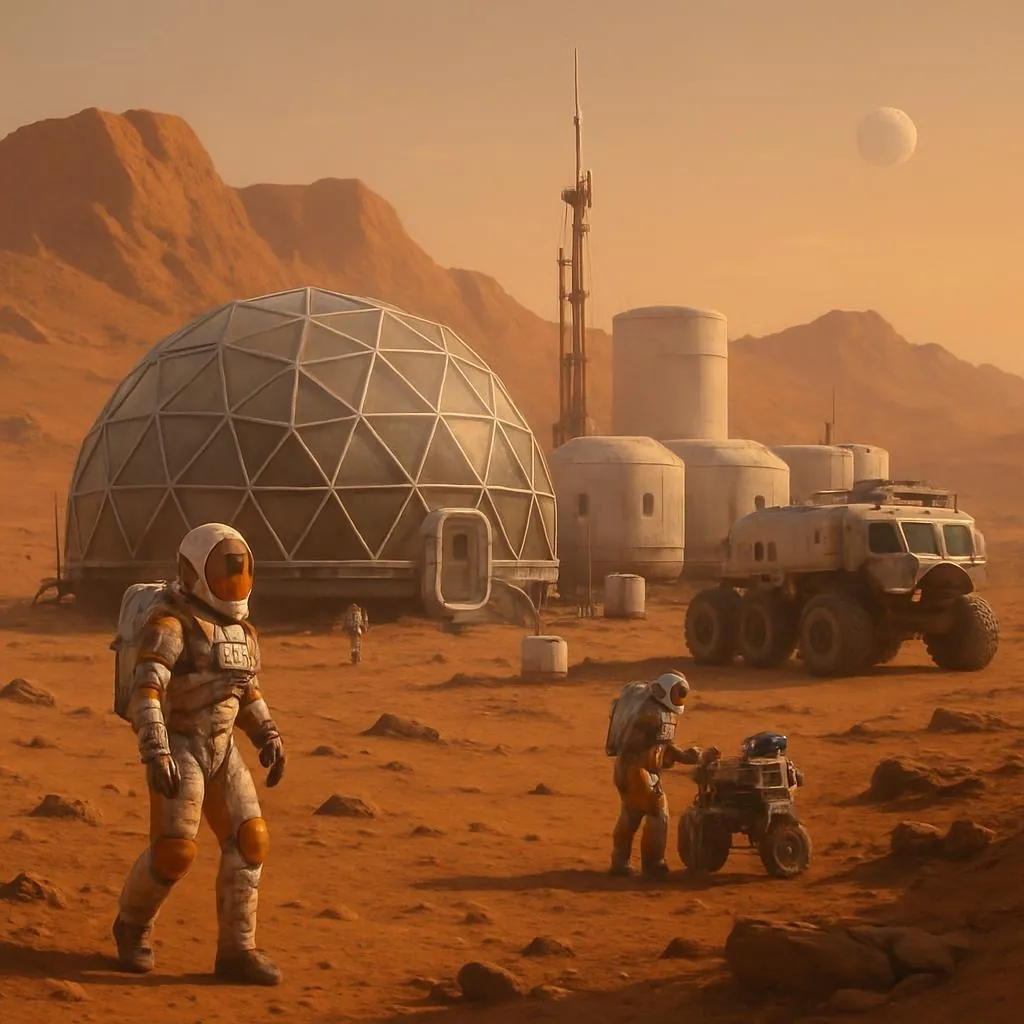
There’s a crucial distinction most articles gloss over: the difference between visiting Mars and living there. Planting a flag and coming home is a flags-and-footprints mission. Actually living on Mars means self-sustaining settlements — closed-loop life support, local food production, local propellant manufacturing, and a population that doesn’t depend on Earth for survival every six months.
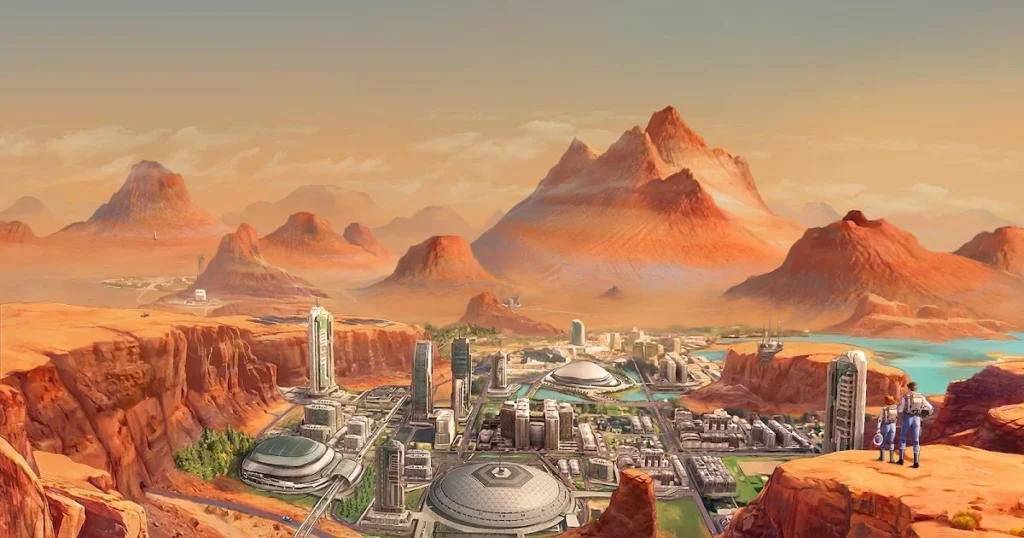
NASA has never formally embraced permanent settlement as a goal. Their CHAPEA (Crew Health and Performance Exploration Analog) missions, with the latest cycle beginning in October 2025, simulate year-long stays in a 3D-printed habitat at Johnson Space Center — useful data, but still firmly in the “extended visit” category. SpaceX’s publicly stated vision is bolder: a self-sustaining city of a million people. The gap between those two ambitions is not a PR difference. It’s decades and trillions of dollars.
For this piece, I’m treating “living on Mars” as the full spectrum — from first crewed landings through permanent outposts. Because you need to understand each phase to know which parts are achievable and which are sci-fi.
2. What’s Actually Happening Right Now (April 2026 Update)
Here’s the current state of play, verified as of April 2026:
- Feb. 2026
Musk announces a 5–7 year delay to Mars plans, citing the need to focus on lunar missions first. SpaceX reportedly told investors it would “prioritize going to the moon first.” The 2026 uncrewed Mars missions are off.
- May 2025
Musk’s updated Mars presentation estimated a 50% chance of being ready for the 2026/27 launch window — which itself was contingent on demonstrating orbital refueling. That demo hasn’t happened.
- 2025
A 2024 Nature feasibility study concluded that a crewed Mars mission using Starship faces “several fundamental engineering constraints” that make the plan unworkable in its current form — particularly the 60+ tanker launches needed to fuel a single Mars-bound Starship.
- Oct. 2025
NASA’s CHAPEA second analog mission begins. Results from the first cycle showed crews managing adequately but highlighted psychological friction as the most persistent challenge — not technical failures.
- 2026 (current)
NASA’s Artemis 2 — a crewed lunar flyby — is proceeding. This is the actual stepping stone to Mars. Without Moon mastery, Mars doesn’t happen. SpaceX’s Starship must first serve as a lunar lander before it touches Martian soil.
Important context: Musk’s revised crewed Mars timeline is now “2029 at optimistic, 2031 more likely” — a statement made in March 2025, before the February 2026 delay announcement. The realistic window, factoring in the latest pivot, is mid-2030s at the absolute earliest for a first crewed landing, likely longer for anything resembling habitation.
3. The Biology Problem Nobody Wants to Talk About
The engineering challenges get all the press. Orbital refueling, heat shield testing, landing on a thin atmosphere — these are spectacular problems. But the biology? That’s where things get genuinely sobering, and a lot of the coverage is still catching up.
Radiation
Without Earth’s magnetosphere, a Mars transit exposes crews to galactic cosmic rays and solar particle events. Current shielding solutions don’t fully address this. No definitive protection exists for a 2–3 year round trip. Risks include cancer, cardiovascular disease, cataracts, and neurological damage.
Bone & Muscle Loss
A 2025 NASA study found bone loss in space is primarily driven by mechanical unloading from low gravity — not radiation. At 0.38g on Mars, weight-bearing bones continue to degrade, raising risks of fractures, osteoporosis, and kidney stones from calcium loss.
Psychological Isolation
6–24 months from help, depending on orbital positions. CHAPEA data highlights this as the hardest unsolved problem. Communication delays of 4–24 minutes mean no real-time contact with Earth. Mental health crises become medical emergencies with no evacuation option.
Martian Dust
A 2025 GeoHealth study detailed how fine Martian dust particles — oxidative and chemically reactive — pose serious respiratory and systemic health risks. Dust storms can last weeks. No Earth analogue fully matches the Martian dust environment.
Here’s the part that genuinely surprised me while researching this: the bone loss mechanism debate is still active. For years, radiation got the blame. A March 2025 NASA study (published in PLOS ONE) found that site-specific bone loss in space is actually driven mostly by the lack of mechanical loading — you lose bone in weight-bearing bones because you’re not standing on them the way Earth makes you. Mars at 38% gravity won’t fix this. Astronauts on the ISS do intense daily exercise to manage it; that worked for 6-month stays. What happens over a multi-year Mars mission is genuinely unknown.
“Most of the funding for Mars settlements is coming from SpaceX. If we’re serious about settlement, we need to do research on human reproduction. We need systems that recycle everything like Biosphere 2. Having these sorts of recycling systems running on Mars is not going to happen in 30 years.”
— Former SpaceX Raptor engineer, Aerospace America, 2025
And reproduction? Nobody’s funding that research seriously. Children born on Mars in partial gravity — we genuinely don’t know what that does to development. The reproduction question may be the single biggest unaddressed barrier to permanent human settlement.
4. The Engineering Challenges — And Where Real Progress Exists
Not all doom and gloom. Real, verifiable progress has happened. Let me separate the genuine advances from the vaporware.
Where SpaceX Has Actually Delivered
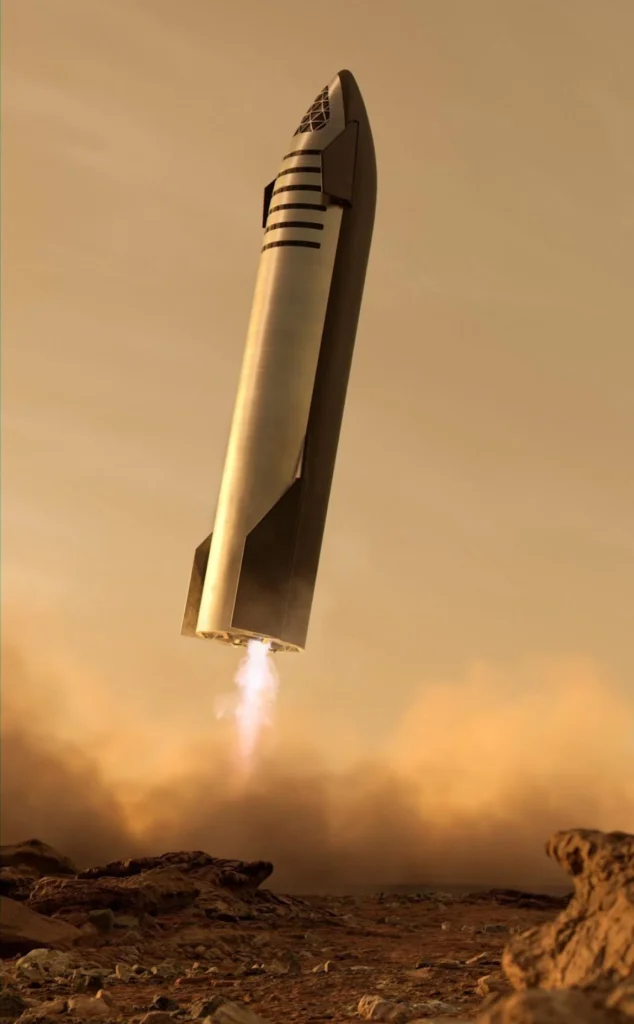
Starship’s iterative development program has been genuinely impressive by historical rocketry standards. By mid-2025, the vehicle achieved multiple successful re-entries and splashdowns after several years of explosive learning curves. The “chopstick” booster catch — landing the Super Heavy booster back on the launch tower’s mechanical arms — worked. That’s not hype. That’s a legitimately historic piece of aerospace engineering.
The problem is orbital refueling. To reach Mars, each Starship needs roughly 1,200 tonnes of propellant. A tanker Starship carries about 100 tonnes. That’s 12 tanker flights per Mars-bound ship — and SpaceX planned five ships for the first uncrewed wave, requiring approximately 60 tanker launches. A full propellant transfer between two separate Starships in orbit has never been demonstrated. SpaceX planned to do it in 2026. It didn’t happen.
ISRU — The Overlooked Game-Changer
In-situ resource utilization is genuinely the most important technology for Mars habitation, and it gets less coverage than rocket aesthetics. NASA’s MOXIE experiment on the Perseverance rover demonstrated oxygen production from Martian CO₂ — a small-scale proof of concept that works. Scaling that to supply a crew is a different challenge, but the chemistry is sound.
Water ice at accessible depths remains uncertain. Water on Mars exists, but confirmed subsurface ice accessible for drilling may be 10–20 km deep in some regions — essentially requiring industrial mining infrastructure on a planet where we’ve never even landed humans. Surface-level ice exists at the poles and has been detected in shallow mid-latitude deposits, which is more promising for practical use.
| Technology | Current Status (2026) | Required for Settlement | Readiness |
|---|---|---|---|
| Starship Re-entry | Demonstrated at Earth; Mars EDL untested | Landing intact on Mars | ⬛⬛⬛⬜⬜ |
| Orbital Refueling | Partial tank transfer only; ship-to-ship undemonstrated | Essential for Mars transit | ⬛⬛⬜⬜⬜ |
| ISRU (Oxygen) | MOXIE proved concept; scale-up pending | Critical for propellant + breathing | ⬛⬛⬛⬜⬜ |
| Radiation Shielding | Passive solutions tested; no complete solution | Non-negotiable for crew survival | ⬛⬛⬜⬜⬜ |
| Closed-Loop Life Support | ISS systems manage ~93% water recycling | Near-100% efficiency needed | ⬛⬛⬛⬜⬜ |
| Food Production (Mars) | CHAPEA hydroponic testing; ~80% self-sufficient in lab | Essential for population >20 | ⬛⬛⬜⬜⬜ |
5. The Realistic Timeline: What the Evidence Actually Supports
I spent several hours cross-referencing timelines from aerospace engineers, NASA documents, SpaceX presentations, and independent researchers. Here’s the most defensible outlook, stripped of PR optimism:
- 2026–2029
Lunar phase dominates. SpaceX focuses on NASA Artemis lunar lander missions. Starship orbital refueling demonstrations continue. No Mars missions in this window.
- 2028–2030
Potential uncrewed Mars precursors — if orbital refueling succeeds. Optimus robots, power infrastructure, ISRU equipment. Even this requires everything going right.
- 2031–2035
First crewed Mars landing (optimistic scenario). Short surface stay, heavy Earth dependence, extreme risk. NASA’s aspirational window; SpaceX’s revised realistic window.
- 2035–2045
Repeated campaigns, longer stays, expanding ISRU capability. This is where “outpost” becomes a meaningful description.
- 2050s+
Transition toward sustained bases with local propellant and food production. The beginning — only the beginning — of genuine habitation.
Self-sustaining settlement? The engineering, biology, and logistics suggest we’re talking 2060s at the absolute minimum, more likely later. Anyone telling you 2035 with a straight face is selling something.
6. Why Mars Still Makes Sense — The Honest Case
Here’s where I push back against my own skepticism. The delays and challenges are real. But dismissing Mars colonization as fantasy is also wrong — it just requires an honest accounting of what “eventual” means.
The multi-planetary argument is logically sound: concentrating all of human civilization on one planet with one magnetosphere, one asteroid trajectory, one volcanic superpower is a bet with long odds over a long enough timeline. Not this century, probably, but the philosophical case is genuine. The question is whether SpaceX’s commercial model can actually get us there, or whether it requires the kind of sustained state-level commitment we’ve never demonstrated in peacetime for any project.
The Moon-first approach — which is now the actual plan — is arguably more sensible than the direct-to-Mars narrative that dominated headlines between 2016 and 2025. You’re 3 days from help on the Moon. You’re 6–24 months from help on Mars. Getting Moon habitation right before scaling to Mars isn’t cowardice; it’s engineering discipline. The tech that works on the Moon becomes the foundation for Mars. The tech that fails there fails at a recoverable distance.
And the science case remains extraordinary. Mars astrobiology — the search for past or present microbial life — is one of the most profound questions in human history. Perseverance’s sample caching program is building toward an eventual Mars Sample Return that could answer it. Whether humans need to be there to make that science happen is debatable. But the question itself is worth the ambition.
7. Common Mistakes in Mars Coverage (and How to Think Clearly)
✓ Things to keep in mind
- Distinguish visiting from living — they’re decades apart
- Track orbital refueling demos as the key technical milestone
- Watch biology research funding as a proxy for serious intent
- Treat Artemis Moon missions as the true rehearsal
- Follow independent feasibility studies, not just company presentations
✗ Things to stop assuming
- That Musk’s timelines are reliable — they’ve slipped by years, repeatedly
- That radiation shielding is a solved problem
- That “self-sustaining” is achievable by 2050
- That biology challenges are secondary to engineering ones
- That one company’s ambition equals a national commitment
FAQ: The Questions People Actually Have
-
When will the first humans land on Mars?
Based on current trajectories as of April 2026: NASA targets the 2030s–2040s. SpaceX’s revised optimistic window is 2031 at the earliest, with a more realistic expectation of mid-2030s — and that’s the first crewed landing, not habitation. The 2026 uncrewed missions have been delayed.
-
What’s the biggest challenge for living on Mars?
Radiation during transit, followed closely by closed-loop life support and psychological isolation. A key finding from a 2025 NASA study is that bone loss at 38% Martian gravity remains poorly understood for multi-year stays — and that gap has serious implications for permanent settlement.
-
Is there water on Mars?
Yes — water ice exists at the poles and in shallow mid-latitude deposits. However, deep subsurface liquid water (potentially kilometres down) would require industrial drilling infrastructure. Accessible surface ice is the more practical short-term resource.
-
Why did SpaceX delay Mars missions in 2026?
Musk announced in February 2026 that SpaceX would prioritize lunar missions for the next 5–7 years. SpaceX reportedly told investors it would “prioritize going to the moon first.” Orbital refueling — essential for Mars — also hasn’t been demonstrated between two separate spacecraft.
-
Can Mars be terraformed?
Theoretically, over centuries or millennia. Current modelling suggests Mars lacks sufficient CO₂ reserves to produce a thick enough atmosphere through greenhouse warming alone. Any terraforming timeline is civilizational-scale, not a 21st-century project.
-
How long does it take to travel to Mars?
7–9 months one-way, depending on orbital alignment. Earth and Mars align for launch every 26 months — miss the window and you wait. A round trip, including surface time, typically requires 18–30 months away from Earth.
The Verdict: Possible, Not Inevitable
Here’s where I land after pulling all of this apart. Human beings will set foot on Mars. The science supports it, the technology trajectory supports it, and frankly so does human nature — we’ve always gone to the difficult places. The question was never “will we?” but “when, honestly?”
The “when” answer has shifted significantly in 2026. A first crewed landing before 2035 now requires a string of technical successes and a level of institutional focus that isn’t currently present. Permanent habitation — the kind where humans are genuinely living on Mars — is a second half of the century story at the earliest. Anyone selling you 2035 settlements isn’t lying exactly, they’re just skipping over three or four revolutions in biology, life support, and psychology that haven’t happened yet.
What this moment calls for isn’t pessimism. It calls for honest ambition: fund the biology research seriously, demonstrate orbital refueling before claiming Mars readiness, and treat the Moon as the necessary stepping stone it is rather than the distraction Musk once called it. Mars will wait. The question is whether our planning will finally catch up to our imagination.
The Red Planet isn’t going anywhere. For once, neither should our timelines.
Related on FutureNow
Artemis 2: What Happens When We Go Back to the Moon The $1 Trillion Space Economy: Who’s Actually Winning ISRU Explained: Mining Mars for Survival Starship: What It Can and Cannot Do
Sources & Further Reading
- Aerospace America — “Will Humans Ever Permanently Settle on Mars?” (Jan 2025)
- Wikipedia — SpaceX Mars Colonization Program (updated April 2026)
- TIME Magazine — “Elon Musk Postpones Mars Plans in Favor of Moon City” (Feb 2026)
- Aerospace America — “A Closer Look at SpaceX’s Mars Plan”
- GeoHealth — “Potential Health Impacts of Martian Dust” (Feb 2025)
- Space Insider — “Weightlessness, Not Radiation, Drives Bone Loss” (Mar 2025, PLOS ONE study)
- SpaceTimeMesh — “The Real Timeline: When Will Humans Actually Live on Mars?” (Oct 2025)
- NASA Human Research Program — “Red Risks for a Journey to Mars” (PMC)
Micro-Habit Engineering: 11 Facts That Will Change How You Approach It
Tech Billionaires: The Wildest Future Forecasts 2026
Elon Musk: What $1.25 Trillion Actually Buys You at IPO
Why NASA Might Be Quiet on the 3I/ATLAS Interstellar Discovery
10 Personal Finance Moves That Could Free Up $10,000 This Year