


How Tech CEOs Hack Their Bodies for Energy
Sleep protocols, VO₂ max obsession, cold plunges, and $2 million a year on biomarkers — a rigorous, unspun look at what Silicon Valley’s most powerful executives actually do to stay sharp, and what the science genuinely supports.
There’s a quiet arms race happening in the C-suites of the world’s most valuable companies. It has nothing to do with market share or AI benchmarks. It’s about mitochondria, sleep architecture, and the question of how many high-quality decisions a human brain can generate before it starts degrading. The people running trillion-dollar enterprises are, increasingly, treating their own physiology with the same systematic rigor they’d apply to a product launch.
This piece isn’t a celebration of biohacking culture, and it’s not a sceptical takedown either. It’s an attempt to look carefully at what these executives actually do — not the curated Instagram version, but the verified, sourced reality — and to ask which bits are grounded in solid evidence, which are plausible but unproven, and which are expensive placebo.
The executives most worth examining here aren’t chosen for fame alone. Jeff Bezos, Tim Cook, Mark Zuckerberg, and Bryan Johnson each represent a meaningfully different philosophy about the relationship between a body and a workload. Together they map the full spectrum, from measured pragmatism to radical self-experimentation.
The Sleep Problem Nobody Wants to Admit
For a generation, hustle culture sold a particular myth: that successful people sleep less. Four hours, five hours, the badge of the relentless. Elon Musk’s well-documented six-hour nights have become almost aspirational in certain corners of tech. But the research has been moving firmly in the other direction for years, and the smarter executives have been listening.
Jeff Bezos has been consistently, publicly clear about this since at least 2016. His reasoning isn’t sentimental — it’s arithmetic.
The logic is elegant and, it turns out, well-supported. A 2025 scoping review published in Behavioural Sciences (Agyapong-Opoku et al., doi: 10.3390/bs15060823) analysed the available literature on sleep deprivation and decision-making and found consistent evidence that sleep loss impairs performance on tasks requiring complex, high-level cognitive function. Studies on surgeons and sports officials found reduced decision-making ability after sleep deprivation — populations facing exactly the kind of high-stakes, time-pressured calls that a CEO faces daily.
A 2023 paper in the Journal of Sleep Research found that maintaining regular sleep patterns — consistent timing, not just total duration — was more predictive of cognitive performance than sleep duration alone. This matters because it suggests the benefit comes partly from circadian alignment, not just raw hours.
Separately, a 2024 study in Sleep Health (Zimmerman et al., PMID: 38233280) found that insufficient sleep led to measurable impairments in cognitive function in healthy adults, even when subjects didn’t feel significantly impaired.
Jeff Bezos — Amazon / Blue Origin
The sleep-first CEO
Bezos built his daily architecture around a simple rule: protect the sleep, then protect the first two hours of the morning. He wakes naturally without an alarm, reads the newspaper, makes coffee, has breakfast with his family. High-IQ meetings are scheduled for 10 a.m. — never late afternoon. He famously stops scheduling complex decisions after 5 p.m. and defers them to the next day. “By 5 p.m., I’m like, I can’t think about this today,” he said.
The contrast with Musk is worth naming, because it illustrates a genuine philosophical split. Musk has repeatedly said he gets six hours of sleep and has publicly lamented that his workload sometimes disrupts even that. His approach treats sleep as a cost rather than an input. The research suggests Bezos has the better side of this argument — but it’s also fair to note that individual variability in sleep requirement is real. A small subset of the population genuinely functions well on less, though most people who believe they’re in this group are simply acclimatised to cognitive impairment and can’t feel it anymore.
Tim Cook — Apple
The early-riser systems thinker
Cook’s approach is less about biohacking and more about system design. He’s in bed by 9–9:30 p.m. to ensure 7–8 hours of sleep before his 3:45–4:00 a.m. rise. He says explicitly that early morning is “the part of the day I can control the most.” That hour of solitude — before the world starts competing for his attention — is where he reads customer emails, sets priorities, and finds mental clarity. Gym follows at 5 a.m. He exercises daily, closing Apple Watch rings early enough that the data tells its own story.
On the Table Manners podcast in early 2025, Cook described his morning as intentional silence: “I like to block out the world and focus on a few critical things and just be silent for a while.” The consistency is notable — same cereal, same cafeteria, same schedule. Decision fatigue reduction through environmental design, not willpower.
Exercise as Cognitive Infrastructure
The fitness habits of these executives aren’t primarily about appearance, though the physical transformations — Bezos at 57 looking like he’d hired an entirely different person’s body, Zuckerberg’s emergence from pale tech nerd to MMA competitor — get most of the press. The underlying logic is more interesting: exercise, specifically the kind that taxes the cardiovascular system seriously, may be the single highest-leverage intervention available for long-term cognitive and physical health.
The data on this is unusually strong. Cardiologist and longevity researcher Peter Attia has cited a study (Mandsager et al., 2018, JAMA Network Open) of over 122,000 patients that found a striking relationship between cardiorespiratory fitness — measured as VO₂ max — and all-cause mortality.
Moving from the lowest fitness quintile to merely “below average” was associated with a roughly 50% reduction in all-cause mortality risk over a decade.
Moving from lowest to “above average” was associated with a 60–70% reduction.
The improvement in mortality risk from going from “low” to “above average” cardiorespiratory fitness was comparable to the mortality burden of end-stage renal disease — larger than the risk from hypertension, type 2 diabetes, or smoking in the same cohort. A 1 mL/min/kg increase in VO₂ max has been associated with a 9% lower risk of all-cause mortality in some cohorts tracked from middle age.
This is why you see tech executives increasingly treating VO₂ max not as an athletic vanity metric but as a health infrastructure target. You don’t need elite athlete-level fitness. Getting from the bottom quartile to the middle of the distribution is where almost all of the mortality benefit sits.
Mark Zuckerberg — Meta
The martial artist CEO
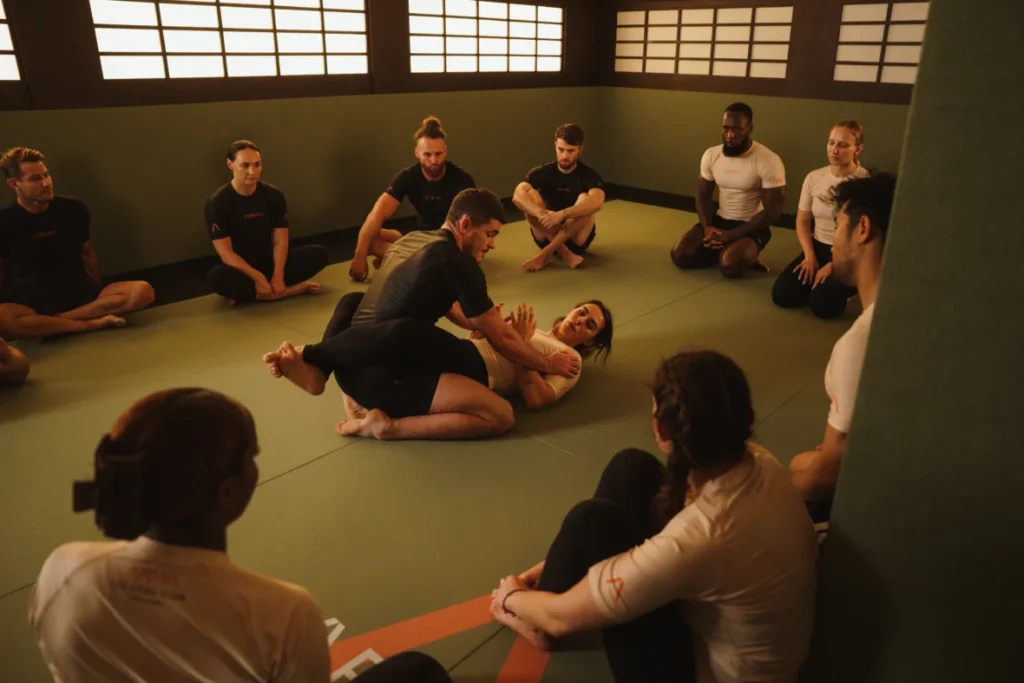
Zuckerberg’s physical transformation is the most striking and least ambiguous of any major tech CEO. Starting with Brazilian Jiu-Jitsu in the summer of 2022 under coach Dave Camarillo at Guerrilla Jiu-Jitsu in San Jose, he became — by his own description — immediately obsessed. By 2023, he was competing, winning gold and silver medals at a BJJ tournament in Redwood City. His training currently involves MMA and BJJ three to four times per week (technical drilling, positional sparring, rolling), with cardio, strength, and mobility work on off days. He rarely takes a day completely off — on genuinely tired days he walks.
His public framing is telling. Speaking to Joe Rogan, Zuckerberg described training as cognitive reset: “After an hour or two of working out or rolling or wrestling with friends, now I’m ready to go solve whatever problem at work for the day.” The technical complexity of BJJ — position, leverage, anticipation, real-time problem solving — likely provides a form of active mental engagement that passive exercise like jogging doesn’t replicate. His neck visibly changed, prompting Rogan to comment on air: “You look thicker. You look like a jiu-jitsu guy now.”
He also uses Meta Quest 3 VR for supplemental fitness sessions — a product integration that doubles as genuine workout variety.
Why Combat Sports, Specifically?
Several tech founders have drifted toward martial arts, which at first seems like an unusual trend. The appeal likely isn’t machismo — or not primarily. Martial arts training combines several evidence-backed benefits simultaneously: high-intensity cardiovascular work, resistance training, complex skill acquisition that demands full cognitive attention, and social engagement through sparring partners. The ego-flattening quality of BJJ in particular — where a 130-pound practitioner can submit someone twice their size, where status outside the gym is entirely irrelevant — may offer something psychologically valuable to people who spend their working lives in environments where their authority is rarely challenged.
Zuckerberg himself noted that BJJ is one of the few activities where “there’s no shortcut — you just have to show up and work.” For a person whose professional environment has few honest feedback loops, that may matter more than the exercise itself.
Bryan Johnson: The Most Measured Man Alive
Bryan Johnson is a different category of case study. The Braintree founder sold his company to PayPal for $800 million in 2013 and has since redirected a significant fraction of his fortune toward a single question: can biological ageing be meaningfully slowed or reversed in a living human, using the person themselves as the experimental subject?
His Blueprint Protocol is public, unusually transparent for a personal health programme, and updated regularly as his biomarkers change. He spends an estimated $2 million annually on it and has a physician-led team tracking him continuously. He has described himself as the most measured person in history, which is plausible — his testing regime covers hundreds of biomarkers across dozens of categories.
Bryan Johnson — Blueprint
The self-quantification extreme
Johnson’s protocol centres on four pillars: diet, sleep, exercise, and supplementation. On diet, he eats exclusively plant-based food, typically around 1,977 calories per day, finishing his last meal in the early afternoon and not eating again until the following morning — a roughly 16+ hour daily fast. He tracks his sleep rigorously; consistent 8–9 hour windows are a priority.
His exercise protocol targets VO₂ max (via interval training), strength (resistance work), and flexibility — about an hour per day. His supplement stack is extensive and evolving: core items include NAD+ precursors (NMN/NR on rotation), vitamin D, omega-3s, magnesium, B12, creatine, and various polyphenol extracts. Some have strong evidence bases; others are experimental.
In late 2024, Johnson completed a 60-session hyperbaric oxygen therapy (HBOT) protocol at 2 atmospheres, 100% oxygen, 90 minutes per session. His published March 2025 results reported hsCRP (a systemic inflammation marker) falling below detectable levels, and a 2.6% extension in telomere length — from 10.3 to 11.4 kilobases. He also received gene therapy targeting follistatin, reportedly producing a 160% increase in follistatin levels, with the aim of inhibiting myostatin and preserving muscle mass.
Johnson’s protocol has been rigorously critiqued by the American Council on Science and Health, among others. The core methodological problem is unavoidable: this is an n=1 case study with no control group, extreme confounding (everything is changing at once), and self-reported outcomes. Case studies are the lowest tier of scientific evidence. There is genuinely no way to know which interventions, if any, produced the observed biomarker changes.
The supplement stack exemplifies this problem. Some components — vitamin D, omega-3s, B12, magnesium, creatine — have solid evidence bases for populations with deficiencies. Others, like NAD+ precursors, have promising animal data but limited human evidence at the doses and durations Johnson uses. Still others are experimental in ways that should give serious pause: gene therapy administered outside of a clinical trial setting is not standard medicine.
What Blueprint represents, ultimately, is a serious, well-resourced attempt to collect personal health data at unprecedented resolution. Whether it produces the longevity outcomes Johnson believes it will is a question that can’t yet be answered.
The Specific Hacks — What the Evidence Actually Supports
Pulling back from individual executives to the techniques themselves, it’s worth being precise about what’s well-evidenced versus fashionable. The biohacking ecosystem generates enormous enthusiasm and significant revenue from techniques that range from genuinely effective to essentially unproven.
Comparing the Philosophies
Looking across these four executives, three distinct models emerge for how a person in an extreme-demand role manages their biology.
| Executive | Core Philosophy | Primary Intervention | Evidence Grade | Cost / Accessibility |
|---|---|---|---|---|
| Jeff Bezos | Decision quality over decision quantity | 8 hrs sleep, late-morning cognitive work, routine morning | Strong | Accessible |
| Tim Cook | Systems design reduces cognitive load | Early rising, daily exercise, consistent routine, meditation | Strong | Accessible |
| Mark Zuckerberg | Physical challenge as cognitive reset | BJJ/MMA 3–4x/week, cold plunge, daily movement | Moderate–Strong | Moderate cost |
| Bryan Johnson | Maximum measurability, radical protocol | Plant-based caloric restriction, HBOT, gene therapy, 40+ supplements | Mixed / Experimental | ~$2M/year |
What strikes a careful observer is how much of the genuinely evidence-backed material costs almost nothing. Bezos’ most important habit — protecting 8 hours of sleep and using the mornings for high-value cognitive work — is available to anyone who can restructure their schedule. Cook’s routine is almost militantly ordinary in its components (gym, bran cereal, consistency). The expensive edge of biohacking — Johnson’s protocol — is also the edge where the evidence gets thin.
This doesn’t mean money buys nothing. Access to precise biomarker testing, personal trainers, nutritionists, and the ability to structure one’s days without a commute or a boss scheduling meetings at 7 a.m. are real advantages. But the correlation between expenditure and outcome in this space is weak, and the fundamental interventions remain stubbornly democratic.
The Decision Fatigue Architecture
One concept that runs through nearly all of these routines, often without being named explicitly, is decision fatigue — the well-documented tendency for the quality of human decisions to degrade as the volume of decisions made in a day accumulates. The research on this is somewhat more contested than the popular version suggests (the famous Israeli judges study has faced replication challenges), but the basic principle — that willpower and cognitive control are depletable resources — remains plausible and influential in executive circles.
Zuckerberg’s famously identical wardrobe (grey t-shirts, jeans) is the canonical example. Cook eating the same bran cereal every morning at the same cafeteria. Bezos’ fixed meeting times and hard cutoffs. These aren’t quirks — they’re environmental design choices that systematically reduce the number of micro-decisions made before the genuinely important ones.
The practice is formalized in what some researchers call “implementation intentions” — pre-committing to behaviours so they run on autopilot rather than requiring fresh deliberation each time. The cognitive savings are real, even if the magnitude of the effect on high-stakes decisions is harder to quantify precisely.
What’s Being Oversold
Honesty requires spending some time here. The biohacking industry has an enthusiasm problem. Several popular interventions are marketed with a confidence that significantly exceeds the supporting evidence.
Cold Plunges
Cold water immersion does produce a real, short-term elevation in norepinephrine — associated with improved mood and alertness — and has genuine anti-inflammatory effects in specific contexts (post-exercise muscle recovery, for example). What it doesn’t do, in a typical 3-minute consumer cold plunge, is meaningfully extend lifespan, radically improve metabolism, or produce the dramatic hormetic benefits frequently claimed. Zuckerberg uses cold plunges as part of his post-training recovery protocol, which is a reasonable application. Using them as a substitute for evidence-based interventions would be a mistake.
Most Supplement Stacks
The core supplements with solid evidence are genuinely useful for people who are deficient in them: vitamin D (most people in northern latitudes), magnesium, B12 (especially important for plant-based eaters like Johnson). Beyond the basics, the evidence for most longevity supplements is largely animal studies and mechanistic plausibility. NMN and NR for NAD+ levels, for instance, have promising preclinical data but modest human trial evidence — a fact the more honest practitioners in this space, including Attia, acknowledge.
Biological Age Clocks
Epigenetic age testing (like the TruAge clocks Johnson uses) is a genuinely exciting research area but is currently imprecise enough that individual results should be treated as directional rather than definitive. The tests measure the methylation pattern of your DNA, which correlates with biological ageing at a population level. Whether a 5.1-year reduction in Johnson’s epigenetic clock score represents a meaningful change in his actual ageing trajectory is a question that cannot currently be answered.
What Actually Works — The Evidence-Based Summary
- Sleep 7–9 hours with consistent timing. This is where the highest-confidence return on effort sits. Protect it before anything else.
- Build aerobic capacity (VO₂ max). Moving from the bottom quartile of cardiorespiratory fitness to average is associated with a 50–70% reduction in all-cause mortality over a decade. This is the most dramatic leverage point in evidence-based longevity.
- Do resistance training regularly. Muscle mass in later decades correlates strongly with functional independence and survival. Two to three sessions a week is adequate for most people.
- Design your environment to reduce micro-decisions. The executives who perform best cognitively over long timescales are those who have structured their days to conserve deliberate attention for their highest-value work.
- Prioritise cognitively demanding work early. Bezos’ 10 a.m. meeting rule and hard afternoon cutoff reflect real patterns in circadian cognitive function. Most people are sharpest in the mid-morning.
- Be sceptical of expensive interventions without strong human trial data. The gap in outcomes between Johnson’s $2M protocol and a consistent sleep-exercise-diet routine, measured honestly, is narrower than the cost difference would suggest.
The patterns here, taken together, suggest something fairly practical: the executives managing these responsibilities most effectively over time have built routines that treat the body as a precision instrument rather than a vehicle to be run until it breaks. They prioritise recovery as aggressively as output. They design their physical environments to reduce friction on healthy behaviours. And they tend — the most grounded ones, at least — to be more interested in consistency than in novelty.
The flashier end of tech health culture — the $50,000 blood tests, the gene therapies, the plasma transfusions — generates enormous media coverage but almost certainly produces marginal benefits compared to the less glamorous fundamentals. There’s a certain irony in the fact that the most evidence-backed advice a tech billionaire could receive is essentially the same advice available to everyone else: sleep properly, exercise consistently, eat mostly whole foods, and stop scheduling important decisions at 5 p.m.
The difference, perhaps, is that they’ve actually built the systems to follow it.
More from FutureNow
Sources & References
- Agyapong-Opoku F et al. “Examining the Effects of Sleep Deprivation on Decision-Making: A Scoping Review.” Behavioural Sciences, 2025. doi:10.3390/bs15060823
- Zimmerman ME et al. “The effects of insufficient sleep and adequate sleep on cognitive function in healthy adults.” Sleep Health, 2024. PMID: 38233280
- Mandsager K et al. “Association of Cardiorespiratory Fitness With Long-term Mortality Among Adults Undergoing Exercise Treadmill Testing.” JAMA Network Open, 2018.
- Bezos J. Interview with David Rubenstein, Economic Club of Washington, 2018. Via CNBC.
- Cook T. Interview on Table Manners podcast, January 2025. Via Fortune.
- Zuckerberg M. Conversation with Lex Fridman, 2023. Via Fortune Well.
- Zuckerberg M. Conversation with Joe Rogan, 2024/2025. Via Routine Impact.
- Bryan Johnson, Blueprint Protocol public documentation. blueprint.bryanjohnson.com
- American Council on Science and Health. “Longevity or Marketing? Dissecting the Claims of the Blueprint Protocol.” February 2025. acsh.org
- Attia P. “The [almost] unbelievable effects of a high maximal aerobic capacity on all-cause mortality.” peterattiamd.com
- 9to5Mac. “Apple CEO Tim Cook details his 4 a.m. morning routine.” October 2024. 9to5mac.com
The One Productivity Trick Billionaires Swear By
5 Time-Saving Habits That Actually Reclaim Your Week in 2026
The Secret Longevity Diet Hacks Billionaires Are Using in 2025-2026
Biohacking Secrets 2026: How Hackers Add 20 Extra Years to Life