
Why College Degrees
Could Become Worthless Soon
The promise of a bachelor’s degree as a reliable path to prosperity is cracking — not just at the edges, but at the foundation. Here’s the evidence, the data, and what it actually means for you.
TL;DR — What You Need to Know in 2 Minutes
The narrative that a four-year college degree is the universal ticket to a decent career is losing its empirical footing faster than most colleges will admit. Here’s the compressed version of everything below.
- The entry-level job market has fractured. Just 30% of the Class of 2025 secured full-time work in their field, down from 41% the year before. AI automation is a primary driver, with major employers explicitly replacing entry-level roles.
- The wage premium still exists — but it’s narrowing and highly unequal. The aggregate lifetime earnings advantage ($2.8M vs. $1.6M) hides an enormous spread. The bottom 25% of college grads earn less than 50% of high school grads. Major and institution matter enormously.
- Credential inflation is real and accelerating. Employers dropped degree requirements when labor was tight; many are putting them back now that it’s not — and increasingly filtering by which school.
- AI is not just a threat — it’s already happening. Big-tech hiring of recent graduates is down 50% since 2020. Entry-level roles in AI-exposed fields (software, marketing, sales) showed 16% slower employment growth than less-exposed roles.
- The debt math is broken for millions. At $42,000+ in average borrowing for a credential that takes longer and longer to pay off, a large minority of students end up with a genuinely negative financial return.
- The degree isn’t dead — but it’s being radically de-risked. What field you study, where, how much you borrow, and how quickly you finish matters more than ever. The right degree can still be a sound investment. The wrong one, from the wrong school, at full price, for the wrong labor market — is not.
- Alternatives are maturing rapidly. Bootcamps, apprenticeships, industry certifications, and skills-based hiring pathways are no longer second-tier options in many fields.
Table of Contents
- 01The Crack in the Foundation
- 02AI Is Already Eating Entry-Level Jobs
- 03The Wage Premium: Still Real, Often Misleading
- 04Credential Inflation & the Employer Reversal
- 05The Debt Trap: When the Numbers Stop Working
- 06What’s Actually Working Instead
- 07Which Degrees Still Pay — And Which Don’t
- 08Making the Call: A Framework for 2026
- 09FAQ: Questions People Actually Ask
- 10Final Thoughts
1. The Crack in the Foundation
For most of the twentieth century, the deal was simple and broadly honored: go to college, get a degree, get a job. The credential served as a socially legible signal that you were trainable, disciplined, and minimally educated. Employers trusted it. Families sacrificed for it. Society organized around it.
That deal is not broken. But it has been significantly renegotiated — and millions of students entering college today are doing so without anyone showing them the new terms.
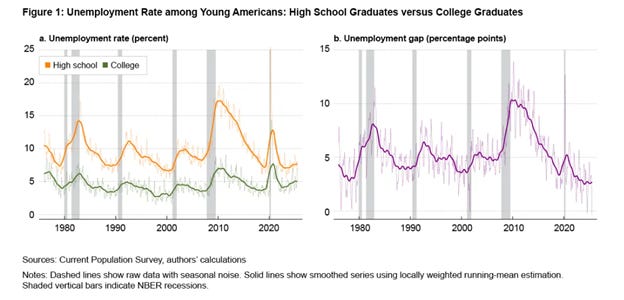
In November 2025, researchers at the Federal Reserve Bank of Cleveland published what may be the starkest single data point of this shift: young college graduates between ages 22 and 27 are now spending more time unemployed than job hunters with only a high school diploma. Their monthly “job-finding rate” — the share who either land work or exit the search — was 37.1%, compared to 41.5% for their peers who stopped at high school. The gap between degree-holder and non-degree-holder employment prospects, they wrote, is at its smallest point since records were reliably tracked.
“For the first time in modern history, a bachelor’s degree is no longer a reliable path to professional employment.”
— Gad Levanon, Chief Economist, Burning Glass Institute, November 2025That quote, from the chief economist of the Burning Glass Institute — a nonprofit labor analytics firm, not an axe-grinding pundit — ran in a CNBC report in November 2025. He wasn’t being provocative. He was reading data.
The Burning Glass Institute’s own July 2025 analysis found that one year after graduation, 52% of the class of 2023 were working in jobs that didn’t require a degree at all. Their description: a “flipped pyramid.” Demand for experienced, senior-level workers remains relatively robust. The rungs at the bottom of the ladder — the entry-level positions that used to turn graduates into competent professionals — are disappearing.
in non-degree jobs
one year out
secured field-relevant
full-time work
recent college grads
Dec 2025
recent grads ages
22–27 in 2025
This isn’t simply a bad economy for everyone. The broader labor market is soft, yes — but the specific deterioration at the entry level of degree-requiring white-collar work is happening faster and more structurally than the general picture suggests. Young graduates aren’t just caught in a cyclical downturn. They’re caught in a structural one, and these tend not to reverse when the economy picks up.
2. AI Is Already Eating Entry-Level Jobs
The technology story here isn’t speculative. It’s not “AI might disrupt white-collar work.” It’s already doing it, and entry-level college graduates are the first casualties.
SignalFire, a data-driven venture capital firm, found that between 2019 and 2024, there was a 50% decline in new roles for people with less than one year of experience at top tech companies. In 2024 alone, hiring of recent graduates by big-tech companies fell 25% compared to 2023, according to SignalFire’s research published by TechCrunch. In sales, design, HR, engineering, and legal departments — fields where graduates once landed their first jobs — the traditional footholds are shrinking.
Companies have been explicit about why. In 2025, executives at several large employers publicly stated they were using AI to replace entry-level functions. The rationale is straightforward: a junior analyst who spent four years learning to research, summarize, and format reports can now be partially or wholly replaced by AI tools that do those tasks faster and without benefits. That doesn’t eliminate the need for analytical judgment, but it does eliminate the headcount needed to perform the labor-intensive parts of the job.
A paper titled “Canaries in the Coal Mine?” from Stanford’s Digital Economy Lab found that early-career workers in roles most exposed to AI — software developers, marketing professionals, sales managers — saw 16% slower employment growth than the least AI-exposed young workers between mid-2024 and September 2025.
The metaphor is apt. The canary in the coal mine doesn’t die because it’s weak. It dies because it’s at the frontline. Entry-level workers in AI-exposed roles are the first to feel what broader swaths of the workforce will feel later.
The Class of 2025 submitted more job applications per person than the Class of 2024 did — 10 versus 6, on average, according to the National Association of Colleges and Employers (NACE). They received fewer offers: a mean of 0.78 vs. 0.83 for the previous class. More effort, worse outcome. That trajectory doesn’t usually reverse without structural change.
About half of employers — 51%, the highest share since 2020–21 — rated the job market for this year’s college seniors as “poor” or “fair.” That’s not from students complaining online. That’s from the employers themselves.
IBM’s Workforce Transformation — From Degrees to Demonstrated Skills
IBM, which employs roughly 288,000 people worldwide, has been at the forefront of rethinking credential requirements since former CEO Ginni Rometty coined the term “new collar workers” in 2016. The company now fills approximately 50% of its U.S. job openings without requiring traditional four-year degrees — and reports that “new collar” hires perform comparably to, and often better than, their degreed counterparts.
IBM’s Vice President of Talent stated as far back as 2017 that the company was actively replacing degree requirements with skills assessments and that boot camp credentials were being evaluated on equal footing with university ones. The company built its own internal training pathway — SkillsBuild — as a direct alternative to traditional credentialing.
It’s worth noting what AI automation does not do: it doesn’t eliminate all knowledge-work jobs. The roles that remain and grow are precisely the ones that require judgment, client relationships, creative direction, and the ability to supervise and prompt AI systems. These roles skew toward experienced workers, which compounds the problem for new graduates who can’t get experience because there are no entry-level roles to gain it in.
4. Credential Inflation and the Employer Reversal
One of the stranger dynamics of the past few years has been the pendulum swing on degree requirements among employers. When labor was scarce (roughly 2021–2023), companies dropped credential requirements to widen their talent pool. When labor loosened, many put them back — and in some cases, added new ones.
The Cengage Group’s 2025 Graduate Employability Report found that 71% of employers now require a two- or four-year degree for entry-level roles, up sharply from 55% in 2024. When employers have more applicants than jobs, they use credentials as a filtering mechanism — not necessarily because the degree predicts job performance, but because it’s a low-cost screen for discipline and persistence.
There’s a darker layer to this, too. A 2025 survey of over 150 companies by recruiting intelligence firm Veris Insights found that more than a quarter — 26%, up from 17% in 2022 — were recruiting exclusively from a brief selection of schools. The credential isn’t just “do you have a degree.” For an increasing number of employers, the relevant question is “did you attend one of our target schools?”
Credential inflation means that as more people hold a bachelor’s degree, the degree itself becomes less differentiating. To stand out, you need a degree from a better school, a graduate degree, or specialized certifications on top of the bachelor’s. Each rung of that ladder costs more money and time.
This creates a perverse incentive structure: the more widely held a credential becomes, the less it signals, and the more pressure there is to spend on additional credentials to signal above the baseline. For families with resources, this is navigable. For first-generation college students borrowing to attend, it often isn’t.
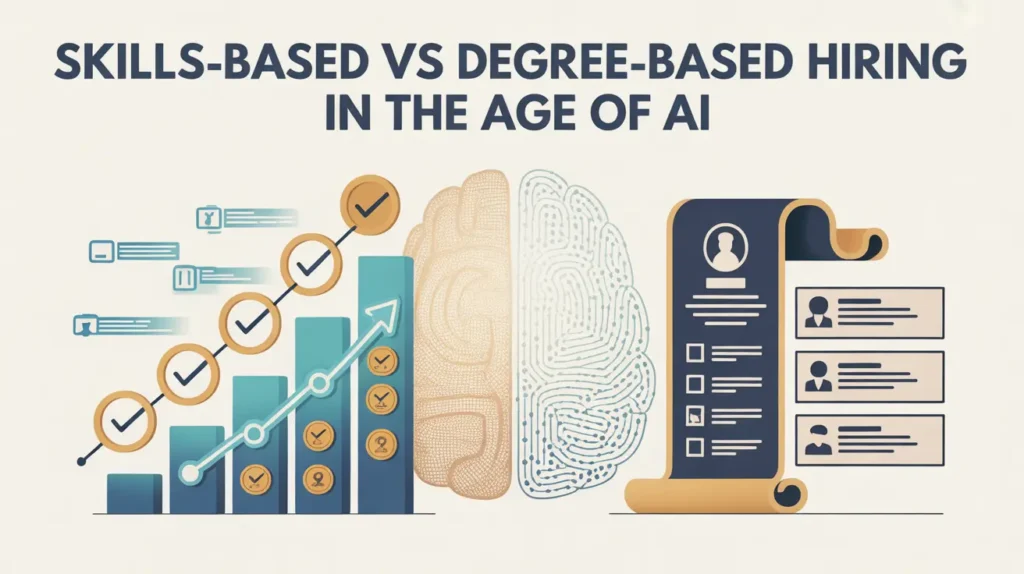
That said, the employer landscape is genuinely bifurcated. Companies like IBM, Google, Apple, Tesla, and Bank of America have made high-profile moves to eliminate degree requirements for many roles — and in IBM’s case, now fill roughly half of open roles without requiring one. A 2025 survey found 81% of U.S. companies embracing skills-based hiring in at least some capacity, compared to 73% in 2023. But the critical qualifier is “in at least some capacity.” The positions where degree requirements have been dropped tend to be specific, and many employers retain them broadly while publicly signaling openness to alternatives.
Meanwhile, a 2025 survey by Intelligent.com found that 53% of hiring managers said their company had eliminated bachelor’s degree requirements for some roles — and 76% said they favored experience over education in at least some situations. These numbers coexist comfortably with the Cengage finding that degree requirements are going up. The truth is that the labor market for college graduates is not moving in one direction. It’s fragmenting.
5. The Debt Trap: When the Numbers Stop Working
The financial case for or against college cannot be evaluated without confronting the debt reality. Total U.S. student loan debt crossed $1.83 trillion as of 2025, according to multiple financial tracking sources. Average federal student loan debt per borrower stands at approximately $39,375, with total debt including private loans reaching roughly $42,673 for many graduates.
These aren’t abstract numbers. They translate into monthly payment obligations that structurally reshape the first decade of adult financial life: delayed home ownership, constrained emergency funds, deferred retirement contributions, and reduced ability to absorb career setbacks.
| Education Path | Typical Total Cost | Avg. Time to Employment | Entry-Level Salary Range |
|---|---|---|---|
| 4-Year Public University | $80,000–$120,000 | 3–9 months after graduation | $42,000–$65,000 (varies widely by major) |
| 4-Year Private University | $160,000–$260,000+ | 3–9 months after graduation | $45,000–$75,000 (network-dependent) |
| Community College + Transfer | $20,000–$50,000 | 2–6 months post-bachelor’s | Comparable to 4-year in many fields |
| Coding Bootcamp (12–24 weeks) | $10,000–$20,000 | 1–4 months post-completion | $50,000–$75,000 in tech roles |
| Apprenticeship (trade/tech) | $0–$5,000 (earn while learning) | Employed during program | $45,000–$85,000 in skilled trades |
| Google/AWS/Microsoft Certifications | $300–$3,000 | 2–6 months post-certification | $55,000–$90,000 in cloud/IT roles |
In July 2025, the One Big Beautiful Bill Act was signed into law, ending the Grad PLUS loan program for borrowers beginning programs on or after July 1, 2026. While the stated rationale was controlling ballooning graduate debt, the practical effect for many students will be restricted access to graduate programs — the very programs that have become increasingly necessary to differentiate in a credential-inflated market.
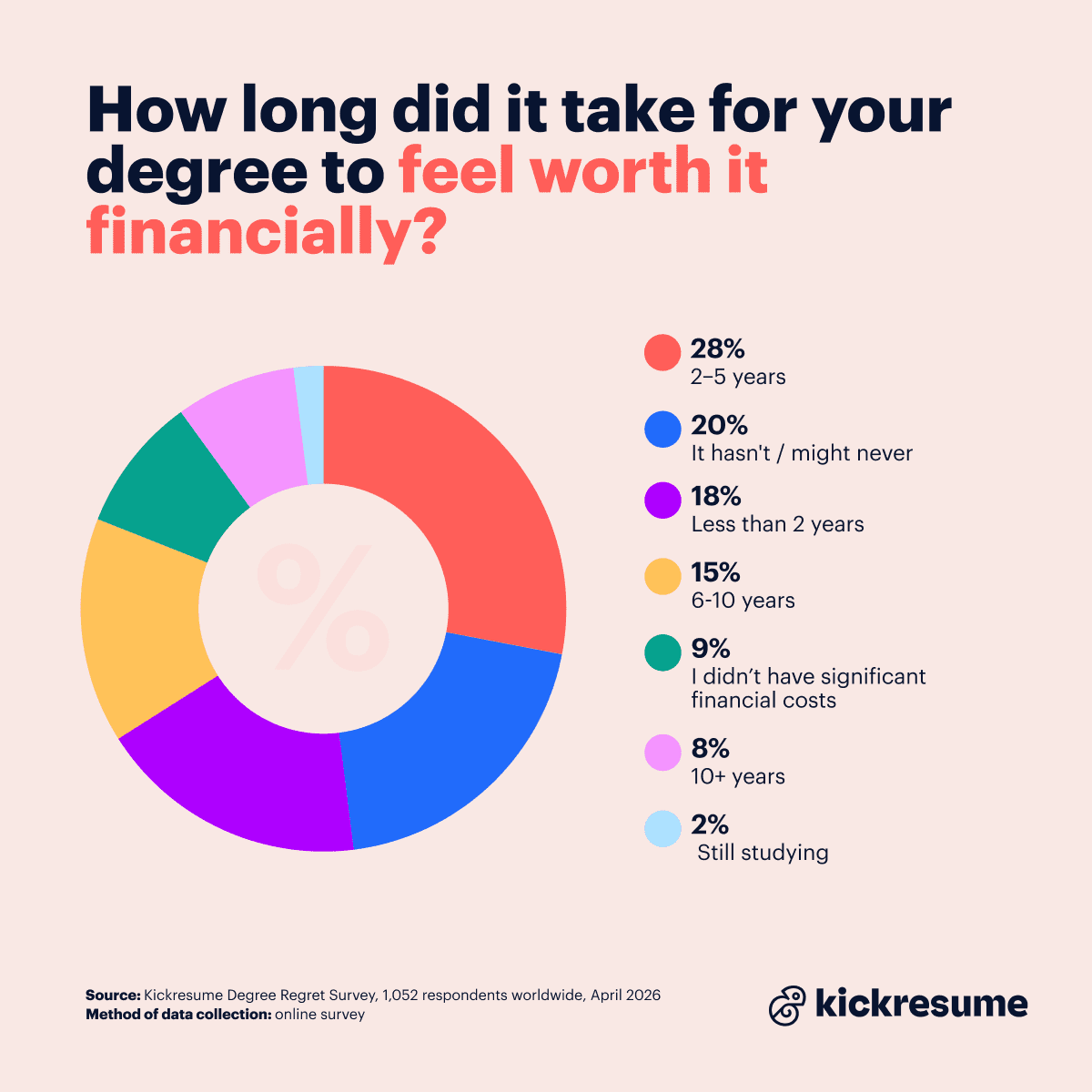
The ROI math on college debt is genuinely favorable for the median student who graduates in four years with average debt in a market-rate major. It becomes significantly less favorable for anyone who takes five or six years, borrows heavily for a low-wage field, or attends a high-cost private institution for a program without strong placement rates. And for the bottom quartile of graduates — at least 25% of everyone who gets a bachelor’s — the Federal Reserve’s own data suggests the return doesn’t justify the investment.
You will sometimes see the statistic that 75% of undergraduates carry no federal loans, cited to argue that the debt crisis is overstated. This is technically accurate but selectively framed. The 56% of student debt is held by graduate and professional students, who borrowed more, often for credentials that don’t pay off. The 7% of borrowers who hold 38% of all student debt are typically graduate and professional degree holders.
The debt crisis isn’t uniformly distributed. But for the portion of the population it affects, it’s severe — and the One Big Beautiful Bill Act’s changes to graduate lending will shift costs rather than reduce them.
6. What’s Actually Working Instead
The conversation about whether to go to college has, for too long, been framed as binary: go to a four-year university, or don’t go at all and make do. That framing is now badly outdated. A growing ecosystem of alternatives has matured to the point where they represent genuine career paths, not fallback options.
Coding and Tech Bootcamps
The bootcamp model, originally built for software development, has expanded into data science, cybersecurity, UX design, digital marketing, and product management. Programs typically run 12–24 weeks, cost $10,000–$20,000 (a fraction of a semester at many universities), and many offer income-share agreements that delay payment until the graduate is employed. Starting salaries for bootcamp graduates in tech roles average $50,000–$75,000, with placement rates that — at the better programs — are genuinely competitive with traditional CS degrees.
General Assembly, Flatiron School, and others have built substantial placement track records. The key variable, which holds across all credential types including university degrees, is the quality of the institution and the relevance of the program to actual employer demand.
Industry Certifications
Google, AWS, Microsoft, and CompTIA have all built certification pathways that are now taken seriously by employers, particularly in cloud infrastructure, IT support, cybersecurity, and data analytics. Google’s Career Certificate programs, available through Coursera, cost under $500 and have resulted in hires at companies including Walmart, Infosys, and Bank of America. They’re not a universal substitute for a degree — but in specific technical domains, they’re increasingly a sufficient one.
Apprenticeships
The apprenticeship model — which pairs paid employment with structured training — has expanded well beyond the traditional trades into healthcare, finance, and technology. The core advantage is that it eliminates both the debt and the opportunity cost of four years out of the workforce. Apprentices earn while they learn, create direct pathways to employment with sponsoring organizations, and often outperform their university-educated peers on job-specific skills because they’ve been doing the work, not studying it.
Traditional 4-Year Degree
- ✓ Lifetime earnings premium (aggregate)
- ✓ Broad career optionality
- ✓ Network and alumni access
- ✓ Required for licensed professions
- ✗ $42K+ average debt load
- ✗ 4–6 years to completion
- ✗ Highly variable ROI by major/school
- ✗ Entry-level job market deteriorating
Skills-First Alternatives
- ✓ Low or zero debt
- ✓ 3–24 months to employment
- ✓ Strong ROI in specific technical fields
- ✓ Portfolio-based hiring increasingly accepted
- ✗ Narrower career optionality
- ✗ Closed for licensed professions (law, medicine)
- ✗ Credential inflation threatens some pathways
- ✗ Network access typically weaker
It’s worth being honest here: there are careers where a four-year degree is not optional. Medicine, law, engineering requiring licensure, academia, and many government positions maintain strict credential requirements that aren’t going away. Anyone planning on those tracks doesn’t have a genuine choice about undergraduate education. The question of alternatives is most relevant for the large middle ground of professional work — knowledge work, tech, business, design, marketing, and the creative industries — where the credential has historically served as a filter rather than a genuine training requirement.
7. Which Degrees Still Pay — and Which Don’t
If there’s one thing that both the skeptics and the defenders of higher education agree on, it’s this: not all degrees are equal, and the variance in outcomes has widened. The question isn’t just “is college worth it?” It’s “is this specific degree, from this specific institution, worth it for this specific person entering this specific labor market?”
| Major Category | Employment Outlook | Median Starting Salary (2025) | AI Disruption Risk (Entry) | Verdict |
|---|---|---|---|---|
| Computer Science / Software Engineering | Weakening for entry-level | $85,000–$110,000 | High | Conditional — depends on AI skills |
| Nursing / Healthcare | Strong; shortage persists | $55,000–$72,000 | Low | Strong investment |
| Engineering (Civil, Mechanical, Electrical) | Stable to growing | $70,000–$95,000 | Medium | Strong investment |
| Finance / Accounting | Selective; entry-level squeezed | $55,000–$75,000 | Medium-High | Depends heavily on employer |
| Liberal Arts / Humanities | Weak; credential inflation | $38,000–$48,000 | High (writing, research roles) | Poor standalone ROI in most cases |
| Education (K-12) | Shortage in many states | $40,000–$52,000 | Low | Depends on location and lifestyle fit |
| Skilled Trades (licensed) | Very strong; shortage | $55,000–$90,000 | Very Low | Excellent non-degree alternative |
The Georgetown Center on Education and the Workforce has documented extensively that 28% of associate degree holders and 16% of high school graduates earn more than the median bachelor’s degree holder. That’s not a fringe outcome. A licensed electrician in a major metro area with a decade of experience regularly earns more than an English literature graduate from a private university who went on to work in publishing or nonprofits. The trades have been systematically undervalued in cultural prestige relative to their financial reality.
8. Making the Call: A Framework for 2026
Given the complexity, here’s a practical decision framework — not a prescription, but a set of questions worth answering honestly before signing on for $40,000 or more in debt.
1. Does your intended career legally require a degree? If yes, there’s no framework needed — you need the credential. If you want to be a doctor, lawyer, licensed engineer, or nurse practitioner, the path is defined. Plan for it financially, but don’t debate the necessity.
2. What is the realistic earnings distribution for your intended major, not the average? Look up the 25th, 50th, and 75th percentile earnings for people with your intended major five years out. If the 25th percentile is below what you’d earn through an alternative path with no debt, the downside risk of the degree is significant.
3. What is your total projected debt at graduation? Divide by ten — that’s roughly your annual payment under a standard repayment plan. If that figure exceeds 10–15% of the median starting salary in your field, you’re taking a meaningful financial risk.
4. What are the realistic alternatives? Not “college or nothing.” What are the actual alternative pathways — apprenticeships, certifications, community college plus transfer, bootcamps — for your target career? How do their outcomes compare to the four-year program you’re considering?
The honest answer, in 2026, is that college remains the right choice for many people and the wrong choice for a significant minority who would be better served by alternative paths. The problem isn’t college itself — it’s the cultural insistence that it’s the only legitimate route to a good career, combined with a system that prices itself as though it holds a monopoly it no longer fully holds.
Families with the ability to fund education without significant borrowing face a different calculus than families who can’t. A student who attends a public university, graduates in four years with modest debt, majors in a high-ROI field, and enters a career where the degree is genuinely relevant is still making a sound investment by any measure. A student who borrows $90,000 for a low-ROI major from a private institution because “it’s what you do” is playing a very different game.
9. FAQ — Questions People Actually Ask
Is a college degree still worth it in 2026?
For many people, yes — but the universal “college always pays” answer is no longer defensible. The median return on a four-year degree remains around 12.5% annually according to the NY Fed, which is solid. But the spread around that median is enormous. Major, institution, debt load, and graduation time all matter far more than they did a generation ago. For high-ROI fields like engineering, nursing, and certain business tracks, the degree remains a strong investment. For low-earning majors at high-cost schools with heavy borrowing, the math frequently doesn’t work.
Why are college graduates struggling to find jobs in 2025?
Several forces are converging: AI automation eliminating entry-level roles that graduates traditionally filled; a broader labor market softening; credential inflation causing employers to screen more aggressively; and a structural “flipped pyramid” where demand for experienced workers remains but entry-level openings have shrunk. The Burning Glass Institute’s July 2025 report found 52% of 2023 graduates were working in jobs that didn’t require a degree one year post-graduation.
Which degrees are most at risk from AI?
Stanford’s Digital Economy Lab found that early-career workers in software development, marketing, and sales — all fields that attract large numbers of graduates — saw 16% slower employment growth than peers in AI-insulated roles. Writing-heavy roles, research assistance, data entry, junior analysis, and content creation are all areas where AI tools have materially reduced the demand for human labor at the entry level. Healthcare, skilled trades, education, and in-person service professions remain significantly more insulated.
Are coding bootcamps a legitimate alternative to a CS degree?
For many people entering tech, yes. A four-year CS degree from a strong university still provides advantages in competitive hiring at major tech companies and in more theoretical or research-oriented roles. But for web development, data analytics, UX, and many cloud infrastructure roles, a well-regarded bootcamp plus a strong portfolio has proven sufficient to get hired. The caveat: bootcamp quality varies enormously. Verify placement rates, check LinkedIn profiles of graduates, and understand the income-share terms before enrolling.
Have companies really dropped degree requirements, or is that mostly PR?
It’s both. IBM, Google, Apple, Tesla, Bank of America, and others have genuinely removed degree requirements from significant numbers of job postings, and IBM’s reported ~50% non-degree hiring is substantive. However, Cengage Group’s 2025 data shows that 71% of employers still require a degree for entry-level roles — up from 55% in 2024. Companies use credential requirements as a filtering tool when applicants are abundant. “We hire on skills” is often more aspirational than operational.
What is credential inflation and why does it matter?
Credential inflation happens when more and more workers hold a given credential, reducing its signal value and pushing the threshold upward. As bachelor’s degrees became widespread, employers began distinguishing by graduate degree, school prestige, or additional certifications. This is expensive for students — and largely self-defeating, since the inflation continues as more people reach each new threshold. It’s one of the structural drivers of rising tuition: if you need the credential regardless of what it costs, the institution has pricing power.
How much student debt is too much?
A rough rule of thumb used by many financial planners: total undergraduate borrowing should not exceed your expected first-year salary. If you’re entering teaching at $45,000 and borrowing $80,000, you’re in structurally difficult territory. The NY Fed’s research suggests that each year beyond four to graduate significantly compresses ROI — from 12.5% at four years to 7% at six. Debt and time are the two biggest levers; controlling them protects the investment thesis even for moderate-ROI majors.
Is the college earnings premium shrinking?
The long-run aggregate premium remains substantial ($2.8M vs. $1.6M in average lifetime earnings per Georgetown CEW data). The gap at age 25 is about 27%, growing to 60% by age 55 per David Deming’s NBER research. However, the Federal Reserve Bank of Cleveland noted in late 2025 that the job-finding advantage for recent college graduates has reached its smallest point in the modern record. The premium exists but is narrowing at the crucial early-career stage when it’s most critical for financial momentum.
What are the best alternatives to a four-year degree in 2026?
It depends entirely on your field. For tech: coding bootcamps, Google Career Certificates, AWS certifications, CompTIA pathways. For skilled trades: registered apprenticeships — pay is competitive and AI automation risk is low. For healthcare support roles: community college associate degrees are typically sufficient and far cheaper. For business and marketing: a community college transfer pathway often produces equivalent outcomes at half the cost. For entrepreneurial paths: direct experience, online learning platforms, and capital are often more valuable than credentials.
Should I go to community college instead of a four-year university?
For many students, a two-year community college followed by a transfer to a state university is the highest-ROI path available. It typically halves the total debt load while producing a diploma from the same institution as four-year students. The caveat is execution: transfer requirements need to be planned in advance, and some programs (nursing, engineering) have prerequisites that require careful sequencing. The stigma around this path has mostly dissolved among employers who actually hire — what shows on the diploma is typically the transferring institution, not the community college.
Will AI eventually make all degrees worthless?
No, and anyone claiming that is overstating the case. Degrees in medicine, law, engineering, and fields requiring deep technical or scientific reasoning will retain value for the foreseeable future. What AI is eroding is the value of credentials that primarily served as sorting mechanisms rather than certifications of genuine, irreplaceable skill. If your degree’s primary value was as a filter — proving you could show up consistently for four years — then yes, that signal is weakening as alternative demonstrations of capability proliferate.
What does “skills-based hiring” actually mean in practice?
In its most genuine form, skills-based hiring involves structured assessments, portfolio review, and take-home projects that evaluate what a candidate can actually do rather than where they went to school. IBM, for instance, uses targeted skills assessments for roles that have dropped degree requirements. In its less genuine form, it means removing the degree checkbox from job postings while still using it as an informal filter in interviews and resume review. The practice is real and growing, but candidates without degrees should be prepared to demonstrate competency more directly than degreed counterparts typically would.
10. Final Thoughts
The headline of this article is deliberately provocative, but the argument isn’t. College degrees are not becoming worthless across the board — but for a growing segment of students, a specific combination of factors is making them a poor investment: the wrong major, at the wrong school, with too much debt, in a labor market that’s structuring away entry-level positions. That combination is more common than the higher education industry would like to acknowledge.
The more honest framing is this: the automatic value of a college degree — the idea that any degree, from any school, in any field, justifies any price — is what’s becoming worthless. The discriminating value of a well-chosen degree, in the right field, at reasonable cost, from an institution with genuine career infrastructure, remains real.
The AI disruption is not a background hum. It’s already measurable in hiring data, employment rates, and the explicit statements of employers. The bottom rung of the white-collar ladder is eroding, and that rung is where almost every college graduate’s career begins. There’s no obvious mechanism for this to reverse; as AI capabilities improve, more of the tasks that justified entry-level hiring will be automated, and the runway problem will worsen.
What this calls for is neither panic nor dismissal. It calls for honest analysis — exactly the kind that most colleges, for understandable financial reasons, are reluctant to provide. High school seniors and their families deserve the full picture: the aggregate earnings data, the distribution underneath it, the debt reality, the alternatives, and the honest risk profile of specific programs at specific institutions. Armed with that, the decision can be made rationally rather than by default.
The fact that this conversation is finally happening — visibly, in mainstream publications, with real data — is, in a strange way, encouraging. The information environment around higher education has been systematically skewed toward the institutional interest for decades. It’s belatedly correcting, and students will be better equipped for it.
More from FutureNow
futurenow.click — Independent analysis on work, technology, and what comes next
Which Jobs AI Will Actually Replace — and When
The Best Certifications for a Career Without a Degree in 2026
Student Loan Strategy After the One Big Beautiful Bill Act
Trade School vs. University: A 2026 Cost-Benefit Breakdown
How to Make Yourself AI-Proof in the Next 5 Years
The Colleges With the Best — and Worst — Graduate Employment Rates
The Job Hack That’s Creating Millionaires Overnight (2026)
Virtual Reality Teacher: The Weirdest Future Career
The Shocking Future of Remote Work in 2026: Hidden Risks and Opportunities Nobody Talks About
AI Economy: 10 Jobs That Will Pay $200K in 2026
AI Jobs 2026: Why Regional Data Tells a Different Story Than Global Headlines
1 thought on “Do College Degrees Still Pay Off?”