

Digital Art & NFTs · Register: Analytical Updated April 2026 · ~2,200 words
Digital Art in 2025: The Market Shrank, the Serious Work Stayed
NFT art trading volume collapsed more than 90% from its 2021 peak. Christie’s closed its digital art department. And the artists who built real communities are doing fine. Here’s what actually happened.
Christie’s shut its digital art department in September 2025. Quietly, without much ceremony. The auction house that sold Beeple’s Everydays for $69.3 million four years earlier called it “a strategic reformatting.” NFT Paris cancelled its fourth annual fair. And by early 2025, NFT art trading volume had dropped to $23.8 million — down from $2.9 billion at the peak in 2021. That’s a 99% correction. Not a dip.
So. Is digital art dead?
No. But the story people are telling about it in 2026 is almost as wrong as the story they were telling in 2021. The hype piece you read last month — the one with the pixelated portrait hammering for $2.3 million and the “actionable steps to mint your first high-value piece” — is doing you a disservice. (I know because I’ve read five of them today.) What’s actually happening is more interesting, and more complicated.
The Numbers, Unspun
There are two completely different market sizes floating around in digital art coverage right now, and I’m going to try to explain why that’s not a conspiracy.
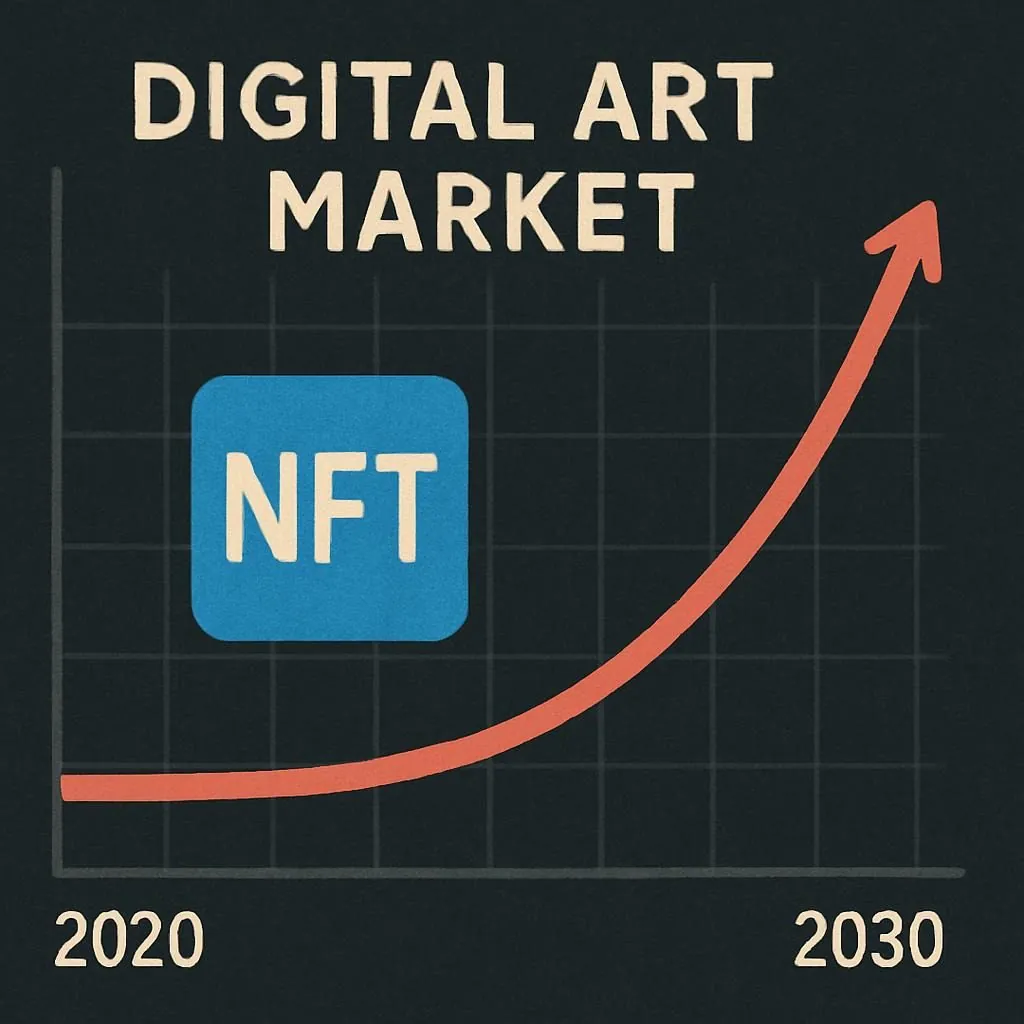
One set of numbers comes from tracking NFT marketplace revenue — actual money changing hands for actual tokens. Statista puts that at about $504 million in projected 2025 revenue, trending down 11% to roughly $479 million in 2026. Tier 2 source — methodology available; represents marketplace transaction revenue, not total market capitalization The other set of numbers — the ones that say “$43 billion market” — are projected valuations of the broader NFT ecosystem including speculative market cap, infrastructure, and gaming integrations. Two different animals. Both technically real. Most articles treat them as interchangeable.
What do those numbers tell you? The speculative retail market — the cartoon apes, the 10,000-piece PFP collections where you hoped number go up — that’s largely gone. And by 2023, reports indicated that roughly 95% of NFT collections had become effectively worthless. The people who lost money were, mostly, people who bought things they didn’t understand from people who had every incentive to keep selling.
But serious collectors — the ones at institutions like MoMA, the Pompidou, LACMA, the Whitney, all of whom have acquired blockchain-based artworks — are still here, still buying. And the share of high-net-worth portfolios going to digital art increased from 3% in 2024 to 13% in 2025. Tier 3 — Blockchain Council report; independent audit not found; treat as directional That’s the thesis-complicating finding I’ll return to: the crash cleared out the tourists, and the serious collectors stepped in.
The crash didn’t kill digital art. It killed the part of digital art that was never really about art.
Editorial synthesis — sources: Artsper NFT Art Boom to Bust analysis (2025), Dazed Digital rise & fall reporting (2025), Art & Object (September 2025)
What Actually Survived (And Why)
Here’s the thing Robert Alice — artist and author of On NFTs (2025) — said in a late-2025 interview that I keep thinking about: “Ironically, it’s everybody else that’s interested in these crazy prices, not the people who are actually in the space.” There was a community building with blockchain-based art years before the 2021 frenzy. That community is still there.
What survived looks different from what got hyped. A few patterns.
Utility-first NFTs. OpenSea CEO Devin Finzer put it plainly: “The days of just pure collectible NFTs, without some sort of interesting layer on top of that, are certainly over.” What’s working in 2025 is NFTs that grant access — to events, communities, collaborative projects, exclusive content. The ownership is almost incidental. The relationship it enables is the product.
Artist-community models. The artists doing well are the ones who built audiences before they built tokens. Not by following a checklist. By actually making work people cared about, then giving collectors a way to participate in something ongoing. Pattern drawn from multiple practitioner accounts — Tier 3, no systematic study found
Institutional acquisition. Serious museums acquiring blockchain art is real and ongoing. It’s not a large market, but it’s a stable one, and it signals the difference between “this movement” and “this moment.”
Here’s the part that doesn’t get discussed. The NFT boom failed partly because the ownership signal looked identical whether the underlying art was good or garbage. A 10,000-piece generative collection and a carefully considered 1/1 work both show up as “NFT sold for X ETH.” The market couldn’t distinguish between them, so it defaulted to hype and social signal instead of quality. The crash, whatever else it did, reintroduced the ability to make that distinction.
The Failure That Taught Everyone Something
Christie’s is the best-documented failure case here, and I want to give it the treatment it deserves instead of the two sentences most articles offer.
Christie’s didn’t just list Beeple and call it a day. They ran a full digital art department for three years. They had curators. They had infrastructure. They did the work. And they still closed it in September 2025. Source: The Art Newspaper, September 2025; Art & Object
The lesson isn’t that Christie’s made a mistake. The lesson is that institutional infrastructure designed for speculative boom conditions can’t survive when the speculation ends. The department was sized for a market that no longer exists. The closure wasn’t a failure of vision. It was a failure of timing assumptions — the assumption that the 2021 market was a floor, not a ceiling.
For artists: the takeaway is that institutional validation isn’t the same as institutional durability. Being sold at Christie’s didn’t protect those artists from the crash. Community did.
Being sold at Christie’s didn’t protect those artists from the crash. Community did. That’s not a soft observation. It’s the actual hard lesson.
Editorial synthesis — sources: Center for Art Law analysis (January 2026), Art & Object (September 2025), Dazed Digital (November 2025)
What the Platforms Look Like Now
The marketplace landscape changed a lot between 2022 and today. Worth knowing before you mint anything.
| Platform | Model | 2025 Status | Best For | ⚠ Limitation |
|---|---|---|---|---|
| OpenSea | Open marketplace | $340M 30-day volume; 280K users coinlaw.io, Feb 2026 | Broad audience, beginners | Optional royalties hurt creator revenue by ~18%; high competition dilutes visibility |
| Blur | Pro trading | $520M 30-day volume; 220K users coinlaw.io, Feb 2026 | Active traders, collectors flipping volume | Ethereum-only; optimized for flippers not artists; creator royalties lowest here |
| Foundation | Curated auctions | Invite-only; smaller volume, higher per-item prices | Established artists with existing audiences | Invite barrier; slow sales cycle; audience-dependent — won’t build your community for you |
| SuperRare | High-end 1/1 | Opened offline brick-and-mortar gallery July 2025 | Serious collectors, institutional-adjacent work | Hard to enter; royalties up to 10% but volume is thin; phygital exhibition strategy still maturing |
| Rarible | DAO-governed, multi-chain | Active; smaller user base | Collaborative, community-governed projects | Governance complexity; smaller buyer pool than OpenSea or Blur |
The blockchain question matters more than most guides admit. Ethereum is where serious institutional money still sits — roughly 62% of NFT contracts, and over $920 million in royalties paid to Ethereum-based creators in 2025 alone. Solana is faster and cheaper, with about 18% of NFT activity. Tezos remains the environmentally-conscious option with artist-friendly infrastructure. Ethereum’s 2022 switch to proof-of-stake cut its energy use by over 99%, so the “Ethereum is destroying the planet” argument is mostly outdated at this point.
Here’s what I think is genuinely underreported: the platform split between Blur (optimized for trading volume, minimal royalties) and Foundation/SuperRare (optimized for artist relationships, maximum royalties) isn’t just a business model difference. It’s a market split between two completely incompatible theories of what digital art is. If you treat your work as a trading instrument, Blur is rational. If you treat your collectors as long-term relationships, Foundation is rational. These two markets will increasingly diverge, and the artists who try to straddle both will be legible to neither audience. The platforms are forcing a positioning decision whether artists make it consciously or not.
If You’re Actually Thinking About Minting Something
Okay. Real talk, not a 7-step blueprint.
The checklist-style guides you’ll find online treat minting like a production process: create art, pick chain, set royalties, build hype, launch. That sequence works if you already have an audience. If you don’t, you’re minting into silence. The process itself isn’t the problem. The sequence is.
What actually works, based on the pattern I’ve seen survive the crash: build the audience first. Not before you mint — before you even think about minting. Make work publicly, consistently, in a specific direction. Find the 200 people who care about exactly what you make. Then mint something for them.
The technical side is genuinely not complicated anymore. MetaMask or Phantom wallet, $20–100 in gas fees on Ethereum (less on Polygon or Solana), and either OpenSea (no-code, 2.5% platform fee) or Manifold (more control, slightly more setup). Royalties at 8–10% are standard. The platform decision matters less than the audience question.
- Do you have 200 people who care specifically about your work? If not, this is your actual first step.
- Does your work mean something outside the NFT context? Would it hold up shown in a gallery? Online without a blockchain certificate?
- Are you prepared for no sale on the first drop? Or the first three?
- Have you researched comparable work on your target platform — price, sell-through rate, time to sale?
- Have you disclosed any AI assistance in your process? Transparency builds more trust than hiding it.
- Is the utility you’re offering (if any) something you can actually deliver over time?
Stop doing this: pricing a first drop at 1 ETH because you saw someone else sell at 1 ETH. Comps matter. If similar work in your style and audience size is clearing at 0.05 ETH, price accordingly and build from there. The floor you establish on your first drop is the baseline your collectors will use to evaluate everything after.
Where This Goes, Realistically
The directions worth watching through 2026–2027:
Phygital hybrids. The most interesting new model is NFTs linked to physical objects — a painting that comes with a blockchain certificate of authenticity, or a digital work with a printed edition. This addresses the persistent “okay, I own it, now what” problem that’s plagued purely digital collecting. Olafur Eliasson’s recent work is doing this seriously. Others will follow.
Gaming integration. Gaming NFTs now account for roughly 25–38% of total NFT transaction volume, depending on whose methodology you use. Statista (2025): 25%; coinlaw.io (February 2026): 38% — likely reflects different counting of gaming-adjacent utility tokens This is the most economically durable part of the market, and it’s mostly disconnected from the art market conversation.
AI + human collaboration. Not “AI-generated art” as a category, but genuine co-creation where the human’s conceptual choices are legible and the AI is a tool, not a replacement. The collectors who stayed through the crash are sophisticated enough to tell the difference. Transparency about process is increasingly not optional.
What I’d bet against: the idea that the next bull run in crypto automatically revives NFT art speculation at 2021 scale. The infrastructure for that speculation — the auction houses with dedicated departments, the mainstream press attention, the celebrity drops — has largely dismantled. Rebuilding it would take years. The market that returns will be smaller and more discerning.
The market that returns will be smaller and more discerning. That’s not a consolation prize. It’s actually better for artists.
Editorial synthesis — sources: Center for Art Law (January 2026), Blockchain Council NFTs & Digital Art analysis (April 2026), Art & Object (September 2025)
The Timeline Is Wrong in Every Guide You’ve Read
Every checklist you’ve seen implies you can go from “made a piece” to “sold” in a few weeks. The artists who are doing well in 2025 built their audiences over 12–36 months before their first successful drop. That’s not a coincidence.
What you do: Treat community-building as the primary job, minting as the secondary job. Post your process, not just your output. Find the platforms (X, Discord, Instagram — whichever matches your work) where the specific collectors who would care about your specific aesthetic are already gathered. Spend six months there before you touch a wallet.
What’s going to stop you: The platforms don’t tell you this, because it’s not in their interest. Gas fees and royalty splits are documented. The 18-month audience-building timeline is not.
Stop doing this: Launching a drop with a “marketing plan” that is actually three Twitter posts and a Discord server with four members. The artists who cleared serious money in 2025 had communities that pre-existed the drop. The drop was an event for people who already cared. Without that, you’re just adding supply to an already-oversupplied market.
The 95% Worthlessness Statistic Applies to Your Due Diligence, Not Just to Sellers
By 2023, roughly 95% of NFT collections had lost virtually all their value. The collections that held value shared something: artists with pre-existing track records, work that meant something outside the hype cycle, and collectors who bought because they cared about the art — not because they expected to flip it.
What you do: Before buying anything, answer three questions. Does this artist have work outside the NFT context? Do they have a relationship with their collectors (newsletters, Discord, actual communication) that predates the drop? And is the price justifiable if the NFT never trades again? If the answer to all three is yes, you’re in the 5%. If the answer to any of them is no, price accordingly.
What’s going to stop you: FOMO. Still. The mechanism that triggered 2021 speculation — social proof, public price tracking, the fear of missing the next Beeple — is still operating. The difference is that in 2021, the tide lifted almost everything. In 2025, it doesn’t. You have to distinguish signal from noise, and the noise is still loud.
Stop doing this: Treating a high-floor price as a quality signal. In 2021, floor prices reflected speculative demand. In 2025, a high floor on a low-volume collection can reflect a single collector holding most of the supply and gaming the visible price. Check sell-through rate and number of unique holders, not just floor.
Quick Answers
Is the NFT market dead?
The speculative retail market largely is. The serious collector and institutional market isn’t. These are different things that got conflated in 2021 and are now separating back out.
How much does it cost to mint an NFT in 2025?
$20–100 in gas fees on Ethereum. Significantly less (<$1) on Polygon or Solana. The minting cost is not the bottleneck. The audience-building time is.
Should I disclose if I used AI to make my work?
Yes. The collectors who survived the crash and stayed are sophisticated. They’ll find out anyway, and transparency is now a competitive advantage, not a liability.
What chains should I use?
Ethereum for institutional credibility and royalty infrastructure. Solana for speed and lower costs. Tezos for environmental positioning. Polygon as a cheaper Ethereum layer-2 option. The choice should follow your audience, not the other way around.
What happened to Christie’s digital art?
They closed the department in September 2025, describing it as a strategic reformatting. The infrastructure they’d built for speculative-era volume couldn’t survive the contraction.
What This Actually Means
The assumption this entire piece rests on is that digital art is a real medium with real cultural staying power, separate from the speculation that temporarily attached itself to it. If that’s wrong — if NFTs were purely a financial instrument and the art was incidental — then the institutions acquiring blockchain works are making expensive mistakes, and the artists building communities are optimizing for a market that won’t exist.
I don’t think that’s wrong. But the evidence is genuinely mixed, and anyone telling you otherwise is selling something.
What I can say with more confidence: the artists doing well in 2025 are the ones who treated the technology as a tool and the audience as the work. That’s not a hot take. It’s just what survives.
AI Topped Billboard in 2026. Here’s What the Labels Got Wrong