
Deepfake Celebrities in 2026: The Numbers That Actually Scared Me
179 deepfake incidents in Q1 2025 alone — more than all of 2024. Arup lost $25 million to a fake CFO on a video call. And Elon Musk has been deepfaked 20 times. Here’s what’s real, what’s vendor hype, and what actually works.
Jump to section
The Numbers. Let’s Start There.
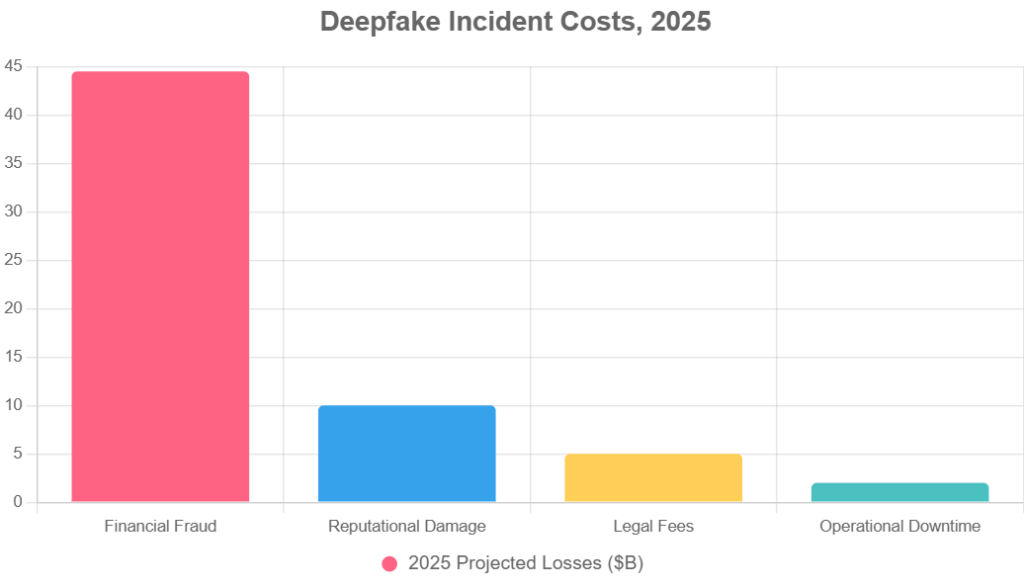
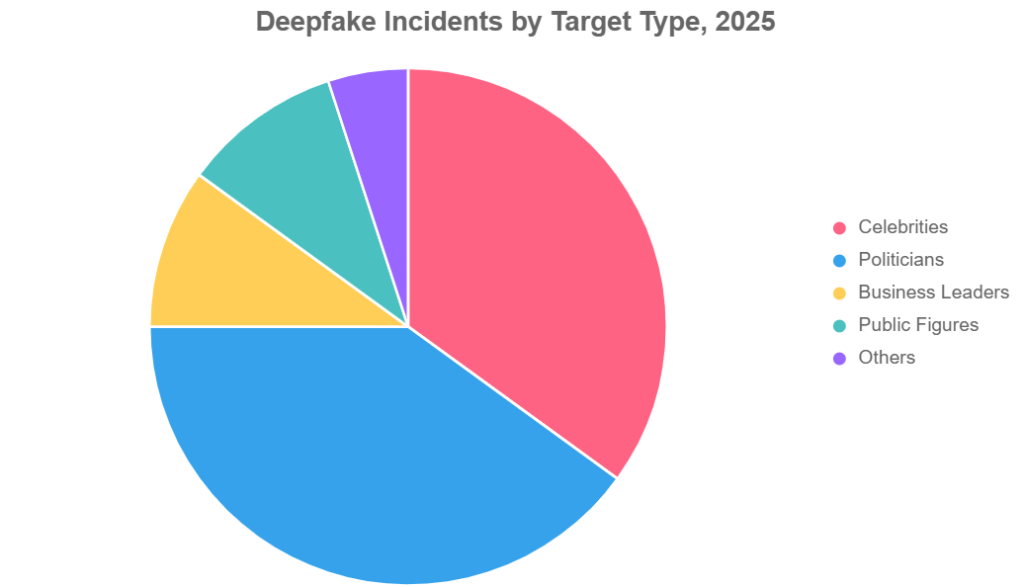
Before we talk about anything else — the numbers in the original article are a mess. “$44.5 billion in fraud losses” attributed to Deloitte actually refers to Pindrop’s contact center fraud projection, which is US-specific and covers all AI fraud, not just deepfakes. “94% of deepfakes target celebrities” gets the data backwards: 96–98% of deepfake content volume is non-consensual intimate imagery, most of it targeting ordinary women — not celebrities. Different datasets, different definitions, jumbled together.
So here’s what the verified numbers actually show:
Volume: Surfshark’s April 2025 analysis, combining the Resemble AI and AI Incident Database, found 179 tracked deepfake incidents in Q1 2025 alone — a 19% increase over all of 2024. This tracks named, documented incidents — not estimated total files. The “8 million files” figure is a separate metric covering total synthetic media volume. Celebrities were targeted 47 times in that quarter, an 81% jump over the entire prior year.
Celebrity targeting: Elon Musk leads with 20 documented incidents — 24% of all celebrity-related cases since 2017. Taylor Swift: 11. Tom Hanks: 3. Keepnet Labs reports that 48% of US deepfake incidents in 2025 used celebrity likenesses to boost scam credibility. Fraud is the dominant use case at 38% of celebrity incidents; explicit content follows at 26%.
Business losses: The Arup case — $25.6 million lost in a single deepfake video call, confirmed by the company and CNN — is the clearest data point we have for corporate exposure. Ceartas’s 2026 synthesis of financial sector data puts the average per-incident business cost at nearly $500,000 in 2024, with large enterprises reaching $680,000. These are averages from aggregated industry reports; methodology varies. Treat as directional for planning purposes.
Fraud trajectory: Deloitte projects generative AI fraud hitting $40 billion in the US by 2027, up from $12.3 billion in 2023 — a 32% CAGR. This covers all AI-enabled fraud, not deepfakes specifically. Deepfakes are a subset.
“Celebrities were targeted 47 times in Q1 2025. That’s more than all of 2024 — in three months.”
Surfshark research, April 2025 — Resemble AI + AI Incident Database
How These Scams Actually Work
The mechanics are simpler than most coverage suggests. And that’s the problem.
Celebrity scams follow a pattern. Someone takes publicly available video — interview clips, press appearances, social posts — and runs it through a generation model to produce synthetic footage of the celebrity endorsing a product. Giveaway scams dominate at roughly 30% of fraud cases; crypto investment pitches run close behind. The audience trusts the face. That’s it. That’s the whole attack.
What’s changed since 2023 isn’t the concept — it’s the accessibility. Models that required GPU clusters two years ago now run on consumer hardware. The quality threshold that fools a casual scroll is low. You don’t need to fool a forensics lab; you need to fool someone who’s half-watching TikTok at 11pm.
Corporate impersonation is more sophisticated. The Arup attack — a whole separate beast — combined spear-phishing email, real-time video deepfake of the CFO, and AI-generated versions of four or five colleagues on the same call. The employee who authorized the $25 million transfer had initially been suspicious of the email. The video call erased those doubts. That’s the second-order problem: deepfakes aren’t just tricking people, they’re specifically tricking people who were already being careful.
⚠ What detection can’t fix
Most detection tools are designed to flag content at rest — a video you upload for analysis. Real-time deepfake video during a live call is a different problem. The Arup attack happened in real-time. The employee couldn’t pause the meeting and run the CFO’s face through a scanner. The defenses that work in that scenario are procedural, not technical: call-back protocols, out-of-band verification, transaction limits that require secondary sign-off.
The Arup Case. Read This Carefully.
Verified Failure Case — $25.6M Lost, January 2024
British engineering firm Arup: a fake CFO, a video call, 15 wire transfers
In January 2024, a finance employee in Arup’s Hong Kong office received an email from what appeared to be the company’s UK-based CFO requesting a “confidential transaction.” The employee was suspicious — good instinct. Then the attackers ran the second stage: a video call. On that call were AI-generated deepfakes of the CFO and four or five colleagues. All of them looked real. All of them sounded real. Every single person on that call other than the victim was synthetic.
Convinced by what looked like social proof from senior management, the employee made 15 wire transfers totaling $25.6 million (HKD 200 million) to five Hong Kong bank accounts. He discovered the fraud only after following up with Arup’s actual headquarters.
Arup confirmed the incident to Fortune, CNN, and the World Economic Forum. Fortune, May 2024; CNN, May 2024; WEF, Feb. 2025 The funds were not recovered. As of early 2025, no arrests had been made.
Rob Greig, Arup’s CIO, described it to the WEF as “technology-enhanced social engineering. None of our systems were compromised and there was no data affected. People were deceived.”
What makes this useful beyond the horror-story angle: the employee did several things right. Skeptical of the initial email. Verified via what appeared to be a video call with familiar faces. The attack was specifically designed to neutralize careful behavior. That’s why the lesson here is about process design, not awareness training.
The fix isn’t “train employees to spot deepfakes.” At the quality level used in the Arup attack — publicly available executive video repurposed as real-time deepfake — human detection doesn’t reliably work. The fix is: no transaction above a threshold gets processed without a second verification channel that the initiating call cannot influence. Phone the CFO on a separately-verified number. Send a Signal message. Something out-of-band.
Cross-source synthesis — this finding requires both datasets
The Surfshark celebrity targeting data and the Arup corporate case look like separate stories. They’re not. Both exploit the same mechanism: social proof from a trusted face. The celebrity scam exploits the viewer’s pre-existing trust in a public figure. The corporate attack exploits the employee’s pre-existing trust in their own CFO. Detection tools help with the former. They’re nearly useless against the latter at real-time video quality. The threat surface isn’t homogeneous — and treating it as one unified “deepfake problem” leads to buying tools designed for one attack pattern while remaining exposed to the other.
Detection Tools: Honest Assessment
The market is real, the tools vary a lot, and the accuracy claims deserve scrutiny.
Here’s the actual state of detection in 2026: AI-generated content detection works well on known generation patterns. When the tool was trained on content from similar models, accuracy rates of 95%+ are achievable. When attackers use newer or adversarially crafted generation methods — specifically designed to evade known detectors — accuracy drops significantly. This isn’t hypothetical; it’s documented in the literature. The generation-detection arms race is real.
Where detection performs well vs. where it struggles
Indicative ranges based on published benchmarks; actual performance varies by tool and content type. Not a controlled study.
Human detection is worse. Studies consistently find humans correctly identify deepfakes at rates around 24–50%, with accuracy declining as generation quality improves. Don’t rely on “it looked off” as a defense strategy.
| Tool | Best use case | Pricing (2025–26) | Verified accuracy claim | ⚠ Limitation |
|---|---|---|---|---|
| Reality Defender | Enterprise API integration, batch video scanning | $99+/mo (Starter) | High accuracy on known GAN output; enterprise clients include major media orgs | No published peer-reviewed benchmark; real-time call detection not the primary use case |
| Sensity AI | Real-time API, celebrity/face-specific detection | ~$49+/mo | Cited by multiple security researchers as a leading face-swap detector | Performance degrades on newer diffusion-based generation methods; limited offline capability |
| Hive AI | Developer API, freemium tier for SMBs | Freemium; $199+/mo Pro | Strong on image detection; audio/video gap noted in independent tests | Free tier has API rate limits; documented performance gaps on audio deepfakes |
| Resemble AI | Voice cloning detection specifically | ~$79+/mo | Purpose-built for voice; strongest in audio-specific deepfake detection | Video detection is secondary to audio; not a full-spectrum solution |
For developers wanting to prototype something before committing to a vendor, here’s a working starting point using OpenCV for blink inconsistency detection. This is a basic heuristic — not a production detector:
import cv2import numpy as np# Requires: pip install opencv-python dlib# dlib's face predictor handles eye aspect ratio (EAR)def eye_aspect_ratio(eye_points): # EAR = (|p2-p6| + |p3-p5|) / (2 * |p1-p4|) A = np.linalg.norm(eye_points[1] - eye_points[5]) B = np.linalg.norm(eye_points[2] - eye_points[4]) C = np.linalg.norm(eye_points[0] - eye_points[3]) return (A + B) / (2.0 * C)def flag_blink_anomalies(ear_sequence, threshold=0.25, min_blink_frames=2): # Very few blinks OR unnaturally regular blinking = flag blink_events = [] in_blink = False count = 0 for ear in ear_sequence: if ear < threshold: if not in_blink: in_blink = True count += 1 else: if in_blink and count >= min_blink_frames: blink_events.append(count) in_blink = False count = 0 blink_rate = len(blink_events) / (len(ear_sequence) / 30) # per second # Normal blink rate: 12-20 per minute (0.2-0.33 per second) return blink_rate < 0.1 or blink_rate > 0.6, blink_eventsThis is a heuristic, not a classifier. Newer deepfake models have specifically addressed blink artifacts. Use it as a signal layer in a multi-signal approach — not a standalone detector.
Who This Actually Hits
For: Regular People / Consumers
The giveaway scam is the main threat. It’s dumb-simple. And it works.
Elon Musk deepfaked for a crypto giveaway. A woman in Lafayette, Louisiana lost $60,000 after what started as a Threads conversation and escalated to a video call with a convincing AI-generated Musk. Facia AI, Oct. 2025 — reported incident, not independently verified at publication; treat as illustrative The pattern is consistent: celebrity face, promise of returns, request to send first.
What actually works: Reverse-image search the channel posting the content. Check the celebrity’s verified accounts for any mention of the campaign. If there’s an investment or giveaway angle — especially crypto, supplements, or medical products — walk away. No celebrity runs unsolicited giveaways through third-party social accounts.
Stop doing this: Don’t use “it looked real” as your verification standard. The whole point is that it looks real. Verify the claim externally, not the video quality.
For: Businesses / Executives
The threat model for your company looks like Arup, not like a TikTok ad.
The celebrity-scam tactics are the public face of the problem. The corporate threat is different: impersonation of your own executives, in real-time, during what looks like a legitimate internal call. The distinguishing factor is that the victim knows the person being faked — which is what makes it harder to resist than a random celebrity endorsement.
What actually works: Out-of-band verification for any transaction above a defined threshold. This means: a separately verified contact number, a pre-agreed code word for sensitive transactions, or a policy that no single video call authorizes a transfer without a separate written confirmation through a known channel. These are procedural controls that deepfakes can’t defeat.
Access barrier: Implementing call-back verification adds friction to normal operations. Finance teams will resist it. The counter-argument is one number: $25.6 million, one call, 15 transfers.
Stop doing this: Don’t think awareness training is the solution. Your employees knowing that deepfakes exist doesn’t help much when they’re looking at a convincing real-time video of their CFO. The Arup employee knew about deepfakes. The attack was designed to override that awareness.
For: Marketers / Brand Managers
Your brand’s association risk runs in both directions.
Celebrities whose likenesses get deepfaked into scam ads suffer reputational damage. The brands those celebrities actually work with get caught in the blast radius. Molly-Mae Hague called out a deepfake ad in June 2025 promoting a perfume she’d never endorsed — thousands of her followers had already bought it from fraudulent resellers. Facia AI, Oct. 2025 — reported incident That’s not just her problem; it damages the legitimacy of influencer marketing broadly.
What actually works: Reverse image/video search your influencers’ likenesses monthly. Set up Google Alerts for “[celebrity name] + [your category]” to catch unauthorized appearances. Build contract language that requires influencers to notify you of any suspected deepfake use of their likeness in your product category.
Stop doing this: Don’t assume platform moderation catches everything. YouTube, TikTok, and Instagram are all in the data as primary distribution channels for deepfake scam content, in that order. Platforms are not your compliance layer.
The Part That Complicates Everything
Here’s the thing nobody says clearly: most deepfake content — by volume — isn’t scams targeting businesses or celebrities. It’s non-consensual intimate imagery targeting ordinary women. Keepnet, Ceartas, programs.com — multiple sources converge on 96–98% of deepfake content being NCII The entire policy and commercial detection ecosystem is mostly oriented around the high-visibility cases: celebrity fraud, executive impersonation, political disinformation. The much larger and more personally harmful problem gets less attention because it’s harder to monetize as enterprise software.
This matters because the detection and reporting infrastructure for NCII deepfakes is significantly weaker than for fraud. If you’re a creator who finds synthetic imagery of yourself circulating without consent, your options are: report to individual platforms (slow, inconsistent), seek legal remedies (expensive, jurisdictionally fragmented), or use takedown services (works sometimes, not systematically).
A fuller treatment of that problem is beyond the scope of this piece, but any honest discussion of “the deepfake celebrity problem” that doesn’t mention it is leaving out the majority of the actual harm.
Questions People Actually Ask
How do I tell if a celebrity video is a deepfake?
Honestly, at current generation quality, human visual detection is unreliable — studies put accuracy around 24–50% even for trained reviewers. The more reliable check is contextual: does the celebrity’s verified social account mention this product or campaign? Has any credible outlet covered this endorsement? Is there a financial ask or time pressure? Those signals are more reliable than trying to spot visual artifacts.
Are detection tools actually reliable?
On known generation methods: reasonably, yes. On newer or adversarially designed content: less so. The detection market is growing fast, but it’s chasing a moving target. Tools like Reality Defender and Sensity AI are credible options for organizations that need systematic scanning — just don’t treat any single tool as comprehensive coverage.
What should I do if I find a deepfake using my likeness?
Report to the platform where you found it — all major platforms have NCII reporting mechanisms. If it’s fraud-related (using your likeness to promote products you didn’t endorse), also report to the FTC or your national consumer protection agency. Takedown services like CEARTAS specialize in creator IP removal and can be faster than platform processes for widespread distribution. Document everything before you report — screenshots, URLs, dates.
Is there legislation protecting people from deepfakes?
Partial, and fragmented. The EU AI Act creates requirements for labeling AI-generated content. The US has the DEFIANCE Act (2024) covering non-consensual intimate deepfakes and the NO FAKES Act (proposed) covering likeness rights broadly — though the latter was still working through Congress as of early 2026. Several US states have enacted their own laws. Australia’s Online Safety Act covers NCII including deepfakes. Enforcement is inconsistent across all jurisdictions.
What’s the cheapest thing a small business can do right now?
Two free things: set up Google Alerts for your brand name plus “deepfake” or “[your executive name] video,” and establish a written policy that no financial transaction above a set amount gets authorized from a single video call without a secondary verification via a separately-confirmed channel. The first catches exposure early; the second closes the most dangerous attack vector without spending anything.
Sources
- Surfshark — Deepfake Statistics 2025 (Resemble AI + AI Incident Database), Apr. 2025
- Ceartas — Global Deepfake Statistics & Impact: 2025 Report (updated Feb. 2026)
- Keepnet Labs — Deepfake Statistics & Trends 2026
- Bright Defense — 150+ Deepfake Statistics (updated Apr. 2026)
- Programs.com — Latest Deepfake Facts & Statistics (2026)
- Fortune — Arup deepfake CFO fraud, $25M, May 2024
- CNN — Arup confirms deepfake scam, May 2024
- World Economic Forum — Lessons from the Arup $25M deepfake attack (Rob Greig, CIO), Feb. 2025
- Facia AI — Top deepfake incidents 2024–2025, Oct. 2025
- SQ Magazine — Deepfake Statistics 2026
- Global Security Mag — Deepfake epidemic for the famous, Apr. 2025
Why AI Will Reshape Banking by 2030—Precision Agentic Transformation
The Meme That Accidentally Changed Politics
Why TikTok Trends Spread Faster Than Diseases: 2025 Best Guide!