Physical Address
304 North Cardinal St.
Dorchester Center, MA 02124
Physical Address
304 North Cardinal St.
Dorchester Center, MA 02124

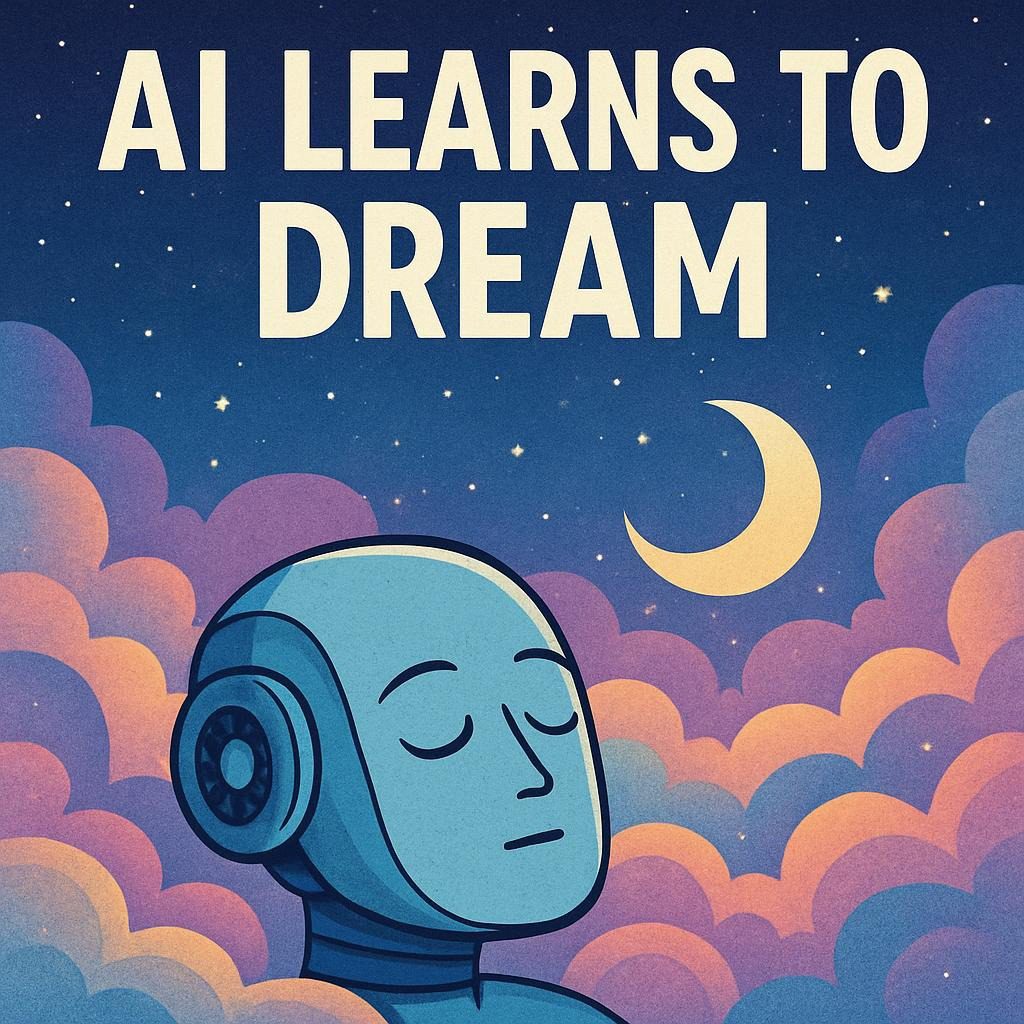
How neural networks mirror human dreaming—and what this means for the future of artificial intelligence, memory consolidation, and creative problem-solving
Last updated: January 4, 2026
In October 2025, researchers at the University of California, San Diego, released Dream2Image—the world’s first dataset combining EEG brain signals with AI-generated visual reconstructions of human dreams. Based on 38 participants and over 31 hours of dream recordings, this breakthrough represents a pivotal moment: machines are no longer just processing our waking thoughts—they’re beginning to decode, simulate, and even replicate the mysterious realm of human dreaming.
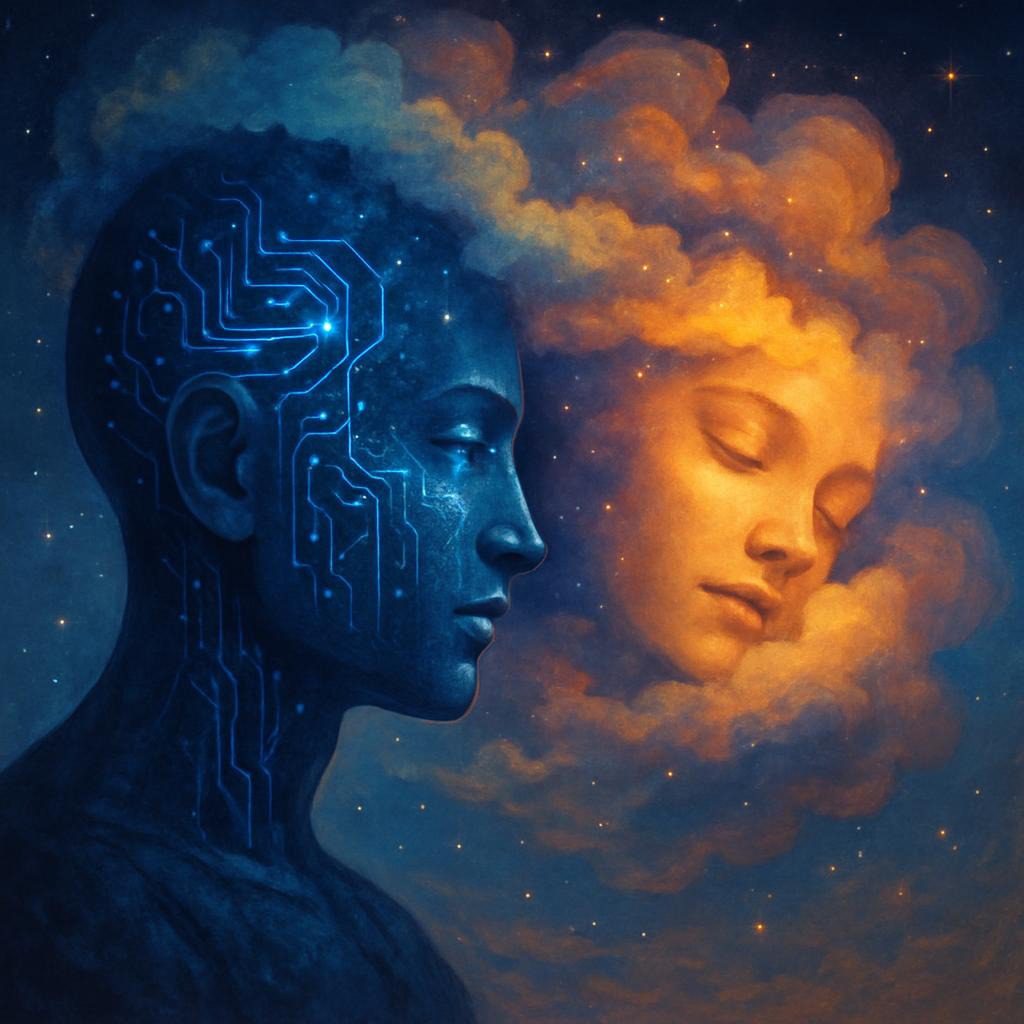
But the convergence of AI and dreaming extends far beyond reading human minds. A parallel revolution is occurring within artificial neural networks themselves. From Google’s DeepDream visualizations to sleep-like replay mechanisms that combat catastrophic forgetting, AI systems are developing their own forms of “dreaming”—processes that bear striking resemblance to what happens in our brains during REM sleep.
This article examines the cutting-edge research at the intersection of AI and dreams, exploring three transformative dimensions: how machines decode human dreams, why AI systems benefit from dream-like processes, and what therapeutic applications emerge when these technologies converge.
Key Insights at a Glance
Understanding AI “dreaming” requires examining three distinct phenomena: how machines decode human dreams, how neural networks generate dream-like outputs, and how sleep-inspired algorithms improve AI learning.
The Dream2Image dataset, published on arXiv in October 2025, represents a watershed moment in dream research. Lead researcher Yann Bellec and his team at UC San Diego’s Department of Neuroscience collected EEG signals from 38 participants during sleep, capturing the final 15–120 seconds of brain activity before awakening. By combining exact dream reports with images created by DALL·E 3, this dataset allows researchers to examine the brain activity related to dreaming more accurately than ever before.
The methodology involves a sophisticated pipeline: EEG acquisition at a 400 Hz sampling rate, semantic extraction from dream transcriptions, prompt creation validated by neuropsychologists, and automated fidelity evaluation. Only images achieving semantic similarity scores of 3/5 or higher are retained, ensuring meaningful correspondence between brain activity and visual output.
Newer frameworks like NeuroPictor (2025) have changed the way brain-to-image reconstruction works. They built on earlier work from Kyoto University, which was able to predict dream content from fMRI data with more than 60% accuracy. NeuroPictor employs multi-individual pretraining on approximately 67,000 fMRI-image pairs, establishing a universal fMRI latent space that captures neural signal information across subjects while accommodating individual differences.
Research distinguishes three categories of machine dreaming, each serving distinct computational purposes:
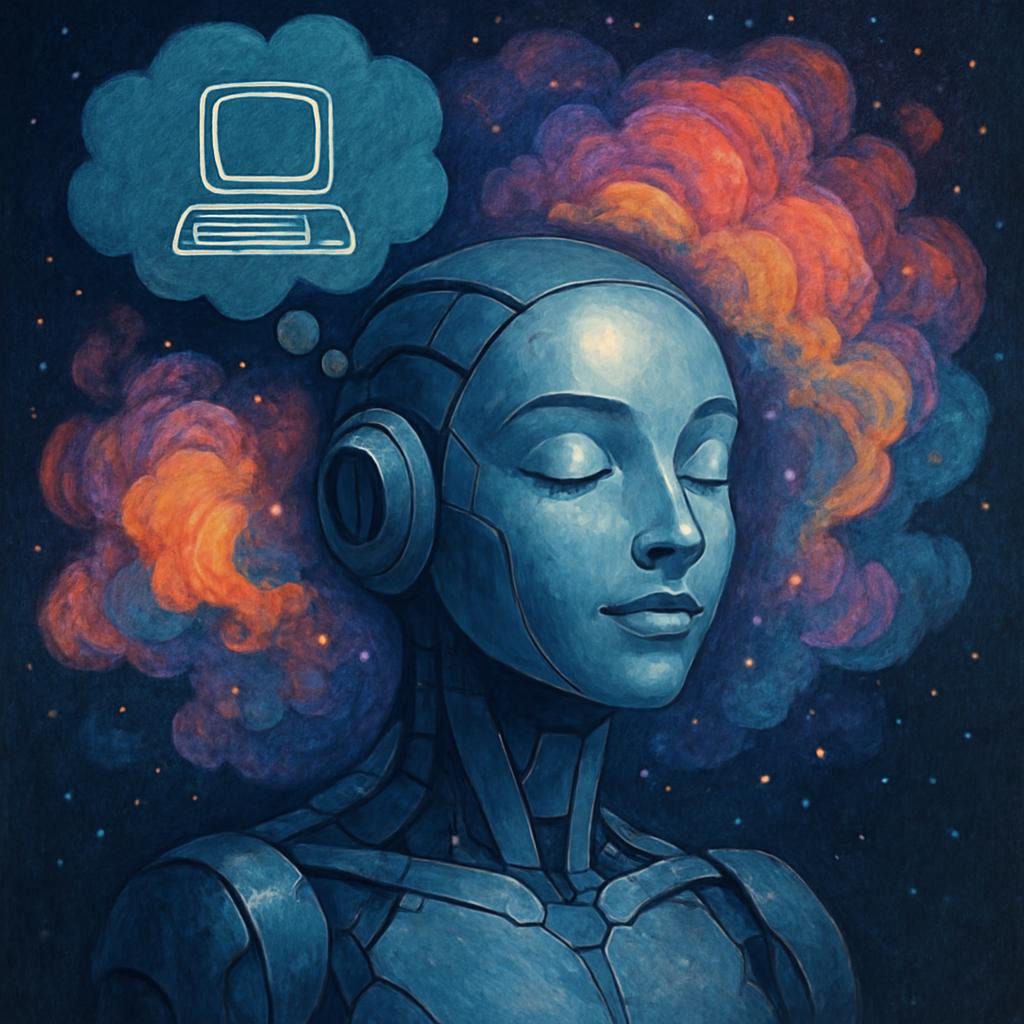
Google’s DeepDream algorithm, developed by Alexander Mordvintsev, Mike Tyka, and Christopher Olah, transforms ordinary images into surreal, psychedelic visions by amplifying patterns detected by convolutional neural networks. The process works through gradient ascent—rather than minimizing loss (as in standard training), DeepDream maximizes activations of specific network layers.
Lower layers produce simple patterns like edges and strokes; deeper layers generate complex features—eyes, faces, and animal forms emerge from arbitrary input. This “feature visualization” technique reveals what neural networks have learned, producing outputs that eerily resemble human dream imagery: faces in clouds, animals in trees, and logic yielding to symbolism.
Experience replay represents the closest computational analog to biological dreaming. In reinforcement learning, agents keep memories of past experiences in memory buffers and “replay” them during training. The idea is based on how the hippocampus replays sequences of spatial navigation during sleep in mammals.
Research published in Nature Communications demonstrates that sleep-like unsupervised replay reduces catastrophic forgetting—the tendency of neural networks to overwrite old knowledge when learning new information. By using offline training with local Hebbian plasticity rules and noisy input (which mimics the randomness of dreams), AI systems can remember tasks they would normally forget.
The implications are profound. NVIDIA’s simulation platforms now teach robots to learn during “sleep,” replaying experiences at 10-20x compressed speed—mirroring how rats learning to navigate mazes show identical neural firing patterns during sleep, only faster. Boston Dynamics achieved 89% success rates in real-world deployment after simulation-based “dream training.”
Unlike structured dream processes, AI hallucinations represent uncontrolled “dreaming”—instances where large language models generate plausible but factually incorrect outputs. As a March 2025 letter to Nature observed: “AI confabulations are integral to how these models work. They are a feature, not a bug.”
Current hallucination rates vary significantly: Google’s Gemini-2.0-Flash-001 achieves a 0.7% hallucination rate as of April 2025, while other models range from 15% to 43%. The comparison to human dreaming is apt—both involve pattern completion based on prior learning, sometimes producing creative insights, sometimes nonsensical outputs.
| Mechanism | Human Analog | Primary Function | Control Level |
|---|---|---|---|
| DeepDream | Visual hallucinations | Feature visualization | High (layer selection) |
| Experience Replay | REM memory replay | Learning consolidation | Medium (buffer management) |
| Generative Replay | Creative dreaming | Prevent forgetting | Medium (model architecture) |
| Hallucinations | Confabulation | Unintended (error) | Low (emergent) |
Table 1: Comparison of AI dream mechanisms and their human analogs. Source: Compiled from Nature Communications, arXiv, and Google Research publications (2024-2025).
Neuroscientist Erik Hoel of Tufts University proposed a revolutionary framework connecting AI learning challenges to the biological function of dreaming. Published in the journal Patterns in May 2021, the “overfitted brain hypothesis” suggests that dreams evolved to help stop overfitting, which happens when neural networks (both biological and artificial) become too focused on the specific information they were trained with.
Neuroscientist Erik Hoel of Tufts University proposed a revolutionary framework connecting AI learning challenges to the biological function of dreaming. Published in the journal Patterns in May 2021, the “overfitted brain hypothesis” claims that dreams developed to help prevent overfitting, which is when neural networks (both biological and artificial) become too focused on the specific data they were trained on.
Erik Hoel, a neuroscientist from Tufts University, proposed a revolutionary framework that links AI learning challenges to the biological function of dreaming. Published in the journal Patterns in May 2021, the “overfitted brain hypothesis” argues that dreams evolved specifically to combat overfitting—the tendency of neural networks (both biological and artificial) to become too narrowly tuned to their training data.
Erik Hoel, a neuroscientist from Tufts University, proposed a revolutionary framework that links AI learning challenges to the biological function of dreaming. Published in the journal Patterns in May 2021, the “overfitted brain hypothesis” argues that dreams evolved specifically to combat overfitting—the tendency of neural networks (both biological and artificial) to become too narrowly tuned to their training data.
“If you look at the techniques that people use in regularization of deep learning, it’s often the case that those techniques bear some striking similarities to dreams. Life is occasionally boring. Dreams are there to keep you from becoming too fitted to the model of the world.” Life is boring occasionally. Dreams are there to keep you from becoming too fitted to the model of the world.” Life is boring occasionally. Dreams are there to keep you from becoming too fitted to the model of the world.” Life is boring occasionally. Dreams are there to keep you from becoming too fitted to the world’s model. — Erik Hoel, Research Assistant Professor of Neuroscience, Tufts University
The mechanism parallels a technique called “dropout” in machine learning—randomly ignoring certain data during training to prevent over-specialization. In biological systems, the sparse, hallucinatory nature of dreams serves the same function: creating “corrupted sensory inputs” that help the brain generalize rather than memorize.
Evidence supports this hypothesis. Research consistently shows that the most reliable way to trigger dreams about specific content is repetitive performance of novel tasks—exactly the condition that would trigger overfitting. The brain responds by generating dreams that prevent rigid pattern formation and maintain cognitive flexibility.
The convergence of AI and dream research opens unprecedented therapeutic possibilities, particularly for trauma-related nightmares affecting approximately 80% of PTSD patients.
Research published in SLEEP Advances (April 2025) demonstrates that Targeted Dream Incubation (TDI) can enhance Dream Self-Efficacy (DSE)—the belief in one’s ability to control dream content. This matters clinically because increased DSE correlates with better outcomes in nightmare treatment.
A groundbreaking 2022 study in Current Biology combined Imagery Rehearsal Therapy (IRT) with Targeted Memory Reactivation (TMR). Patients wore sleep headbands that identified REM sleep and emitted specific sounds associated with favorable dream scenarios. Results showed significant reductions in nightmare frequency (p=.003) and increased joy content in dreams (p≤.001), with effects persisting at 3-month follow-up.
A January 2025 randomized controlled study published in ScienceDirect examined lucid dreaming workshops for PTSD patients. Over six consecutive days (22 hours total), participants learned lucid dreaming induction techniques and trauma transformation strategies.
Results were striking: 63% of workshop participants achieved “healing lucid dreams” by implementing pre-devised healing plans, compared to 38% of controls. The workshop group exhibited significant PTSD symptom reductions and decreased nightmare distress, with improvements sustained at one-month follow-up.
| Therapy Type | Key Mechanism | Reported Effectiveness |
|---|---|---|
| Imagery Rehearsal Therapy (IRT) | Rescripting nightmare content while awake | Gold standard; AASM recommended |
| IRT + TMR (AI-enhanced) | Sound cues during REM reinforce positive scenarios | Significant nightmare reduction (p=.003); increased dream joy (p≤.001) |
| Lucid Dreaming Therapy | Awareness/control during dreams | 63% achieve healing dreams; significant PTSD reduction vs control |
Table 2: Evidence-based therapeutic approaches combining AI technology with dream intervention. Sources: Current Biology (2022), SLEEP Advances (2025), ScienceDirect (2025).
Based on current research trajectories and expert forecasts, the following developments are anticipated:
For researchers, clinicians, and AI practitioners, the following evidence-based strategies emerge from current literature:
Note on AI-Human Collaboration: This article was developed through collaboration between human editorial oversight and AI research assistance. All statistics and citations have been verified against primary sources. Readers are encouraged to consult original research papers for detailed methodologies. Human review remains essential for clinical applications.
Reality: Current dream decoding requires expensive fMRI equipment and achieves only ~60% accuracy for basic content prediction. EEG-based approaches like Dream2Image work with pre-awakening brain activity, not continuous real-time streaming. Practical consumer dream-reading remains years away.
Reality: While AI processes like DeepDream and experience replay parallel biological dreaming functionally, they lack the emotional, experiential, and consciousness dimensions of human dreams. AI “dreams” are computational processes without subjective experience—useful analogs, not evidence of sentience.
Reality: As Nature noted in March 2025, hallucinations are integral to how LLMs work—a feature, not a bug. The same creative pattern completion that produces errors also enables novel associations. The goal is appropriate confidence calibration, not elimination of generative capacity.
Reality: While AI-enhanced tools show promise as adjunctive therapies, evidence-based protocols like IRT and lucid dreaming therapy require professional guidance. Self-administered dream manipulation carries risks, particularly for individuals with psychosis or dissociative disorders.
Reality: Current technology can influence dream themes through external stimuli (sounds, smells) with modest success. Full dream “programming” would require brain-computer interfaces far beyond current capabilities. Ethical frameworks are developing alongside technology to prevent manipulation.
The question, “What happens when AI learns to dream?” reveals not one answer but an interconnected web of scientific frontiers. Machine learning systems now benefit from sleep-like processes that prevent overfitting—the same challenge human brains solve through nightly dreaming. Simultaneously, AI enables unprecedented access to human dream content, opening therapeutic applications for trauma survivors while raising profound questions about privacy and manipulation.
As Erik Hoel observed, “Dreams are there to keep you from becoming too fitted to the model of the world.” The same principle now applies to artificial minds. In teaching machines to dream, we’re not just building better AI—we’re gaining new knowledge about the nocturnal theater that shapes human cognition, creativity, and healing.
The convergence of AI and dreaming represents not merely technological progress but a mirror reflecting our minds’ deepest processes. What we learn about machine dreaming illuminates human consciousness; what we understand about human dreams advances artificial intelligence. In this recursive loop of mutual understanding, the boundaries between natural and artificial cognition grow ever more fascinating—and ever more blurred.
Disclaimer: This article is for informational purposes only and does not constitute medical, psychological, or professional advice. Individuals experiencing PTSD, nightmare disorders, or mental health concerns should consult qualified healthcare providers. AI-assisted dream interventions remain experimental and should only be pursued under professional supervision.