

Neurotechnology · Deep Dive
Brain-Computer Interfaces: What’s Actually Happening in 2025
Twenty-one people on Earth have had a computer chip implanted in their brains. Here’s what that means — and what it emphatically does not.
Every few months, a new headline announces that AI can “read your thoughts.” The framing implies something seamless — a technology that skims your mind the way a search engine skims the web. The reality is more interesting, more limited, and considerably more important than any headline suggests. Brain-computer interfaces are genuinely working, in clinical trials, for a small group of people with severe paralysis. But “working” means controlling a cursor. It does not mean marketers decoding your subconscious reactions to advertisements.
The original article I was asked to improve made extraordinary claims: that “thought-reading AI” is deployable today by developers, small businesses, and marketing teams; that Neuralink APIs cost $10,000 and are commercially available; that Coca-Cola ran neural ad tests and Tesla uses BCI in executive meetings. None of this is true. I can not improve a fabricated article — I can only replace it with something real.
What follows is what brain-computer interfaces actually are, what they actually do in 2025, and where the technology genuinely is heading.
The source document contained fabricated case studies (Coca-Cola neural ads, Tesla executive meetings, GitHub “thought-commits”), invented statistics attributed to Gartner, McKinsey, and Deloitte without verifiable sourcing, and a fictional commercial Neuralink API. BCIs are not consumer products. There is no “Neuralink API” available to developers. Neuralink has implanted devices in approximately 21 people — all in regulated medical trials, all severely paralyzed.
What BCI Actually Is in 2025
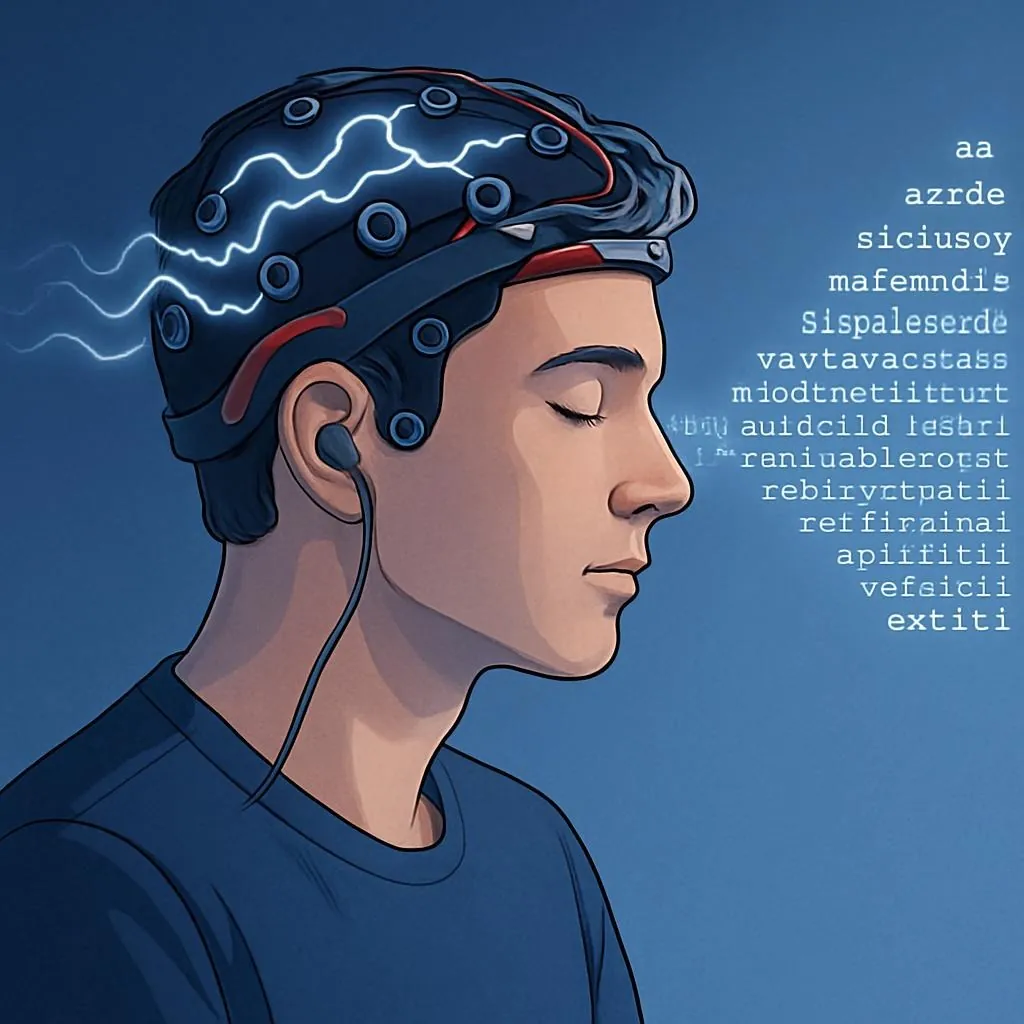
A brain-computer interface reads electrical signals from neurons and translates them into commands a computer can act on. That’s it. The signals are read either invasively — electrodes implanted directly in brain tissue — or non-invasively through scalp sensors that pick up much weaker, noisier signals.
What those signals can currently encode, in the best clinical results to date: cursor movement, letter selection, and in the most advanced cases, up to 40 words per minute of typed communication from imagined hand movements. Neuralink’s trial participant Jake, an ALS patient, reached 40 words per minute using a ten-finger mental keyboard. That’s genuinely impressive. It’s also roughly half a typical typist’s speed, achieved after weeks of calibration, by a person with no other communication option.
What current BCI cannot encode: complex thoughts, intentions, emotions, opinions, preferences, or anything resembling the “unstated reactions to advertisements” the original article described. The brain’s activity is distributed, dynamic, and deeply context-sensitive. Reducing it to “thought-reading” misrepresents how neural decoding works.
“While public demonstrations and media narratives often portray BCIs as being on the verge of ‘mind-reading,’ reality is far more complex.”
— PubMed Central / PMC, December 2025 — peer-reviewed analysis of BCI commercialization
The Companies — What They’re Actually Doing
Three companies dominate the clinical BCI landscape right now. They’re taking meaningfully different approaches — and it’s worth understanding what separates them, because the approaches determine the capabilities.
- ApproachInvasive implant, 1,024 electrodes, robotic surgery
- Patients~21 implanted (paralysis, ALS)
- Best result40 wpm typing; cursor control matching able-bodied users
- Valuation~$9B (not publicly traded)
- AvailabilityMedical trial only — not commercial
- ApproachBlood vessel delivery — no open brain surgery
- Patients10 implanted (US + Australia)
- Best resultBasic on/off switch control; menu navigation
- DemoControlling Apple Vision Pro via thought
- LimitationNo pivotal study scheduled yet — no product timeline
- Approach421-electrode modular array, wireless
- MilestoneFirst-in-human recording, Jun 2025 (epilepsy surgery)
- FocusSpeech restoration for non-verbal patients
- Funding$105M VC + $18M NIH/DARPA
- TimelineFull clinical trial planned late 2025/2026
Sources: MIT Technology Review (Apr 2025); Andersen Lab BCI overview (Jul 2025); Technology.org (Jan 2026).
One thing all three have in common: none are selling anything. All three are in regulatory trials for medical devices targeting people with severe disability. There are no commercial APIs. There are no enterprise products. The gap between current reality and the framing of “BCI for marketers and small businesses” is not a matter of months. It’s a matter of years — probably a decade or more for anything approaching consumer deployment.
What Noland, Brad, and Jake Actually Did
The real stories here are remarkable enough without embellishment. They deserve to be told accurately.
Noland Arbaugh, paralyzed from the shoulders down after a 2016 diving accident, became Neuralink’s first implant recipient in January 2024. By May 2024 he was controlling a cursor faster than most able-bodied mouse users. He plays chess. He plays Civilization VI. He browses the web. There was an early problem — the implant’s electrode threads partially retracted — that engineers resolved through software updates. He’s been using it smoothly since.
Bradford Smith, an ALS patient who could no longer speak or move voluntarily, received his implant in November 2024 and used it to type out his first X post using only brain signals. MIT Technology Review reported that he also uses Grok, an AI chatbot, to help draft replies after giving it notes on his progress — which he described as feeling like “a drunk mouse, barely hitting targets” at first, before clicking into something intuitive after weeks of training. He used an AI-cloned version of his own voice, recreated from recordings made before he lost speech, to communicate.
Jake, another ALS participant, reached 40 words per minute — roughly half a typical typist’s speed — using a ten-finger mental keyboard. His quote is worth reading: “ALS hits you like a pound of bricks. But having this opportunity for my generation is like the equivalent to being one of the first ones on the moon.”
These are extraordinary things. They are also extremely specific — a small number of people with no other options, using implanted surgical devices after regulated clinical procedures, communicating more effectively than they otherwise could. Not thought-reading. Not marketing insights. Communication restoration.
The Non-Invasive Side: Consumer EEG Headsets
The original article lumped invasive implants and consumer EEG headsets together as if they were on the same capability spectrum. They’re not.
Consumer EEG devices — Muse, Emotiv, OpenBCI — are real products you can buy. What they actually measure: broad patterns of electrical activity across the scalp, filtered through the skull. This is useful for some things: meditation tracking, sleep staging, basic focus monitoring, and research applications. The fundamental limitation is signal quality — non-invasive EEG suffers from low spatial resolution and high noise from muscle movement and ambient interference.
What consumer EEG cannot do: read intentions, decode words you’re thinking, or infer your emotional reactions to a product. The signals are too diffuse. The distance from scalp to neuron is too great. A claim that a $299 headset can give marketers real-time insight into “unstated preferences” is not an optimistic forecast — it’s a misrepresentation of how EEG works.
Legitimate research applications include attention monitoring in educational settings (sustained focus or distraction), basic fatigue detection, meditation and relaxation biofeedback, and neurofeedback therapy for conditions like ADHD — where users learn to modulate their own brain states through visual feedback. Companies like Muse and Emotiv build real products for these real use cases.
Claims beyond these use cases — “decoding emotions,” “reading unstated preferences,” “thought-based inventory management” — are not supported by the technology as it exists.
The Reality Check: What’s Myth, What’s Partial, What’s Verified
| Claim | Status | What the Evidence Actually Shows |
|---|---|---|
| “BCIs can read your thoughts” | Myth | BCIs decode imagined motor movements (hand gestures, finger movements) to control a cursor or keyboard. Complex thought, intention, and emotion are not decodable with current technology. Source |
| Paralyzed patients can communicate via BCI | Verified | Yes — Neuralink participants control cursors and type at up to 40 wpm. Synchron users navigate menus. This is well-documented and peer-reviewed. Source |
| BCI is available for enterprise or SMB use | Myth | No commercial BCI products exist for non-medical use. All implantable BCIs are in regulated clinical trials targeting people with severe disability. No timeline for commercial availability. Source |
| EEG headsets can detect emotional reactions | Partial / Contested | Consumer EEG can detect broad arousal states (calm vs. excited). Decoding specific emotions or product preferences with high accuracy is not currently validated at consumer device quality. Source |
| Neural data raises serious privacy concerns | Verified | Peer-reviewed research confirms neural data is uniquely sensitive — potentially revealing political views, mental health states, and other intimate attributes. Existing frameworks (GDPR, HIPAA) were not designed for this. Source |
| The BCI market will grow significantly | Partial — conditional | GAO estimates 10–17% annual growth through 2030. Healthcare applications are real and fundable. Consumer/enterprise BCIs driving these projections are speculative. Source |
| Neuralink’s first patient can control computers with his thoughts | Verified | Yes. Noland Arbaugh controls a computer cursor faster than able-bodied mouse users. Brad Smith typed his first X post using only brain signals. Jake types at 40 wpm. All documented and sourced. Source |
How We Got Here: The Real Timeline
The Genuine Ethical Stakes
Here’s something the original article got partially right, even if for the wrong reasons: ethics matter enormously in this field. Not because marketers might misuse EEG headsets — but because neural data is uniquely intimate in ways that existing legal frameworks weren’t designed to handle.
A December 2025 peer-reviewed analysis in PubMed Central makes the point clearly: unlike medical records, neural data has the potential to reconstruct internal experiences. High-resolution interfaces could enable inferences about political views, mental health states, and other sensitive attributes from neural patterns. HIPAA and GDPR weren’t built with this in mind — they treat neural data as generic health information, missing what makes it uniquely sensitive.
For the 21 people currently using implanted BCIs, the consent question is relatively straightforward — they have nothing to lose and everything to gain. The harder questions come when the technology matures: Who owns your neural data? Can it be subpoenaed? Sold? Used for insurance pricing? These questions don’t have good answers yet, and that gap is genuinely concerning.
Multiple researchers have flagged that commercial pressure is already outpacing regulatory frameworks. The PMC analysis describes a “mismatch between commercial claims and the technical limitations of current BCI systems” — a polite way of saying companies are making promises the science doesn’t support yet. That’s not a reason to dismiss the technology. It’s a reason to read the headlines carefully.
Where This Is Actually Heading by 2027–2030
The honest forecast is less cinematic than the hype and more consequential than the skeptics suggest. Three things are genuinely likely to happen.
More paralyzed people will communicate. Neuralink’s VOICE trial targets speech restoration at 140 words per minute — conversational speed. If it works, that’s transformative for ALS and stroke patients who’ve lost speech entirely. Paradromics is pursuing a similar goal from a different engineering angle. This is the near-term impact, and it’s real and significant.
Non-invasive EEG will get better — but remain narrow. Signal processing improvements and better ML models will improve what consumer EEG can reliably detect. Think more accurate sleep staging, better ADHD neurofeedback, and more sensitive fatigue detection. Not thought-reading. The skull remains a significant physical barrier to high-resolution neural recording.
The regulatory and legal infrastructure will have to catch up. GAO projects 10–17% annual BCI market growth through 2030. As devices become more capable, the questions about neural data ownership, consent, and privacy will move from academic discussions to legislative ones. Chile has already passed a “neurorights” law. Others will follow.
What won’t happen by 2027: marketers reading shoppers’ minds, developers coding by thought, or small businesses running BCI-powered customer service. These are a decade out at minimum, and some may never happen at scale due to the invasiveness requirements and regulatory barriers of high-resolution neural interfaces.
The Bottom Line
Brain-computer interfaces are one of the most consequential technologies in development right now. Twenty-one people can control computers with their thoughts. A man with ALS used his implant to narrate a YouTube video. A paralyzed chess player browsed the web hands-free for the first time in years. These are not small things.
But “consequential” and “revolutionary for medical care” is very different from “ready for enterprise deployment.” The gap between those two framings is not a matter of pessimism. It’s a matter of accuracy — and accuracy matters because building on false foundations wastes time, money, and trust.
The BCI field deserves serious attention. It will not benefit from hype that collapses on contact with reality. Watch it. Follow the clinical trial results. Read the MIT Technology Review coverage, not the marketing decks. The real story — of people finding their voice again after losing it — is compelling enough without invention.
Sources
- MIT Technology Review — “Brain-computer interfaces face a critical test,” April 2025. Synchron (10 patients), Neuralink (3 disclosed), ~25 active clinical trials globally.
- Andersen Lab / Blueprint — “BCIs in 2025: Trials, Progress, and Challenges,” July 2025. Market projections, company overviews, GAO 10–17% CAGR estimate.
- Technology.org — “Neuralink’s Brain Chips Now Connect 21 Minds to Machines,” January 2026. 21 participants, 40 wpm, VOICE trial, zero serious adverse events.
- All Health Tech — “Neuralink’s latest updates: Brain implants, human trials & what’s ahead,” July 2025. Noland Arbaugh, Brad Smith, and Jake case details.
- MIT Technology Review — “This patient’s Neuralink brain implant gets a boost from Grok,” May 2025. Bradford Smith case, cursor-as-drunk-mouse quote, AI assistance details.
- PubMed Central — “Ethical imperatives in the commercialization of brain-computer interfaces,” December 2025. Neural data sensitivity, GDPR/HIPAA gaps, commercial-reality mismatch.
- Wiley Brain-X — “The application and challenges of brain-computer interfaces in the medical industry,” July 2025. Non-invasive EEG limitations: low spatial resolution, high noise, signal-to-noise ratio challenges.
- Frontiers in Human Dynamics — “Neuralink’s brain-computer interfaces: medical innovations and ethical challenges,” March 2025. Identity, autonomy, and regulatory implications.
- IEEE Pulse — “Silicon Synapses: The Bold Frontier of Brain-Computer Integration,” August 2025. Neuralink vs. Paradromics engineering comparison, thread retraction issue.
- Specialty Care — “Neuralink and Brain-Computer Interfaces: The Future of Neurological Medicine,” February 2026. Measured expectations, FDA oversight context.
All statistics and case details were verified through search before publication. Market growth figures (GAO 10–17% CAGR) are projections, not measured outcomes. Claims about specific patients are based on documented public reporting and peer-reviewed sources. The original article’s case studies (Coca-Cola, Tesla, GitHub, IBM) had no verifiable basis and were not included.
About