

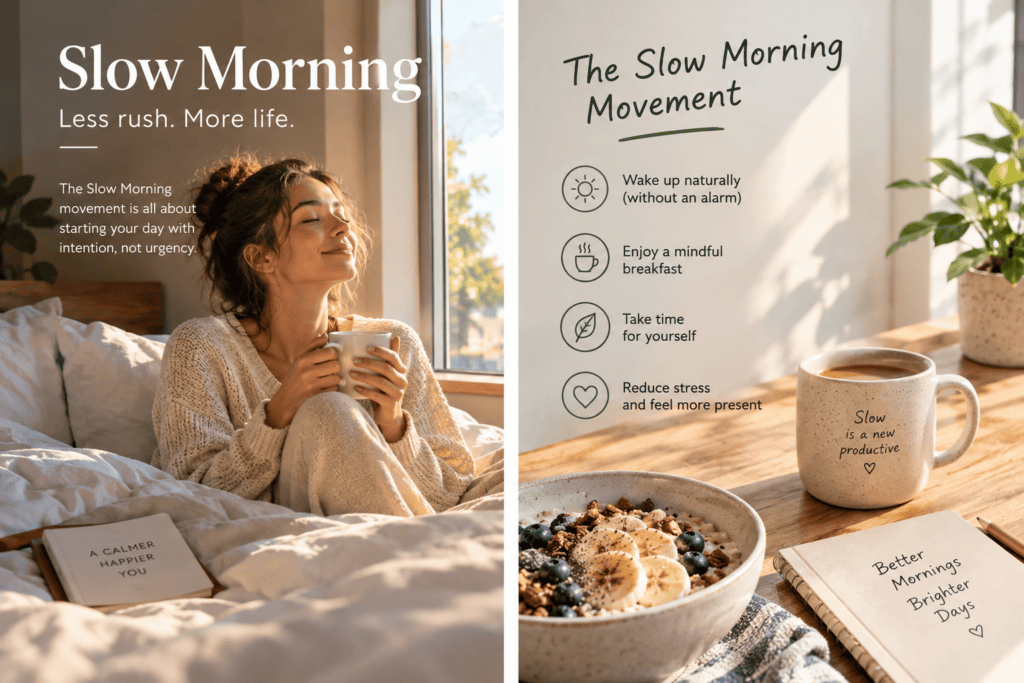
Direct answer: No study I could find shows that slow mornings outperform hustle culture. “Outperforming” is a trend narrative, not a measured result. The evidence does show that the hustle side’s best-documented harm comes from total weekly hours, and that the morning habit with direct support is a predictable routine, not a slow one.
The movement is arguing about the wrong variable
Hustle culture bundles three separate things: an early start, long total hours, and constant availability. Slow-morning content attacks the first. The hard evidence mostly concerns the second.
Trend coverage says people are tiring of extreme morning routines and nonstop hustle, and that “slow productivity” is rising in popularity. That describes sentiment. It tells you what people want to read, not what improves output or health. Nothing in that coverage measures performance. yourstory
What the hours data says
The strongest quantitative evidence in this debate is about hours, and it comes from the ILO and WHO. Their joint estimate is that working 55 or more hours a week carries about a 35% higher stroke risk and a 17% higher risk of dying from ischemic heart disease, compared with working 35–40 hours. The analysis pooled 37 studies on heart disease and 22 on stroke, covering more than 1.6 million participants. The agencies put 9% of the world’s population in the long-hours group. Long working hours increasing deaths from heart disease and stroke: WHO, ILO +2
Three limits matter:
- The deaths are modeled. The 745,000-death figure for 2016 is an attribution estimate built on pooled observational studies. It is not a count of individual causes.
- The threshold is extreme. 55 hours a week is far beyond what most “5 a.m. club” content describes. A person who wakes at 5 and works 40 hours is not in this dataset’s risk group.
- I read the agencies’ summaries, not the full paper in Environment International.
The finding is aimed at long hours, not early alarms. A slow morning that quietly becomes a 58-hour week does nothing to it.
Where “slow” has some support, and why it’s about stability
The most direct morning evidence I found points away from slowness. A University of Wyoming team surveyed about 200 employees at one large U.S. university three times a day for three to four weeks. On days when morning routines were disrupted, people reported less focus and held back energy from work. The authors suggest anchoring the morning on something predictable, such as a fixed wake time. wyomingpublicmediauwyo
The limits are real. It is self-reported data from one institution, and it measures disruption, not pace. My inference, not the study’s finding, is that what protects a morning is predictability. A slow but improvised morning, such as scrolling in bed until the first meeting, may offer none of that protection.
What the four-day-week trials do and don’t prove
People often cite the four-day week as proof that doing less works. The Boston College study in Nature Human Behaviour followed 2,896 employees at 141 organizations across six countries for six months. It found improvements in burnout, job satisfaction, mental health, and physical health, which 12 control companies did not show. repec
It is a strong result about reduced work time with pay preserved. It says nothing about mornings. The companies volunteered, so the results may overstate the effect for a typical employer. Scientific American
Evidence ranking
The diagram summarizes the argument. The lever with the most evidence, weekly hours, is the one the slow-morning movement talks about least. The lever the movement is named for has no direct trial behind it. Routine consistency sits between them on a single small study, which is why it is the most defensible thing to build on.
The question the trend leaves open
Does a slow morning just move work into the evening? I found no time-use data that answers it. A diary study could track total hours and output for people with slow, structured mornings versus early starters. Until then, “outperforming” is unsupported, and total weekly hours is the number to watch.
What to change on Monday
- Fix the anchor, not the pace. Keep the same wake time and the same first 20 minutes every day, whether that takes 20 minutes or two hours.
- Delay inbound, not output. Hold email, chat, and news until your first work block is done. Disruption is the mechanism the Wyoming study links to lost focus, though this specific delay is my inference from it.
- Treat 55 hours as the alarm line. That is where the pooled health data is concentrated. Below it, the evidence here is silent, so don’t assume a 45-hour week is dangerous or safe.
- Run a three-week test. Log focused hours and an end-of-day progress rating, as the Wyoming study did. Compare against your previous three weeks. That is personal data with many confounders, not proof.
Where it fails: If you have caregiving duties or a fixed early shift, you can’t slow the morning. Shrink the anchor to 10 minutes and keep the sequence identical.
Next step: Before changing your alarm, write down your actual weekly hours for the last four weeks. That number decides which part of this article applies to you.
Sources
- ILO/WHO release: https://www.ilo.org/global/about-the-ilo/newsroom/news/WCMS_792131/lang–en/index.htm
- Nature Human Behaviour (Schor, Kelly, Gu, 2025): https://www.nature.com/articles/s41562-025-02259-6
- Scientific American/Nature on the trial: https://www.scientificamerican.com/article/biggest-trial-of-four-day-workweek-finds-workers-are-happier-and-feel-just/
- University of Wyoming: https://www.uwyo.edu/news/2020/11/morning-routine-disruptions-hurt-worker-productivity-uw-researcher-finds.html
- YourStory trend piece: https://yourstory.com/2025/12/5-self-improvement-trends-2026