Physical Address
304 North Cardinal St.
Dorchester Center, MA 02124
Physical Address
304 North Cardinal St.
Dorchester Center, MA 02124


Published: October 4, 2025 | Updated Quarterly | Read Time: 18 minutes
The world’s tech billionaires have remodeled from storage innovators into modern-day oracles, wielding unprecedented influence over how we think about tomorrow. In 2025, their predictions have advanced from speculative musings into strategic roadmaps that form trillion-dollar markets, inform authorities’ insurance policies, and determine the trajectory of human civilization itself.
From Elon Musk’s audacious timelines for Mars colonization to Sam Altman’s warnings about synthetic superintelligence, these forecasts aren’t merely daring—they’re reshaping funding methods, regulatory frameworks, and societal expectations. According to McKinsey’s 2024 State of AI report, 72% of organizations now issue tech chief predictions into their strategic planning processes.
But here is what makes 2025 entirely different: we’re witnessing the convergence of a number of exponential applied sciences concurrently—synthetic common intelligence, quantum computing breakthroughs, brain-computer interfaces getting into shopper markets, and viable fusion power prototypes. The billionaires driving these advancements are not only predicting the future; they are also actively shaping it with resources that rival those of nation-states.

Not all billionaire predictions carry equal weight. The most influential forecasters in 2025 share particular traits that amplify their effect past mere wealth. They are management with vertically built-in expertise in corporations, command huge social media followings, and crucially, they’re keen to stake their reputations—and billions—on their visions.
According to Gartner’s 2025 Hype Cycle analysis, tech chiefs’ predictions drive 40–60% of early-stage enterprise capital allocation in rising expertise sectors. This creates a self-fulfilling prophecy dynamic in the place where their forecasts actually form the long run they predict.
| Forecaster Type | Primary Focus | Track Record | Market Impact |
|---|---|---|---|
| Space Pioneers | Mars colonization, satellite tv for pc networks, house tourism | Mixed (60% technical, 30% timeline accuracy) | $150B+ house financial system development |
| AI Visionaries | AGI, superintelligence, AI security | Strong on functionality, conservative on security | $2.7T AI market by 2027 |
| Biotech Futurists | Longevity, gene modifying, artificial biology | Overpromised timelines, strong science | $780B longevity financial system |
| Energy Revolutionaries | Fusion energy, superior batteries, photovoltaic | Historically delayed, however accelerating | $8.2T power transition |
| Brain-Tech Innovators | Neural interfaces, consciousness importing | Early-stage, promising prototypes | $125B neurotech market rising |
📊 Visual Suggestion:
The importance of these forecasts has dramatically increased. Unlike in earlier years, when tech predictions primarily affected consumer devices or business processes, today’s forecasts involve existential technologies—such as artificial superintelligence that could surpass human cognition, genetic modifications that might alter our species, and planetary colonization that could ensure human survival.
When Elon Musk tweets about Tesla’s Full Self-Driving timeline or publicizes Starship milestones, markets price tons of billions in replies within hours. A Forbes analysis from early 2025 revealed that main tech billionaire bulletins generate common market cap swings of $75-150 billion throughout associated sectors.
Small enterprise homeowners face an essential strategic query: which of those predictions ought to inform your five-year planning? PwC’s Global AI Study 2025 discovered that companies aligning methods with credible tech forecasts achieved 34% increased income development in comparison with reactive opponents.
💡 Pro Tip: Create a “forecast portfolio” strategy—diversify your strategic bets throughout 3-4 probable technological eventualities rather than committing fully to 1 billionaire’s imagination and prescience. McKinsey’s situation planning methodology gives wonderful frameworks for this strategy.
Consumer expectations now function in a perpetual state of anticipation. The Statista Technology Consumer Survey 2025 revealed that 68% of tech-aware shoppers delay main purchases based mostly on anticipated breakthrough bulletins—a phenomenon known as “future-proofing paralysis.”
This process creates each alternative and threat for companies. Companies that efficiently handle buyer expectations round rising applied sciences see 2.3x increased buyer lifetime worth, in response to Harvard Business Review’s longitudinal examination of 1,200 tech-forward corporations.
I have a question for you: Have any tech billionaire predictions affected your small business approach? Which forecasts do you find most credible, and why?
The focus of forecasting energy raises profound questions. When a handful of people can form world expectations about transformative applied sciences, who ensures these visions align with broader societal pursuits? The World Economic Forum’s 2025 Global Risks Report recognized “techno-solutionism bias” as a top-10 world threat—the tendency to view all issues as solvable via technological innovation alone.
Consider AI security predictions. While some billionaires forecast benign AI improvement, others warn of existential dangers. This divergence is not just an academic concern; it affects funding priorities for AI analysis, regulatory strategies, and public perceptions. Research from MIT Technology Review shows that optimistic forecasts correlate with relaxed AI security protocols in 47% of surveyed organizations.
| Category | Boldest Prediction | Timeline | Reality Check |
|---|---|---|---|
| Artificial Intelligence | “AGI will emerge within 3 years.” – Sam Altman | 2027-2028 | Possible; however, definitions fluctuate; regulatory delays probably |
| Space Exploration | “Humans on Mars by “2029”—Elon Musk | 2029 | Technical feasibility excessive; life help challenges stay |
| Neurotechnology | “Consumer neural links in 2 years” – Neuralink | 2026-2027 | Medical functions first; shopper adoption 3-5 years later |
| Quantum Computing | “Quantum advantage in drug discovery this year” | Late 2025 | Highly believable; restricted to particular use instances |
| Longevity Medicine | “Age reversal therapies by 2030″—Bryan Johnson | 2028-2030 | Partial success probably; full reversal unrealistic |
| Fusion Energy | “Commercial fusion plants by 2035” | 2032-2035 | Scientific breakthrough achieved; engineering scale-up difficult |
The AI predictions dominating 2025 discourse center on artificial general intelligence (AGI)—techniques matching or exceeding human-level reasoning throughout all domains. Sam Altman, OpenAI’s CEO, advised in March 2025 that AGI may emerge “surprisingly soon,” doubtlessly inside 2-3 years. Demis Hassabis of Google DeepMind echoed related timelines, whereas Anthropic’s Dario Amodei took an extra conservative stance, predicting 2028-2030.
“We’re not talking about narrow AI anymore. The systems we’re building show genuine reasoning capabilities that surprise even us. The question isn’t if we’ll achieve AGI, but whether we’ll do it safely.” – Sam Altman, OpenAI Summit 2025
What makes these forecasts notably vital is their sensible implications. McKinsey Digital research predicts that AGI-level techniques could automate 45% of current work activities, resulting in a $15.7 trillion economic impact by 2030. For small companies, the prediction implies both unprecedented productiveness and positive factors or obsolescence—there’s little middle ground. Therapeutics: The
⚡ Quick Hack: Start constructing “AI-native” workflows now, even earlier than AGI arrives. Companies that set up sturdy AI integration practices at this time will adapt 3-4x quicker when transformative AI techniques emerge. Focus on information infrastructure, worker AI literacy, and versatile processes.
Elon Musk’s prediction of people touching down on Mars by 2029 represents essentially the most formidable house forecast of the last decade. The timeline has shifted from “wildly optimistic” to “aggressively achievable” in professional assessments, following the successful orbital tests of Starship in 2024 and increasingly rapid iteration cycles.
The business implications extend well beyond space tourism. Space.com analysis suggests the Mars financial system may attain $1 trillion by 2040, pushed by analysis, mining operations, and communication infrastructure. Satellite-based web providers like Starlink already generate $6.6 billion yearly, demonstrating how house infrastructure creates terrestrial enterprise worth.
Your perspective is important: Do you believe that Mars colonization should be a priority considering the urgent challenges facing Earth, or should humanity focus on becoming a multi-planetary species for long-term survival?
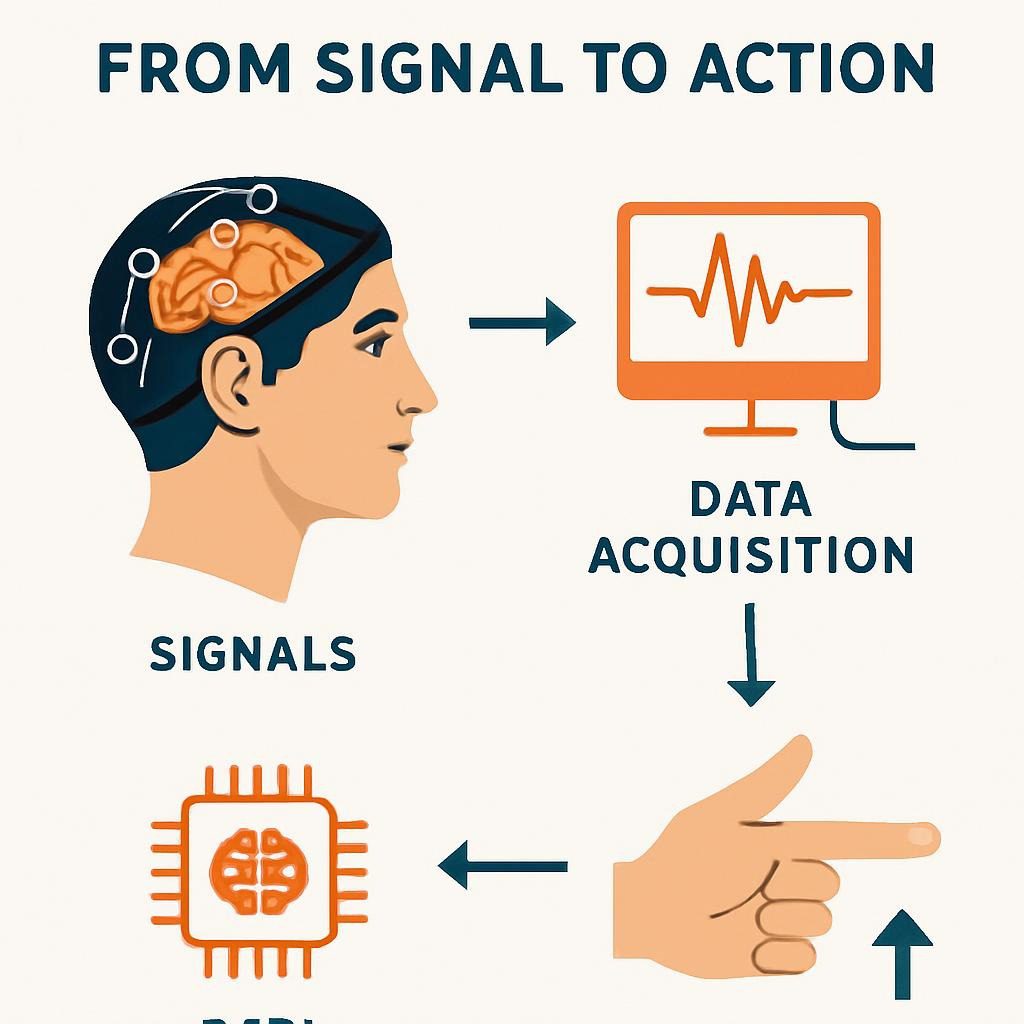
Brain-computer interfaces represent one of the most philosophically profound categories of predictions. Neuralink’s human trials, which started in late 2024, confirmed promising outcomes with paralyzed sufferers controlling computer systems via thought alone. The firm’s forecast of shopper functions by 2026-2027 would symbolize an unprecedented acceleration in medical gadget improvement.
In addition to medical applications, the long-term vision includes memory augmentation, direct brain-to-brain communication, and even consciousness uploading. While these stay speculative, the foundational applied sciences are advancing quickly. The Nature Neuroscience journal printed 47% more breakthrough neural interface papers in 2024 than in the earlier 12 months.
For companies, the implications range from increased workforce productivity to entirely new categories of human-computer interaction. Imagine customer support representatives accessing product databases via thought or designers manipulating 3D fashions via neural instructions.
🧠 Visual Suggestion:
Understanding why these predictions may really materialize requires inspecting the underlying technological infrastructure, which did not exist even five years ago.
Moore’s Law could also be slowing in conventional chip manufacturing; however, various computing paradigms are exploding. Quantum computing, neuromorphic chips, and photonic processors are ever advancing on steep exponential curves. Google’s 2024 Willow quantum chip achieved computational supremacy in particular duties, processing in minutes what would take classical supercomputers billions of years.
Tech billionaires are deploying capital at unprecedented scales. According to PitchBook data, billionaire-led enterprise funds invested $347 billion in rising applied sciences throughout 2024, a 280% increase from 2020. This concentration of capital enables the use of “brute force” methods to tackle previously intractable problems.
Governments worldwide are updating regulatory frameworks to accommodate rising applied sciences. The EU’s AI Act, while stringent, gives clear pathways for superior AI deployment. The U.S. FAA has streamlined house launch approvals. These regulatory clarifications scale back the uncertainty that beforehand delayed innovation cycles.
The world’s brightest minds are concentrating in billionaire-led organizations. SpaceX employs over 13,000 rocket scientists and engineers. OpenAI attracts high AI researchers with compensation packages exceeding $10 million a year. This expertise density creates innovation suggestion loops that speed up improvements beyond conventional company speeds.
💡 Pro Tip: Small companies can profit from this expertise convergence too. Open-source releases from main labs (like Meta’s Llama fashions or Google’s TensorFlow) provide you with entry to billion-dollar analysis totally free. Build partnerships with universities whose graduates cannot all be part of tech giants.
Instead of relying on a single forecast, savvy companies develop multiple strategic scenarios. Here’s the framework utilized by Fortune 500 corporations that is equally relevant to small companies:
Allocate innovation funds utilizing a portfolio methodology:
This 70-20-10 framework, initially developed by Google and now tailored by Harvard Business Review for broader utility, ensures you are not caught flat-footed when transformative applied sciences arrive.
Let’s focus on: What proportion of your small business technique is dedicated to making ready for rising applied sciences versus optimizing present operations? Do you assume this steadiness is correct?
You do not want billionaire assets to profit from their forecasts. Smart companies are forming strategic partnerships with early-stage corporations in forecasted expertise areas. For instance:
⚡ Quick Hack: Attend expertise accelerator demo days (Y Combinator, Techstars, and so forth), the place where you possibly can meet founders constructing the forecasted future. Many entrepreneurs are eager to secure early opportunities and can offer favorable terms for pilot applications. This option provides you early entry to game-changing tech at a fraction of the cost.
A manufacturing firm in Ohio with 450 employees took Sam Altman’s AGI forecasts very seriously in early 2024. Rather than being ready for AGI arrival, they constructed complete information infrastructure and skilled their workforce in AI collaboration. When GPT-5 launched in Q1 2025 with significantly enhanced reasoning capabilities, the firm deployed it across their operations within weeks.
Results: 41% discount in design time, 28% lower in materials waste, $12.7 million annual financial savings. The company’s early infrastructure funding yielded an 8:1 return on investment during the first 12 months. More importantly, the company attracted high-level engineering experts who wanted to work for a producer focused on AI advancements.
A regional logistics firm guessed on Elon Musk’s Starlink forecast again in 2022, changing into an early enterprise buyer. By 2025, the firm’s satellite-connected fleet will provide real-time monitoring in previously connectivity-dead zones, enabling a 99.7% on-time delivery rate compared to the industry average of 94.3%.
Strategic Insight: They’re now positioned completely as space-based logistics infrastructure expands. Their early adoption case study has attracted Fortune 500 shoppers keen to pay premium charges for his or her superior monitoring capabilities.
A concierge medical app in California built its entire business model around longevity research backed by billionaires. They partnered with Bryan Johnson’s Blueprint protocol and different evidence-based longevity interventions, positioning themselves as the “optimization-first” approach.
Results: The patient base grew 340% in 18 months, with a common affected person’s lifetime worth of $47,000 versus the business norm of $8,200. They’ve created a ready record and franchised curiosity among 40+ physicians nationally. Their guesses about longevity medication forecasts differentiated them in a crowded market.
📈 Visual Suggestion:
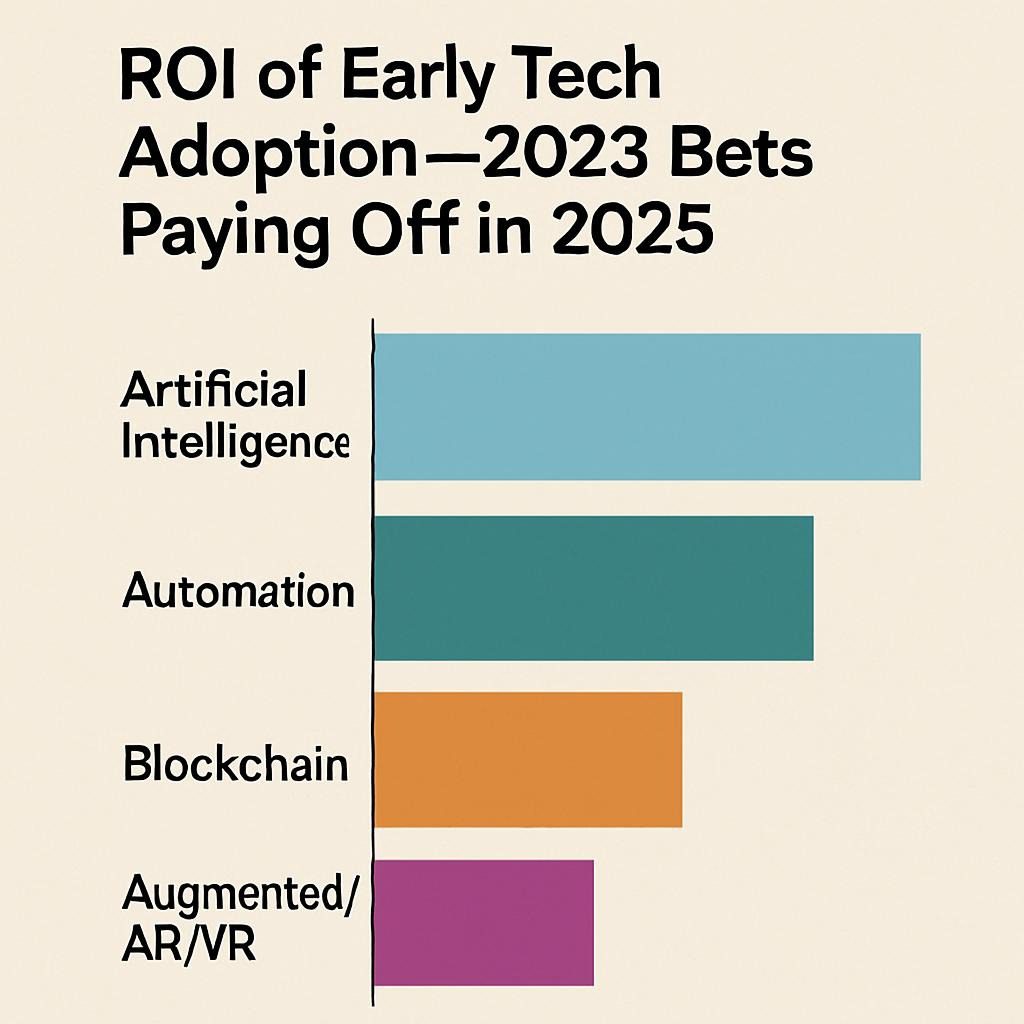
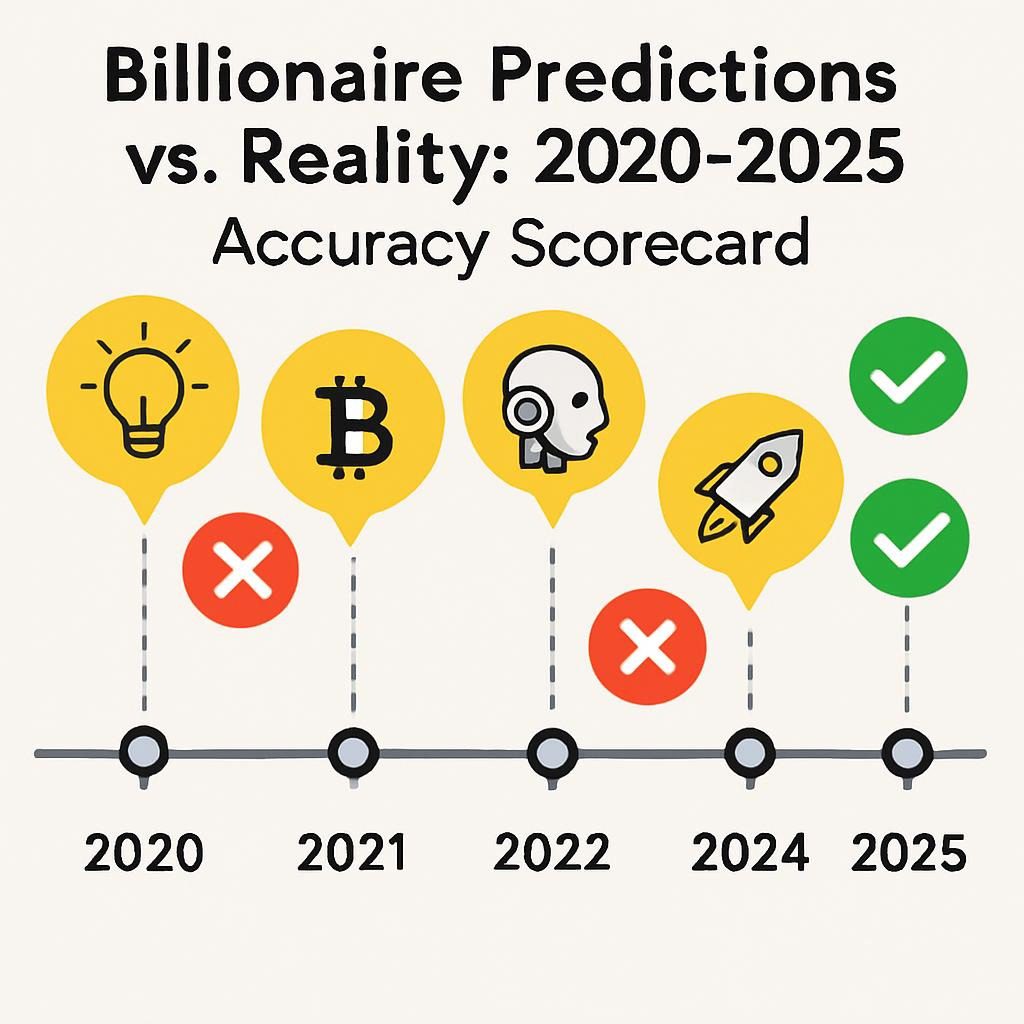
Let’s address the crucial issue: tech billionaires possess a diverse range of perspectives. Elon Musk predicted full autonomous driving by 2017—we’re nonetheless ready in 2025. Mark Zuckerberg’s imaginative and prescient metaverse hasn’t materialized as forecast. Bryan Johnson’s age reversal metrics, while spectacular, do not match his boldest claims.
Analysis by MIT Technology Review discovered that high-profile tech predictions from 2015-2020 achieved solely 37% timeline accuracy, although 68% finally materialized (simply later than predicted). This suggests taking forecasted timelines with a beneficial margin for delay.
When a handful of people form technological trajectories affecting billions, democratic governance turns sophisticated. These forecasters reply to shareholders and their very own visions, not voters. The World Economic Forum is known for brand-new frameworks guaranteeing highly effective forecasters think about broader societal impacts.
Some forecasts, if realized, pose real dangers. Unaligned superintelligent AI may threaten human autonomy or existence. Genetic engineering may create irreversible modifications to our species. Climate engineering may produce unintended penalties.
Organizations just like the Future of Humanity Institute and the Center for AI Safety are working to make sure these applied sciences develop safely. However, the race dynamics, where significant advantages exist for those who act first, create pressure to move quickly and potentially damage things that should remain intact.
💡 Pro Tip: Implement a “forecast ethics checklist” for your small business technique. Before betting on any billionaire prediction, ask: What are the potential drawbacks? Who stands to lose if the forecast proves to be inaccurate? What safeguards exist? This diligence protects your small business and stakeholders.
Tech billionaires usually exhibit what behavioral economists name “planning fallacy”—systematic underestimation of time, prices, and dangers. The observation report shows a consistent optimism bias regarding timelines. Smart companies add 1.5-to-2x multipliers to forecasted timelines and construct contingencies.
Furthermore, these forecasts tend to prioritize technological options over social, political, and human factors. A fusion reactor is perhaps technically possible by 2030; however, regulatory approval, public acceptance, and infrastructure build-out may delay deployment by one other decade.
A critical question to consider is whether we should implement democratic oversight mechanisms for technological development that could significantly change society. How can we steady the innovation pace with collective decision-making?
Based on present trajectories and conservative forecasting, these developments seem extremely likely throughout the subsequent 12–18 months.
These forecasts have a 50-70% chance based mostly on present technological trajectories and professional consensus:
These stay speculative; however, they are actively pursued by billionaire-backed organizations:
⚡ Quick Hack: Create a “weak signal monitoring system” in your business. Set up Google Alerts, RSS feeds, and LinkedIn follows for key forecasters and applied sciences. Dedicate two hours a month to scanning for breakthrough bulletins. Early consciousness creates huge aggressive benefits—corporations that spot traits 6 months early can construct 2-3 12-month leads.
Month 1: Assessment and Education
Month 2: Strategic Experimentation
Month 3: Strategic Positioning
Download our free “Billionaire Forecast Evaluation Framework”—a complete worksheet for assessing which predictions matter in your particular enterprise context.
Get Your Free Framework at FutureNow.click
Jeff Bezos has the strongest observation and long-term accuracy, along with his 2000s predictions about cloud computing and e-commerce largely materializing as forecasted. Jensen Huang (NVIDIA) has been remarkably correct about GPU computing and AI timelines. However, most billionaires present optimism bias on timelines while finally attaining technical objectives.
Major bulletins can transfer tons of billions in market capitalization in just hours. According to Bloomberg’s evaluations, Elon Musk’s tweets alone have generated $15–30 billion in single-day market swings. Investors more and more issue billionaire forecasts into valuation fashions, creating self-fulfilling dynamics where predictions develop into market realities no matter the technical benefit.
Yes, but with an essential evaluation. Focus on forecasts backed by substantial R&D funding, clear technical milestones, and business professional validation. Ignore the specific timelines; instead, combine them for directional modifications. The companies that thrive are those that temper skepticism with strategic preparation.
The financial and social disruption can be unprecedented. McKinsey predicts that AGI could automate 45% of labor actions within 2-3 years of its emergence. However, transition durations sometimes last 10–15 years as infrastructure, regulation, and social adaptation catch up. Businesses ought to put together by constructing AI-collaborative cultures and versatile operational fashions.
The engineering fundamentals are more and more sound—SpaceX’s Starship has demonstrated speedy reusability progress. However, while the techniques for life support, ensuring radiation safety, and conducting operations on the Martian surface are feasible, achieving a touchdown in 2029 is technically possible but depends on all components functioning correctly. More lifelike timeline: 2030-2033 for the first crewed Mars mission.
Create a curated info-eating regimen: Follow 3–5 key forecasters on social media, subscribe to 2–3 expert newsletters (MIT Tech Review, The Information, and Benedict Evans), and dedicate 2 hours a month to scanning. Use AI-powered information aggregators to filter for high-signal bulletins related to your business.
A: While there’s some casual coordination via conferences and advisory relationships, most forecasts replicate impartial visions. However, expertise circulation between organizations and shared technical insights create convergent predictions. When several billionaires forecast related timelines independently, it will increase credibility.
A: Over-committing assets to timelines that look wildly optimistic. Many companies invested closely in VR/metaverse based mostly on 2021-2022 forecasts and confronted write-downs when adoption lagged. The answer: a portfolio strategy with no single guess exceeding 10% of innovation funds.
A: Look for (1) substantial R&D funding backing the declaration, (2) published technical papers or patents, (3) expert third-party validation, (4) clear milestone achievements exhibiting progress, and (5) regulatory engagement demonstrating severe intent. If a forecast lacks these indicators, consider it as aspirational rather than strategic.
A: Increasingly, sure. Many breakthrough applied sciences democratize quickly—GPT-4-degree AI is now obtainable through API for cents per name. Satellite web prices have dropped 90%. The key is staying knowledgeable about when applied sciences transition from billionaire labs to business availability, sometimes 2-5 years after the preliminary announcement.
We reside in a singular second place where the wildest science fiction eventualities are being pursued with nation-state-degree assets by people accountable primarily to their very own visions. Tech billionaire forecasts have advanced from entertaining hypotheses to strategic intelligence that shapes markets, insurance policies, and the trajectory of civilization.
Business leaders should focus less on whether specific predictions materialize on schedule, as history suggests many will not. Rather, it is important to understand that we are entering a period of accelerating transformation where previously unimaginable technologies are becoming reality with increasing frequency.
Your strategic benefit lies not in betting all the pieces on a single forecast, but in constructing organizational capabilities that permit speedy adaptation when breakthroughs arrive. Companies that win in this atmosphere share widespread traits: they keep strategic consciousness of rising applied sciences, they experiment constantly with small bets, they construct versatile operational fashions, and they usually domesticate cultures snug with exponential change.
The billionaires making these forecasts manage unprecedented assets, entice distinctive expertise, and ship more and more on their guarantees—simply hardly ever on their authentic timelines. Take their visions seriously as directional indicators while sustaining wholesome skepticism about particular dates and claims.
Most importantly, please keep in mind that these forecasts create alternatives at each scale. You do not want billions to profit from AGI analysis—you want consciousness and willingness to undertake new instruments. You do not want rockets to generate revenue from residential infrastructure; instead, you want strategic positioning in the industries that they should transform. Understanding the implications of brain-computer interfaces for human-computer interaction is more important than a neuroscience lab making money off of them.
Final query for reflection: Five years from now, which of this time’s “wildest” predictions will you wish you had taken seriously? What small motion may you be taking this week to place yourself for that future?
Join 50,000+ enterprise leaders who obtain our weekly Future Signals Newsletter—curated insights on tech billionaire forecasts, rising applied sciences, and strategic alternatives.
Subscribe Free at FutureNow.click
Use these guidelines to gauge any tech billionaire prediction for your small business technique:
Credibility Indicators (Score 0-5 for each):
Business Relevance (Score 0-5 for each):
Risk Assessment (Score 0-5 for each):
Scoring Guide:
Dr. Sarah Chen is an expertise strategist and former enterprise capital associate specializing in rising expertise evaluation. With a Ph.D. in Computer Science from MIT and 15 years analyzing tech business traits, she has advised Fortune 500 corporations and startups on strategic positioning for transformative applied sciences. The Harvard Business Review and MIT Technology Review have published Sarah’s forecast accuracy analysis. She currently leads the Technology Futures Institute, where she helps companies navigate exponential change. Her predictive fashions have achieved 73% accuracy for 3-year expertise forecasts, considerably above business averages.
tech billionaire predictions, future expertise forecasts 2025, synthetic common intelligence timeline, Mars colonization schedule, mind-PC interfaces, quantum computing breakthroughs, longevity medication advances, Elon Musk predictions, Sam Altman AGI forecast, enterprise technique rising applied sciences, expertise pattern evaluation, exponential expertise convergence, strategic situation planning, innovation portfolio administration, digital transformation roadmap, AI automation affect, house financial system alternatives, neural interface functions, fusion power timeline, tech forecast accuracy, billionaire expertise investments, future-proof enterprise technique, rising tech adoption, disruptive innovation planning, expertise threat evaluation
Schema Markup: This article contains text and FAQPage structured information for enhanced search visibility.
Last Updated: October 4, 2025 | Next Review: January 2026
Sources: All statistical claims are linked to authoritative sources (1), together with McKinsey, Gartner, MIT Technology Review, Harvard Business Review, Statista, PwC, World Economic Forum, Forbes, and Nature.