
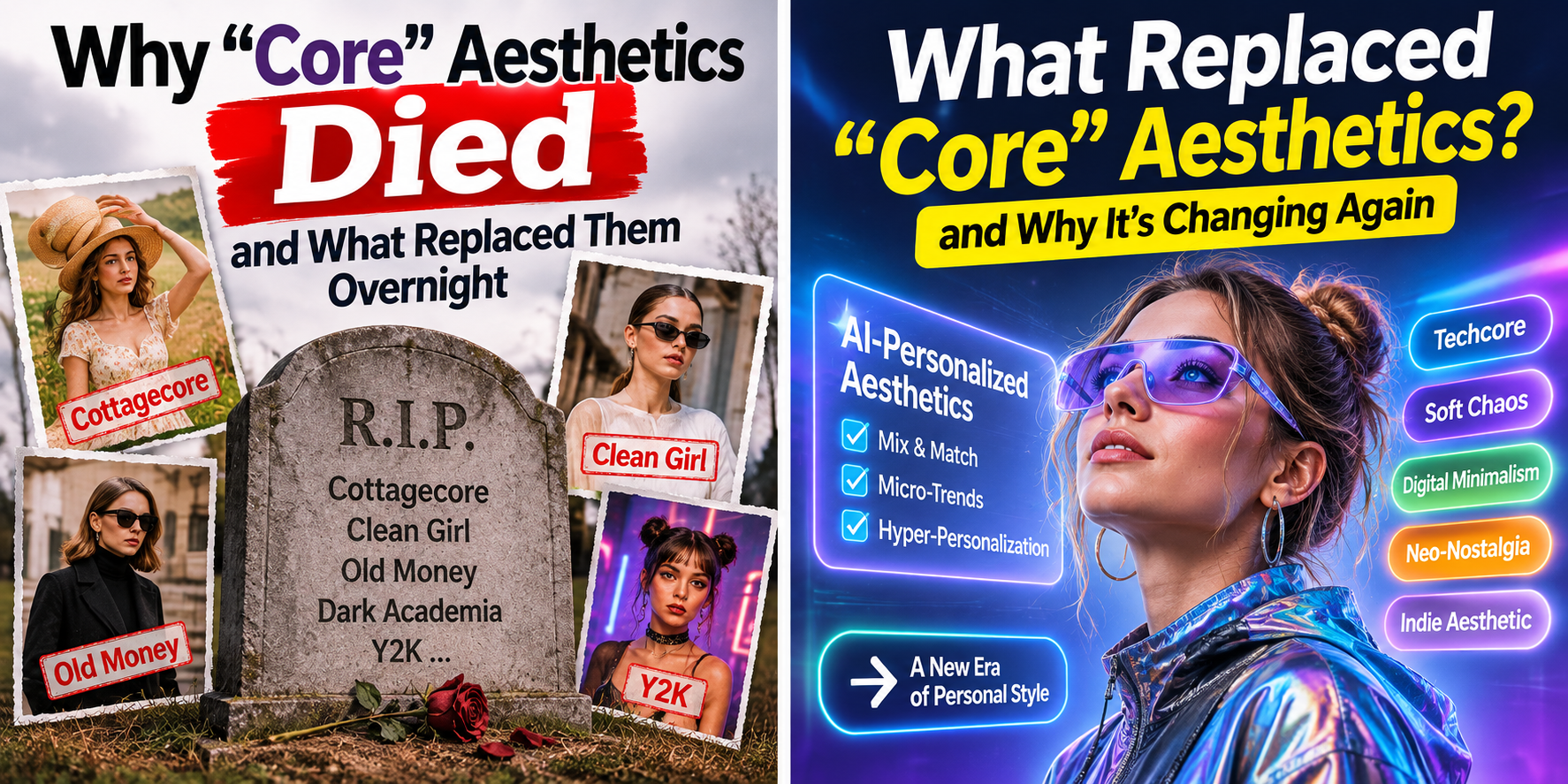
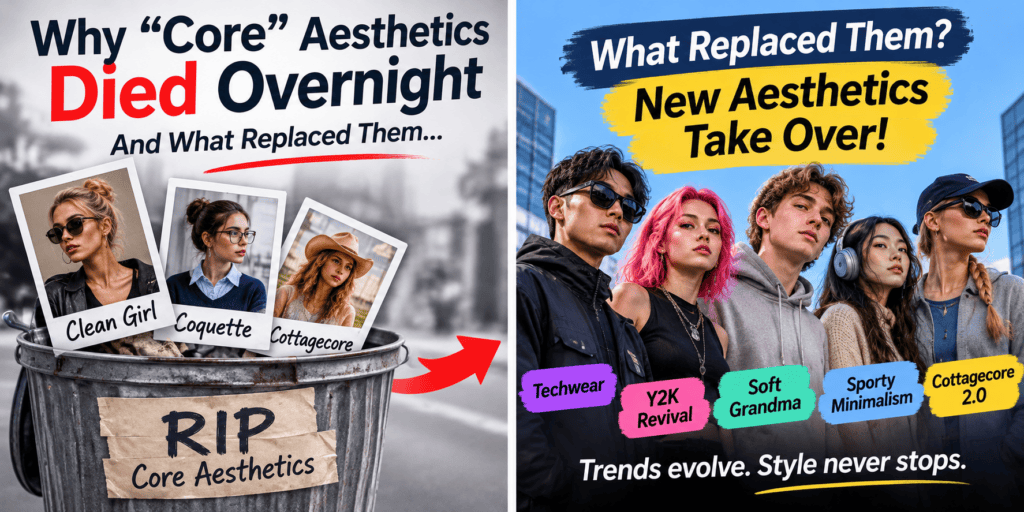
Direct answer: Nothing replaced “core” aesthetics overnight, because they haven’t disappeared. What is fading is the identity built on a single named aesthetic. Pinterest’s 2026 forecast reports trends growing 4.4 times faster than seven years ago, and its response is personalization: people remix aesthetics instead of adopting one. personalcareinsights
The premise of this topic is wrong, and the evidence shows why. If “core” had died overnight, the next big thing on Pinterest’s 2026 list wouldn’t be called Poetcore. Pinterest’s own list includes “Poetcore,” a literary, academia-inspired aesthetic, and a trade outlet notes it quietly pushes back on quiet luxury. That is a core, named and packaged like the ones before it. macaonewsremezcla
So what actually changed? The relationship between people and the label. This piece separates what the evidence supports from what it doesn’t.
What the evidence says (ranked by strength)
Strongest: platform search data, with a caveat. The 4.4x figure comes from Pinterest’s annual report. That report is first-party, and Pinterest sells advertising against trends. Its claimed forecasting accuracy, 88 percent, is also self-reported. Pinterest’s regional head said the methodology is unchanged, with generative AI added to the research. I could only read excerpts and coverage of the report, not the full document, so treat the number as reported, not independently verified. macaonewsbandt
Medium: trade analysts. WGSN analysts reportedly believe microtrends may be making their own exit, and a separate WGSN piece describes proliferation falling from its TikTok peak. That’s informed opinion from a forecasting firm, with no public time series attached in the excerpts I saw. fashionunitedwgsn
Weakest: commentary and op-eds. Useful for vocabulary, not for proof.
A real disagreement. One beauty columnist says she doesn’t buy the claimed death of the “girl aesthetic”. And one trade report notes that some observers read the escapism-and-comfort trend as a reflection of a global economic downturn, not trend fatigue. Both readings fit the same data, and I can’t rule either out. Substackmacaonews
The distinction most coverage misses
Coverage runs two different things together:
- The suffix. The “-core” label goes back further than TikTok. A fashion psychologist traces it to trend forecasters as early as 2013, with normcore. nylon
- The engine. Named, fast-expiring aesthetics, accelerated since the rise of TikTok in 2019. nylon
My judgment: the suffix is losing status, but the engine is intact. The engine has moved up a level. A commercial analysis of the shift says nearly all the pieces still exist: ballet-core, mob wife, Barbiecore, coquette, and office core all moved from niche communities into mainstream retail, and the same piece says the endless cycle produces decision fatigue and dissatisfaction. People got tired of adopting an aesthetic. They didn’t get tired of aesthetics. fibre2fashionfibre2fashion
This is editorial analysis, not a measured result. The 2026 forecasts show the pattern clearly. Pinterest reports that nearly a quarter of Gen Z and millennial trend participants avoid fatigue by putting their own spin on trends. That is a different behavior from joining a tribe. cosmeticsbusiness
The diagram is a model, not a measurement. It’s my reading of how the forecasts describe behavior. The text above carries the evidence.
What actually replaced it
Pinterest’s 2026 picks cluster around a few traits: tactile, nostalgic, expressive. Coverage describes modernized textures and finishes instead of direct trend revivals. A nostalgia-and-comfort signal sits behind that: 55 percent of global respondents prioritize comfort. In fashion, one outlet frames it as the clean-girl era giving way to maximalism. Pinterest’s 2026 beauty forecast signals the end of fast fads and fixed aesthetics +2
Note the pattern. The replacements are named too (Glamoratti, Neo Deco, Poetcore). The difference is that they’re built as flexible toolkits. A Westwing-sourced interiors piece makes the same point: the common denominator of all trends is their flexibility. The community-owned label gave way to the attribute you can borrow without joining anything. architekturaibiznes
There is also a self-aware endpoint. One industry commentator describes Corecore as the core to end all cores. That is a joke, but it’s informative: the format has begun to parody itself, which is usually a late-cycle sign. wmh-i
The question left open: does the cycle slow down?
It might not. The honest answer is that the evidence doesn’t resolve it. If trends move 4.4x faster and people respond by remixing, the remixing could simply be a faster loop with less visible labels. To settle it, you’d need a multi-year time series of aesthetic-term search or hashtag volume, split by named-core versus attribute terms (for example, “poetcore” versus “linen texture”). I didn’t pull that data, and none of the sources I read publish it.
My lean, flagged as inference: labels will shorten further, and attributes will persist longer. That would make named cores worse as a long-term asset and attributes better.
Practical moves that bite
- Creators and editors: stop building a content series around one named aesthetic. Tag posts by attribute (texture, palette, era, mood) so the content survives when the name expires.
- Retail and ecommerce: test a named-aesthetic collection against an attribute-led one on a single product category. Compare sell-through after a fixed window, for example, eight weeks, and don’t compare unlike categories.
- Anyone forecasting: treat platform reports as directional. Cross-check with a second, non-selling source before committing inventory or editorial calendars.
- If this thesis is wrong: the signal would be named cores still growing in search at the same pace through 2027. That would mean fatigue is a vocal minority, which is exactly what the single-platform data can’t rule out.